
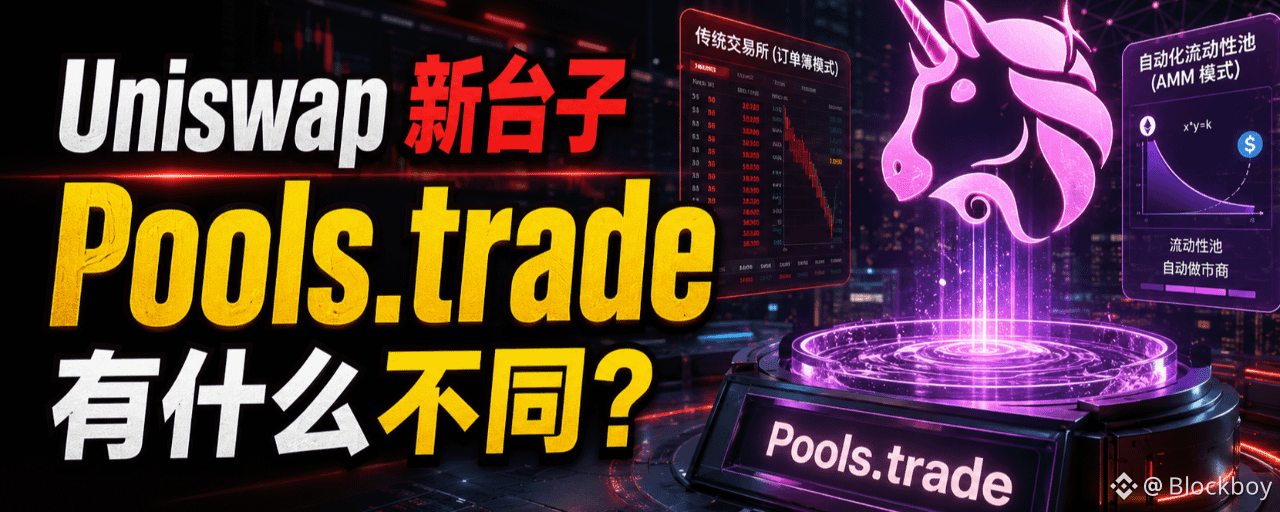

Report date:2026-08-06
Research subject:Pools.trade (Uniswap Labs official launch platform)
Chain:Robinhood Chain (Arbitrum Orbit L2)
Comparison platforms:Pump.fun (Solana), Four.meme (BSC), Pons (Robinhood Chain), Flap (Robinhood Chain)
Data sources:Uniswap official blog, Dune Analytics, PANews, Odaily Planet Daily,律动 BlockBeats, CoinFactory, BSCN, CryptoSlate, Phemex, FalconX, The Block, etc.
Disclaimer:This report is for research purposes only and does not constitute investment advice
1. What is Pools.trade
On August 6, 2026, Uniswap Labs officially released Pools.trade—a token launchpad deployed on Robinhood Chain. This isn’t a third-party startup taking a brand license from Uniswap; it’s a product Uniswap Labs itself built and launched.
The importance of this cannot be overstated. Uniswap has always been the core trading infrastructure in the Ethereum ecosystem and even the broader DeFi world, but it previously played the role of a “venue provider”—no matter where you launch tokens, you just need to come trade with me. Now it’s decided to open its own “token launch factory” and directly enter the token issuance process. That’s like a stock exchange starting its own IPO division.
According to PANews’ report, Pools’ domain (pools.trade) was registered as early as July 17, 2026. Uniswap initially set a noindex tag to keep things low-key, until August 4, when founder Hayden Adams responded “very soon” to community follow-up questions. Then on August 6, the official website launched and published an official blog post.
II. The two issuance modes: Crowd Launch and Instant Launch
Pools offers two token issuance modes. In each mode, the supply is fixed at 1 billion tokens, and both ultimately enter Uniswap v4 liquidity pools.
Crowd Launch—This is Pools’ most core differentiator.
4-hour time-weighted bidding auction (TWAP): participants place bids within a 4-hour window; the price moves with demand, and earlier bidders get a better price. All bidders receive the same final settlement price when the auction ends.
Allocation ratio: 50% of tokens go to the public auction, and the remaining 50%, together with the raised funds, goes into a Uniswap v4 liquidity pool; liquidity is permanently locked.
Graduation threshold: trading opens once the auction reaches $10,000 FDV. If it doesn’t meet the target, all bids are fully refunded.
Anti-bundling: the time-weighted mechanism weakens the strategy of grabbing in the “machine-gun pool” in the last second.
Basically, the core value of Crowd Launch is fairness. The biggest problem with traditional launch platforms is: no matter how you design it, bots will always be faster. Pools reduces reliance on “sniping speed” at the mechanism level by changing the speed contest into a time-weighted system.
Instant Launch
This is the more familiar model for most people—similar to Pump.fun’s combined curve (Bonding Curve):
After the token is created, it can be traded immediately; the price moves along the curve based on demand.
80% of tokens go to curve trading, and the remaining 20%—along with the funds—is used to establish Uniswap v4 liquidity.
No graduation threshold, no deadline, no refund mechanism.
The design logic behind the two modes is: Crowd Launch is for serious projects pursuing “fair distribution”; Instant Launch is for meme players who pursue “speed first.” One platform, compatible with two philosophies.
III. Fee structure: the ultimate “dimensionality reduction” attack
This is the most visually obvious difference Pools has compared with all competitors:
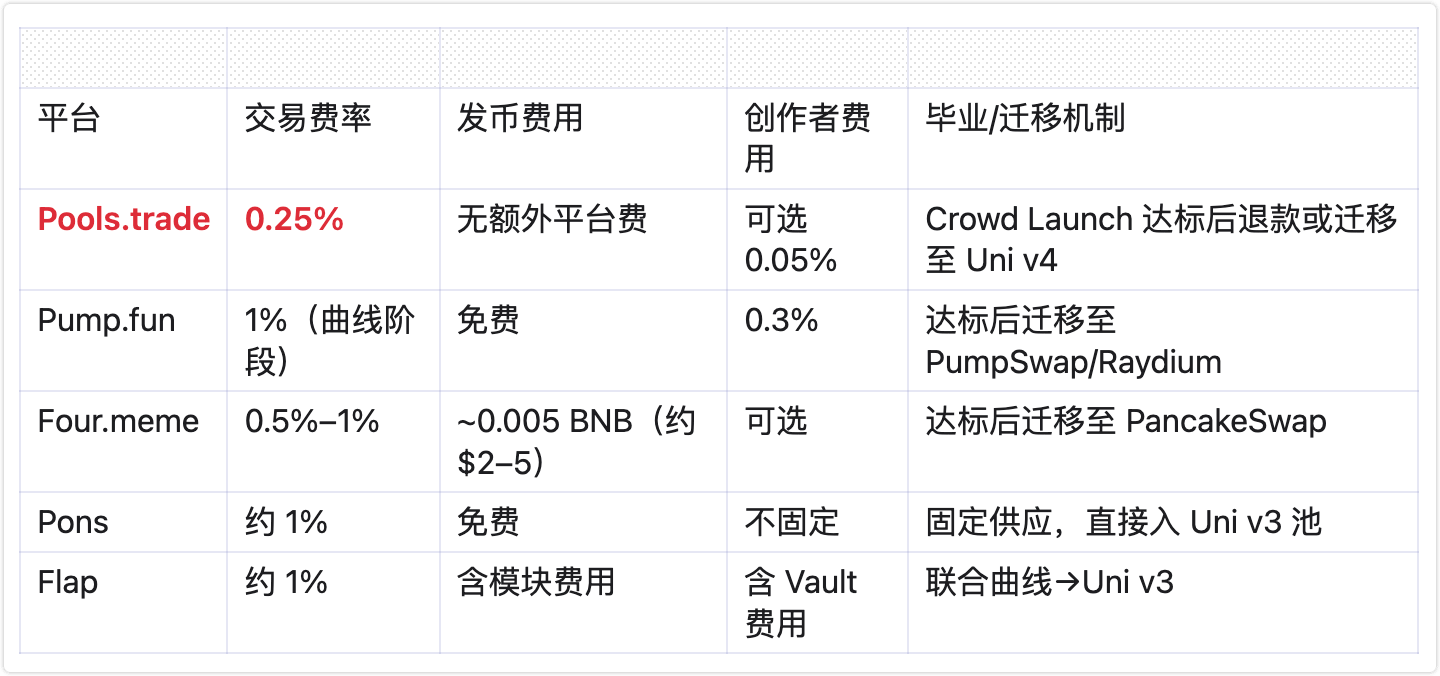
Pools’ 0.25% fee rate is just the standard LP fee rate of a typical Uniswap pool—it doesn’t add a single additional “launchpad fee” on top of the base fees. Other platforms typically charge 1% or even higher. That 4x price gap is Pools’ most direct cost advantage.
In addition, LP fees auto-compound (autocompounding), so liquidity grows over time. Creators may choose to take a 0.05% creator fee (5 bps out of 25 bps).
As CoinFactory’s analysis points out: Uniswap has the confidence to push fees this low because it doesn’t need to make money from launchpad platform fees. It already handles over 95% of DEX trading volume on Robinhood Chain, with cumulative trading volume over $10 billion. The launchpad is just the traffic entry; trading is the main course.
IV. Liquidity design: permanent lock + automatic reinvestment
Liquidity is permanently locked
Pools’ liquidity pool is held by the protocol, so token creators cannot withdraw liquidity. For users who’ve experienced countless “launch token → pump → pull liquidity and run” scams, this is the most direct source of reassurance.
Anti-sniping mechanism
The token creator completes the buy within the same block as the token goes live, ensuring the creator themselves is the first buyer—directly cutting off the path for bots to front-run and buy in block 0.
Automatic reinvestment of LP收益
LP fees are automatically reinvested back into the locked liquidity position, meaning liquidity won’t be left “idle” just because fees accumulate.
By contrast:
During the bonding-curve phase, Pump.fun is controlled by the platform; after graduation, the liquidity in PumpSwap may be removed.
Pons is also fixed supply + non-custodial, but after creation it directly enters a Uniswap v3 pool, without Pools’ liquidity cliff period and permanent-lock mechanism.
V. Ecosystem distribution: Uniswap’s ultimate weapon
This is the most underestimated aspect of Pools—and the part that makes competitors feel most hopeless:
For every token launched on Pools, from the moment it is created it automatically connects to Uniswap’s entire distribution network:
Uniswap Web App: the main interface where tens of millions of users swap tokens every day; Pools tokens appear directly in search and trading results.
Uniswap Wallet: a mobile wallet with built-in trading functionality.
Uniswap Launches aggregated tab: a new listing aggregation page where Pools tokens and tokens launched by other platforms are displayed side by side.
Uniswap API: MetaMask, Ledger, and all major DEX aggregators route trades through the Uniswap API—meaning Pools-issued tokens are visible and tradable on cross-platform aggregators from day one.
To put it simply: other launch platforms are like renting a storefront in a new mall to sell goods, while Pools is like opening a flagship store right in the middle of Wangfujing Street—there are already millions of people passing by every day.
VI. Comparison with existing competitors on Robinhood Chain
There are already about 15 launch platforms competing on Robinhood Chain, and the daily token launch volume has surpassed Solana (about 34k vs 23k; data as of July 20). The baseline landscape before Pools entered is as follows:
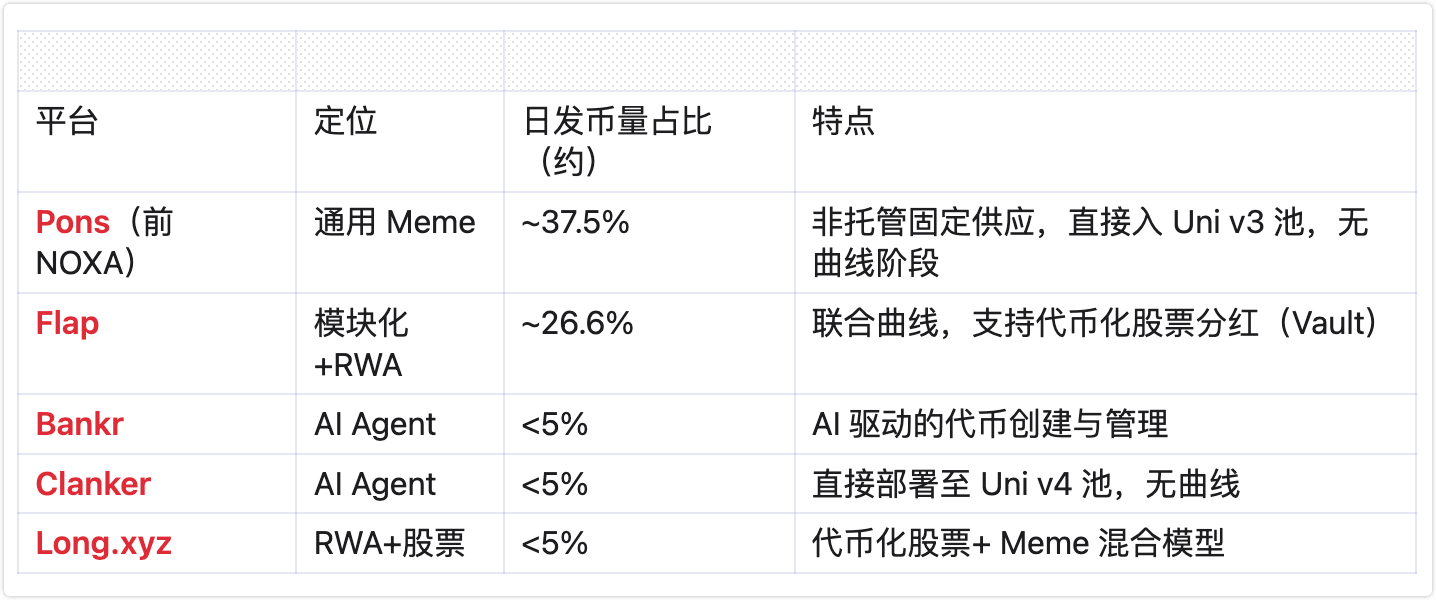
According to deep reporting from PANews, Pons currently holds a 54% share of trading volume (Crypto Times) and about 58,000 daily active addresses, making it the #1 launch platform on Robinhood Chain.
But once Pools enters, the entire landscape faces a reshuffle. The core reason is:
Uniswap brand + trust: In DeFi, there’s no development team more widely trusted than Uniswap Labs.
Fee compression: 0.25% vs competitors’ 1%—a change-level difference for high-frequency traders and market makers.
Distribution compression: shown directly in the Uniswap Web App, effectively zero customer acquisition cost.
Pons’ risk: Pons’ dominance is built on the traffic shift after NOXA was suddenly shut down. User loyalty hasn’t been tested by time. If Uniswap offers a more reliable option with lower fees, traffic may migrate again.
VII. Comparison with Pump.fun (cross-chain perspective)
Pump.fun is the near-monopoly meme coin launch platform on Solana. As of 2026, it accounted for 99.3% of meme coin launches in the Solana ecosystem (Dune data). Cumulative revenue is about $1.08 billion, and it has issued the $PUMP token.
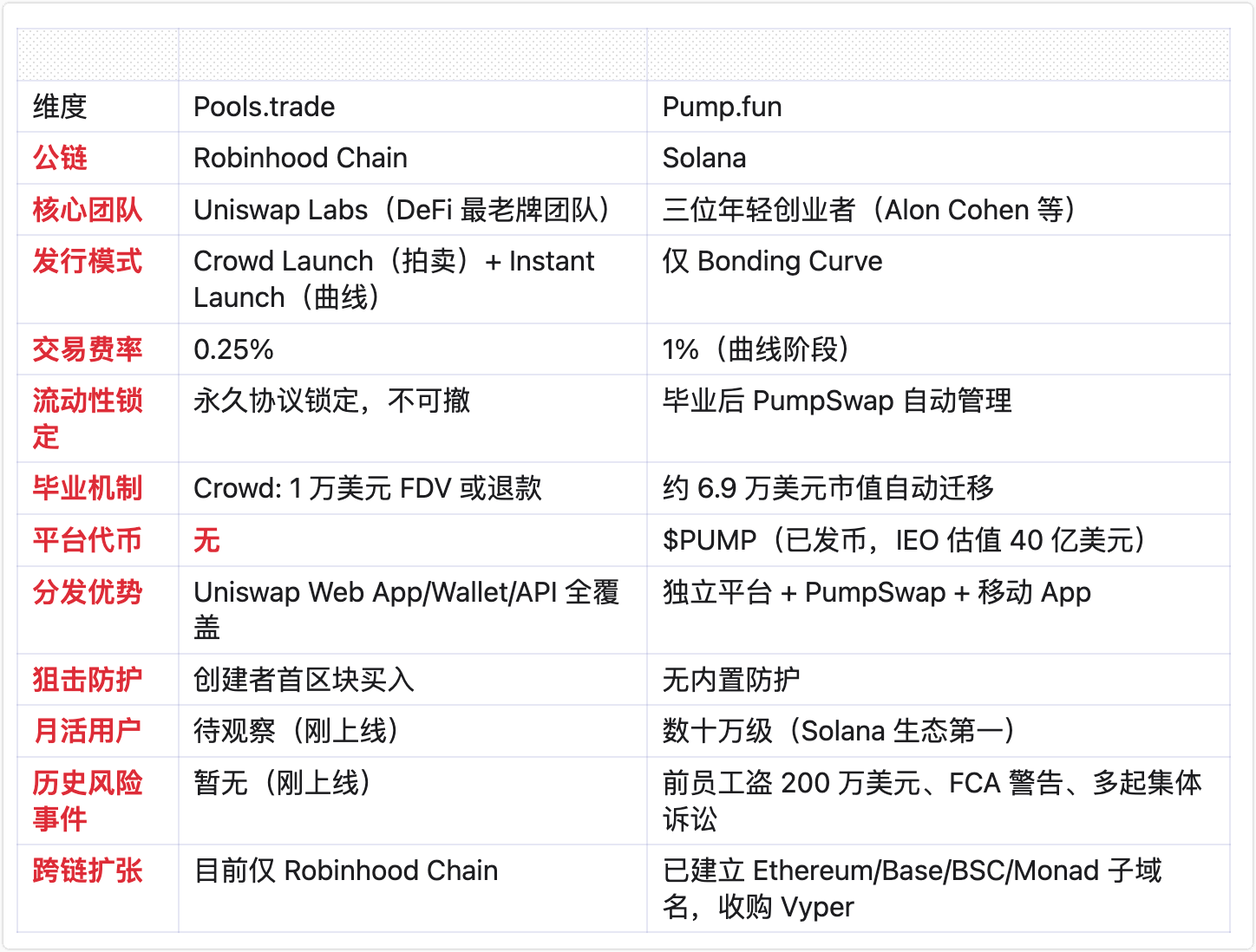
Pump.fun’s biggest advantage is the first-mover edge and network effects. When almost everyone is playing meme coins on Solana, it’s hard to persuade them to switch chains. Pools’ game is different: it doesn’t need to persuade users to switch chains—it only needs to convince those users and creators who are already active on Robinhood Chain to choose it rather than Pons/Flap.
VIII. Comparison with Four.meme (BSC perspective)
Four.meme is the biggest one-click token creation platform on the BNB Chain, positioned like a “BSC version of Pump.fun.”
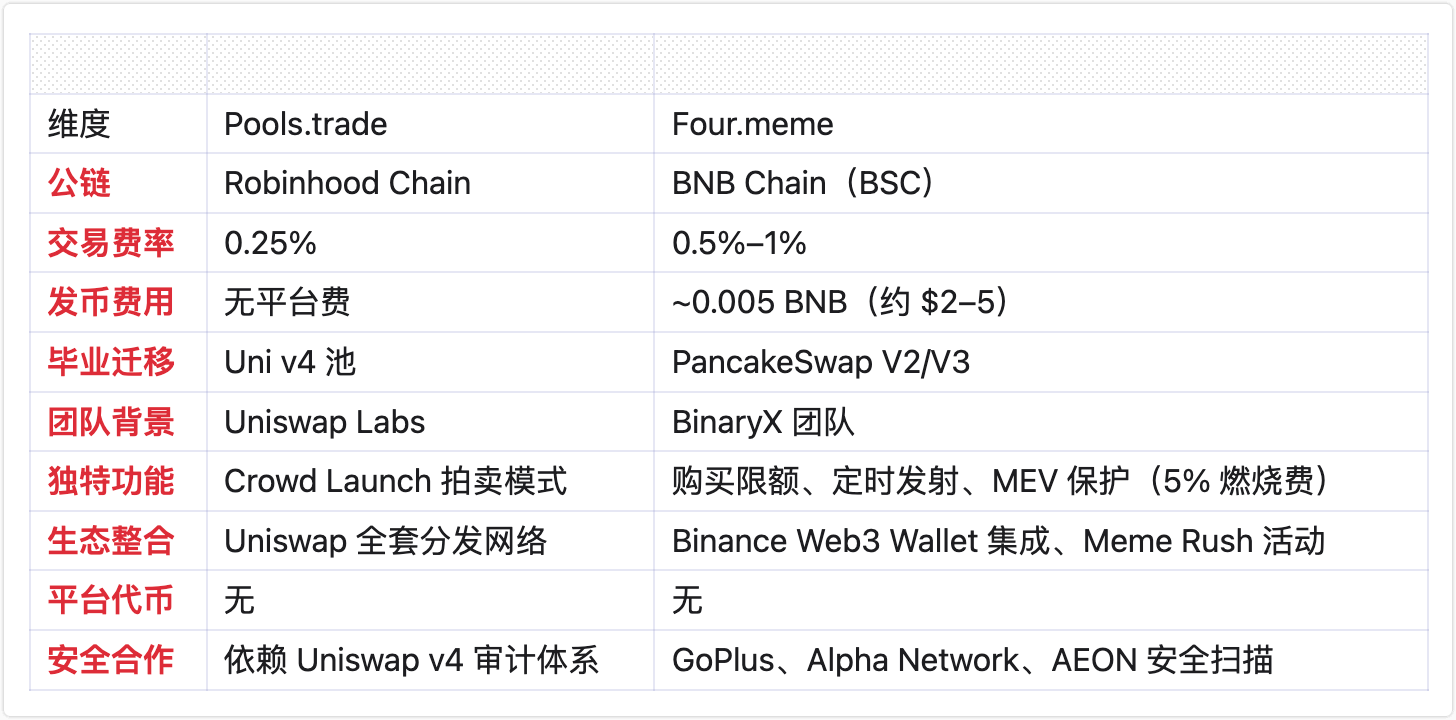
Four.meme’s fundamentals on BSC are very solid, benefiting from Binance’s massive user base. But at its core, it’s only a BSC rehash of Pump.fun, lacking original mechanism innovations like Crowd Launch. Pools’ advantage is that it not only provides a standardized curve mode, but also offers an auction mode that has no counterpart—this is the most fundamental differentiation.
IX. Potential risks and uncertainties for Pools
Every new platform, beyond the hype, also has risks that must be faced:
1. The platform just launched—no market validation yet
Pools was officially released on August 6 but hasn’t undergone real trading-volume stress testing. All mechanism designs are very well thought out on paper, but in actual operation, various unknown issues may arise—smart contract vulnerabilities, frontend performance bottlenecks, anti-sniping mechanisms being bypassed, and so on.
2. The Meme ecosystem on Robinhood Chain is still in the early stage
Even though more than 363,000 tokens have been issued on-chain, only three have a market cap over ten million USD (CASHCAT, PONS, $TENDIES), and about 20 are over one million USD (according to PANews data). The vast majority of tokens don’t survive past 48 hours. The ecosystem is extremely speculative, so platform hype can swing quickly with on-chain sentiment.
3. The risk of unofficial token speculation
Multiple community tokens claiming to be associated with Pools/Uniswap have already appeared in the market, including $UPOOLS, FRONG, and others. Uniswap Labs has explicitly stated that there are no official POOLS tokens. Any asset claiming to be a “Pools platform token” is an unofficial issuance.
4. The bundling risk with Robinhood Chain
Pools is currently deployed only on Robinhood Chain, so the platform’s fate is deeply tied to the development of this chain. If Robinhood Chain faces regulatory issues, a security incident, or user outflows, Pools will be directly affected as well.
5. Competitive pressure coming from Pons
Pons has 58,000 daily active users and an early-mover creator network, so it won’t be easy for Pools to steal market share. The wealth effect created by Pons’ token $PONS (a 15x surge in half a month) also ties a large number of speculative users to it.
X. Summary and judgment
Pools.trade is not a “Pump.fun clone.” It’s Uniswap’s redefinition of the entire token-launch track.
Core differentiation summary:
An original Crowd Launch auction mechanism—using time-weighting to replace a speed contest, solving the most fundamental problem in meme launches: the initial capital being split up by bots and scientists.
A quarter of the industry’s fee rate—0.25% vs 1%. For ecosystem participants, this is a real, measurable reduction in cost.
A moat with zero distribution cost—native integration with Uniswap Web App/Wallet/API, so tokens reach a million-level user base from the very first second of their existence.
The most trusted brand endorsement in DeFi—Uniswap Labs’ brand value is a scarce resource in the meme-launch arena where trust is lacking.
No platform-token philosophy—don’t profit by selling newly issued tokens at the expense of users; profit by making the ecosystem’s “pie” bigger.
This isn’t just the birth of a new platform—it marks a strategic extension of DEX infrastructure upstream into the token-launch stage. If Pools succeeds, we may see more DEXes follow the same path—from “only handle trading” to “handle issuance + trading” as a full stack.
The battle among 15 launch platforms on Robinhood Chain may be accelerated by Pools’ entry and cause a reshuffling.
Disclaimer: This report is for research reference only and does not constitute any investment advice. Pools.trade is an official product of Uniswap Labs, but there is currently no official platform token. Any asset claiming to be an official Pools token has not been confirmed. Meme coin trading on Robinhood Chain involves extremely high risk, and the vast majority of tokens may go to zero within a very short time. Pools.trade has only just launched, and its smart contracts have not yet been tested by long-term market conditions; there may be undiscovered vulnerabilities. Please fully understand risks before participating, and assume responsibility at your own discretion (DYOR).