

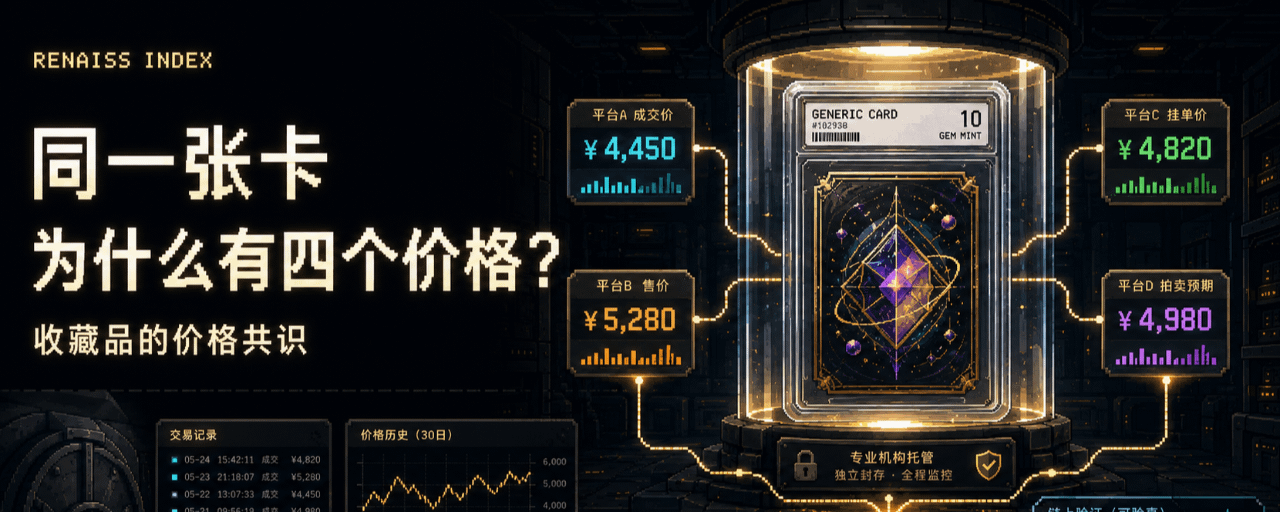

The same grading card may show up with four different prices across different platforms at the same time.
A seller’s list price is one figure, the most recent transaction price is another, a card shop’s buyback price is another, and private transactions in the community may keep changing the price.
The difference doesn't come entirely from an information gap.
The card’s language, release year, grading company, score, scarcity, transaction region, and condition history all affect the final price. Even for the same card, it’s hard to get an all-market consensus quote at any time like you can with BTC or stocks.
That’s also why I’ve been following @renaissxyz and the recent launch of the Renaiss Index.
Renaiss positions it as the price infrastructure for collectibles finance, hoping to form transparent, verifiable reference prices through real market data.
It sounds like “just making an index for cards,” but behind the scenes it handles the most difficult RWA issue for collectibles: once a physical item is tokenized, how does the market determine what it’s worth?
Physical assets on-chain happen quickly, but price consensus forms much more slowly
Mapping a collectible into an on-chain asset doesn’t have a particularly high technical barrier anymore.
Generate a Token, write the card name, number, grade, and image, and then put the ownership record on-chain. This workflow can be completed quickly.
But the existence of Tokens doesn’t mean the prices also become valid automatically.
Stocks have huge volumes of daily trading, and the order book keeps generating new prices. Mainstream crypto assets can form continuous quotes through multiple exchanges and liquidity pools. Physical collectibles trade far less frequently—some rare cards only see a publicly reported trade once every few months or even years.
There’s another common misconception in the market: treating the listing price as the market price.
A card can be listed for $10,000, but if no one buys it for the long term, that number only reflects the seller’s expectations. What truly has reference value is actual trade history, historical prices of comparable items, and the real buy/sell demand that exists in the current market.
The first thing a collectibles index needs to solve is to separate “how much someone wants to sell for” from “how much the market is actually willing to pay.”
Before price, you must answer where the physical item is.
Collectibles are different from pure digital assets in one clear way.
On-chain BTC doesn’t need to prove that another BTC exists in off-chain custody. Physical card assets, however, must prove that the corresponding physical item truly exists—and that it hasn’t been resold twice, swapped, or taken away privately.
So collectibles finance needs to follow a longer path of trust:
First confirm the identity of the physical item, then confirm the escrow status, then establish price references; only then comes trading, buybacks, redemptions, and transfers.
Renaiss’s Vault OS is responsible for connecting independent vaults, authorized card stores, and collectibles into a verifiable escrow system; the Renaiss Index organizes price and trading data; the market layer then handles buying/selling, buybacks, and redemptions.
If any layer is missing in these steps, problems can arise with on-chain assets.
Only having price, without trusted escrow, means users can’t confirm that the Token they bought corresponds to a real item.
With escrow but no price data, the market still has to rely on a small number of merchants or sellers to quote, and liquidity can be hard to expand.
If only Tokens are traded, with no stable physical settlement path, on-chain ownership ultimately may be just a digital receipt that can’t be cashed out.
Renaiss’s choice to fill in the fundamentals first is for exactly this reason. What collectibles finance needs isn’t a single trading page, but an evidentiary chain that can be traced from the physical item all the way to on-chain transactions.
Renaiss Index is more like a ruler
A price index won’t decide for collectors what price a specific card must be sold at.
It’s more like a public ruler—giving collectors, card stores, custodians, markets, and developers a relatively consistent set of reference standards.
Renaiss’s official website already displays both FMV and listing prices for some cards.
Putting these two numbers together is meaningful. FMV reflects the system’s estimated fair market value, while the listing price is the current seller’s quote. When there’s a difference between the two, users can judge more intuitively whether the seller’s quote is higher or lower than the market reference.
If this price data is accumulated to be complete enough, its uses can go beyond ordinary buying and selling.
Pack products can adjust costs and expected values based on the market value of the card pool; card stores can reference the index to set buyback quotes; the Vault can evaluate the size of escrowed assets; liquidity protocols can adjust risk parameters based on price changes; third-party applications can also build new collectibles tools via data interfaces.
Seen this way, the target of Renaiss Index isn’t only a card-buying user.
It has the chance to become a coordination layer among different market participants, so that a card can operate around the same set of price data—from entering the vault, to generating on-chain records, to trading and redemption.
A collectibles index is harder to build than crypto price oracles
The direction of Renaiss Index is easy to understand, but the implementation difficulty can’t be underestimated.
First is the source of the data.
Whether trade records across different platforms are genuine, whether private trades can be verified, and whether auction prices include commissions, taxes, and shipping costs—all of these affect the final data.
Second is item variation.
For the same card, the price between PSA 10, PSA 9, and an ungraded version can differ greatly. Even with the same grade, differences in special labels, serial numbers, language versions, and card condition can also cause price gaps.
There’s also the problem of insufficient trading volume.
If a card trades only twice a year, the most recent price is easily influenced by a single buyer. Treating that trade as the latest market price directly could lead to a large deviation.
Volume boosting also needs to be prevented.
Once a price index starts affecting Pack pricing, buyback prices, or collateral limits, manipulating trade records creates economic incentives. If a small number of addresses trade with each other, they could inflate the price of illiquid collectibles.
Therefore, a credible collectibles index needs at least to make public several key questions:
Where does the data come from? How do we distinguish listings from actual trades? How are anomalous trades filtered? How are different grades grouped? How often are low-trade-volume assets updated? How are cross-region prices handled.
“Data on-chain” can only prove that a piece of data hasn’t been modified after the fact; it can’t automatically prove that the data was originally real and reliable.
The value of an index still depends on data filtering and the calculation method.
Why are those 70+ teams worth putting here to look at
Renaiss’s first public technical hackathon has ended. The official numbers show 70+ teams registered, and 45 early projects were ultimately delivered.
This set of data can’t directly prove that Renaiss has formed a developer ecosystem, but it shows that developers are starting to try to build new products on top of the existing infrastructure.
For the long term, the collectibles market lacks standardized data, escrow, and settlement interfaces.
If every team had to contact card stores themselves, set up warehouses, collect prices, verify grades, and then develop trading products, the costs would be extremely high. Once Renaiss turns these steps into reusable infrastructure, developers can focus their energy on user products.
Renaiss’s CLI, future third-party SDKs, and permissionless VRF fairness protocols can also be understood from this angle.
Developers don’t need to rebuild an entire collectibles backend from scratch. They can call escrow assets, price data, or fair randomness mechanisms to build market, gaming, research tools, and financial applications.
Those 45 early projects are still far from mature products, but they can help validate one thing: whether the capabilities Renaiss provides can truly be used by third parties—not just serve its own platform.
What can a $1.5 million funding round solve?
Renaiss has completed a $1.5 million seed round led by YZi Labs.
A funding announcement by itself can’t prove that the business model is already established. Its more practical meaning is to give the team time to keep building infrastructure.
Collectibles escrow needs to connect to real-world vaults and card stores; a price index needs continuous data collection, cleaning, and maintenance; and physical settlement also involves logistics, insurance, and rules across different countries.
These efforts won’t automatically run just because smart contracts are deployed.
For Renaiss, whether capital can ultimately create value depends on how much trusted escrow nodes it can add, how many collectible assets it can cover, how much real transaction data it can accumulate, and whether it can allow third-party developers to reliably call on these resources.
User scale and platform trading volume can reflect product heat. But it’s escrow coverage, data quality, and settlement capability that will determine how far the infrastructure can go.
My take
I won’t summarize Renaiss as “cards are the next Bitcoin.”
Collectibles don’t have a unified issuance structure, and their liquidity can’t be compared to mainstream crypto assets. Sentiment, culture, scarcity, and community preferences all influence price—and they’re hard to compress into a simple financial curve.
But the collectibles market does indeed have long-term problems: it’s hard to tell real from fake, custody is fragmented, trading data is not transparent, cross-region trading is inconvenient, and when holders want to sell, they may not be able to quickly find buyers.
The path Renaiss has built so far is to first prove the existence of physical items through Vault OS, then establish price references through the Index, and then have trading, buybacks, redemptions, and third-party applications revolve around this data.
This road is slower than simply issuing a collectible Token, and it’s also closer to what the real market is actually missing.
Whether Renaiss Index can ultimately become an industry reference depends on data coverage, calculation transparency, and whether it is adopted externally. If an index is used only by its own platform, it can only be considered a product feature; only when card stores, vaults, developers, and other markets are willing to cite it does it have infrastructure value.
A Token can be created within minutes.
To give a physical card a price that can be verified, traded, and redeemed, escrow records, real transactions, and long-term market consensus must all support it together.
What Renaiss is trying to do is to keep this harder-to-establish ledger.