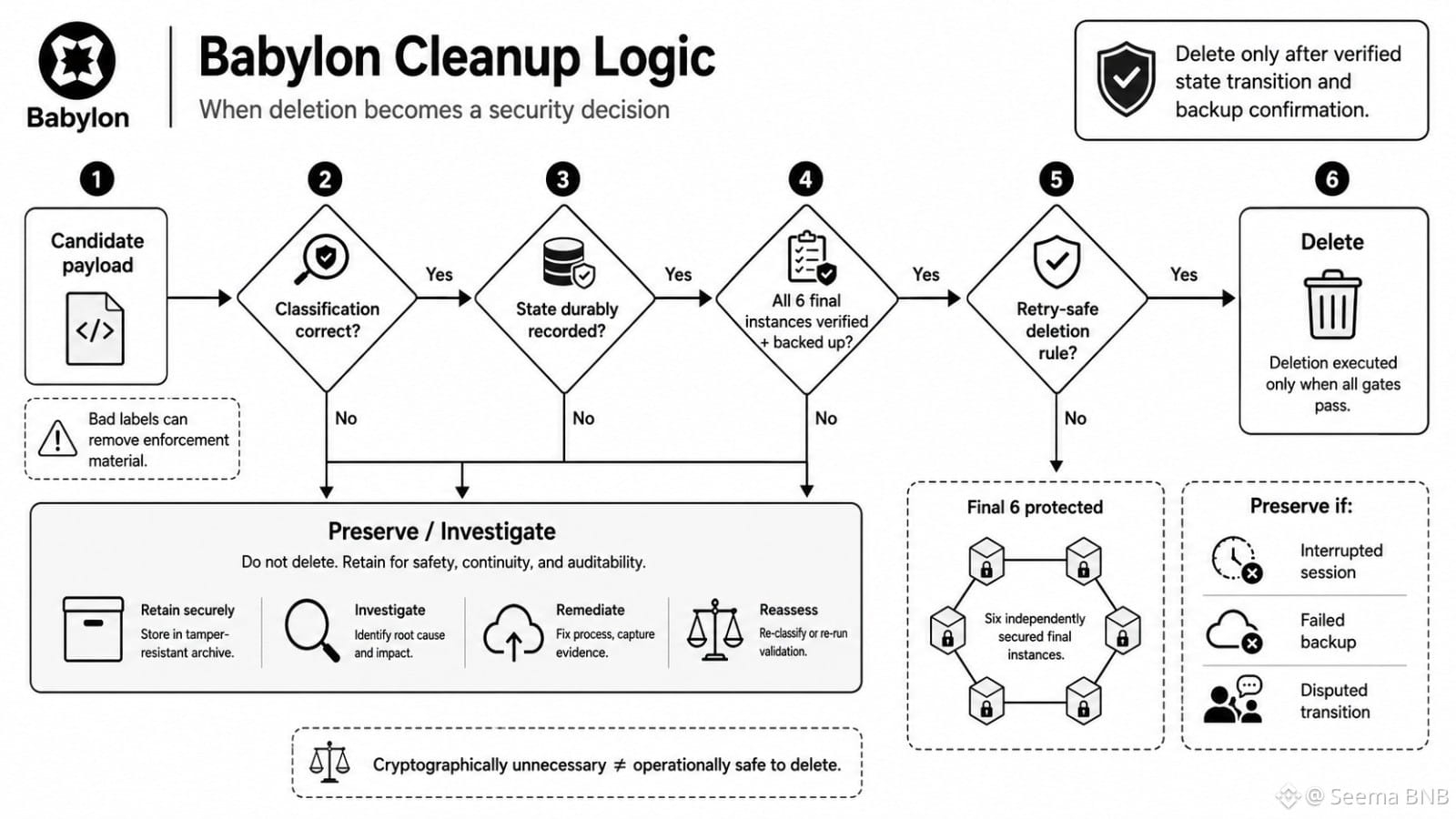
I judged Babylon’s cleanup logic from the final six objects first. That looked efficient. Then I noticed deletion itself could become part of the security model.@BabylonLabs_io
The obvious point is storage reduction. That is not the real issue.
The hidden behavior is classification. A candidate payload may be cryptographically unnecessary, yet still operationally important during an interrupted cut-and-choose session, failed backup, or disputed state transition. Delete it early and the system may lose material needed to explain what happened.
Some cleanup risk is normal. No protocol can preserve every temporary object forever.
But BABY’s real test is lifecycle discipline vs operator convenience. Does Babylon delete only after the state change is durably recorded? Does a manifest prove all six final instances verify correctly and have independent backups? Can the deletion job retry safely without touching one of those six?
Automation helps, yes. But only when rules are idempotent and the deletion condition is explicit.
I am still watching the uncomfortable edge: what happens when operators believe setup is finished, while failure analysis says it is not?
For BABY, garbage collection is not housekeeping anymore. It is a delayed security decision, and one bad label may remove more than data.
#baby $BABY
The obvious point is storage reduction. That is not the real issue.
The hidden behavior is classification. A candidate payload may be cryptographically unnecessary, yet still operationally important during an interrupted cut-and-choose session, failed backup, or disputed state transition. Delete it early and the system may lose material needed to explain what happened.
Some cleanup risk is normal. No protocol can preserve every temporary object forever.
But BABY’s real test is lifecycle discipline vs operator convenience. Does Babylon delete only after the state change is durably recorded? Does a manifest prove all six final instances verify correctly and have independent backups? Can the deletion job retry safely without touching one of those six?
Automation helps, yes. But only when rules are idempotent and the deletion condition is explicit.
I am still watching the uncomfortable edge: what happens when operators believe setup is finished, while failure analysis says it is not?
For BABY, garbage collection is not housekeeping anymore. It is a delayed security decision, and one bad label may remove more than data.
#baby $BABY