

TL;DR
· Morgan Stanley cites TSR data, predicting that in 2026 the shipment volume of enterprise SSDs for data centers will reach 525EB.
· The capacity increase is mainly driven by a higher share of high-capacity products; nearline HDDs are also forecast to rise to 1845EB.
· SSDs benefit from AI and cloud workloads, while nearline HDD production expansion remains constrained by head and test capacity.
According to Morgan Stanley’s Japan electronic components team, citing TSR data, the shipment volume of data center enterprise SSDs in 2026 is expected to reach 525.0EB, doubling year over year; the shipment volume of data center nearline hard disks (NL HDD) is expected to increase to 1845EB, up 30.4% year over year.
The meaning of these forecasts is very straightforward. AI and cloud data center expansion are simultaneously driving higher demand for two types of storage. On one side, enterprise SSDs handle higher-speed data reads and writes; on the other, nearline HDDs continue to accommodate large-scale, low-cost data storage. Demand growth is not simply a matter of “buying a few more hard drives”—it is shifting more toward products with larger capacity and higher density, and the capacity growth rate is clearly faster than the unit-count growth rate.
Under the TSR definition, the 2026 total SSD shipment capacity forecast rises to 775.03EB, up 55.6% year over year—higher than last month’s forecast of 759.36EB. Among them, enterprise data center SSDs are the most prominent source of incremental growth. Nearline HDD demand is also revised upward, but increasing production is more likely to be limited by head supply and testing capacity constraints.
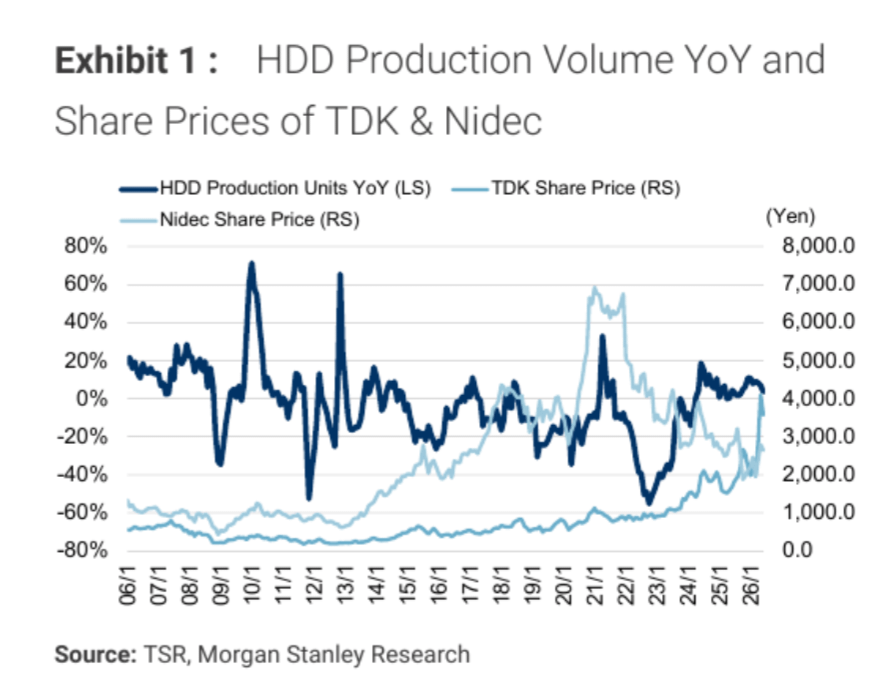
Year-over-year changes in HDD production volume and the stock price trends of TDK and Nidec show that after the trough in 2023, HDD production rebounded in 2024–2025.
Enterprise SSDs are the biggest driver: June capacity up 124.5% year over year
Enterprise SSDs have already shown strong growth in the monthly data.
In June, the enterprise data center SSD shipment capacity reached 46.33EB, up 124.5% year over year and up 12.0% quarter over quarter. Unit shipments were 6.35 million units, up 41.1% year over year. Capacity growth far outpaced unit growth, behind which is an increase in the share of higher-capacity products.
This is also one of the reasons why the 2026 forecast was raised. TSR raised its 2026 forecast for enterprise data center SSD shipment capacity from last month’s 509.33EB to 525.0EB, with a year-over-year increase of 100.0%. For 2025, the figure is expected to be 262.5EB, up 58.2% year over year.
Looking at the entire SSD market, the growth is also very clear. Total SSD shipment capacity is expected to reach 498.0EB in 2025, up 38.0% year over year; in 2026, it will further rise to 775.03EB, up 55.6% year over year. Enterprise data center products contributed the strongest growth rate.
What matters more to investors is that data center expansion not only boosts demand for GPUs, servers, and networking equipment, but also drives backend storage capacity needs. Model training, inference logs, vector databases, backups, and archiving all require more storage space, making enterprise SSDs a critical piece of high-performance data access hardware.
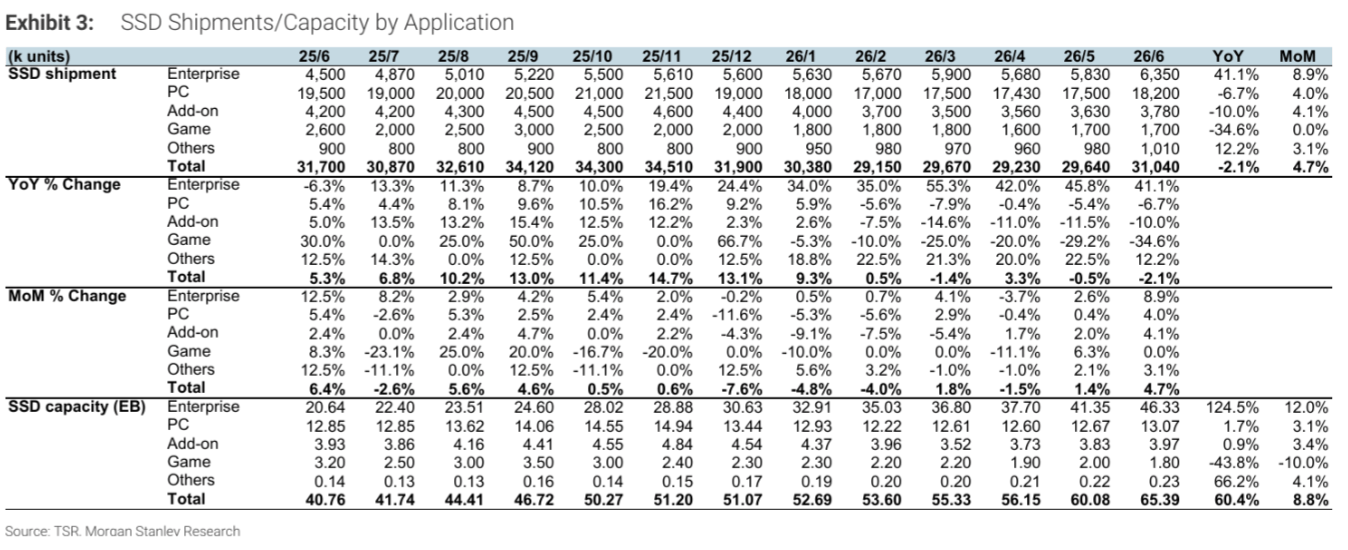
SSD shipments by application: capacity/volume table—Enterprise SSD capacity in June was 46.33EB, up 124.5% year over year and up 12.0% month over month.
Nearline HDDs are also growing, but their capacity is supported by “bigger drives.”
Nearline HDD growth is also strong, but the structure is different.
Under the TSR definition, the 2026 data center NL HDD shipment capacity is expected to reach 1845EB, up 30.4% year over year. At the same time, total HDD shipment capacity is expected to be 2053.5EB, up 26.1% year over year; total HDD capacity for 2025 is expected to be 1627.9EB, up 29.5% year over year.
In terms of unit counts, growth is not as dramatic as the capacity numbers suggest. In June, NL HDD production was 7.03 million units, up 12.3% year over year, but down 0.6% month over month. The full-year 2026 NL HDD production forecast is 84.39 million units, up 12.8% year over year. This indicates that nearline HDD capacity growth relies mainly on increased capacity per drive, rather than a large simultaneous expansion in unit shipments.
The share of higher-capacity helium-filled products continues to rise. In June, helium-filled product output was 5.95 million units, up 17.4% year over year, with a faster growth rate than overall NL HDD production. For cloud vendors and AI data centers, increasing capacity per drive allows them to store more data without changing or only slightly increasing rack space, power, and operational/maintenance costs.
TDK’s official materials also support this direction. In its FY3/26 performance briefing, TDK said that nearline HDD demand continues to increase due to growth in the need for high-capacity storage, and that HDD vendors are more inclined to meet demand by raising capacity per drive. However, TDK’s FY3/27 nearline HDD production forecast is 76 million units, up 7% year over year, which differs from the TSR calendar-year definition and should not be directly compared.
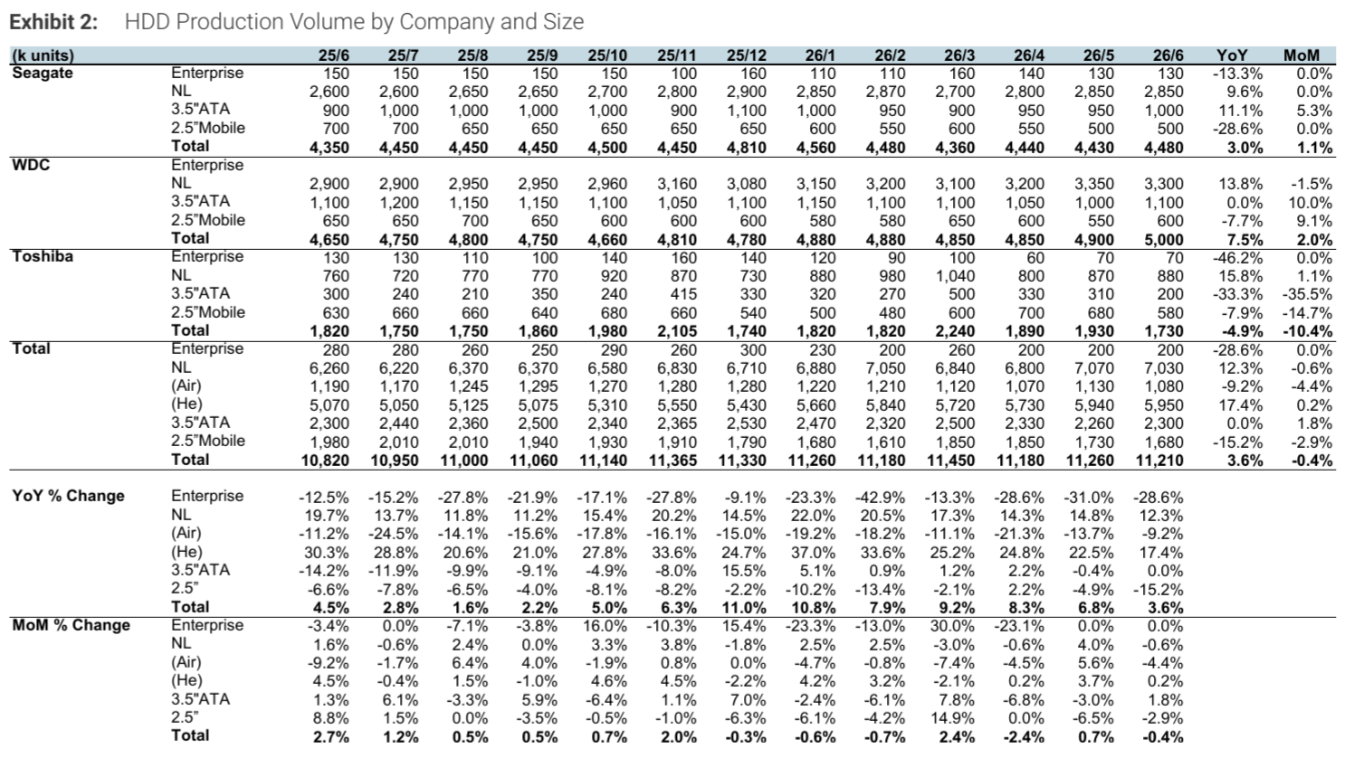
HDD production volumes by vendor and specification: in June, total NL output was 7.03 million units; He-filled products were 5.95 million units, up 17.4% year over year.
Raising the demand forecast does not mean the supply chain is under no pressure.
Storage demand is strong, and it is easiest to misread it as supply being able to naturally keep up. Nearline HDDs are more likely than SSDs to encounter manufacturing and testing constraints.
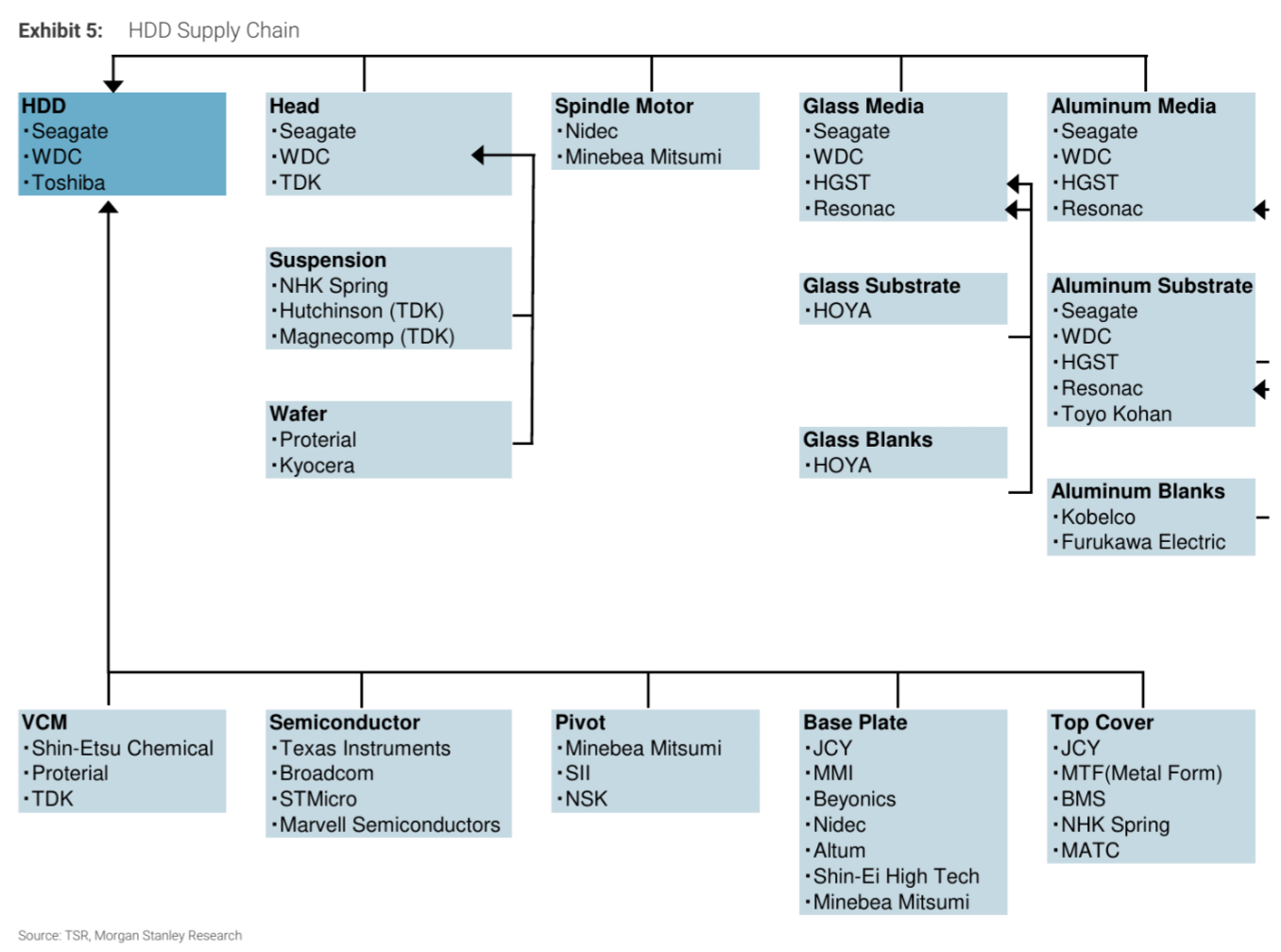
In the NL HDD production chain, heads, motors, platters, and testing processes can all affect final shipments. The report notes that further production expansion may be constrained by head supply and the progress of expanding testing facilities. Based on its supply-chain share definition, TDK’s market share in the NL HDD head market is about 12%–13%, while Seagate and Western Digital are highly self-sufficient.
TDK’s overall share may look low, but in the segments of external supply and incremental supply, it will still be closely watched by the market. If data center customers keep adding demand, and the top HDD makers’ internal head production capacity and testing capabilities cannot expand in sync, the difficulty of getting the capacity forecast to land will increase.
Testing capacity is also crucial. High-capacity HDDs are not delivered immediately just because they are produced; reliability verification and testing time will consume production-line capacity. The higher the capacity, the more stringent customers’ requirements for stability and yield, and ramp-up speed on the supply side is also more likely to be constrained.
External information also points to the same pressure point. In its 10-Q for Q1 2026, Seagate said that its data center business mainly includes high-capacity nearline products for cloud and enterprise customers, and that AI applications are driving growth in data generation and storage demand. TrendForce reported on July 22 that AI data centers are driving HDD demand; Japanese HDD component suppliers are expanding capacity; nearline HDD prices rose by roughly 10% quarter-over-quarter from April to June. Even very large-scale customers still face supply tightness.
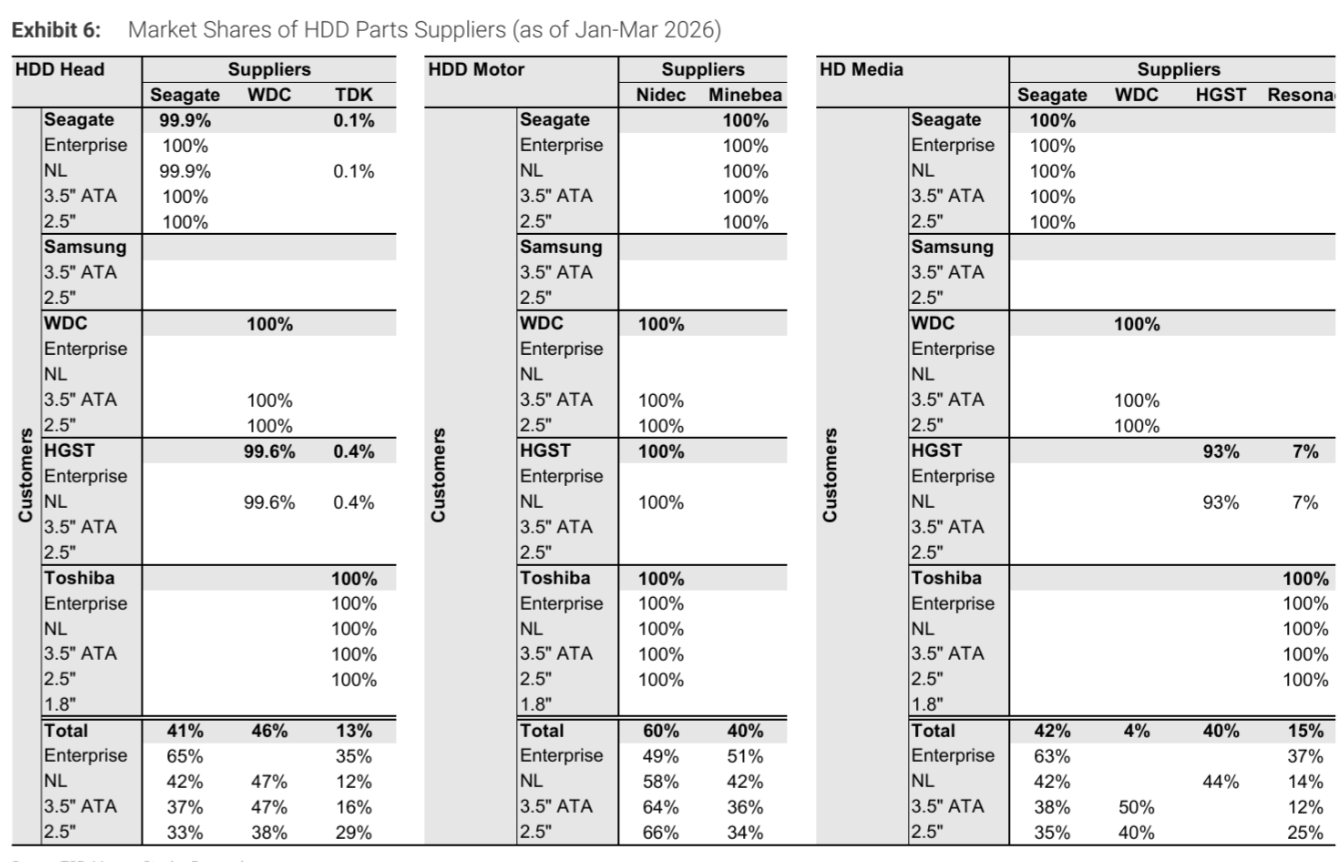
Table of the HDD supply chain and component shares: Head segment market shares are approximately 41% / 46% / 13% for Seagate / WDC / TDK.
The 525EB and 1845EB figures are still just forecast numbers
The most important signal in this forecast is not that the storage industry is already experiencing a widespread shortage, but that data center capacity demand is still being revised upward—and both SSDs and nearline HDDs benefit at the same time.
The main story for enterprise SSDs is even more direct. AI and cloud workloads drive higher demand for high-performance storage, and higher-capacity products amplify growth in the EB-based figures. The main story for nearline HDDs is more supply-side. Long-term cold data, training data, backups, and archiving still require low-cost, high-capacity storage, but the production-ramp speed is constrained by parts and testing capabilities.
The two numbers 525EB and 1845EB should be understood as shipping forecast figures for 2026, not delivery results that have already been locked in. If the head supply, testing facilities, or high-capacity product yield cannot ramp up in time, the actual supply of NL HDD may be lower than the forecast. If cloud vendors’ capital expenditures or AI data storage demand cool off, SSD capacity growth may also come in below current assumptions.
The divergence in this data center storage expansion will ultimately come down to two real issues: whether the month-over-month capacity growth rate of enterprise SSDs can be maintained at a high level, and whether nearline HDD manufacturers can steadily ramp high-capacity product volumes. Demand is already in the forecast stage—the supply constraint is the main challenge to execution.