



Original title: (Interview with Creader founder Tim: Let AI remember the world, and leave the stories to the authors)
Original author: Dongcha Beating
On July 23, Keigo Higashino passed away at the age of 68.
For more than forty years, he wrote 106 books. (The Midnight Detective) (Malice) (The Devotion of Suspect X) (The Miracles of the Namiya General Store), together forming a vast parallel world.
Many readers are already familiar with that world on the page. They know that Kaga Kyoichiro will continue the investigation along the streets of Tokyo, that Yusuke Kawai? Wait—sorry: Manabu Yukawa? will always be able to see the hidden truth in physical phenomena, and that beyond the case, there are families trapped in debt, students crushed by the pressure to get into higher schools, and ordinary people who can’t escape the past.
The murder case is only the entry point; what really remains in the story is how desire is produced, how secrets expand, and how a person is slowly pushed toward the ending by their own choices.
The world in Keigo Higashino’s work feels real because everything has a source. A lie told three chapters earlier does not disappear into thin air; a childhood experience can change the fate of those walking side by side many years later; a cup placed in the wrong position, a letter never sent, may all regain meaning before the story ends.
Detective fiction shrinks a sprawling world into a scene one can enter. In reality, many things go unexplained and many relationships end without resolution, but within these hundreds of pages of twists and turns, at least some traces can be traced back, and some choices will have consequences.
Readers thus gain a temporary foothold.
Writers keep this parallel world constantly under its own gravity. The more sprawling the worldbuilding, the harder it is to maintain that gravity. Characters increase, timelines intersect, and a sentence written casually may become foreshadowing one hundred thousand words later. A character cannot suddenly forget their past; a war cannot happen in the wrong year; a relationship cannot change direction without reason.
What long-form writing truly lacks is often the memory needed to hold an entire world.
What Creader wants to handle is precisely this part of the work. It extracts characters, places, events, relationships, and timelines from the novel, turning them into an interconnected structure.
At a time when many AI products are trying to generate stories for people, Creader’s founder Tim cares more about another question: can technology enter creation without being too eager to finish everything for the creator?
This isn’t the first time Tim has approached this question.
In 2014, Tim came to the UK. At that time, his English was still not fluent, and online fiction became his entry point into another world. Later he studied computer science, worked on reading platforms, researched blockchain and intellectual property, and also joined startups built around IP infrastructure. Over more than ten years, technology kept changing, but the question remained the same: how can a person fully express the world in their mind without losing their own judgment with the help of tools?
At the end of 2025, Tim began doing this again. He believes the most important part of writing is still those moments that cannot be accelerated. The author does not yet know the answer, the characters still have several possibilities, and the story has not too early become something complete and smooth, yet no longer belonging to anyone.
The gravity of the world
Tim loves reading web fiction and also historical fiction. Recently he read one set in the Xianfeng era. The author placed the characters amid the Qing court, the Anglo-French forces, the Battle of Dagu Fort, and changes in Chinese communities in Southeast Asia. Real history forms the boundary, while fictional characters live, migrate, and make choices within it.
Tim likes this approach. History is not treated as a simple backdrop; it keeps entering the characters’ destinies. Readers may come close to a real war because of a fictional character, and then, already knowing how the war ends, feel anxious about the fate that has not yet happened to that character.
The credibility of the world comes from the connections among history, characters, and consequences.
Beating: How would you judge whether a story is a good story?
Tim: What I care most about is whether the characters truly live in that world. A story can have very complex settings, but if the characters are merely tools to help the author push the plot forward, readers will sense it very quickly. The stories I truly remember are the ones where the characters all have their own reasons. Even if he does something wrong, you can understand why he got there.
Recently I’ve been reading a lot of historical fiction and alternate history. Historical fiction is interesting because the author cannot be completely arbitrary. They have to respect what has already happened, while creating characters in the gaps left by real history.
For example, I read a novel set in the Xianfeng era, which involved the relationship between the British-French forces and the Qing court, the Battle of Dagu Fort, and also Chinese communities in Luzon and Java. At certain points I would stop and look up the real history. A fictional story brought me back to reality again.
For me, this is what a story’s vitality looks like. It does not lock you inside the novel; instead, it lets you start from the novel and re-understand the outside world.
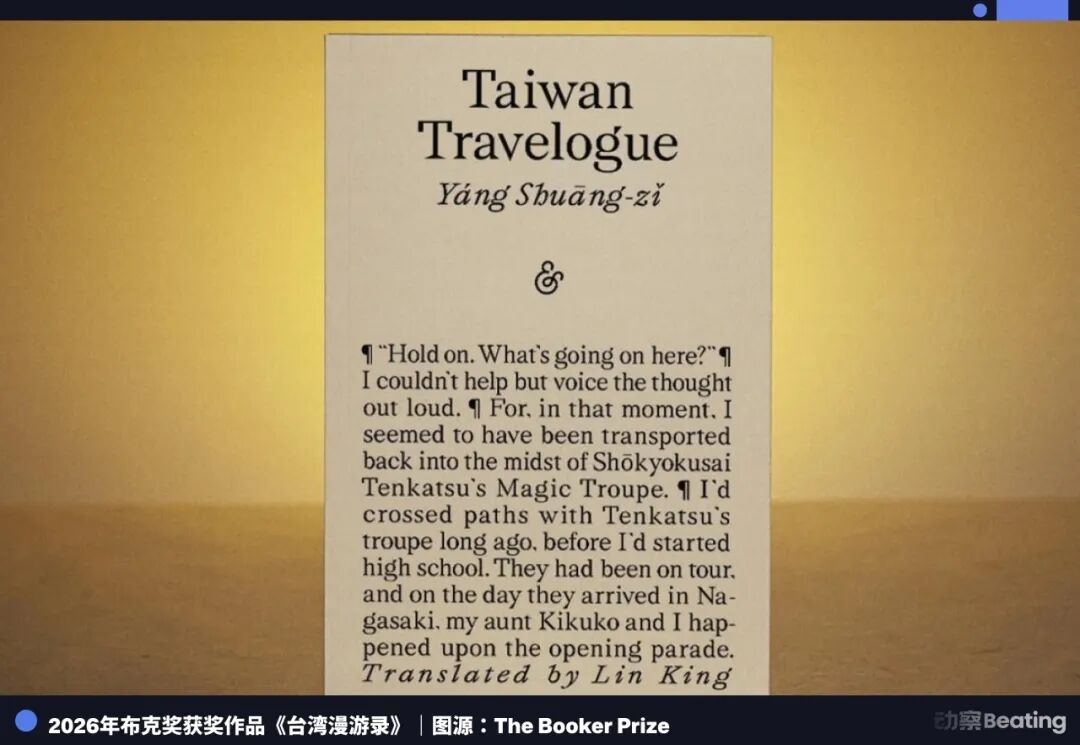
Beating: You mentioned the novel (Taiwan Travelogue), which won the Booker Prize this year. What attracted you to it?
Tim: It tells the story of Taiwan under Japanese rule, and through the journey of a Japanese woman writer and a Chinese Taiwanese translator, it brings together food, language, colonial relations, and the emotions between two people. I really like how it handles “translation.” Translation is not just turning one sentence into another language; it is how one person helps another understand an unfamiliar place. There is knowledge in that, and there are also power relations. Who is describing this world, and who is explaining it for whom, all affects what readers ultimately see.
This also makes me think that literature should not be the privilege of professional writers alone. When someone seriously records their relationship with themselves and the world, they are already writing. Ordinary people’s experiences are not necessarily lacking in value; often, they simply lack a way to organize those experiences into a form.
What technology can truly help with should also be this part: giving what has already been experienced a chance to be expressed more completely.
A thought that has been pursued for more than ten years
In 2014, Tim came to the UK. In an unfamiliar language environment, online fiction gave him his first sense of stability. He was drawn to its vast worlds, clear rules, and continually growing character relationships, and he also began to think about whether the creative and serialization mechanisms of Chinese web fiction could appear in the English-language market.
To answer this question, he started learning computer science, later entered large tech companies in China and began in operations; during graduate school he studied supercomputing, blockchain, and intellectual property. He and his partners joined competitions, wrote white papers, made demos, and tried to bring story rights and revenue distribution onto the chain. After that, he successively joined companies such as Story Protocol and FLock, continuing to work with IP, blockchain, AI, and developer ecosystems.
This path seems to have taken a long detour, yet in the end it still returns to writing.
Beating: What was the original starting point for making Creader?
Tim: When I was young, I already liked worlds with complete structures. I played Pokémon, Fire Emblem, Golden Sun, and built Gundam models. What attracted me wasn’t just any single character, but the fact that these worlds had their own rules. Characters, places, history, and relationships could keep extending, but they were not randomly pieced together.
After coming to the UK, this feeling became even clearer. At that time my English was not good enough, and online fiction was both an escape and a foothold for me. It gave me a familiar world I could enter even in an unfamiliar environment.
At the time I was thinking: could the creation and distribution mechanism of Asian web fiction work in Western markets? To build this, I started learning technology and made some very small websites. My undergraduate graduation project was a reading platform; it’s just that my technical ability and understanding of business were both limited then, so I never truly continued it. But I never forgot this matter.
Beating: Why did you later turn toward blockchain and IP?
Tim: At that time I thought the most important issue in the creative industry might be ownership. Who wrote a story, how it would be adapted later, how the revenue would be distributed—these links had never been transparent enough. Blockchain seemed to offer a new kind of infrastructure: works could be registered, licensing relationships could be tracked, and income could be automatically distributed according to rules.
This system can work technically, but the deeper I built it, the more I realized it did not solve the problem of creation itself. Wallets, tokens, and registration workflows may instead make reading and writing heavier. We solved how to establish rights after a work is completed, but we did not answer how a work, before it is completed, turns from a vague idea into a real story.
This is also why my direction changed later. The problem is not only in economic relations, but also in the process of human cognition.
Beating: Why are you restarting Creader now?
Tim: One very direct reason is that AI programming tools allow an individual to accomplish things that used to require a whole team.
Before, building a complex product first meant thinking about financing, hiring, and development cycles. Now one person can quickly make a prototype and verify the most important part first. That brought me back to a question from ten years ago. But generative AI also showed me another danger. Many products accelerate output without truly helping creators think. It can quickly give you a complete piece of writing, but completeness does not mean this is what you want to express.
I began to realize that what truly needs protection is not the act of writing, but the ability to form judgments during the writing process.
The writing of memory
Tim calls Creader a “narrative engine.” It tries to preserve the writing path authors are familiar with—open a chapter and begin writing directly. When help is needed, dialogue, structure, and analysis panels can be brought up; when not needed, those functions recede behind the page.
A long novel, by contrast, is divided into several interconnected layers: the main text, scenes, chapters, characters, places, timelines, rules, and relationships. The system keeps reading what the author writes and incorporates the information it can confirm into the story’s internal archive.
In a world that keeps growing, what Creader tries to maintain is what lies beyond the upper limit of human memory.
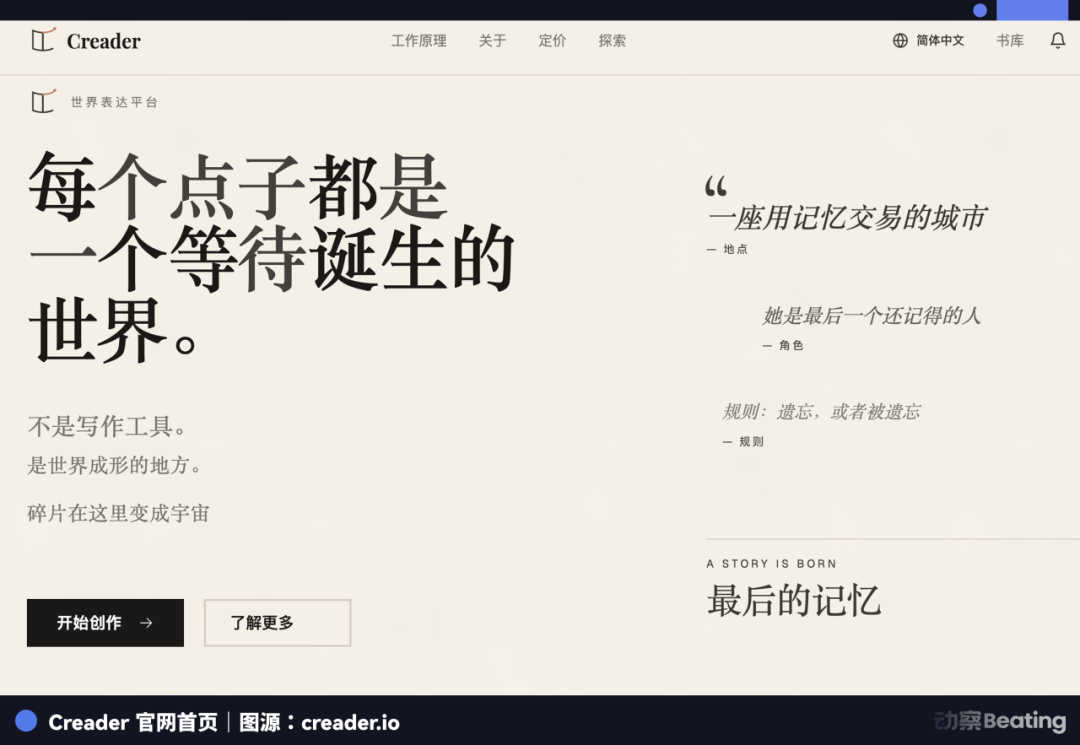
Beating: Why do you call Creader a “narrative engine” instead of an AI writing tool?
Tim: Because writing tools easily make people think of generation: you give it a request, and it writes a paragraph for you. But narrative is not just sentences. It also includes characters, events, time, relationships, and how the whole world operates. What Creader really wants to handle is the connections among these things.
We mainly look at two kinds of consistency. The first is narrative consistency. For example, whether a character’s transformation has buildup, whether a hidden thread has been resolved, whether a chapter really advances the story. The second is temporal consistency. For example, what a character knows now and does not know; what they did three days ago; whether the distance between two places allows them to appear at that time.
As time passes, many long-form novelists find it hard to remember the entire world at once. What AI is best suited for here is not deciding, but remembering and reminding.
Beating: In actual use, how is it different from Word, Google Docs, or just chatting directly with a large model?
Tim: We hope the main path is always writing. Users can open a page and start immediately; they don’t need to finish dozens of character settings first, and they don’t need to learn a complicated piece of software first. Other functions should be like side paths, appearing only when needed.
For example, if you get stuck halfway through writing, you can open a panel with a shortcut key and ask what a certain character has done before, or check whether this section violates earlier settings. After finishing, the system can also give comments like an editor.
The problem with general chat tools is that every conversation pushes you into the next round. They can keep producing new content very easily, but they struggle to preserve the structure inside a story over the long term.
Creader extracts story facts from the main text. Characters, places, events, and relationships are no longer just names scattered across tens of thousands of words; they enter the same knowledge system. What AI calls on is not a temporary chat log, but the internal reality the story has already established.
Beating: Wouldn’t that, in turn, make novels formulaic?
Tim: This is something we are very cautious about. In the early stage, we chose works like Dream of the Red Chamber and Hamlet as corpus for model learning to do narrative analysis, and later gradually expanded to about thirty works. The purpose was not to learn a particular author’s style, and even less to tell authors how to imitate, but to find questions that remain valid across different works.
For example, whether a description serves a narrative function, whether a metaphor comes from a character’s real observation, whether a conflict changes the relationship between characters. The system can raise these questions, but it cannot turn literature into a single uniform answer.
We are closer to an editor than to a ghostwriter. An editor can say this part seems to lack motivation, this thread hasn’t appeared for a long time, or this section explains too much. But the author is entirely free to disagree. In literature, there is no scoring standard that everyone must obey.
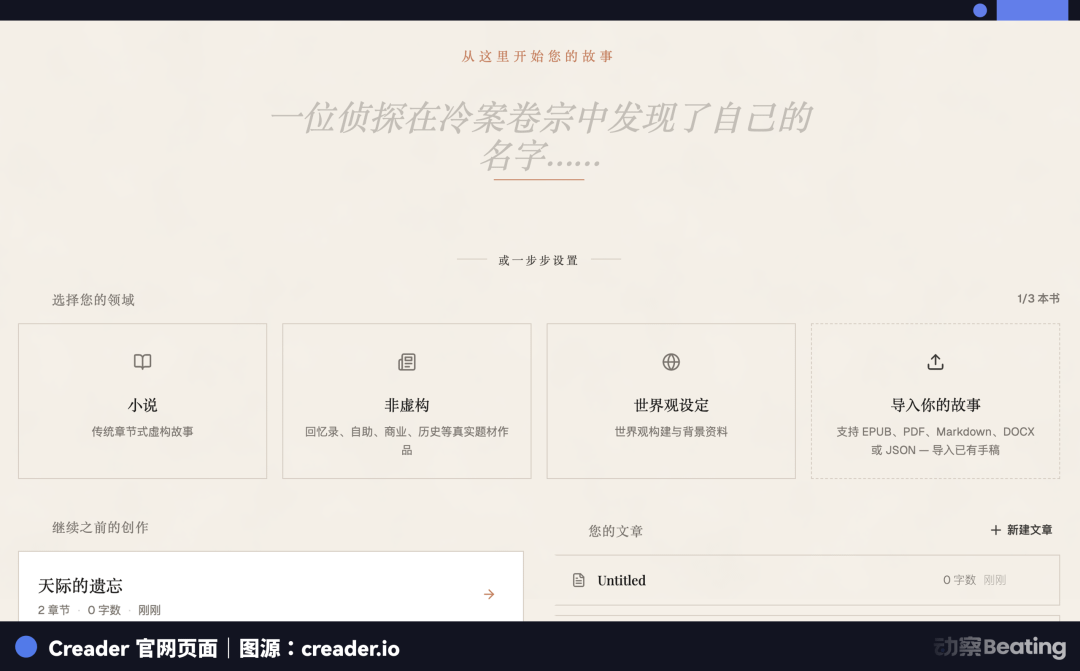
Beating: Does Creader allow AI generation?
Tim: It will, but generation is not the core. Different users need different things. Professional writers may not want AI to enter the main text at all; they may only need help organizing characters, timelines, and foreshadowing. Ordinary users may have very complete life experiences but not know how to turn them into structure, and may need more help.
The key is to preserve boundaries. We hope that in the future we can clearly distinguish which content is completed independently by humans, which is AI-assisted editing, and which is mainly AI-generated. Using AI itself does not mean there is no creation, but readers should know how it was made.
I don’t think one must choose an extreme between pure manual work and total generation. The question is whether the author keeps making decisions, and whether they preserve their intention, experience, and responsibility.
Beating: If a person has their own ideas and creativity, but just hands over the “hard labor” like typing and organizing materials to AI, does that still count as creation?
Tim: I think that’s a very interesting question. How do you define creation?
For example, when you are creating an article, what you’re truly investing is your ideas, your creativity, and which materials you want to organize into it. In the past, these things had to be completed bit by bit by hand or by typing, and part of it was, in my view, pure hard labor. Now if AI replaces that part of the hard labor, does it count as creation? I think it still does.
First of all, AI still has to be defined as a tool. It cannot replace humans. At least now, most AI generation still needs to be initiated by a person—you have to communicate with it, tell it what you want to write, from what angle, and what you ultimately hope to get.
Some people may have a very good idea, but no ability to express it fully. Now they use AI to complete that task, and that should not erase the idea they originally had. They are still creating; they are just using a new tool.
Beating: If the final text is mainly completed by AI, how should the author’s identity be judged?
Tim: I think the future needs to distinguish three cases: human creation, AI-assisted creation, and AI-generated creation.
Some people only use AI to check grammar and organize their thoughts; some let AI generate part of it; others may use AI for almost everything. All of these can exist, but there should be clear labels so readers know how the work was made.
Previously, a writer was exposed for having a considerable portion of their work use AI. What people were truly angry about may not have been that they used AI, but that they didn’t disclose it, even treating “the reader didn’t notice” as a kind of success.
Professional writers have their own way of thinking and their own creative philosophy. The fact that they can collaborate with AI and write a book in which readers do not notice AI’s involvement does not mean that another person could do the same. “If I did it, I could do it too” is not necessarily true.
Beating: But many readers still instinctively reject AI-generated novels.
Tim: If a story is good enough and the language is good enough, I personally won’t refuse to read it just because it used AI. But what many people worry about is whether AI is going to replace writers. Media also often describes it in terms of “what AI can replace,” and that gives creators a direct sense of threat.
I think there is nothing wrong with some people’s attachment to old methods. Programming is the same; some people are willing to write line by line themselves. AI is not万能, and traditional methods still have value sometimes.
What matters most is why a person uses AI.
A professional author can write eight thousand or ten thousand characters a day; they may not need AI to generate text for them at all. By contrast, what they may truly need is help organizing their thoughts: I have so many characters, clues, and plotlines in my head—how should I arrange them?
So for different people, AI occupies different positions. Some people need generation; some only need collaboration. Tools should adapt to human ability, rather than require everyone to write in the same way.
Let the answer appear a little later
The most obvious problems with AI generative writing are factual errors, clichés, and repetitive language. But Tim believes the harder-to-detect danger comes from speed: AI can always give an answer that looks correct too quickly.
The text becomes complete, but thinking may stop before completeness is reached.
Tim calls this state “premature coherence.” Large models are good at finding the most reasonable completion for gaps, but creation precisely requires those gaps to remain for a while. Characters can be unstable, motivations can conflict with each other, and an idea can remain unnamed for a very long time.
Within these undecided parts, creators have the chance to discover what they truly want to write.
Beating: You write yourself, so why do you still prefer to type it out yourself?
Tim: Conversations with AI are very fast. It’s a back-and-forth process. It generates a section, you read it, find something wrong here, and immediately begin the next round of conversation. Your brain keeps moving forward and it’s hard to truly slow down.
But when writing it yourself, it is different. Writing is actually a process of slowing down the speed of thought in your mind. Halfway through, you stop and think: am I moving in the right direction right now? Am I writing what I truly want to write?
If you use AI generation directly, you are mostly reading and judging its answers. If something is wrong here, you let it revise it; if something is off there, you immediately enter the next round. The process of slowly forming sentences yourself is missing in between.
So I think handwriting, or typing it yourself, this kind of old-fashioned writing is helping people slow down their thinking and giving you more time to keep questioning the value of your expression.
Beating: For you, what is the most precious part of writing or literature?
Tim: Of course I don’t come from a literature background; I look at literature from a computer background. For me, literature mainly has two meanings.
The first is recording your interaction with the world. Why do people record, why do they write? At first, it was because they hoped many facts could be seen by later generations. Where a person lived, what they experienced, how they understood that era—all of it can be left behind through words.
The second is recording the imagination in your mind. When people see more, experience more, and interact more with the world, their imagination is also opened up. Why do science fiction and fantasy exist? Why does One Hundred Years of Solitude exist? Because an imagination first sprouts in someone’s mind, is then recorded, and finally becomes a world that does not exist in reality but can be entered by many people.
I think literature, at its core, is still about helping people express their inner world.
Everyone is thinking about something; they just may not be willing to say it, and may not be willing to post it on Weibo or other public social networks. But sometimes they still want to record what they were thinking in that moment, so they write a note.
Literature is not compulsory; it is not as if once written it must be shown to others.
You keep that moment’s thoughts to yourself, and I think that can also be literature. What matters most is that you recorded what was in your mind.
Beating: I heard you also want to put Creader into educational settings. How did you think about that?
Tim: We are currently in contact with some institutions in Singapore and Vietnam, looking at how this product could be used in education.
When our generation was young, there was no AI. Because there was no AI, when we encountered a problem we had to learn on our own and figure things out ourselves. That process leaves a background layer in your thinking: you know you need to think, to transform what you see into your own knowledge. But for children born after 2005 or 2010, AI may accompany them for a very long time. At the very stage when they most need to learn and build self-learning ability, they already have a tool that can provide answers at any time.
In the next five to ten years, there may be a kind of inertia where, when I see something unfamiliar, my first reaction is also to ask AI.
The problem is that the human brain has a very important ability: we connect what we see in life, what we learn in class, and some things that were originally unrelated, and in the end form our own understanding. Models are better at providing answers along lines of relevance. If a person for a long time only receives this kind of already-organized relevant content, their thinking may also become increasingly dependent on existing paths.
So in educational settings, we actually do not want to provide generation from the start. Students should first write an outline themselves, think from that outline about what to write, and then complete the main text. Teachers can then see how they revise, how they communicate with the system, and how an idea gradually takes shape.
First make the writing good
In the next month, Tim plans to work more closely with a Vietnamese art publishing institution.
This is also the first time the product has had to confront regional differences in a more concrete way. When a writing tool enters another country, what changes is not only the interface language.
Beating: What’s the development plan for Creader next?
Tim: Next we may collaborate with an institution that helps Vietnamese artists enter international markets. Every year they publish a magazine distributed in different parts of the world, introducing the Vietnamese artists they work with. We want to see whether Creader can enter their real creative, editorial, and publishing workflow. It’s also a learning experience for us, because professional authors and institutions have longer feedback cycles. They are often already writing a book and won’t use it today and give you a conclusion tomorrow.
This is a small but refined product, and many things still need to live in real usage scenarios before we know whether they truly work.
Beating: When authors from different countries use the same product, will there be problems adapting to local conditions?
Tim: Yes. Language is a very big difference.
For example, British English and American English are two very different language habits. The most superficial differences are spelling and vocabulary, such as colour and color, flat and apartment, lift and elevator. Deeper down, there are differences in slang, dialogue style, and writing rhythm.
We once contacted a British author, but he wrote stories set in the United States. When writing, he needed to keep checking dictionaries and materials to confirm whether an American character would really speak that way. Because a person’s educational background enters their writing. If you were educated in British English, many words would naturally be written in British forms. Even for a professional author, writing does not end once it is written down; they have to keep researching, checking, and replacing.
At present we mainly support British English, American English, and Chinese. Later we will also explore the Japanese, Korean, and French markets. Europe has a strong writing culture, while the U.S. has many self-publishing authors; each market has very different writing and publishing practices.
Beating: After AI appeared, will future content still be a book, an article? Or will it become something readers can interact with?
Tim: We are also thinking about interactive fiction, worldbuilding, and multi-threaded narratives. But in the end, I still feel that text gives people far more room for imagination than video and images. Once you see an image, your mind forms a relatively fixed shape, and it’s hard to completely detach from it.
But when people read text, everyone can imagine it again. Why does a work inspire so much fan fiction and fan art? Because everyone starts from the same piece of text, but in the end sees different things.
Of course, there can be interactive novels in the future; readers can enter different narratives, and one world can grow many stories. But first, the writing itself still has to be done well.
Beating: Would investors feel this isn’t a big enough business?
Tim: Yes. When talking with some investors, they may compare it with directions like agents and AI memory layers, and feel that writing tools aren’t a particularly big business. Of course it can also be framed as a “memory layer,” saying we are helping AI preserve a world’s memory. That’s fine too, but I don’t think it’s necessary.
I made this product to help people write a good story. If it can help me tell a good story needed for fundraising, that of course is also proof. But is it really necessary to make it sound that big? I don’t think so.
It may not be a business that makes huge money, but it can be a product that continues over time. Investors who are genuinely interested and understand this can talk. But I’d rather first make the thing I like well.
This year’s goal is simple too: one hundred authors actually use Creader, and ten of them complete and publish their books through it. If we achieve that, I think this year’s KPI is met.
I believe that as AI-generated content becomes more and more common, people will also start looking for a relatively clean space again.
The time that was spared
In Time and Free Will, Bergson distinguishes two kinds of time. One is time that can be divided and measured. It belongs to clocks, calendars, and production plans: one minute after another, every unit seeming the same.
Another kind of time happens inside human consciousness. The past never truly disappears; instead, it keeps entering the present. A moment of hesitation may carry memories from ten years ago, and the words written down also carry the warmth left behind by yesterday’s argument.
Bergson called it “duration.” Writing happens in such time.
An author pauses between two words, weighs them carefully, deletes a freshly written paragraph, and then finds it again the next day. They may be unable to decide because of a character, or leave the desk halfway through writing. During that time with no actual output, something is still changing—it just hasn’t yet become sentences.
Creation is not converting time into word count. Time itself is the material of creation.
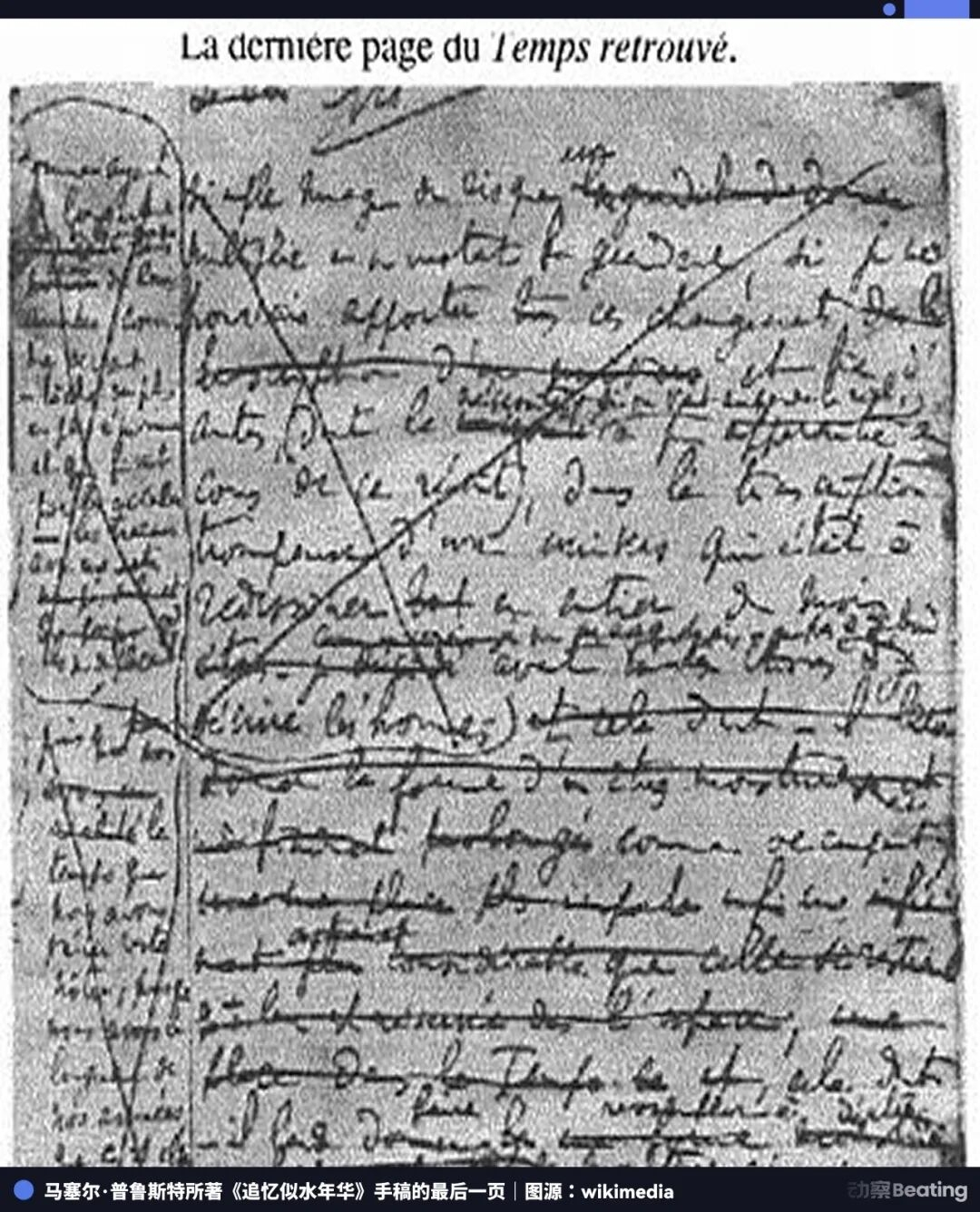
A large model generating a thousand words may only take a few seconds. It can quickly mobilize patterns already existing in language and predict the most likely expression based on context. It pauses, but that is a computational wait, not a person reconsidering themselves in hesitation.
Borges compressed vast time into very short passages, while Proust let a moment keep extending inward into memory. Different languages are not only a set of stylistic choices; they also record how a person experiences the world, how they endure pauses, and how they live with their own time.
The flaws in writing also belong to that time.
A turn that never quite closed, a repetition that was too stubborn, a judgment the author may no longer agree with years later—all show that the person who wrote it was once in a specific position. They only knew this much at the time, and could only get this far.
Imperfection is sometimes not a technical shortcoming, but evidence that the text is still connected to a finite human being.
Creader stands within this contradiction and tries to give its answer.
Tim describes Creader as a piece of land. What the tool can do is not to grow a forest in advance, but to preserve the soil, organize the boundaries, and give an unfinished world a place to keep growing.
Land is different from a production line. A production line demands stability, accuracy, and on-time delivery, while land allows waiting. Seeds may take a long time to sprout, branches may grow in the wrong direction, and even overgrown weeds can create a new world.
Understanding creation as land means that the tool provides not a way to reach the finish line faster, but a space that can hold what is unfinished.
In an era when conclusions have become too easy, we can also choose not to finish the story for the time being.
Original link