


The reason for this article has two points:
First, the post yesterday had a high level of engagement, and many new followers have joined me, which can be seen as guidance for new followers;
Second, some people asked how I saw the 98000 position for the long trades (they probably went through my previous analysis and found that I mentioned taking long positions starting from 87000 with a target near 98000 for profit). Including when I shorted at 113500, I initially mentioned taking profit at 82500. After taking profit, some people also found it miraculous and asked me why that position? I will answer that today.
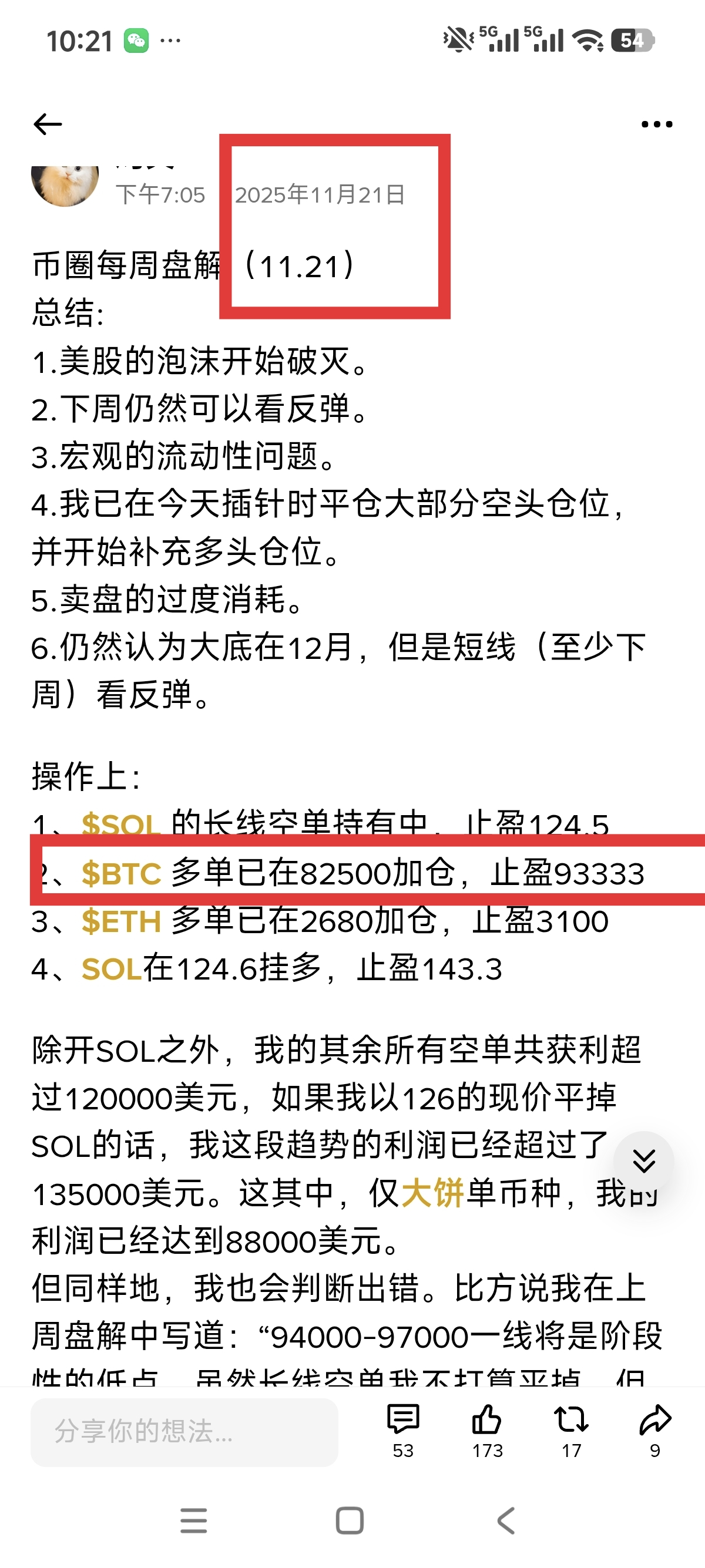
(11.21 buy long see 93333)
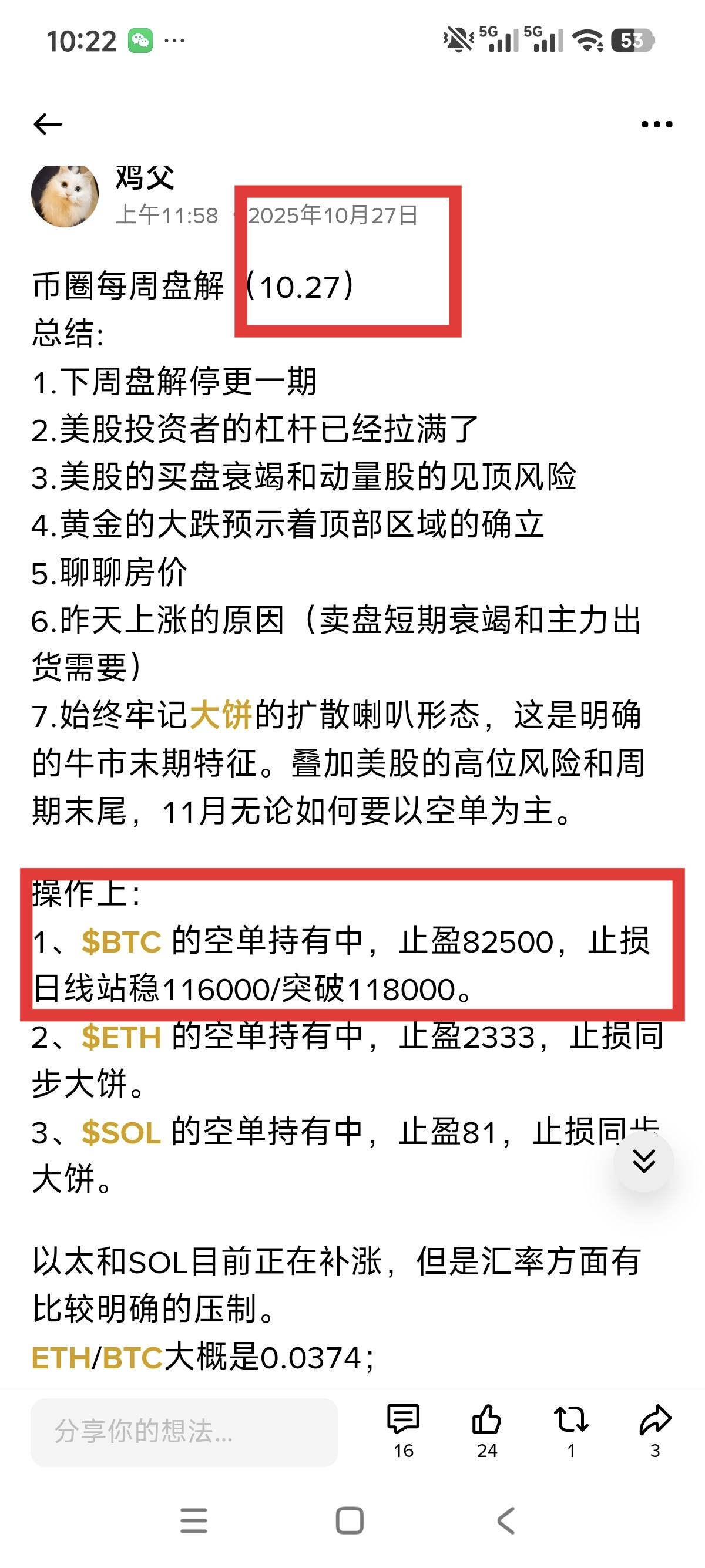
(Short at 82500 on 10.27)
Why do trend trading:
Before I start expressing my views, please think about the following questions:
1. Among those who dare to trade live and are profitable, how many are short-term traders?
2. Among the smart money that ranks high in profits, how many are short-term traders?
3. Currently, BN only has contract spot trading, and no spot trading. If BN launches spot trading in the future, will the gap between us trend traders and most intraday short-term traders further widen?
Here, especially the second question is very worth considering for everyone. In trading and investing, who should we learn from? Of course, we should learn from those who make money.
The @Pickle Cat I previously recommended multiple times, is she a long-term trader?
King of copy trading @大夫 , can you hold your positions?
Including those who made relatively high profits in the real market, are @汪 @Kenzoy all trend traders?
Even if the holding period is relatively short, like @奶盐153 and @懂币猫的实盘 , isn't it still a big swing? The holding period is often several days.
And among those who make relatively high profits in intraday short-term trading, can you give a few examples?
So when I previously saw someone criticize @大头-悟道中 and @我是小z啊i , saying they were opening hedging accounts, I felt very helpless.
Especially little Z, I saw some comments saying:
"Clearly could have closed it, then buy again when it drops, yet holding on, must be hedging" (You are a prophet, knowing it will rise to 94000 then retrace to 89000, and then go to 98000)
"It has been fluctuating for so long and not closing, now that it has gone up, it closed, undoubtedly hedging" (The trend hasn’t even formed, why close out during fluctuations? I don’t understand.)
"Those who hold long positions on the square are all hedging" (Yes, Huang Guo Cat is also hedging, her small account is floating a loss of 50 million u)
Things like this, and so on... The words spoken even do not conform to basic trading logic.
So I was a bit desperate and then went to Huang Guo Cat's comment section to leave a message saying 'Forget it, save as much as you can, some people can't be saved.'
To be frank, if it weren't for the fact that my account had already started to grow in 24, and if I hadn’t publicly shared my long positions in trading analysis in 24, I guess even I would be questioned about 'hedging accounts opening positions'. After all, going short from 113500 to 82500, more than 30,000 points, according to some people's statements, 'normal people' wouldn't trade like this.
So the question arises, have short-term traders made money?
If little Z had taken everyone's advice, then he should have closed his position on the day he broke even, because at that time the comments were 'Quickly close it, it's hard to break even, if you don't close it, you'll lose back again.'
Later, when little Z had a floating profit of 20wu, those voices disappeared, and when little Z's floating profit retraced to 10wu, those voices reappeared: 'When it had a floating profit of over 100,000u, it should have been closed', 'Did it lose back?', 'Quickly close now, otherwise it will be liquidated soon'...
If little Z had closed his position at that time, then he wouldn't have made 40wu; his profit would have stopped at 10wu.
For short-term traders, where can a long position at 90,000 go? At most, it can go up to around 93000. Then when it looks like 94000 is profitable, in reality, when Bitcoin tries 94000 again, these people will short again, thereby losing back the previous profits.
The final result is:
Trend traders add positions at 90000, take profit at 97000, and make more money.
The final profit of short-term traders is only from the very first trade of '90000-93000'.
So you see, many people ridicule the long-term short positions of the big head, saying the profits have retraced a lot. But did all these people really earn more than the big head in November-December? If the big head can't hold the positions, he could only have taken 50 points at most, but in the end, he took 500 points. Did those who ridicule the big head accumulate 500 points on Ethereum in the past three months?
Of course, I am not sure if they will have a small account opening a reverse position while the large account is floating profit and the small account is floating loss. I just feel that this is something that 'normal people' wouldn't do. To put it bluntly, if someone thinks this way can create accounts, and then rely on being a KOL to make money, anyone can do it, right?
Trend trading is not only not a scam, it is the correct way to trade. Those intraday short-term traders, one by one, ask yourselves, have you made money trading? Do you know any techniques, or do the indicators you look at differ from the ones we look at? Have you drawn lines, calculated Fibonacci, made money?
Why can't you make money?
Because what you said, 'take profit when there's profit, buy again when it drops' is itself a false proposition.
The actual situation is that if you close your position and there is no pullback, then in the case of not being able to re-enter long positions, you will open a short position in the opposite direction, and in the end, you have a 50% chance of being stopped out. Once it goes one-sided or there is an issue with position management, it will lead to liquidation.
The actual situation is that your order positions are poor, the risk-reward ratio is bad, and it is even hard to set a reasonable stop-loss, which often leads to small profits and large losses.
Short-term traders, not monitoring the market feels uncomfortable, being in cash also feels uncomfortable, and the final outcome is that trading also feels uncomfortable.
Regarding position setting:
Before answering this question, I want to declare that my positions will not all hit.
Let me give a recent example, on December 10, I posted that I had set up a medium-term short position with the goal of seeing new lows (breaking below 80600). This short position was ultimately exited at 88000, a full 8000 points away from my target. Although it was still a profit, the expected return was significantly reduced.
Including me, I started to adhere to a low-long strategy from July 25, expecting to reach 136000 by late October. But in the end, everyone knows that the peak of this bull market was 126000, which was a full 10000 points away from my target. Finally, I managed to hold through 10.11, and then exited when it rebounded to around 113000, at which point there was almost no profit left.
What logic is my position setting based on?
This is just like how you short-term traders set your positions, only that the candlestick charts you look at are 5 minutes, 15 minutes, 1 hour. The candlestick charts I look at are daily, weekly, monthly (I hardly even look at 4H candlestick charts).
Why do I want to close my short and open a long on January 1? Because of three consecutive monthly bearish candles, so January, in my view, is bound to be bullish, just buy more as it dips.
The Fibonacci levels you calculated, I also calculated, just at different levels.
I also look at where the dense distribution areas (price zones) are and the support of moving averages, only that I look at the daily and weekly charts.
Why were previous long positions closed at 82500? Because that was the dense trading area from March to April 25, and it was situated between the weekly MA60 and MA125 (referencing January 22, which also fell between the weekly MA60 and MA125). Ultimately, this was still a liquidity dense area on the large-scale heat clearing chart.
The reason I took profit on the medium-term long position at 97200 is the same principle, only that I was looking at the daily chart instead of the weekly.
That said, I can't help but worry—some people only do short-term trading and not long-term, is it because their order placements are entirely based on feeling? Before creating an order, have they thought deeply about it, have they calculated it?
"It feels like it has risen too much, let's open a short, with a 1000 point stop-loss and 2000 point take profit."
I want to say, this is very scary. Because once the market completes a trend and starts to fluctuate, it will subtly influence retail traders' judgment of price ranges.
When Bitcoin plummeted to 80600, everyone's first reaction was that it would rebound to 10w+. But as long as the market grinds for a month, short-term traders will feel that '89000 is the high point, a good shorting position'.
You can check your own orders, did you open any short positions during December 26 to January 2?
If there is, then it is. Regardless of whether your short position is for profit or loss, the actual situation is that your judgment in the 89000-90000 range was: it has risen too much and is going to fall, this is a high position, the success rate of shorting here is high.
Regardless of whether you made money or lost money on that short, the thinking was problematic. If you lost, that’s fine, but if you made money, then it’s troublesome because you won't realize your own issues.
Actually, this problem can be solved easily, which is to force yourself to look at the market only once a day (at 8 AM), only look at 4H and above levels, and only decide whether to trade between 8-9 AM, whether it's market price or limit order.
Learn to slow down, learn to stay calm, learn to control your hands, be patient like a hunter.
It is important to understand: time is the essence of trading.