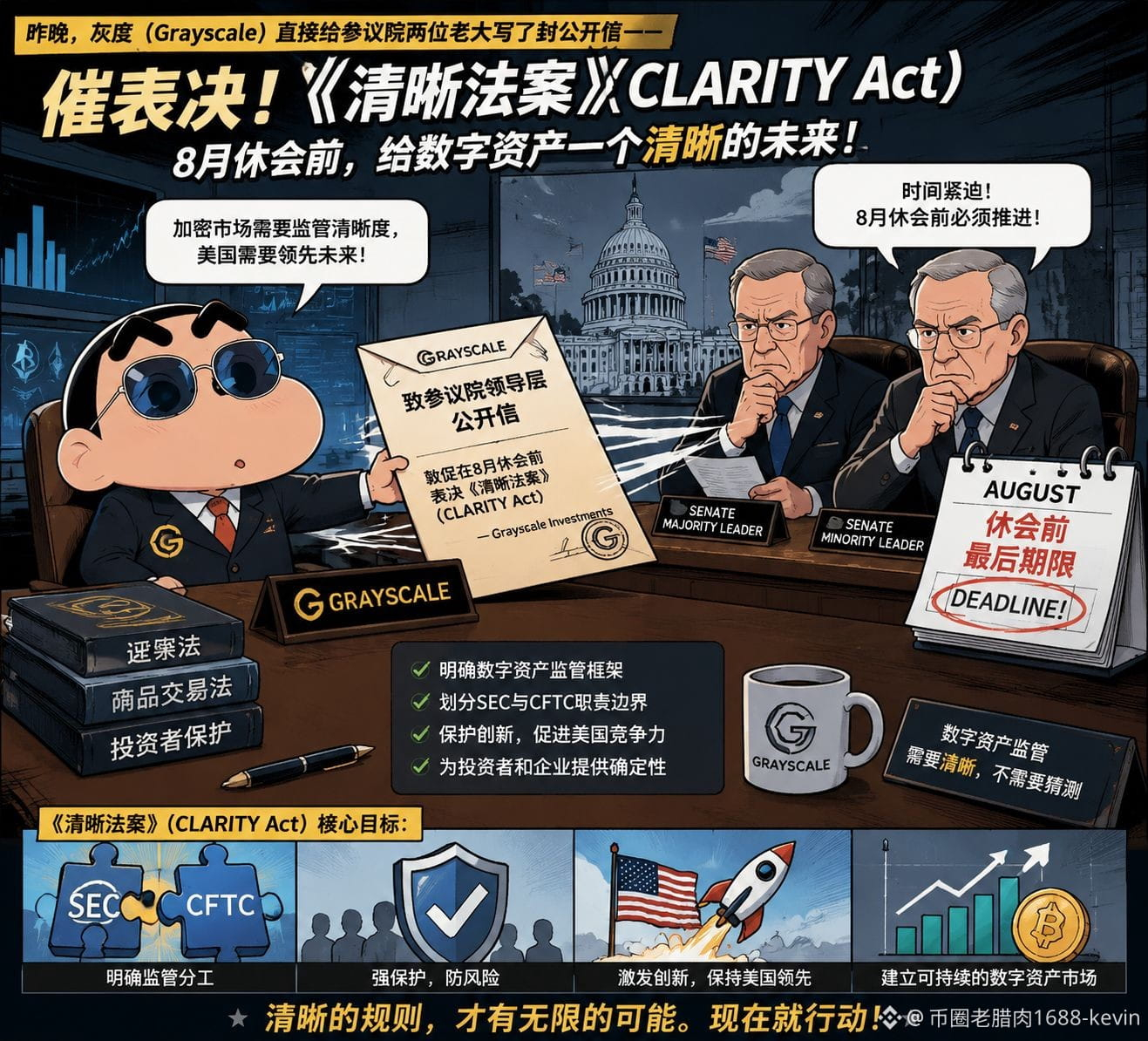

#灰度敦促参议院表决clarity法案
Grayscale is getting anxious: if the bill keeps getting delayed, the crypto market could really get "cut off".
Brothers, last night Grayscale directly sent an open letter to the two Senate leaders, urging them to hurry up and vote on the CLARITY Act before the August recess. This is pretty interesting, and the signal it sends is worth pondering.
1. Why is Grayscale so anxious?
Put simply, if it doesn’t pass soon, institutions and money will both run away. Grayscale’s chief legal officer said it outright: “Days without clear rules are days of capital outflow.” That’s not alarmism. Right now, the bill’s approval probability in prediction markets has already fallen to 26%-37%, more than halved from before. The Senate recesses on August 10, so there just isn’t enough time.
2. Where is the bill stuck?
There are mainly three problems: first, the ethics provisions keep sparking debate, and the White House has just proposed a new compromise version, but whether Democrats will accept it is still uncertain. Second, DeFi regulation would require decentralized protocols to do KYC, which is technically very hard. Third, stablecoin yield is strongly opposed by banks, which fear depositors will move all their money into stablecoins to earn interest.
3. The chain reaction for crypto stocks and the market
This affects the market on two levels: the first is a delayed catalyst, slowing the pace of institutional money entering. JPMorgan’s view was blunt: the drop in approval odds is a direct headwind for the crypto market. The second is even more painful — if the delay drags on, incremental businesses like tokenization could be cut off by traditional financial infrastructure, rather than flowing onto public blockchains.
Looking at specific names, Coinbase is the most sensitive. When bill news made progress last week, it jumped 11% directly; now that expectations have cooled, it will definitely face pressure. MSTR is more complicated: it just took an $8.2 billion loss and urgently needs policy tailwinds to tell a story to the market, while also needing the bill’s passage so institutional participation can lower its 10.8% financing cost.
4. How to trade it
In the short term, don’t bet on headlines — there probably won’t be any big surprise. If you already have a position, keep a close eye on prediction market probabilities and the Senate schedule; if you don’t, wait until the dust settles. The key here isn’t direction, it’s patience. Buy low and go long, waiting for the good news to land!
$COIN $CRCL $BTC
Grayscale is getting anxious: if the bill keeps getting delayed, the crypto market could really get "cut off".
Brothers, last night Grayscale directly sent an open letter to the two Senate leaders, urging them to hurry up and vote on the CLARITY Act before the August recess. This is pretty interesting, and the signal it sends is worth pondering.
1. Why is Grayscale so anxious?
Put simply, if it doesn’t pass soon, institutions and money will both run away. Grayscale’s chief legal officer said it outright: “Days without clear rules are days of capital outflow.” That’s not alarmism. Right now, the bill’s approval probability in prediction markets has already fallen to 26%-37%, more than halved from before. The Senate recesses on August 10, so there just isn’t enough time.
2. Where is the bill stuck?
There are mainly three problems: first, the ethics provisions keep sparking debate, and the White House has just proposed a new compromise version, but whether Democrats will accept it is still uncertain. Second, DeFi regulation would require decentralized protocols to do KYC, which is technically very hard. Third, stablecoin yield is strongly opposed by banks, which fear depositors will move all their money into stablecoins to earn interest.
3. The chain reaction for crypto stocks and the market
This affects the market on two levels: the first is a delayed catalyst, slowing the pace of institutional money entering. JPMorgan’s view was blunt: the drop in approval odds is a direct headwind for the crypto market. The second is even more painful — if the delay drags on, incremental businesses like tokenization could be cut off by traditional financial infrastructure, rather than flowing onto public blockchains.
Looking at specific names, Coinbase is the most sensitive. When bill news made progress last week, it jumped 11% directly; now that expectations have cooled, it will definitely face pressure. MSTR is more complicated: it just took an $8.2 billion loss and urgently needs policy tailwinds to tell a story to the market, while also needing the bill’s passage so institutional participation can lower its 10.8% financing cost.
4. How to trade it
In the short term, don’t bet on headlines — there probably won’t be any big surprise. If you already have a position, keep a close eye on prediction market probabilities and the Senate schedule; if you don’t, wait until the dust settles. The key here isn’t direction, it’s patience. Buy low and go long, waiting for the good news to land!
$COIN $CRCL $BTC