


As 2025 comes to a close, traditional financial institutions and leading figures in the crypto space (KOLs) are releasing their outlooks for 2026. A consensus is forming: a 'structural bull market' driven by institutional capital, clear regulation, and real utility may be on the horizon, and the market's power structure and value logic are undergoing profound transformation.
 I. Institutional Perspective: Betting on 'The Year of Ethereum' and a Structural Slow Bull Market
Traditional financial institutions, represented by Standard Chartered, are evaluating crypto assets with a more refined framework, and the adjustments in their forecasts themselves signal market maturity.
1. Standard Chartered: Downgraded price targets but strengthened expectations for Ethereum's leadership.
● Geoffrey Kendrick, head of digital asset research at Standard Chartered, recently made it clear that although he has downgraded Ethereum (ETH)'s absolute price forecast, he still expects 2026 to be 'the year of Ethereum.'
● The bank has lowered its target price for ETH at the end of 2026 from $12,000 to $7,500, but is more optimistic about long-term targets for 2028 and beyond, adding a forecast of $40,000 for 2030. This adjustment is primarily based on Bitcoin's overall performance falling short of expectations, dragging down the prospects for dollar-denominated digital asset portfolios.
● However, Standard Chartered believes that the fundamentals of Ethereum relative to Bitcoin are improving, and expects the ETH/BTC exchange rate to gradually rise.
Its core argument lies in Ethereum's structural advantages: in
1. Dominance in the fields of stablecoins, tokenization of real-world assets (RWA), and decentralized finance (DeFi);
2. Network transaction volumes hit new highs due to stablecoin transfers;
3. And continuously enhance the capacity of the underlying layer through upgrades like Fusaka.
4. Standard Chartered predicts that by 2028, the market size for stablecoins and RWA may expand to $2 trillion, with most of the activity processed on the Ethereum network.
2. Consensus among leading institutions: bidding farewell to the frenzy cycle and welcoming value integration
The outlook reports for 2026 from several top investment institutions present a highly consistent narrative, no longer focusing on short-term speculation but rather on fundamental shifts in the industry.
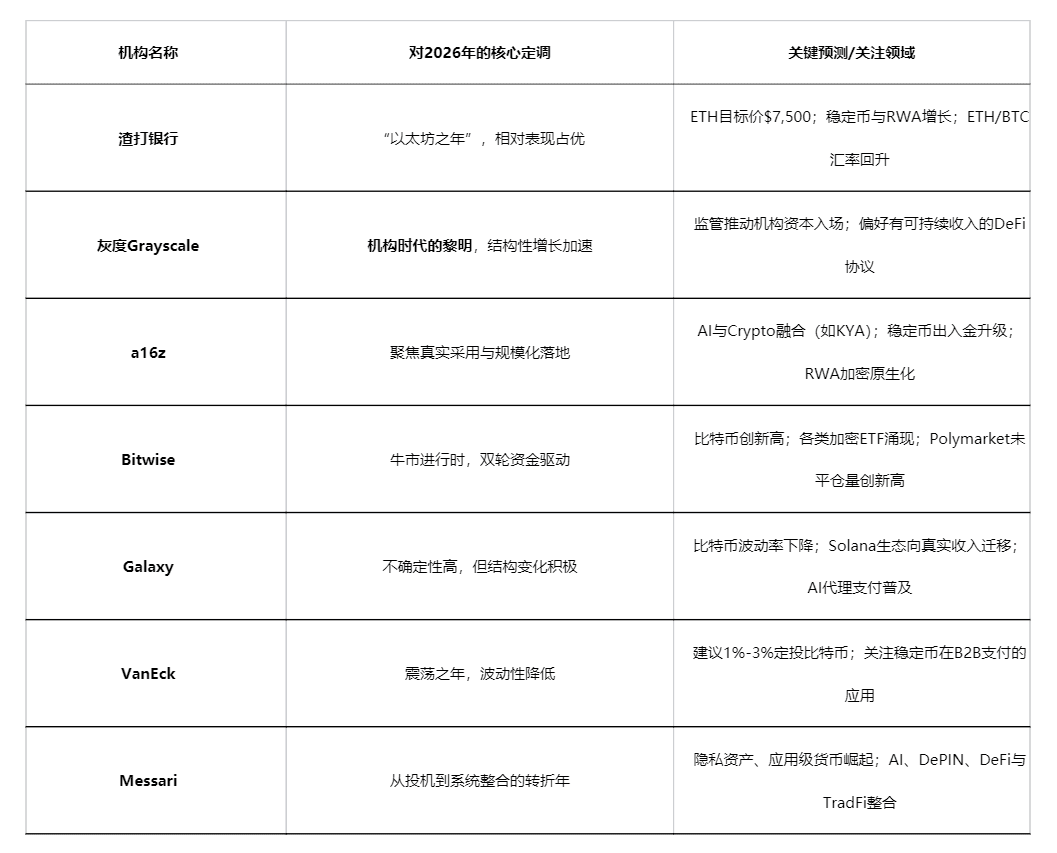
● Grayscale defines 2026 as 'the dawn of the institutional era,' believing the market is transitioning from a 'retail cycle' to 'institutional capital dominance,' driven by macro demand for scarce digital assets and improved regulatory clarity.
● a16z has stepped out of the price discussion, focusing on how next-generation crypto products will be truly adopted, proposing 17 landing directions including AI agents on-chain (KYA), staking media, and RWA crypto-native.
● Bitwise has the most optimistic attitude, believing that the 'dual driving force' composed of ETF funds (Wall Street) and trading platform holdings (retail) lays the foundation for the bull market, predicting Bitcoin will reach new highs, with its volatility potentially lower than Nvidia's stock.
● Galaxy and VanEck's predictions are relatively cautious. Galaxy points out high market uncertainty, and Bitcoin options pricing indicates a potential shift towards differentiation. VanEck believes that 2026 is more likely to be a 'year of turbulence,' with market volatility having decreased, suggesting investing in Bitcoin through dollar-cost averaging.
The table below summarizes the judgments of major institutions on the core trends for 2026:
 II. KOL Insights: Survival strategies under trend differentiation
Compared to the grand narratives of institutions, KOLs on the front lines of the market provide more specific and diverse trend judgments and survival guides.
1. Core Tracks: AI, prediction markets, and the return to fundamentals
Multiple KOLs point out that opportunities in 2026 will arise in areas capable of generating real cash flow or addressing actual needs.
● The fusion of AI and blockchain has been mentioned multiple times. XHunt & Biteye founder @DeFiTeddy2020 believes that the combination of AI agents and blockchain is one of the deterministic opportunities. Theory Ventures' Tomasz Tunguz predicts that corporate investment in AI agents will for the first time exceed human labor costs.
● Prediction markets are highly anticipated. Chief editor of Wu Says Colin Wu and KOL Crypto Monkey @monkeyjiang both believe that with major events like the 2026 World Cup approaching, prediction markets (such as Polymarket) may see an explosion.
● Returning to fundamentals has become the consensus. Investor @0xJeff points out that as crypto narratives fade, the sustainability of projects and whether they truly create value become the new standards for judgment. DeFi OG Chen Mo @cmdefi believes that the industry will enter an era of 'token interest binding,' where only those projects that can strongly bind token value to protocol income and network effects will have a future.
2. Beware of risks and embrace change
KOLs have also generally highlighted potential risks. @DeFiTeddy2020 reminds us to pay attention to the possible emergence of seven black swan events. Raoul Pal, founder of Real Vision, advises investors to extend their time horizon, hold quality assets, and avoid investing based on 'borrowed conviction.' These views collectively point to a more complex and professional market environment, requiring participants to shift from 'casting a wide net for trends' to 'precision deep research.'
III. Power Shift: KOLs, Liquidity, and New Value Framework
The market in 2025 underwent a silent power shift that profoundly affects the rules of the game in 2026.
1. KOLs: From disseminators to 'market judgment nodes'
The influence of top crypto KOLs has surpassed traditional financial media in terms of speed, trust, and action orientation. They are no longer simple information movers but key judgment nodes providing 'views' and 'conclusions' that have been filtered and processed in an information overload era. Market pricing is responding more rapidly to KOL interpretations, forming a new logic of 'whoever tells the story clearly first will influence pricing.' However, this influence is undergoing brutal internal selection, with the lifecycle of emotionally-driven 'shouting' KOLs shortening, while 'research-type' KOLs providing verifiable, methodologically supported insights are building long-term trust compounding.
2. Liquidity paradox and the reconstruction of value assessment frameworks
The market presents a contradictory liquidity picture: while Bitcoin ETFs and others bring in massive institutional funds, most altcoins, except for Bitcoin, Ethereum, and a few assets, are facing liquidity exhaustion. This is driven by fourfold forces:
● Institutional funds are subject to compliance restrictions, forming a 'closed loop' that only flows into leading assets.
● Tokens from high-valuation projects in 2021 are entering their unlocking period, creating persistent selling pressure (high FDV traps).
● Retail investor behavior has polarized—either hoarding Bitcoin/Ethereum or speculating on highly volatile Meme coins, while altcoins in the middle ground are being abandoned.
● Global capital is competing among different risk assets, and the crypto market is not the only destination.
In this context, the old narrative logic (such as DeFi, GameFi) may fail, and a new value assessment framework must return to its essence:
● Fundamentals: Focus on the real income and actual utility of projects, rather than just market capitalization.
● Mechanism Aspect: Examine the ability to capture value, namely whether the income generated by the protocol has a clear path to reward token holders.
● Trend Aspect: Seek opportunities that are 'sufficiently novel' and 'bottom-up' rather than those pre-set by institutions.
IV. Summary and Outlook
Combining the outlooks of institutions and KOLs, the profile of the crypto market in 2026 is gradually becoming clearer: it is neither a simple reappearance of a frenzied bull market nor a stagnant pool.
This year, Ethereum, with its foundational ecosystem in stablecoins, RWA, and DeFi, is expected to lead in relative performance. The fusion of AI and blockchain, prediction markets, RWA, and other tracks that require real utility support will receive more attention. At the same time, market participants must face the profound structural changes of highly differentiated liquidity, power shifting towards professional KOLs, and the reconstruction of value assessment systems.
Ultimately, with the improvement of regulatory frameworks (such as the US Clarity Act) and the deepening of institutional capital, the crypto market is bidding farewell to its chaotic era and entering a new phase characterized by value discovery and long-term capital. For investors, in-depth industry research, rigorous examination of project fundamentals, and adapting to new power structures will be more important than chasing short-term hot spots.
Join our community to discuss and become stronger together!
Official Telegram community: https://t.me/aicoincn
AiCoin Chinese Twitter: https://x.com/AiCoinzh
OKX Welfare Group: https://aicoin.com/link/chat?cid=l61eM4owQ
Binance Welfare Group: https://aicoin.com/link/chat?cid=ynr7d1P6Z