How to choose when buying a Nasdaq 100 ETF in the US stock market: $QQQ, $QQQM, or $IQQ?
QQQ, QQQM, and IQQ are all passive ETFs that track the Nasdaq-100 Index. They mainly invest in technology giants such as Apple, Microsoft, and Nvidia, making them typical high-growth tech sector products.
🔹 QQQ (Invesco QQQ Trust):
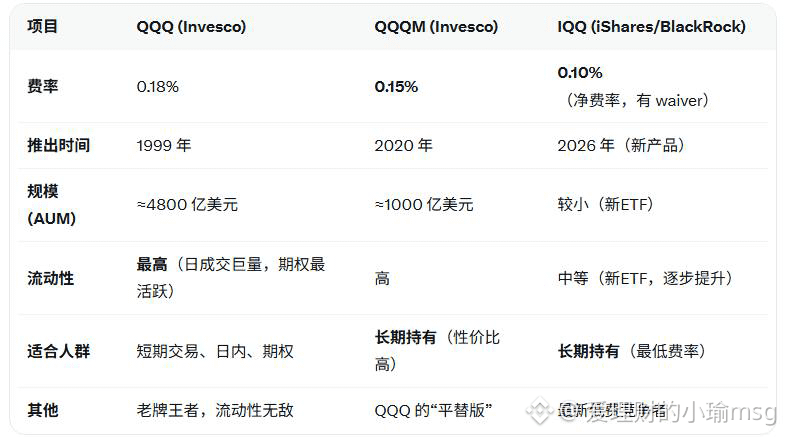
Launched in 1999, it is the oldest and largest Nasdaq 100 ETF. Its current assets under management are about $480 billion.
It has extremely strong liquidity, with huge average daily trading volume, and active options trading. It is suitable for short-term trading, intraday operations, and investors who need high liquidity. However, its fee rate is relatively higher at 0.18%.
🔹 QQQM (Invesco NASDAQ 100 ETF):
Launched in 2020, it is the “low-cost version” of QQQ, with a fee rate of 0.15% and assets of about $100 billion.
It is suitable for long-term investors. While maintaining nearly the same performance as QQQ, its lower expenses make it the mainstream choice for most ordinary investors.
🔹 IQQ (iShares Nasdaq 100 ETF):
A BlackRock product newly launched in 2026. Its current net expense ratio is only 0.10% (gross expense ratio is 0.12%, with expense waivers), making it the lowest-cost option among the three.
It aims to provide Nasdaq 100 exposure at the lowest possible cost, which suits investors who prioritize minimizing long-term fees. However, as a new ETF, its scale and liquidity currently still lag behind the first two.
IQQ is a new ETF, and its current bid-ask spread is about 0.04%~0.1% (slightly larger than QQQM). Each buy/sell transaction will incur this hidden cost.
One-sentence summary:
For flexible trading, choose QQQ; for a balance, choose QQQM; for the lowest long-term cost, choose IQQ.
Since all three track the same index, the key differences are fees, scale, and liquidity. Over the long run, products with lower fees are generally at an advantage.
QQQ, QQQM, and IQQ are all passive ETFs that track the Nasdaq-100 Index. They mainly invest in technology giants such as Apple, Microsoft, and Nvidia, making them typical high-growth tech sector products.
🔹 QQQ (Invesco QQQ Trust):
Launched in 1999, it is the oldest and largest Nasdaq 100 ETF. Its current assets under management are about $480 billion.
It has extremely strong liquidity, with huge average daily trading volume, and active options trading. It is suitable for short-term trading, intraday operations, and investors who need high liquidity. However, its fee rate is relatively higher at 0.18%.
🔹 QQQM (Invesco NASDAQ 100 ETF):
Launched in 2020, it is the “low-cost version” of QQQ, with a fee rate of 0.15% and assets of about $100 billion.
It is suitable for long-term investors. While maintaining nearly the same performance as QQQ, its lower expenses make it the mainstream choice for most ordinary investors.
🔹 IQQ (iShares Nasdaq 100 ETF):
A BlackRock product newly launched in 2026. Its current net expense ratio is only 0.10% (gross expense ratio is 0.12%, with expense waivers), making it the lowest-cost option among the three.
It aims to provide Nasdaq 100 exposure at the lowest possible cost, which suits investors who prioritize minimizing long-term fees. However, as a new ETF, its scale and liquidity currently still lag behind the first two.
IQQ is a new ETF, and its current bid-ask spread is about 0.04%~0.1% (slightly larger than QQQM). Each buy/sell transaction will incur this hidden cost.
One-sentence summary:
For flexible trading, choose QQQ; for a balance, choose QQQM; for the lowest long-term cost, choose IQQ.
Since all three track the same index, the key differences are fees, scale, and liquidity. Over the long run, products with lower fees are generally at an advantage.