“Can’t step on the accelerator for the pivot”
The burden of the legacy business is too heavy. In the era of internal-combustion vehicles, German and Japanese automakers built a complete system of self-interest—from engine and transmission patents to the supply chain, dealers, and unions. Every additional EV sold means one fewer high-profit ICE vehicle sold, directly taking away from the existing “pie” across the company and its upstream and downstream partners. Internal resistance and the pains of transformation are far greater than for China’s new power brands starting from scratch, so their pace has generally been slower, and even strategic reversals have occurred.
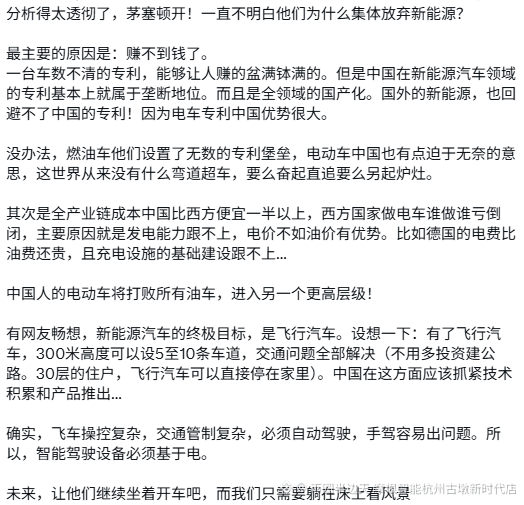
Is making EVs really unprofitable? And can’t China’s companies do better? China benefits from full-industry-chain scale effects, allowing the end-to-end vehicle cost of pure-electric models in the same segment to be 30%–50% lower than that of European automakers. Western automakers either price EVs high and can’t sell them, or cut prices and suffer huge losses. For example, Ford’s EV business has posted losses for many consecutive years totaling tens of billions of dollars. Volkswagen’s EV business profitability is also far inferior to its ICE segment. It’s not that they don’t want to make EVs—they do, but once they do, they can’t beat China’s brands and they also drag down overall profit.
Patents are a barrier, but not an “absolute monopoly.” China’s patent application volume and industrial maturity in areas such as traction batteries, motors, in-vehicle control electronics, high-voltage platforms, and charging piles are indeed globally leading. Especially for practical technologies like LFP and CTP/CTC battery formats, an industrial barrier has formed: “It’s cheaper to adopt China’s solutions than to develop in-house.” However, overseas still has technical reserves in some areas—such as automotive-grade chips, high-end power semiconductors, and certain chassis control algorithms—so it’s not completely impossible to work around China’s patents. More often, what happens is that “once you get around them, you completely lose the cost advantage.”
The burden of the legacy business is too heavy. In the era of internal-combustion vehicles, German and Japanese automakers built a complete system of self-interest—from engine and transmission patents to the supply chain, dealers, and unions. Every additional EV sold means one fewer high-profit ICE vehicle sold, directly taking away from the existing “pie” across the company and its upstream and downstream partners. Internal resistance and the pains of transformation are far greater than for China’s new power brands starting from scratch, so their pace has generally been slower, and even strategic reversals have occurred.
Is making EVs really unprofitable? And can’t China’s companies do better? China benefits from full-industry-chain scale effects, allowing the end-to-end vehicle cost of pure-electric models in the same segment to be 30%–50% lower than that of European automakers. Western automakers either price EVs high and can’t sell them, or cut prices and suffer huge losses. For example, Ford’s EV business has posted losses for many consecutive years totaling tens of billions of dollars. Volkswagen’s EV business profitability is also far inferior to its ICE segment. It’s not that they don’t want to make EVs—they do, but once they do, they can’t beat China’s brands and they also drag down overall profit.
Patents are a barrier, but not an “absolute monopoly.” China’s patent application volume and industrial maturity in areas such as traction batteries, motors, in-vehicle control electronics, high-voltage platforms, and charging piles are indeed globally leading. Especially for practical technologies like LFP and CTP/CTC battery formats, an industrial barrier has formed: “It’s cheaper to adopt China’s solutions than to develop in-house.” However, overseas still has technical reserves in some areas—such as automotive-grade chips, high-end power semiconductors, and certain chassis control algorithms—so it’s not completely impossible to work around China’s patents. More often, what happens is that “once you get around them, you completely lose the cost advantage.”