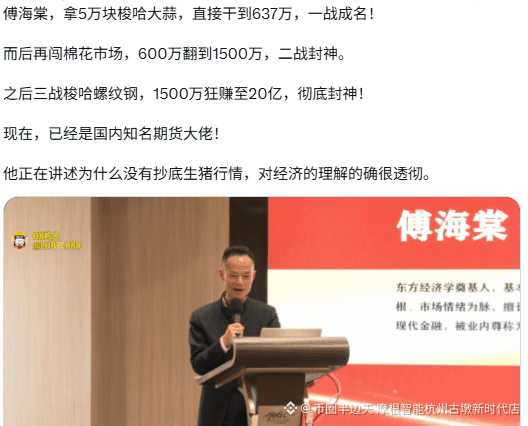
Fu Haitang is not in a hurry to bottom-fish in live hogs. The key is to strictly follow his long-standing “supply-demand resonance” bottom-fishing standards—not merely to watch the price fall. Behind it is his straightforward understanding of economic laws:
Meeting only the single condition of “low-price losses” is not enough to create resonance. His bottom-fishing requires multi-condition resonance: “low price + low inventories + deep losses across the entire industry + improving demand + high price premiums (i.e., a large positive basis/discount-to-market gap).” During this round of live hog price declines, although prices remain sluggish and livestock-raising companies are losing money, social inventories are still at a high level, and capacity reduction has not been thorough. The magnitude of earlier losses was not enough to force large-scale culling of breeding sows. The industry has not truly reached the level of “nobody wants to keep doing it” liquidation.
Capacity liquidation is delayed: it hurts first before real de-capacity happens. He has been clear that policy calls to cut capacity have had no practical effect; only when market losses truly make industry participants feel the pain will breeding farmers proactively cull sows and exit the sector. In this round, the initial loss severity was limited, capacity was not genuinely cleared, and the oversupply situation has not fundamentally changed—so the time to bottom-fish has not arrived.
The trend is something you wait for, not something you create. This is the investment principle that runs through his entire approach: do not trade frequently—just wait for the certain, extreme, favorable行情. When supply-demand conflicts have not been thoroughly intensified and bottom signals have not all appeared, he would rather stay in cash and wait than enter early, to avoid enduring long drawdowns while the market is still halfway to the bottom.
III. His core investment logic
Fu Haitang’s “all-in” style of trading looks aggressive, but in essence it is contrarian investing based on the industry’s fundamentals. The core logic is very simple:
“Way of Heaven” thinking: if commodity prices remain below the cost of the entire industry for the long term, they will definitely rise back; otherwise that commodity will be “extinct”—an objective law that cannot be violated. Conversely, if prices rise so high that the entire industry is crazily expanding capacity, they will also inevitably fall.
Field research is king: he doesn’t trust paper data or hearsay in the market. He personally goes to production areas, asks farmers, and calculates costs to judge the real supply-demand situation.
Trade only extreme conditions: he doesn’t participate in range-bound, oscillating markets. He acts only when the whole industry is extremely pessimistic or extremely euphoric—capturing the turning point where extremes reverse (物极必反).
Meeting only the single condition of “low-price losses” is not enough to create resonance. His bottom-fishing requires multi-condition resonance: “low price + low inventories + deep losses across the entire industry + improving demand + high price premiums (i.e., a large positive basis/discount-to-market gap).” During this round of live hog price declines, although prices remain sluggish and livestock-raising companies are losing money, social inventories are still at a high level, and capacity reduction has not been thorough. The magnitude of earlier losses was not enough to force large-scale culling of breeding sows. The industry has not truly reached the level of “nobody wants to keep doing it” liquidation.
Capacity liquidation is delayed: it hurts first before real de-capacity happens. He has been clear that policy calls to cut capacity have had no practical effect; only when market losses truly make industry participants feel the pain will breeding farmers proactively cull sows and exit the sector. In this round, the initial loss severity was limited, capacity was not genuinely cleared, and the oversupply situation has not fundamentally changed—so the time to bottom-fish has not arrived.
The trend is something you wait for, not something you create. This is the investment principle that runs through his entire approach: do not trade frequently—just wait for the certain, extreme, favorable行情. When supply-demand conflicts have not been thoroughly intensified and bottom signals have not all appeared, he would rather stay in cash and wait than enter early, to avoid enduring long drawdowns while the market is still halfway to the bottom.
III. His core investment logic
Fu Haitang’s “all-in” style of trading looks aggressive, but in essence it is contrarian investing based on the industry’s fundamentals. The core logic is very simple:
“Way of Heaven” thinking: if commodity prices remain below the cost of the entire industry for the long term, they will definitely rise back; otherwise that commodity will be “extinct”—an objective law that cannot be violated. Conversely, if prices rise so high that the entire industry is crazily expanding capacity, they will also inevitably fall.
Field research is king: he doesn’t trust paper data or hearsay in the market. He personally goes to production areas, asks farmers, and calculates costs to judge the real supply-demand situation.
Trade only extreme conditions: he doesn’t participate in range-bound, oscillating markets. He acts only when the whole industry is extremely pessimistic or extremely euphoric—capturing the turning point where extremes reverse (物极必反).