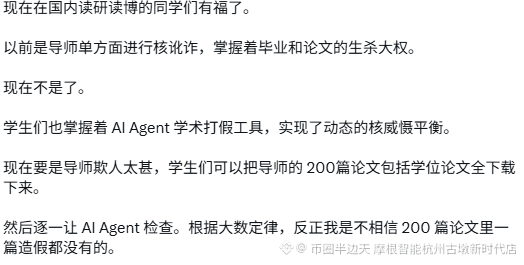
Asymmetric deterrence. The premise for MAD is that both sides can withstand a first strike and carry out retaliation. This is not the case for students: reporting an advisor is usually not anonymous (who is supervising you, who can obtain that batch of data—once the circle is checked, it’s obvious). Also, the time scale for punishment is completely different: delays, signature blocks, and cutting off recommendation letters are enforced immediately, while investigations into academic misconduct are measured in years—and they often end with nothing. And on top of that, the advisor also has the “gun” of AI plagiarism detection; for them, the cost of checking students is lower and the consequences are more direct. This is more like one side having a nuclear weapon but lacking second-strike capability.
I think the real positive value of this is preemptive deterrence. When “all my old papers might be checked line by line at any time” becomes a consensus, it will indeed, at the margin, make people write more cleanly. But that benefit is diffuse and long-term, whereas the cost of “reporting an enemy” is specific and paid immediately.
The imbalance of power between teachers and students, and the persistence of academic misconduct despite repeated bans, stem from institutional problems: unclear boundaries between advisors’ rights and responsibilities; inconvenient student appeal channels; opaque academic misconduct enforcement procedures; and missing regulations on retaining original data.
Relying on AI tools to achieve a “balanced mutual threat” is only a short-term game of bargaining brought by technology; it cannot fundamentally solve the problem. A truly healthy ecosystem requires clear institutional constraints, accessible legitimate channels for rights protection, and unified standards for academic integrity—so that supervision has rules, power has boundaries, and appeals have a path, rather than escalating into a situation where everyone fears and turns on everyone else.
In the past, students facing an advisor’s academic misconduct or abuse of power often chose to endure it because of insufficient information capability and high costs of filing complaints. AI tools lower the threshold for collecting evidence; they can help constrain advisors’ academic conduct, and force the relationship between teachers and students back toward equality. They have some positive deterrent effect, and they also provide technical support for legitimate academic supervision.
Describing the teacher-student relationship as a confrontation of “nuclear extortion - nuclear deterrence” is a distorted view of the game. Normal graduate training should be based on collaboration between mentor and mentee and the transmission of scholarship. If both sides hold weapons to “ruin the other’s academic career” and remain on guard against each other, the end result can only be to destroy trust in research: advisors will not dare to guide freely, and students will not dare to communicate honestly—ultimately harming proper academic training.
I think the real positive value of this is preemptive deterrence. When “all my old papers might be checked line by line at any time” becomes a consensus, it will indeed, at the margin, make people write more cleanly. But that benefit is diffuse and long-term, whereas the cost of “reporting an enemy” is specific and paid immediately.
The imbalance of power between teachers and students, and the persistence of academic misconduct despite repeated bans, stem from institutional problems: unclear boundaries between advisors’ rights and responsibilities; inconvenient student appeal channels; opaque academic misconduct enforcement procedures; and missing regulations on retaining original data.
Relying on AI tools to achieve a “balanced mutual threat” is only a short-term game of bargaining brought by technology; it cannot fundamentally solve the problem. A truly healthy ecosystem requires clear institutional constraints, accessible legitimate channels for rights protection, and unified standards for academic integrity—so that supervision has rules, power has boundaries, and appeals have a path, rather than escalating into a situation where everyone fears and turns on everyone else.
In the past, students facing an advisor’s academic misconduct or abuse of power often chose to endure it because of insufficient information capability and high costs of filing complaints. AI tools lower the threshold for collecting evidence; they can help constrain advisors’ academic conduct, and force the relationship between teachers and students back toward equality. They have some positive deterrent effect, and they also provide technical support for legitimate academic supervision.
Describing the teacher-student relationship as a confrontation of “nuclear extortion - nuclear deterrence” is a distorted view of the game. Normal graduate training should be based on collaboration between mentor and mentee and the transmission of scholarship. If both sides hold weapons to “ruin the other’s academic career” and remain on guard against each other, the end result can only be to destroy trust in research: advisors will not dare to guide freely, and students will not dare to communicate honestly—ultimately harming proper academic training.