

Original title: (Liang Wenfeng was unhappy about the leak of closed-door meeting contents and halted DeepSeek’s second round of fundraising)
Original author: Insight Beating
On July 25, citing people familiar with the matter, Bloomberg reported that DeepSeek has already paused its ongoing efforts to complete the second round of fundraising and has orally informed some prospective investors that the company will not sign the investment agreements as previously expected.
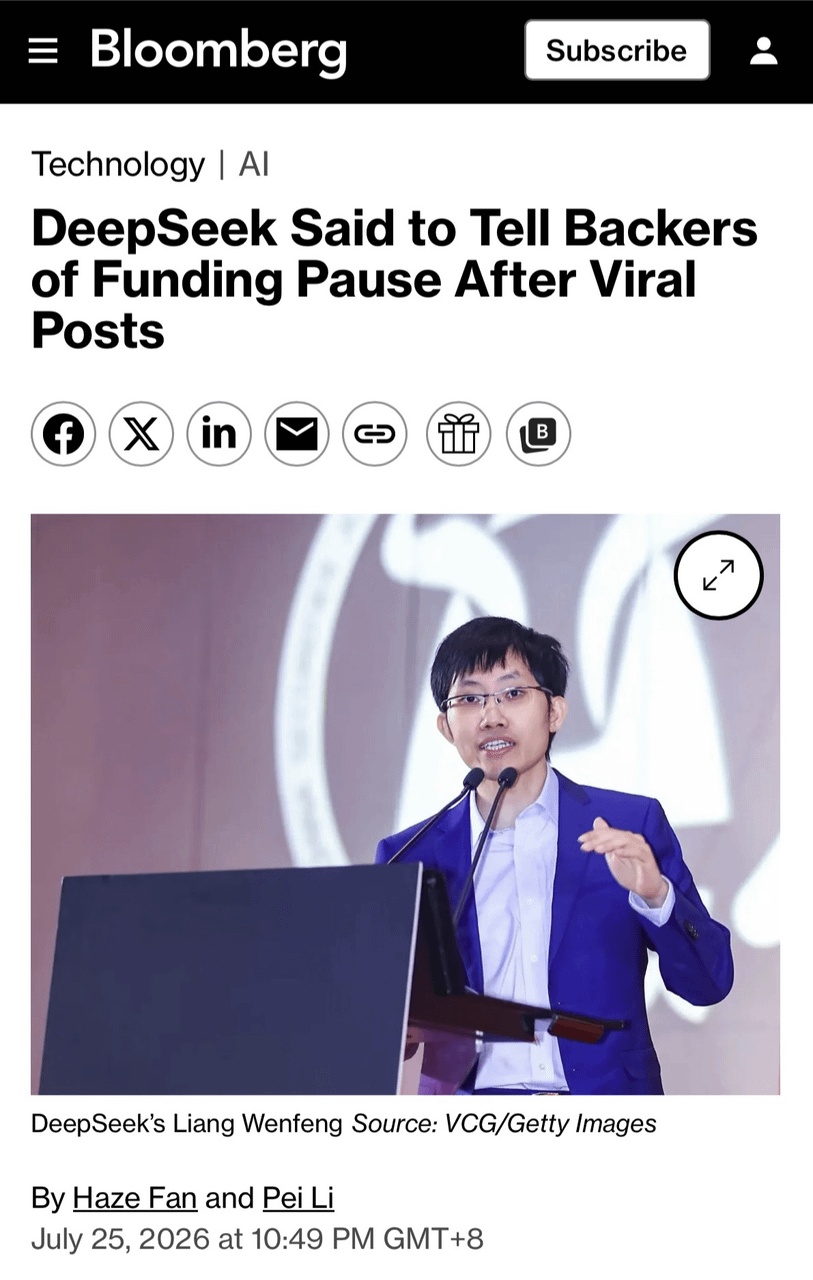
The pause partly stems from Founder Liang Wenfeng’s frustration after the contents of a closed-door meeting were leaked. The meeting took place during the first round of fundraising. Liang Wenfeng spoke to potential investors for nearly four hours, covering topics including commercialization, the model roadmap, compute capacity reserves, domestic chips, and future revenue. Two months later, a transcript of a recording—thousands of words long—began circulating online.
According to information disclosed by Bloomberg, this round of financing is merely paused and has not been fully canceled. Negotiations may restart in the future. The onshore IPO that DeepSeek is preparing has also not been halted; the fastest timeline could see the company submit its listing application this year.
In June this year, DeepSeek completed its first external financing since its founding, according to multiple media reports. The amount was about 50 billion yuan, and the post-money valuation was about 350 to 400 billion yuan.
Right after the first round wrapped up, the company started contacting investors in mid-July and was planning the second round. Citing another group of people familiar with the matter, Reuters on July 15 reported that the company hoped to raise funds at a valuation of about 500 billion yuan, with a potential maximum scale reaching 50 billion yuan.
According to reports, some institutions had expected that they would be entering the signing stage soon.
This round of financing is widely believed to be directly related to an expansion of compute capacity and IPO plans. Bloomberg previously reported that DeepSeek has begun approaching financial and banking advisors. The internal goal is to submit an application as early as possible this year and complete the listing in 2027. If the second round lands, it can not only supplement funding before the IPO, but also establish a higher valuation benchmark.
The leaked documents
The meeting took place on May 20. It lasted about 3 hours and 44 minutes in total. The first half featured Liang Wengfeng introducing the business philosophy, open-source logic, and the AGI roadmap, while the second half was investors’ Q&A.
From July 22 to 23, this material began circulating in China’s tech and investment circles. It was then widely forwarded by many media outlets, self-media accounts, and overseas communities. According to verification by media with the institutions that invested in DeepSeek, the closed-door meeting indeed took place in May, and the overall content is believable and credible.
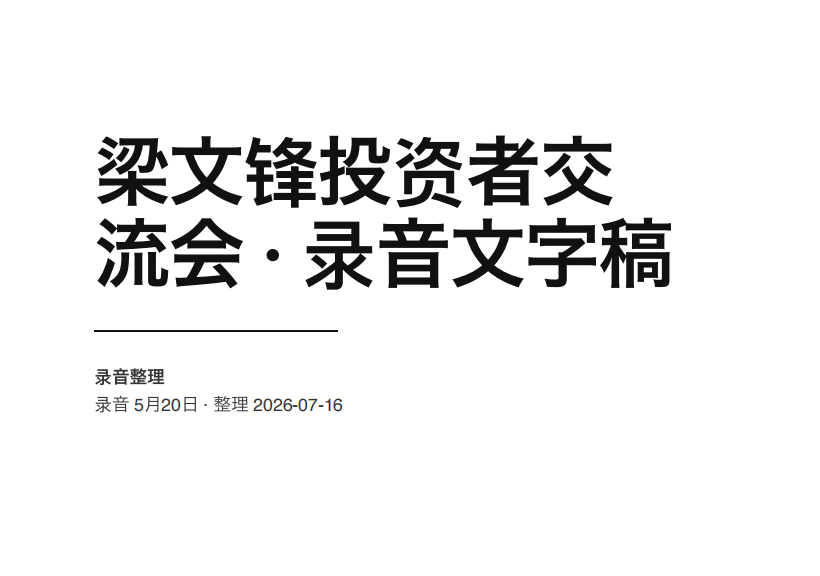
Before Liang Wengfeng finished his main remarks and the meeting moved into open Q&A, the host specifically reminded attendees: “Liang Wengfeng shared a lot of information that is relatively sensitive. Please do not circulate any numbers or situations externally, including things like the number of cards. Also, please do not record screens for sharing externally.”
Two months later, nearly the entire content of what had been singled out and asked not to be circulated appeared on the internet.
What did the meeting discuss?
The transcript spread so fast for two reasons: on the one hand, Liang Wengfeng rarely talks publicly about DeepSeek for long periods; on the other hand, the meeting included a large amount of company information that had not been disclosed previously.
Liang Wengfeng still puts AGI at the very front of the company’s goals. He believes that C-end users, B-end business, and commercial revenue are only stage-by-stage products along the path to AGI. The company currently does not plan to arrange products and research directions around short-term profits.
He summarizes AI development as a set of rising steps: first language models, then the thinking chain, then Agents. The next most important issue is continuous learning. DeepSeek hopes that the next-generation model will not only be used by external users, but will also first help its own researchers develop the next-generation model. At this stage, the company places greater emphasis on general Agents and Coding Agents, while its prioritization of vertical Agents such as in finance and healthcare is relatively low.
Compute power and chips—these are the most sensitive parts. The transcript says the main difference between AI companies in China and the U.S. is not talent but resources. Liang Wengfeng estimates that the compute power DeepSeek used in the past might be only one-twentieth of that of its U.S. peers, so there is an overall time gap of about 12 to 18 months in the model. The future goal is to shorten that to 3 to 6 months and surpass competitors in some directions. The material also mentions the equivalent compute power DeepSeek has, the scale of chips needed for future models, the number of chips provided by Huawei, and the performance conversion between Huawei cards and NVIDIA cards. These figures were cited repeatedly during the spread, but there are no publicly available procurement contracts, and neither DeepSeek nor Huawei has made any formal confirmation.
As for the team, he said the company can be restrained on many interests, but the stability of the core team cannot be compromised. The financing completed recently has given employees’ stock options a real valuation, greatly alleviating the risk of talent loss.
Judging from the leaked content, what was leaked was not DeepSeek’s scandals—it was instead a fairly positive piece of publicity. Moreover, judgments such as the insistence on open-sourcing, prioritizing research on AGI, and emphasizing model efficiency have all appeared in his past public interviews.
The issue is that this was a closed-door investor meeting with explicit confidentiality requirements. Besides concepts and judgments, the meeting also covered compute capacity reserves, chip supply, model scale, revenue forecasts, and the intended use of the financing. Such information is not only related to DeepSeek itself, but could also involve suppliers, investment institutions, and commercial terms under negotiation.
For a company that is about to undergo its second round of financing and prepare to enter the public market, confidentiality capability itself is part of investors’ due diligence. The full contents of a closed-door meeting can spread widely two months later. The company would therefore have to re-evaluate the attendee list, communication methods, and the boundaries of information disclosure.
Why was there confidence to pause financing?
An important background to the pause in the second round right before signing is that DeepSeek currently has no cash pressure.
Before this year, DeepSeek had long not conducted external equity financing. The company was incubated out of Hanfang Quant’s AI research system in 2023. Early R&D spending mainly came from Hanfang’s operating revenue and R&D budget. Starting in April this year, news about financing began to circulate in the market; the valuation and scale rose rapidly within weeks. In June, the first round was completed, making it one of the largest single rounds of financing in China’s AI industry.
According to a Reuters report, Liang Wengfeng personally invested about 20 billion yuan in this round, making him the largest single investor. Tencent invested about 10 billion yuan, CATL about 5 billion yuan. Other participating institutions include NetEase, JD.com, IDG, and China’s National Industry Investment Fund for Artificial Intelligence.
The equity structure shown after the completion of the financing indicates that Ningbo Cheng’en Enterprise Management Consulting Partnership holds about 60.19% of the operating entity; Liang Wengfeng directly holds about 31.01%; the Hangzhou Chengli platform where external investors are located holds about 8.52%; and the national AI industry investment fund directly holds about 0.28%. After domestic media penetrated multiple layers of partnership arrangements and made estimates, the equity controlled directly and indirectly by Liang Wengfeng is about 84.29%. This figure is closer to the control-rights definition and should not be understood as his personal direct shareholding of 84.29%.
According to reports by The Information and other media, most business investors enter through limited partnership platforms, face a five-year lock-up period, and do not have voting rights in the operating company. The national AI industry investment fund, however, directly holds shares and retains voting rights.
In other words, after external capital comes in, Liang Wengfeng still holds the main decision-making power. With the company having just completed roughly 50 billion yuan in financing, pausing the second round will not immediately affect the company’s operations.
Hanfang Quant is often seen as another major source of confidence for him. In 2025, the funds under this firm are expected to have an average return rate of about 56.6%. Among large domestic quant firms with assets under management exceeding 10 billion yuan, it ranks second. Its current assets under management are over 70 billion yuan. What Hanfang can provide mainly includes management fees, performance compensation, shareholder profits, and other lawful R&D investments. What directly demonstrates Liang Wengfeng’s financial strength is the 20 billion yuan he put up in the first round of financing.
Not enough money
DeepSeek’s current flagship model is a V4 preview version released in April this year. The plan was to roll out the official version in mid-July, with two editions: Pro and Flash. V4-Pro has a total of 1.6 trillion parameters, activating 49 billion parameters per Token. V4-Flash has about 284 billion total parameters, activating 13 billion parameters. Both versions support a 1 million Token context window and have opened up the model weights.
As competition moves from chat and reasoning to Agents, continuous learning, and large-scale model training, the company needs to invest more in chips, data centers, high-quality data, and engineering talent. While the first-round scale of about 50 billion yuan is considerable, compared with capital investment by top U.S. AI companies there is still a clear gap. This is also why the second round was launched quickly right after the first landed.
As of the time of publication, DeepSeek has not publicly responded to the pause in its second round of financing, nor has it provided any statement regarding the authenticity of the leaked transcripts, how they spread, or the sensitive figures contained in them.
Original link