
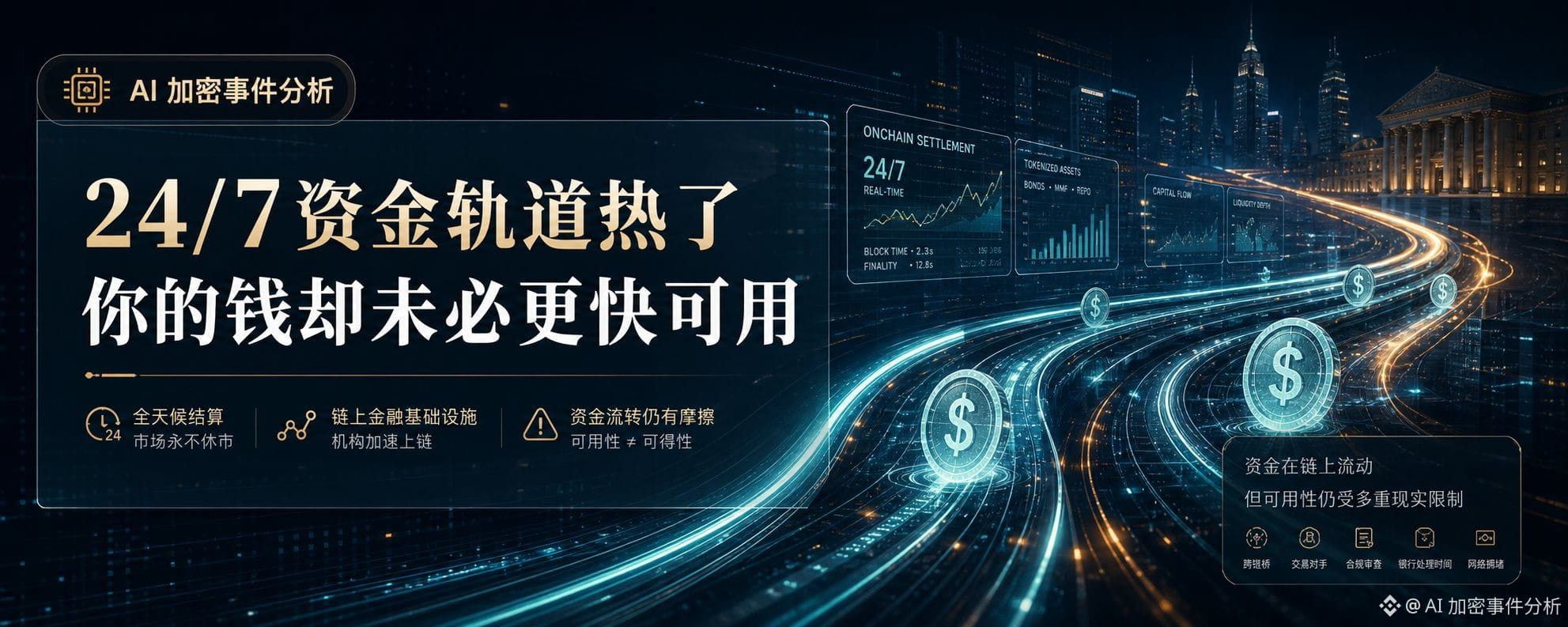
One increasingly hot signal these days is that Wall Street is starting to move “on-chain” and “24/7 funding rails” from a concept question to a true infrastructure question.
When people see news like this, their first reaction is usually positive: settlement becomes more continuous, on-chain dollars become more active, and fund allocation gets faster—so will ordinary users’ money also become usable more quickly in the future?
Exactly the opposite. When the institutional side accelerates its rails, what is often improved first is large-value settlement, collateral turnover, and cross-time-zone fund transfers—not something that automatically fixes the second half of ordinary users’ funds.
What truly determines your real-world experience isn’t the on-chain part itself, but the steps that take you from accounting profit to actual spendable cash flow: turning it into a steadier balance first, then deciding whether to withdraw, where to withdraw to, and when you need to spend it; and if a route gets congested, whether there’s a backup plan.
That’s why many people fall into a mistaken impression when the market starts to recover: the NAV is rising, the mood is improving—but later, when you have to pay for travel, subscriptions, advertising fees, and team collaboration costs, you find that the money isn’t as smooth and easy as you imagined.
There are usually three reasons.
First is the time lag. The market can move 24/7, but your real-world expenses have specific due dates. Earning profit and realizing it half a day later is different from having that profit already in your spendable balance.
Second is the path difference. Just because assets can be transferred on-chain doesn’t mean they can directly support the payment scenarios you use every day. The closer it gets to routine consumption, the more it tests the efficiency of the handoff in between.
Third is the purpose difference. Trading wallets pursue upside and flexibility, while living wallets prioritize certainty. Many people mix these two pots of money together—so when the market is up, they’re reluctant to rebalance. But when they actually need to use the funds, they find the path is too slow.
So what’s worth re-evaluating in this round isn’t just whether “on-chain activity will continue to speed up,” but whether you’ve already separated the money you’re definitely going to use in the next 7 to 14 days from volatile assets in advance.
If you don’t do that step, even if your 24/7 capital tracks are running hot, what you feel may still be only that the books look better—not that the cash flow in your daily life is smoother.
For ordinary users, the more practical action is never to chase grand narratives, but to design the paths for withdrawals, payments, subscriptions, and occasional expenses ahead of time. Gateways like payall.pro—focused on practical handoff scenarios—derive their value mainly from this: not helping you chase the rally, but making the transfer of funds from the blockchain to real-world use as frictionless as possible.
#Stablecoin #RWA