


Source: Hua Li Hua Wai
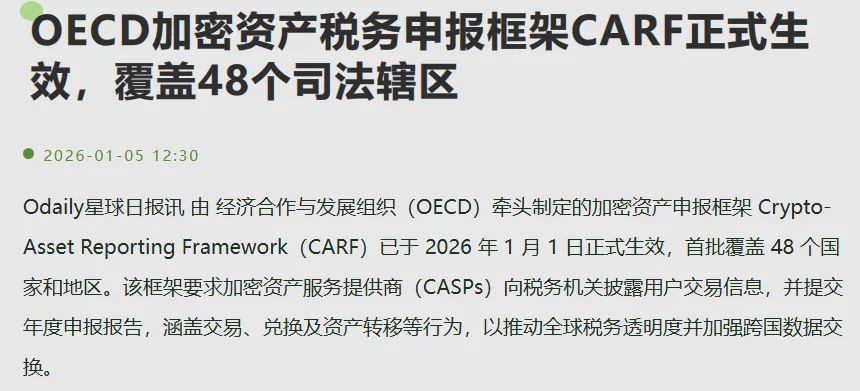
These past few days, I've seen some discussions in the group about CRS. The general idea is that, according to recent reports from certain crypto media websites, starting January 1, 2026, exchanges like Binance will send users' cryptocurrency transaction data to the tax authorities in the users' tax residence jurisdictions, so that tax authorities can carry out corresponding tax collection procedures.
This has led to several questions that many people might be concerned about:
- What exactly is CRS regarding cryptocurrencies?
- Which countries or regions will be included in the tax scope starting this year?
- Will this have any impact on users in mainland China?
- Can this be avoided by directly withdrawing crypto assets to an on-chain wallet?
To better answer the questions above, let's discuss them separately below:
1. What exactly is a CRS for cryptocurrencies?
Those who have frequently traded US stocks in the past two years (especially those who have made profits) should already be familiar with CRS. Taking our side (mainland China) as an example, since last year, many people have been sharing their experiences of paying back taxes online. Due to some unspeakable reasons, China has started to use CRS information to conduct overseas tax audits in the past two years. Many people who have made money in US stocks have probably experienced wave after wave of reminders from tax authorities via text messages and phone calls.
The so-called CRS (Common Reporting Standard) is a global standard for the automatic exchange of tax information developed by the OECD. Its main purpose is to combat cross-border tax evasion. Financial institutions (such as exchanges) are required to collect customer information as required and report it to their national tax authorities on a regular basis. The tax authorities then automatically exchange information among participating countries.
However, the original CRS did not include transaction data for crypto assets. Therefore, traditional CRS regulations did not require cryptocurrency exchanges (such as Binance) to proactively report users' crypto transaction data before 2025. With the development of the crypto market, the OECD has now launched what is known as CRS 2.0, a revision of the original CRS that includes electronic money, CBDCs, and cryptocurrency-related assets in the reporting scope. In some jurisdictions, it has already been announced that the transition to CRS 2.0 data collection and reporting requirements will begin on January 1, 2026.
The specific regulations for cryptocurrencies are governed by CARF (Crypto-Asset Reporting Framework), a global framework for the automatic exchange of tax information specifically for crypto asset transactions, supplementing the crypto portion of CRS. CARF also officially came into effect in its first batch of countries on January 1, 2026, with plans for the first automatic international exchange of information in 2027.
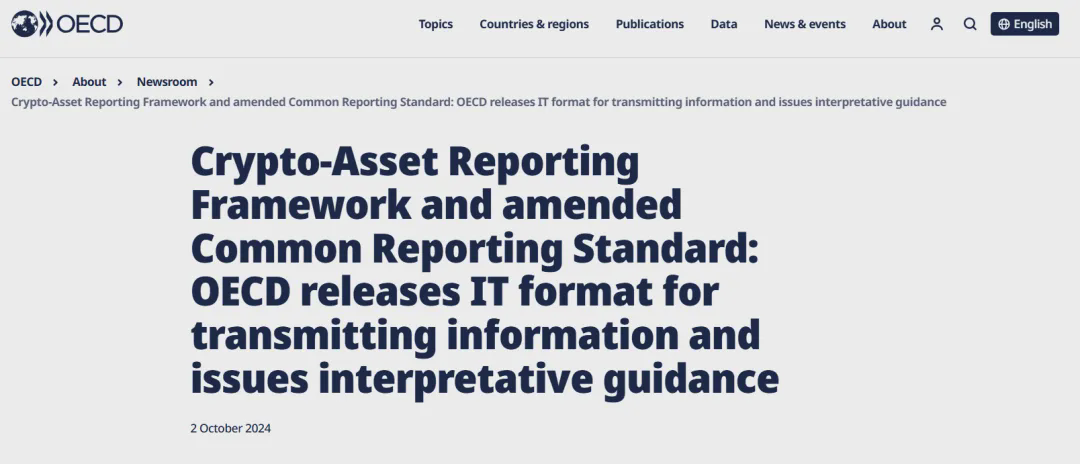
Actually, CRS 2.0 and CARF are not new issues. I remember people discussing them online (on social media) last year. It's just that recently, Chinese encrypted media websites have suddenly started reposting and reporting on them, bringing the issue back into the spotlight. For example, the OECD website already published information about CARF last year (October 2024), as shown in the image below.
To explain this more simply, you can understand it like this:
Prior to 2025, traditional CRS did not require centralized platforms such as crypto exchanges (such as Binance) to report users' crypto transaction details (because there was no specific requirement in the old version of CRS).
Starting in 2026 (inclusive), with the implementation of CRS 2.0 / CARF and other related regulations and their adoption by some countries, exchanges such as Binance may be required to report users' crypto asset transaction data to the tax authorities of the corresponding countries (but even if it is implemented immediately now, most international exchanges will not start until 2027).
2. Which countries or regions will be included in the tax collection scope starting this year?
So, some of you might be wondering: Which countries or regions will be included in the taxation scope starting this year? Will China be included?
Based on publicly available information online, 48 countries and regions worldwide (including EU member states, the UK, Japan, Canada, Brazil, and Singapore) have committed to implementing CARF starting January 1, 2026. This means that if Binance (and other cryptocurrency exchanges) is legally operating in the corresponding countries and regions, and you happen to be a registered resident of those regions, then theoretically, Binance will be required to implement relevant regulations to "record" your data and report it as needed (including transaction data, account balance, and identity information).
However, taxes are collected based on annual revenue. As mentioned above, even if CARF were implemented immediately, the formal information exchange would not begin until 2027. In other words, the tax authorities in these countries/regions may conduct their first automatic information exchange in 2027 (data collected in 2026 will be sent to the tax authorities of the tax residence in these countries/regions in 2027).
According to data released by the OECD, 75 jurisdictions have politically committed to joining CARF. However, only 48 jurisdictions plan to join the first batch of exchanges in 2027, while the remaining jurisdictions plan to join in 2028. (See the diagram below.)

For example, the UK has already implemented CARF, which took effect in January 2026. The US plans to join CARF in 2028 and begin data exchange in 2029.
3. Will this have any impact on users in mainland China?
Regarding the implementation of CARF in China, we may need to examine it separately:
First, let's talk about Hong Kong.
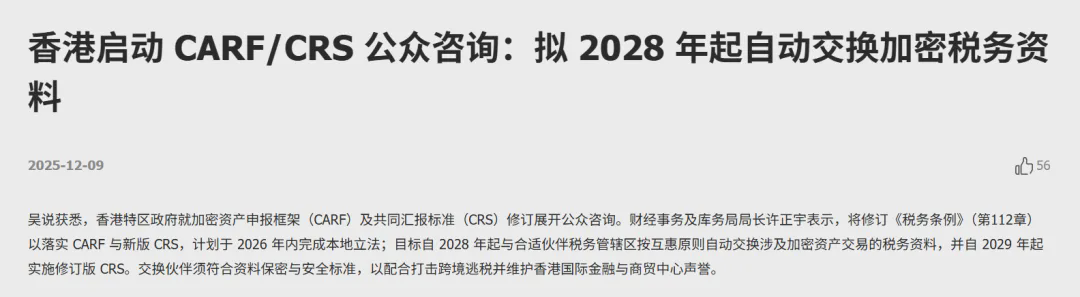
According to relevant reports, on December 9, 2025, Hong Kong announced through a government gazette that the authorities were conducting public consultation on the implementation of the Crypto-Asset Reporting Framework (CARF) and related revisions to the Common Reporting Standard (CRS). The goal is to automatically exchange tax-related information on crypto-asset transactions with relevant partner tax jurisdictions from 2028, and to implement the revised CRS rules from 2029.
Secondly, there's the mainland side.
Although China completed its first CRS information exchange in September 2018, and since last year, the mainland has been using CRS information to conduct wave after wave of tax audits on overseas income, cryptocurrencies have never actually been officially legalized under the mainland's legal framework.
First, mainland China is not currently on the CARF list, nor has it incorporated CARF into its domestic legal system. Therefore, strictly speaking, mainland China's tax authorities "will not" accept transaction data from cryptocurrency exchange users based on CARF rules.
Secondly, exchanges including Binance do not provide services based in mainland China. Binance's announcement also clearly states that it does not provide related services to mainland users (this is the official statement, but you should know the details). In other words, cryptocurrency exchanges are illegal and unrecognized in mainland China. Given this, the tax authorities will not "actively" seek out exchanges they do not recognize and demand that they hand over data.
Third, mainland China does not recognize the legality of cryptocurrencies. This means that crypto assets such as USDC and USDT are not allowed to circulate and are illegal in mainland China. Therefore, the tax authorities "will not" collect taxes on such assets. To use a perhaps imperfect analogy, we can't say that buying cabbage is prohibited and illegal, yet openly demand that those who trade cabbage through overseas channels legally pay 20% tax on their cabbage transactions!
In short, unless you're foolish enough to run around in the street with a megaphone shouting, "I have 100 Bitcoins, do I need to pay taxes?", nobody will actually know you have 100 Bitcoins. Therefore, if you are a user with a mainland Chinese identity, you can currently ignore CARF; there's no need to care about it, or rather, it's not a high priority for you right now, because you won't be within its reach in the short term (e.g., within a few years).
Of course, the above three points are only theoretically valid. History also tells us that wherever wealth flows, new solutions will always emerge.
As of January 2026, the global cryptocurrency market capitalization has exceeded $3.1 trillion. Although cryptocurrencies have always been illegal (or non-compliant) in mainland China, and legalization of cryptocurrencies in mainland China is basically impossible under the existing system (such as the foreign exchange system), we have been able to feel a very obvious trend in the past two years: tax authorities have begun to strengthen their verification of the income of mainland residents abroad.
The unique risk here is that, due to the special circumstances here, our taxation is often not defined based on whether your assets are legal. Although we define cryptocurrency itself as illegal, meaning we won't tax you through cryptocurrency payments, what if we rephrase it? For example, if you earn $1 million next year through overseas means (regardless of the method), then that money could be defined as overseas property income or overseas investment income, or even as "income from unknown sources" or "illegal income"... Let's leave this topic at that for now, otherwise the article might get lost again.
Someday in the future, when a pool of wealth becomes large enough, we will always have new solutions to capture high-net-worth individuals who are in the country but have their money overseas. But these are all things for the future. It's useless to worry about them now. You should first be able to keep your crypto assets in the future (without losing them all).
4. Can this be avoided by directly withdrawing crypto assets to an on-chain wallet?
First, if taxation of a certain type of asset is legal, then you shouldn't even think about tax avoidance or tax evasion, because doing so would be illegal. Second, although blockchain is decentralized, we cannot simply assume that transferring assets from an exchange to an on-chain wallet (including a cold wallet) will circumvent CRS (CARF) scrutiny.
In theory, CARF does not audit on-chain assets because it is difficult to do so. However, it is important to know that CARF directly reports to "people". In other words, as long as your crypto assets have passed through financial institutions (including exchanges, custodians, fiat currency deposit/withdrawal channels, etc.), your behavior (including the corresponding wallet address for withdrawal) has been fully recorded by the financial institutions. With records, it can be tracked. It is just a matter of whether the tax authorities need to spend time and resources to do so.
Unless your current on-chain assets (these addresses are not currently associated with centralized exchanges or other institutions, or are not associated with wallet addresses that have withdrawal records with centralized exchanges) will never be associated with any centralized institution/channel, then as long as you don't admit it, naturally no one will know that this wallet is yours.
In short, CARF has never been about technical means, but rather about long-term, systematic tax evasion. Moving your crypto assets from an exchange to the blockchain only postpones the process in time, not completely eliminates the risks.
Regulatory oversight may be delayed, but it won't be forgotten. As ordinary people, we can only follow the trend, not try to fight it. If we don't understand something, we can choose to take profits when we're ahead and plan our exit in advance. If we do understand something, we can continue to move forward discreetly, prepare a Plan B in advance, and then take it one step at a time.
5. Will 2026 be the first year of global compliance for the crypto industry?
The development of anything is multifaceted. For the future of the crypto industry, CARF is not necessarily a bad thing. Perhaps one day in the future, when we look back, 2026 will become the first year of global compliance in the crypto industry!
In fact, since last year, many users have received notices from exchanges such as Binance and OKX requiring them to provide "proof of asset origin". Every event has its signs. On the one hand, mainstream exchanges hope to further comply with regulations, and on the other hand, they are afraid that this compliance process will affect their performance, so they have been increasing their DEX and Wallet businesses.
Furthermore, since 2024, we have also witnessed the birth of some important compliance laws for the crypto space, such as the EU's MiCA and related US laws (GENIUS Act, CLARITY Act, etc.).
If we consider 2024 and 2025 as the years of concentrated legislation for the crypto industry, then 2026 will undoubtedly be the first year of global compliance for the crypto industry. Compliance is definitely a major trend for the future, and it also marks the crypto industry's transition from a "wild west" era to a "layered era."
- Comprehensive compliance layer represented by ETFs, stablecoins, etc.
- The gray area represented by DeFi and on-chain derivatives (high risk + high return)
- Anti-compliance layers that use anonymity and privacy as narratives (will continue to be marginalized by the market in the future).
Based on this major development trend, Bitcoin has now entered the compliance layer (more and more countries, including the United States, have recognized Bitcoin and included it in their national strategic reserves). It will no longer be a social experiment operating in a gray area. It will (already) become one of the most important asset classes globally. The traditional bull market logic of altcoins will also be completely changed. In the future, opportunities for mindless 100x and 1000x coins will become increasingly rare. Only altcoin projects with strong narrative capabilities, strong profit-generating models, and the ability to tell compliant stories will be able to continue to survive in the long term.
Not everyone likes compliance, but it can determine who or which projects will survive in the future. 2026, as the year of compliance, is not the end for cryptocurrencies, but rather the end of the "wild growth of cryptocurrencies." As we mentioned in our article last month (December 23, 2025): perhaps only when the current cryptocurrency industry "dies" can this industry have a better future.
Everything has its highs and lows. If you're willing to learn from the lows, they can shape your future. In investing, persistence often trumps novelty, and systematic approaches trump emotional influence. Any news or report you see might just be someone trying to manipulate your emotions. This is one reason why I consistently record and share my thoughts. When I write, I focus on understanding the underlying reasons for market fluctuations and how to better help myself and others improve their probabilities and build long-term effective trading habits. By running a public account and creating discussion groups, I can not only share my thoughts more effectively but also learn daily from others (through comments and discussions). In a sense, these groups are not just circles but also learning environments—mutual support circles built around experience sharing and long-term thinking.