


Robinhood itself started out as an internet brokerage. When it comes to on-chain U.S. stock token spot trading, Robinhood Chain sounds like it could be the “king of kings.” But once you get into the world of crypto, it’s a case of the dragon needing to coil and the tiger needing to lie down. Solana firmly holds the number-one seat in on-chain U.S. stock token spot trading, and no other chain can challenge it:
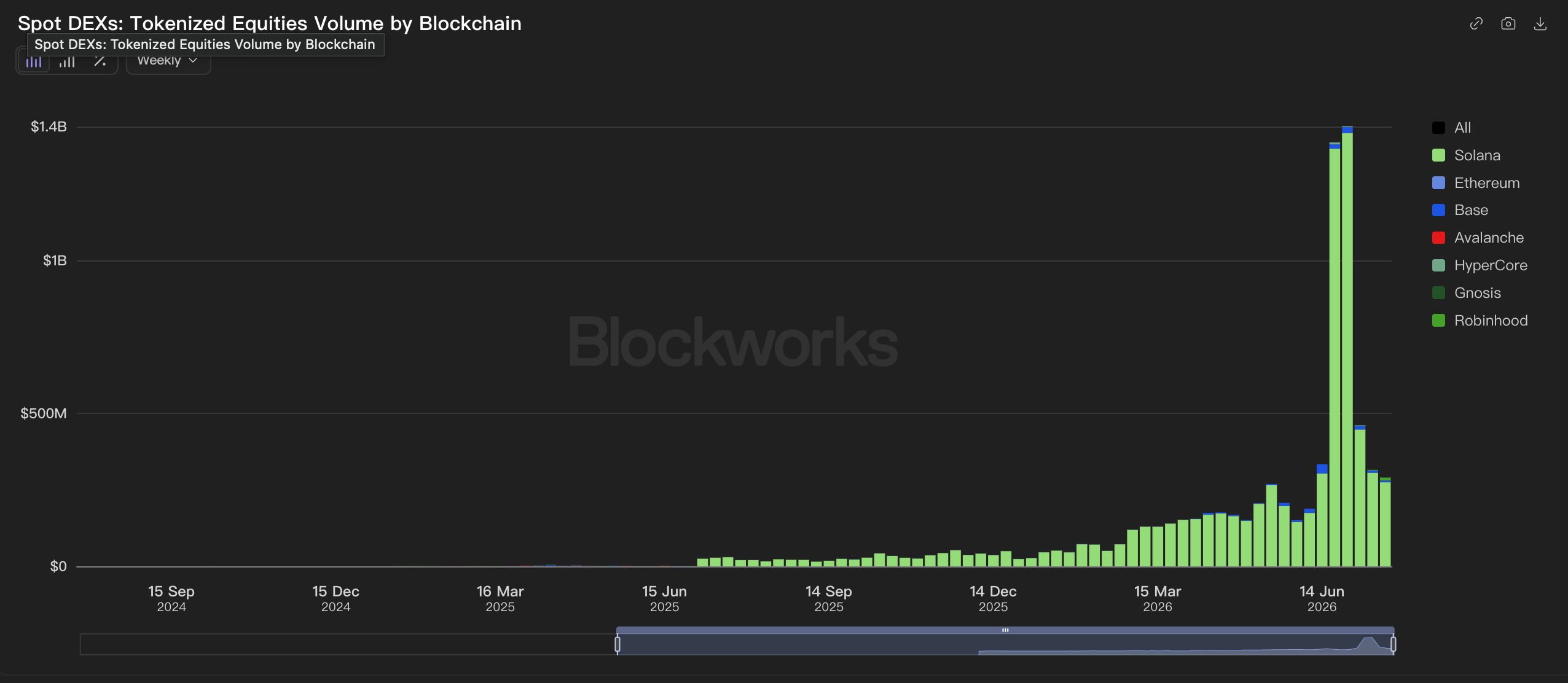
Over the past two weeks, Solana’s on-chain U.S. stock token spot trading volumes were approximately $306 million and $275 million. It not only leads all other chains by a huge margin (specifically, over the past two weeks, no other chain’s on-chain U.S. stock token spot weekly trading volume exceeded $10 million), but it also maintains a fairly clear advantage over Binance, which has long ranked first among CEXs for U.S. stock token spot trading volume. Likewise, over the past two weeks, Binance’s U.S. stock token spot trading volumes were approximately $160 million and $183 million.
That is to say, in the crypto market segment of trading tokenized US stocks, Solana’s scale is practically “a school.” And in the past two weeks, the Robinhood chain’s data were about $2.32 million and $9.41 million—compared to Solana, they’re definitely not the same tier, one after another.
But if you consider that the Robinhood chain only officially launched a little over half a month ago, and that in the past two weeks its data ranked 3rd and 2nd among all chains, then it’s not so “not the same tier.” Instead, it has the drive and momentum of a newborn calf.
So where does the tokenized US stock trading volume on the Robinhood chain come from? Meme coins.
That’s right—meme coins are driving US stock trading on the Robinhood chain, and this very well could be the next big opportunity on the Robinhood chain.
On the Robinhood chain, meme coins saved US stocks.
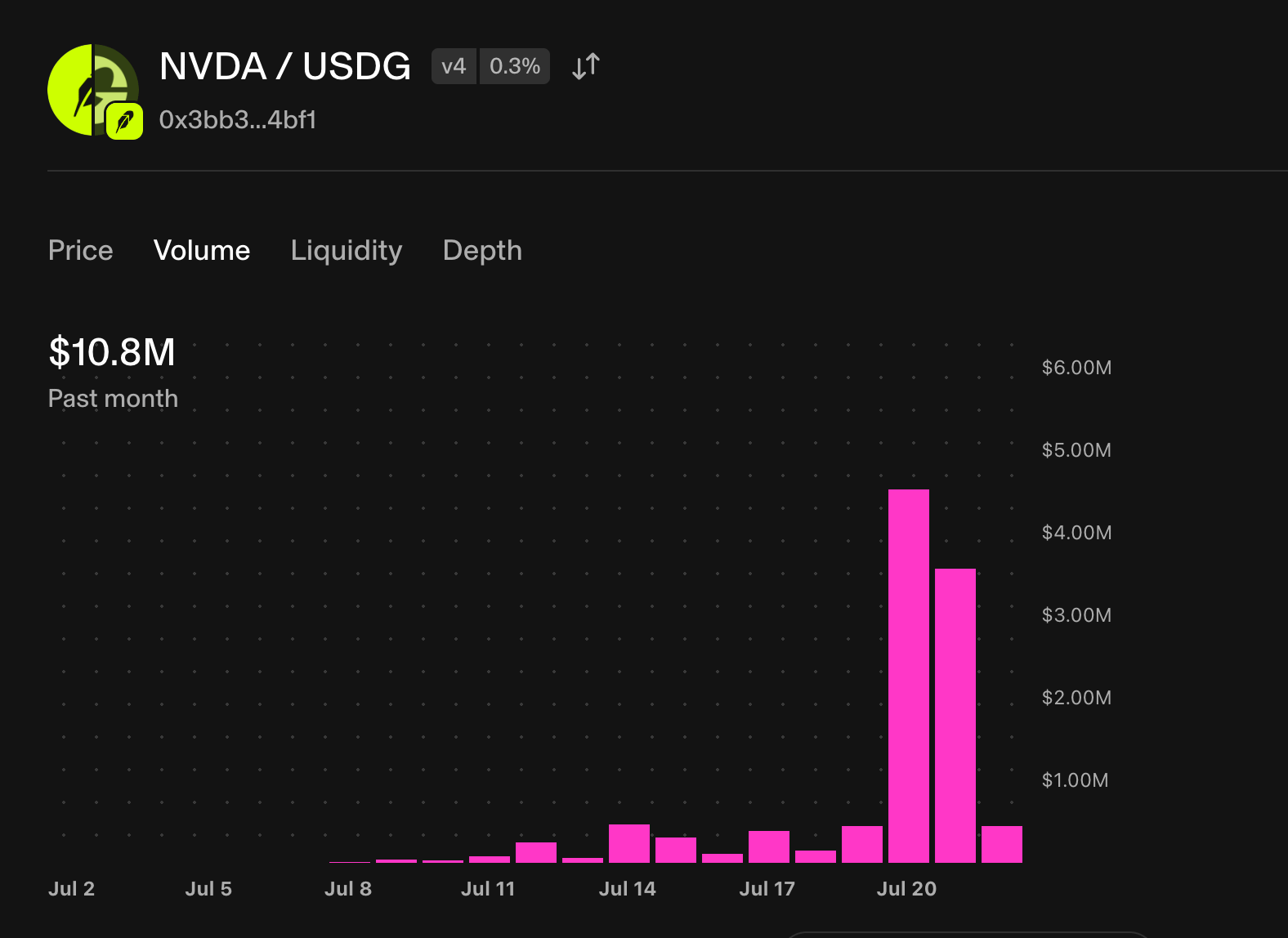
Since the Robinhood chain went live, the most actively traded tokenized US stock on-chain has been $NVDA. The trading volume of the Uniswap NVDA/USDG v4 pool has successfully surpassed $10 million.
Before July 20, the trading volume of this pool had never broken $500,000 in a single day. Nearly all the trading volume came from the past two days—the trading volume over those two days exceeded $8.1 million.
All of this is thanks to two meme coins: $REAL and $AI.
$REAL is the US stock meme coin paired with $NVDA on Bankr. On July 20, Bankr launched a feature that uses tokenized US stocks as a liquidity pool to issue new meme coins, supporting more than 90 tokenized US stock tokens such as $NVDA, $TSLA, $AAPL, $SPY, and others.
Bankr founder @0xDeployer personally came out and issued the first token of this new functionality, namely $REAL. Since the founder issued it personally, and he also stated on X that he would recruit a CTO team for this coin, the coin’s trading volume on the very first day it launched (July 20) exceeded $5.6 million.
$AI comes from another platform long.xyz. That platform actually started much earlier than Bankr—$AI was issued on July 14, and it’s also a meme coin paired with $NVDA. Even though it was launched early, nobody paid much attention until Bankr came out and sparked a fire; on July 20, $AI’s daily trading volume also reached $1 million.
On July 20, the Uniswap NVDA/USDG v4 pool had a trading volume of $4.5 million. Combined with the previously lukewarm situation of daily volumes staying below $500,000, this surge in volume can be attributed entirely to the two meme coins mentioned above.
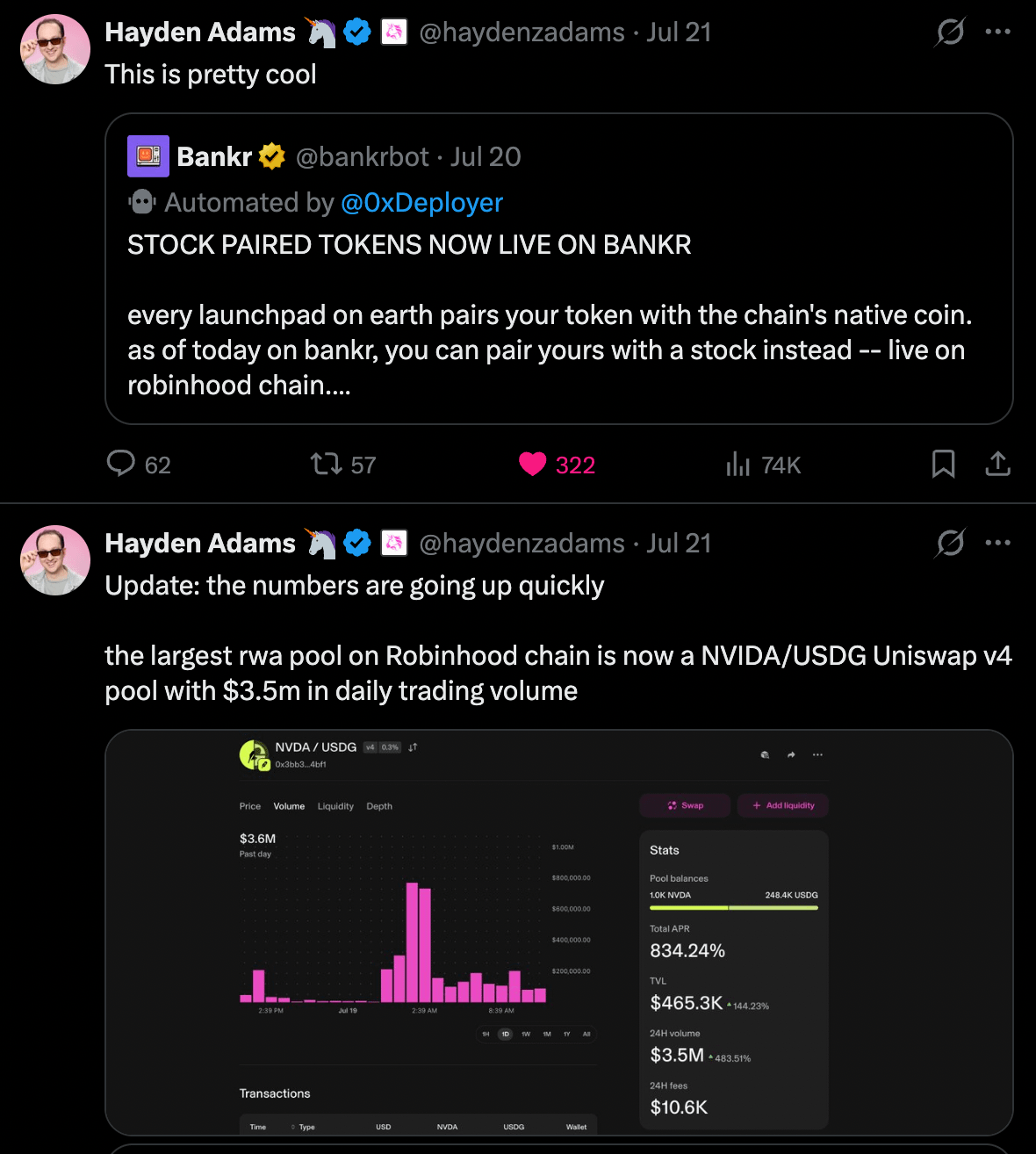
Uniswap founder Hayden Adams noticed this and found that the source was Bankr’s $REAL, so he specifically posted a tweet saying, “The new feature is freaking awesome.”
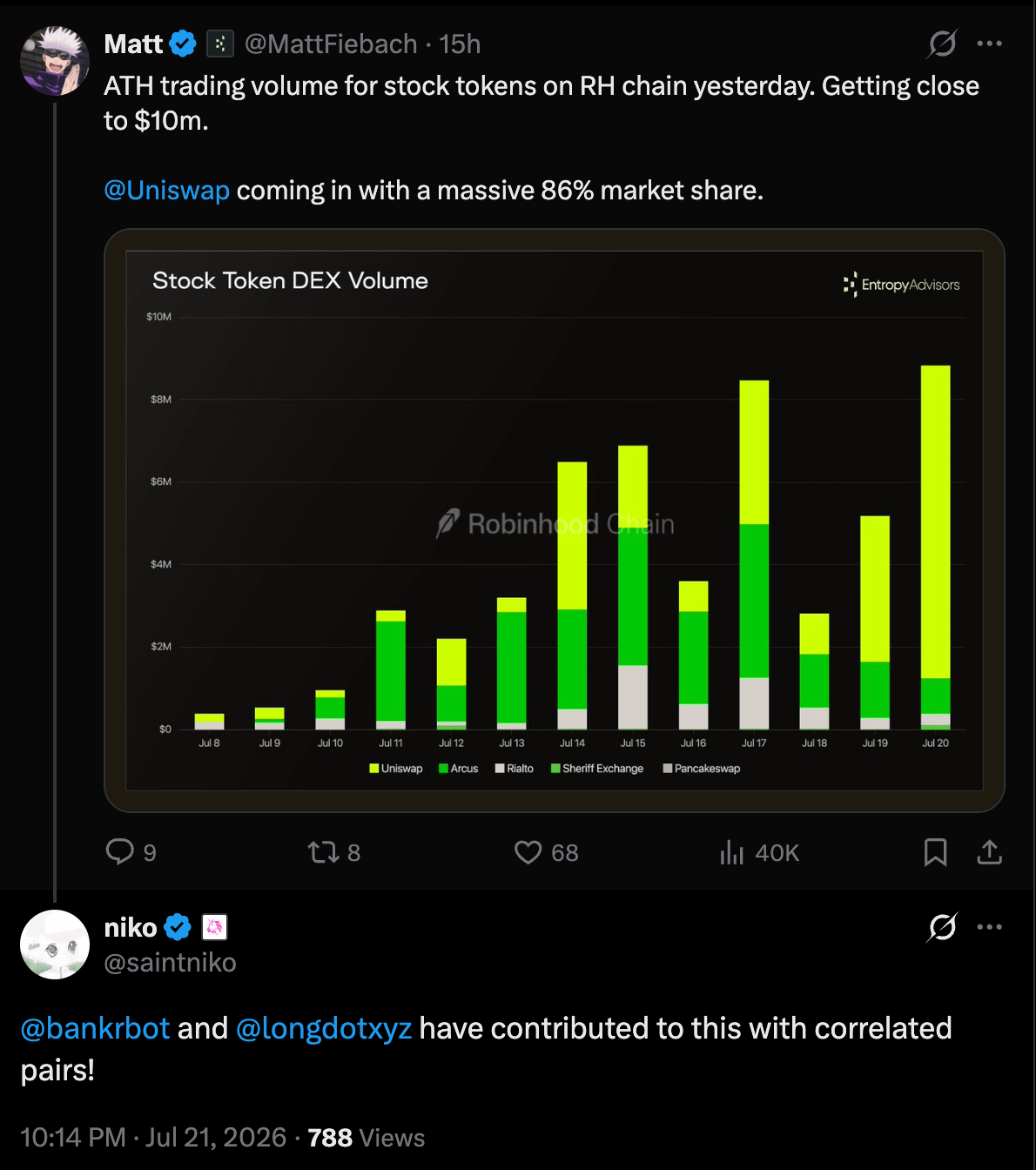
Uniswap team member @saintniko also commented under a tweet about the Robinhood chain’s US stock token trading volume setting a new all-time high: “Bankr and long.xyz contributed via the relevant trading pairs!”
Robinhood is the most suitable chain for this kind of gameplay.
No other chain is more suitable for US stock memes than Robinhood.
First of all, this is a chain created by an internet brokerage that personally got involved—the stock genes are stamped in their bones.
Second, Robinhood CEO Vlad has repeatedly said that this chain needs to do RWA. People say that, but before US stock meme coins appeared, that statement had always been in a state of “the ideal is丰满, while reality is骨感.”
In the past two weeks, the DEX spot trading volume on the Robinhood chain was $1.845 billion and $1.826 billion, respectively. Of that, the meme coin trading volume was $1.347 billion and $856 million, respectively; the rest is almost entirely contributed by exchanges between ETH and stablecoins. For tokenized assets, the trading volume was only a pitiful $2.32 million and $9.41 million.
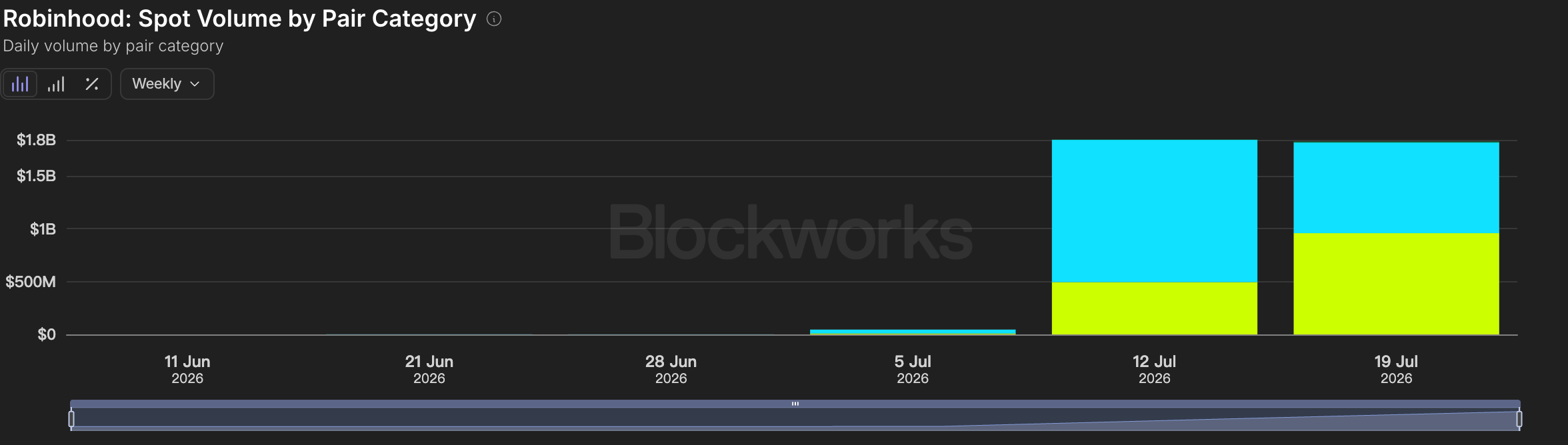
Meme coin hype will eventually enter a fatigue period, while RWA needs to be developed. Cleverly, US stock memes combine the two into one, and a new narrative emerges—then the on-chain excitement can keep going.
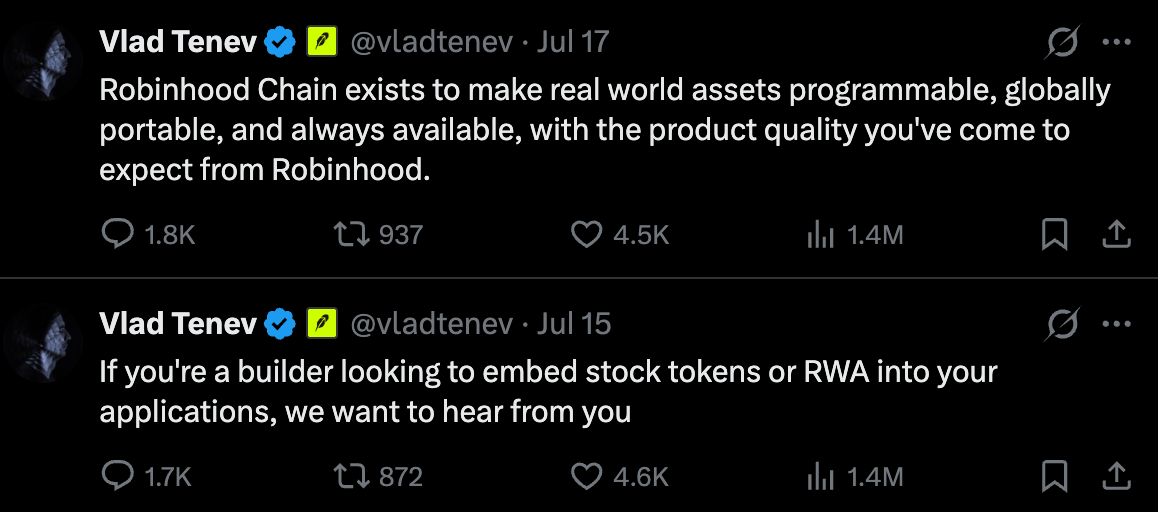
Also combine Vlad’s earlier stance: on July 15, a tweet welcomed builders who want to embed tokenized US stocks and other RWA assets into on-chain applications; on July 17, a tweet said that one of the missions of the Robinhood chain is to make RWA programmable.
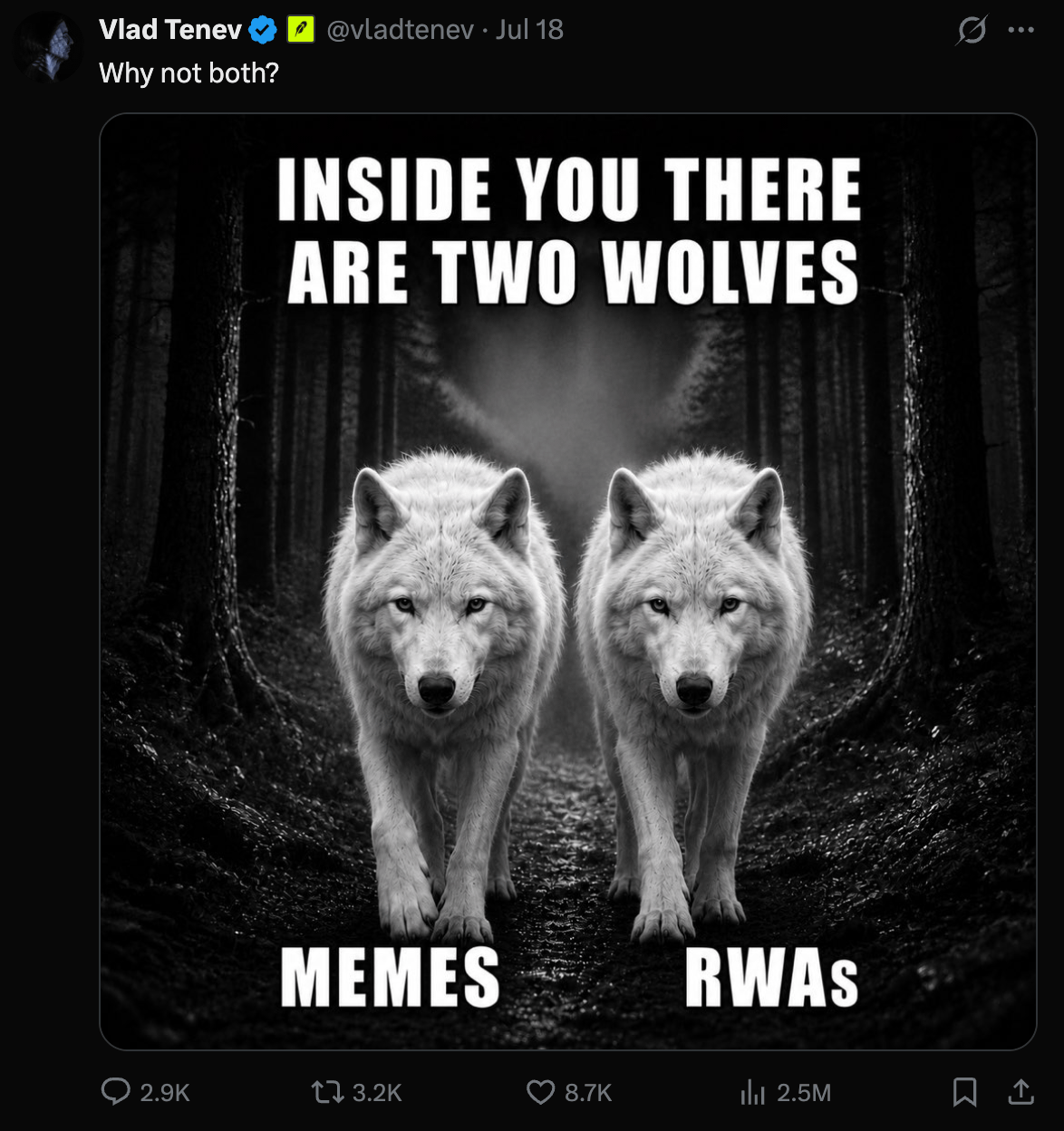
Especially this chart—it shows his vision of meme coins and RWA blossoming side by side on the Robinhood chain: “Why can’t the two go hand in hand?”
In the past, RWA projects always made retail traders feel that they were far away, or that they couldn’t earn much money. US stock memes solve this problem well. The alt.fun that was popular on Hyperliquid for a while before—people would wonder, if I issue meme coins using US stock contract positions, will I lose money?
If it would make retail traders’ first reaction be to think to go there, then the narrative was already wrong from the start. The cultural genes of each chain and the current atmosphere determine that even if similar gameplay emerges, it leads to different market understandings—whether it can actually work. On the Robinhood chain, the US stock + meme strategy makes everyone subconsciously think that this is the narrative that best matches Vlad’s idea. Also, using tokenized US stock spot as the liquidity pool is far better than using contracts. After all, it’s real shares. Therefore, if the narrative works, as there are more and more US stock meme coins, to some extent meme coins become “deflationary” toward stocks—because the tokenized US stock is locked in the pool.
Similarly, you can also imagine that once the scale grows, Robinhood directly guides retail traders to take stocks and put them into liquidity pools to manage their wealth—directly breaking down the dimensional barrier between meme coins and stocks.
Right now, the total supply of $NVDA on Robinhood is only around 14,000 coins, while the Uniswap v4 pool for $REAL and $AI already has close to 1,700 coins. This is still despite the fact that, so far, no meme coin story has managed to reach a $10 million market-cap level benchmark.
Target tracking: competition between Bankr and long.xyz
At the current stage, it’s enough to just look at these two platforms, because mainly it’s these two that have the volume and are competing.
There are also very few specific targets to look at. Bankr mainly looked at $REAL—the logic has already been gone over in the earlier sections: the founder personally issued it and personally promoted it. But the promotion cadence is really a bit slow—there’s a large amount, yet the price action just hasn’t been able to blast aggressively upward.
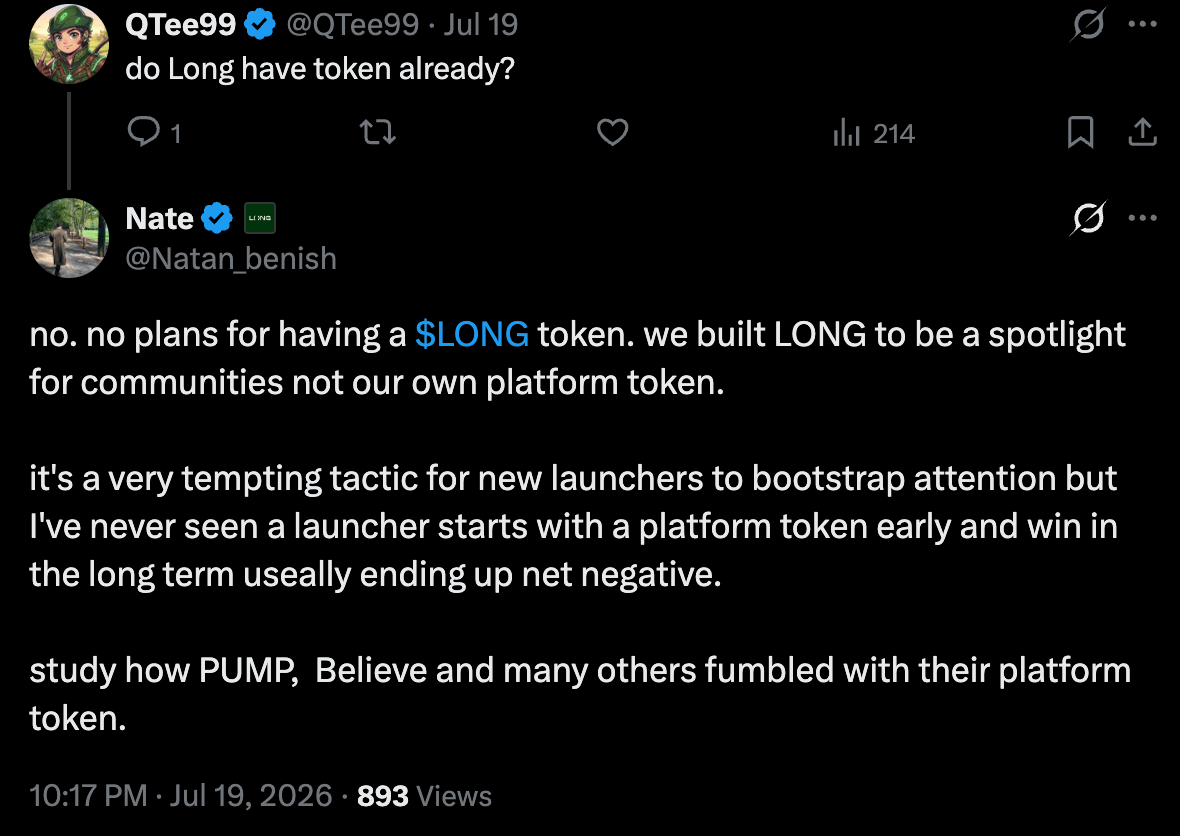
As for long.xyz, first the founder has clearly stated that there are no plans to issue a platform token:
Second, the two targets he personally stepped in to buy: one is $AI mentioned earlier, and the other is the $SPACEHOOD he issued himself (paired with $SPCX).
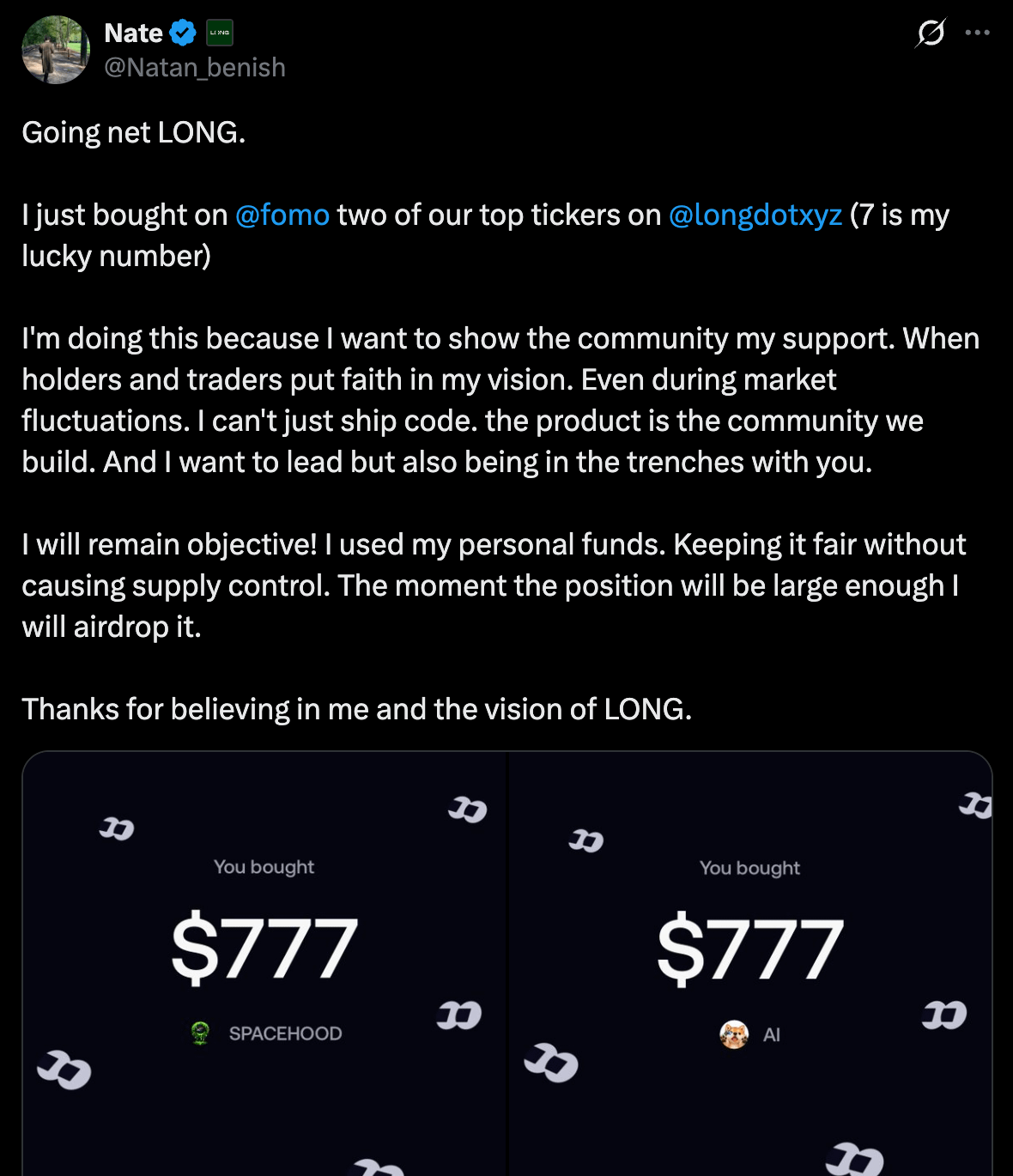
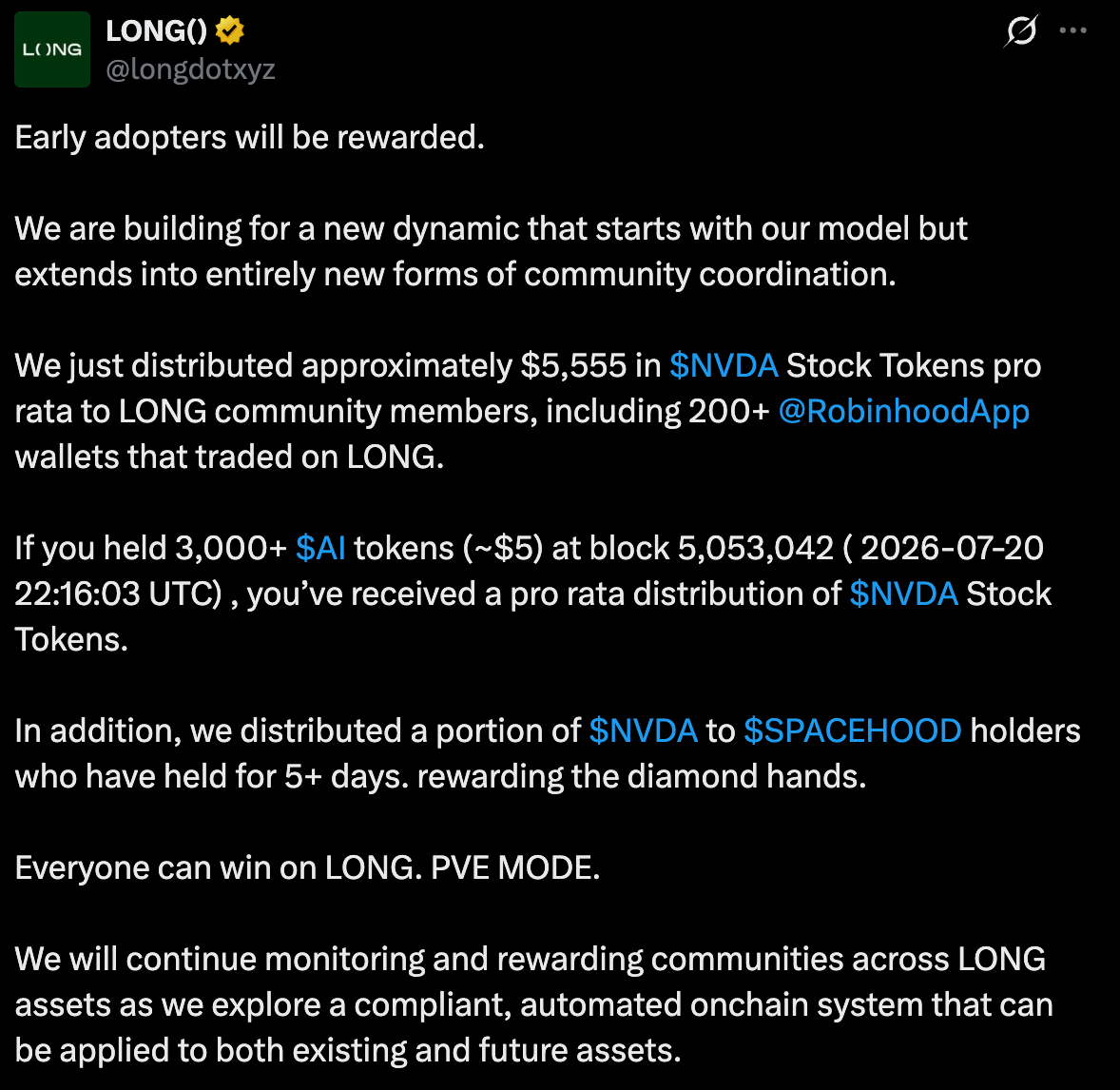
long’s support for these two targets is extremely obvious—they already conducted an $NVDA airdrop reward for long-term holders of these two tokens:
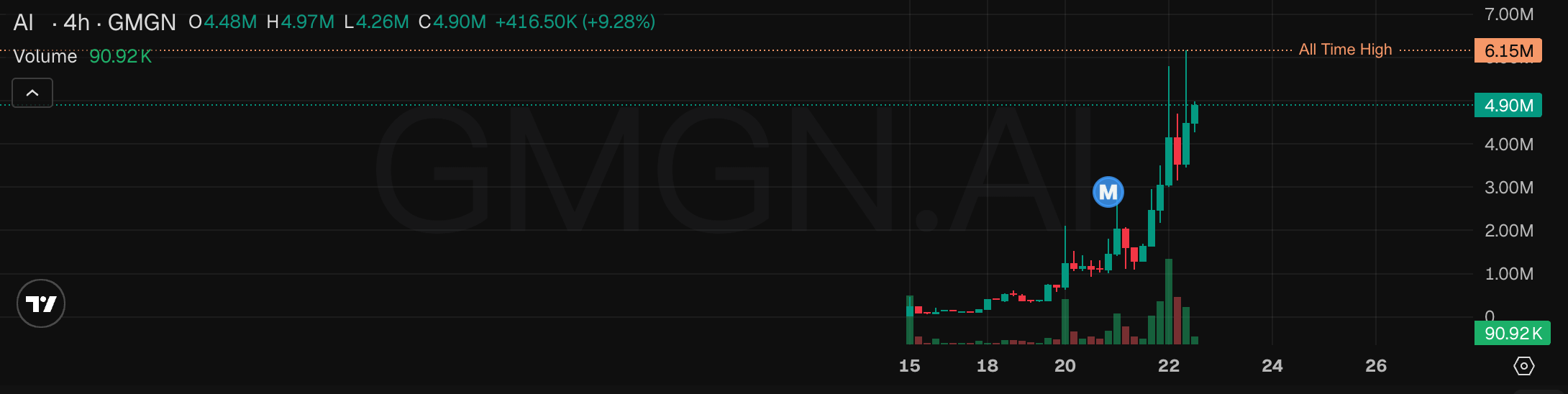
$AI is also the leading target in this sector right now. Over the past couple of days it’s been climbing nonstop, with the highest market cap reaching $6.15 million.
If a US stock meme can break through and hold the $10 million market-cap threshold, and then continue moving upward, then US stock memes are very likely to become a new popular gameplay on the Robinhood chain. If the dream is even bigger, this has never happened in the market before—it could become Robinhood’s signature killer move. Just like every chain has its own特色, it might even lead the entire market in a new direction, becoming a very new big narrative opportunity. After all, the narrative for meme coins hasn’t been updated in a long time.