


Today we will continue to discuss in order of market capitalization.
The project currently ranked fifth in the cryptocurrency market by market capitalization is BNB, which is the platform token of Binance.
This project, in fact, I had already discussed systematically as early as 2023.
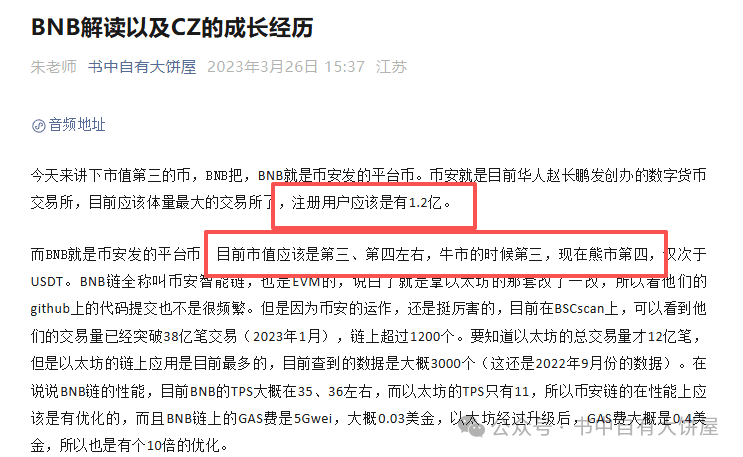
At that time, the number of registered users on Binance was about 120 million, and unexpectedly, three years later, this number has reached 300 million, almost doubling by 2.5 times.
But interestingly—
BNB ranked third and fourth in market capitalization back then, but has now been surpassed by XRP, falling to fifth place.
1. Why do I keep saying: The core feature of BNB is 'stability'
I emphasized repeatedly at the beginning that BNB's greatest feature is not explosiveness, but stability:
Bull markets are not the ones that rise the most
Bear markets are not the ones that fall the hardest
Retracement is controllable, rhythm is smooth
This kind of coin is actually very suitable for 'long-term value investors', not those chasing short-term emotions.
Everyone can look up BNB's historical trends, and you will find it almost perfectly matches a saying:
Rises slowly, but falls slowly too.
Two, Token data and current status
1️⃣ Supply structure
Initial total issuance: 200 million coins
Initial circulation: about 137 million coins
Through continuous destruction, about 63 million coins have been destroyed so far
CZ's promise that year was:
Use 20% of platform profits to buy back and destroy BNB until the total amount decreases to 10 million coins.
But the reality is——
This progress is much faster than expected.
2️⃣ Price and market value performance
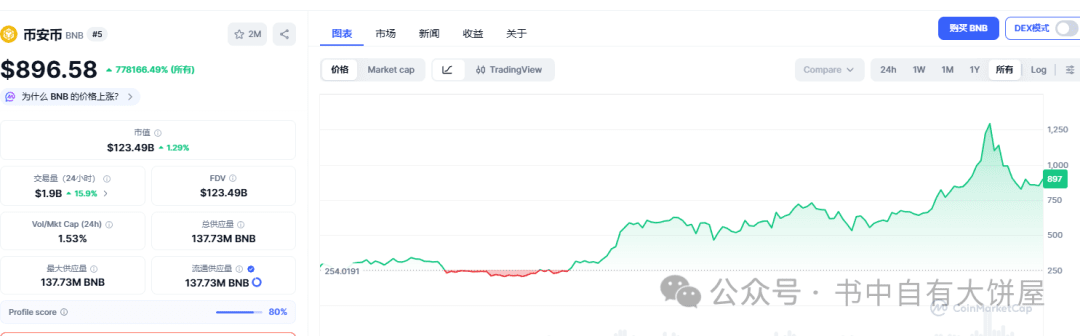
In this cycle, BNB rose from 200+ USD
All the way up to a peak of 1300+ USD
The maximum increase was about 6 times
Then retraced to a minimum of 820 USD
Current market value is about 123 billion USD
This is still a typical curve of 'steady growth'.
Three, three core factors driving BNB's rise
1️⃣ Buyback destruction: the real engine
This is the most important and also the most underestimated point of BNB.
Many people think:
BNB's buyback and destruction comes from buying coins from the market.
But in reality it is not.
BNB's buyback mainly destroys: the BNB held by the team + CZ.
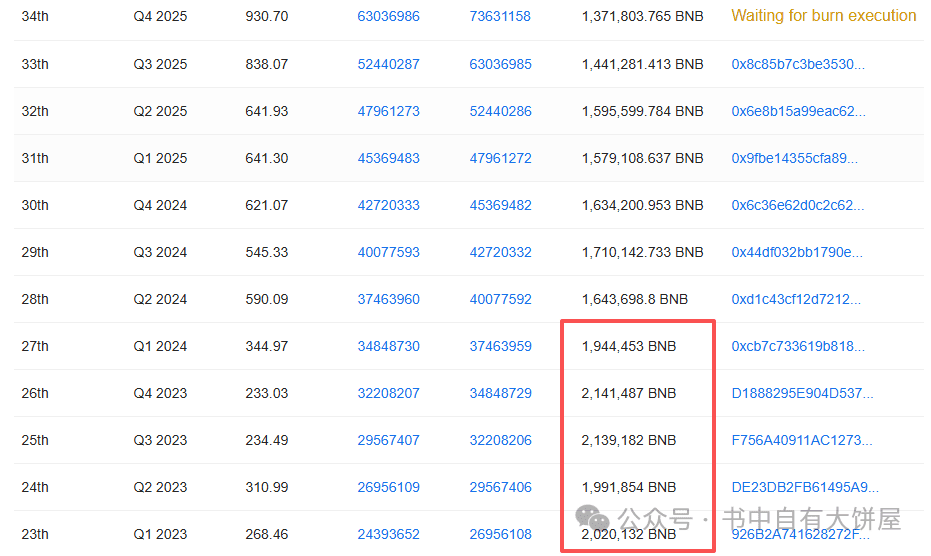
🔍 Destruction data review (2025)
According to the official blog data from bnbchain.org that I found:
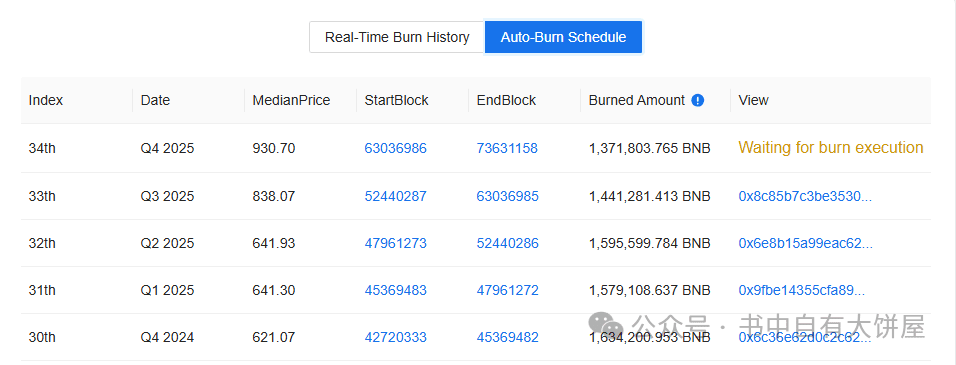
Q1–Q4 of 2025
Single quarter destruction amount is about 1.3–1.5 million coins
Destruction price median is about 600–900 USD
Annual destruction total is about 5.98 million coins
Annual destruction amount is about 4.5 billion USD
Note this saying:
Destruction amount ≈ platform profit × 20%
👉 That is to say:
4.5 billion × 5 = 22.5 billion USD
The exchange behind BNB has an annual net profit level that has exceeded 22.5 billion USD.
To say something not exaggerated:
Exchanges are the most terrifying money-sucking machines in this industry.
Why is BNB so 'low-key'?
The reason is simple:
What is destroyed is not the circulating supply in the market
Will not create short-term pump emotions
Officially disclosed only on the blog, not heavily marketed
But from an investment perspective:
Using the real money earned to destroy one's own chips, rather than throwing them into the market, is itself a strong long-term positive.
So there’s nothing to complain about!
2️⃣ Platform token empowerment: stability
① Holding coins equals rights (VIP fees)
Holding BNB can get transaction fee discounts
As the number of registered users increases, this type of demand group is also growing
Although single-point stimulation is not strong, it wins in long-term, continuous, and compounding.
② New listing & Launchpool system
Launchpool
Wallet new listing
Various types of IEO / airdrop thresholds
The core logic is only one: to participate, you must hold BNB.
Although, as a centralized platform, it cannot be precisely counted, as long as the total number of users continues to grow,
👉 The 'passive lock-up demand' for BNB will continue to exist.
3️⃣ On-chain gas consumption (an overlooked variable)
BNB is also the gas token of the BSC chain.
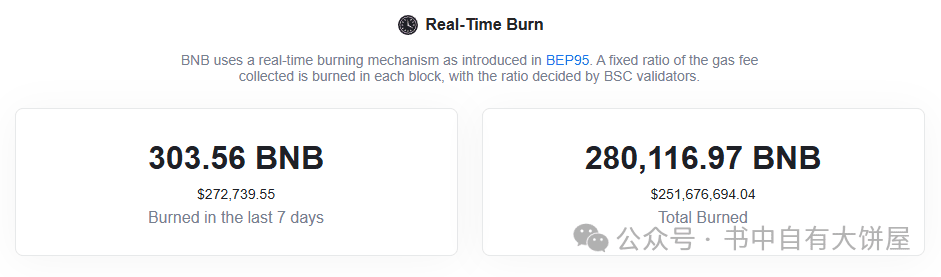
Currently, BSC adopts the BEP-95 real-time destruction mechanism:
In each transaction fee
About 10% directly destroyed
Remaining distribution to validators and stakers
This is a real-time, on-chain, verifiable destruction mechanism.
The real consumption brought by the hype for meme coins
In around October 2025, BSC once set off a wave of hype for meme coins:
On-chain trading volume surged
Daily transaction count once reached tens of millions
Average daily BNB destruction amount reached hundreds of coins
According to BNBburn data:
In the past 7 days, about 300 BNB have been consumed
A total of about 280,000 BNB has been destroyed through BEP-95
Looking at it alone is not exaggerated, but this is a long-term, continuous 'underlying wear mechanism'.
4️⃣ Coin hoarding effect
BNB's 'stability' itself is also attracting a certain type of person:
Early coin hoarders
Risk-averse long-term capital
Treat BNB as a 'quasi-equity' holder
This type of person does not trade frequently, but continuously reduces the circulating supply.
Four, BNB's mid-to-long-term price projection (rational version)
1️⃣ Destruction progress calculation
Currently remaining to be destroyed is about 37 million coins
Average annual destruction in recent years is 5–6 million coins
Expected to achieve the goal within 5–6 years
If another peak period occurs, even faster
2️⃣ User growth ceiling
Currently Binance:
Registered users are about 300 million
Under strong KYC constraints
Actual deduplicated users, reasonably estimated at 30–50 million
Future assumptions:
Registered users will double in 6 years → 600 million
Actual users → 50 million–100 million
But the problem is:
With a global population of 6 billion, there is one Binance account for every 10 people, which is almost the extreme scenario.
3️⃣ Market value and coin price projection
Comparison data:
Three years ago:
Market value was about 50 billion USD
Users 120 million
Now:
Market value is about 125 billion USD
Users 300 million
A total of about 25 million coins have been destroyed
Assuming in the next 5 years:
Destruction amount will complete the same scale again
User count doubles but growth slows down
Market value increases by 2–2.5 times
👉 Corresponding market value:
2500–3125 billion USD
👉 If the total amount decreases to approximately 110 million:
Coin price range approximately 2250–2840 USD
This is a rational, non-emotional estimation range.
Five, three issues that must be faced
1️⃣ What happens after the buyback ends?
5–6 years later, the maximum benefit disappears:
No more large-scale buybacks
Where are the new stimulation points?
This is the biggest uncertainty of BNB.
2️⃣ User growth is approaching its limit
Let's compare:
WeChat: 1.3 billion
Facebook: 1 billion
YouTube: 2 billion
But they are:
Entertainment + Social + Universal applications
And Binance is:
High-threshold financial trading platform
User scale is not even on the same level.
3️⃣ Systemic risk of platform token narrative
BNB is highly bound to Binance:
Company-level centralized projects
History has the precedent of FTT
Even if CZ says he wants to build a 'century-old enterprise',
But:
No one can guarantee certainty in 10, 20 years.
Six, real issues regarding the BSC chain
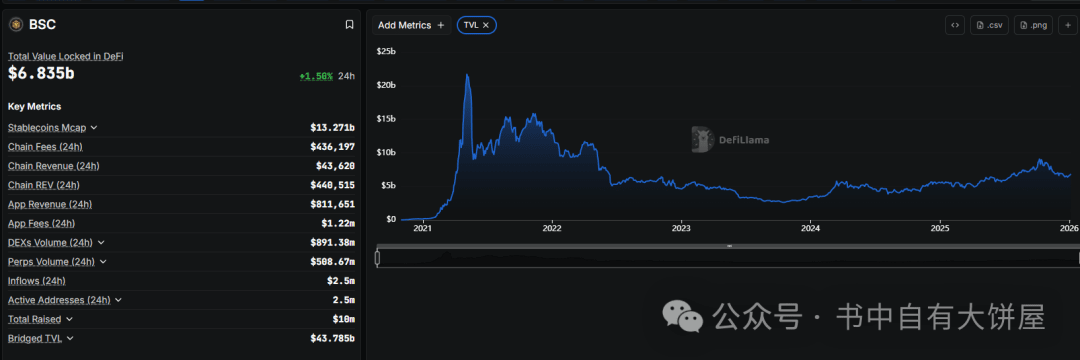
Current BSC TVL ≈ 6.8 billion USD
Ranked fourth, has not yet recovered to the peak of 2021
Public chain capability:
Weaker than ETH
Growth rate weaker than SOL
Even being chased by Coinbase chain
Consensus mechanism:
POSA (PoS + PoA)
43 candidate nodes
21 block-producing nodes
Decentralization is obviously insufficient
BSC is more like:
A chain that serves the exchange, not a public chain with an independent narrative.
Seven, the final judgment
If BNB wants to go further:
Must strengthen the chain's capabilities and ecology
Make BSC the second growth curve
Instead of always relying on exchange profits
But the reality is:
A highly profitable main business finds it difficult to actively pursue 'non-profitable but long-term' innovation.
This is exactly the problem that all giants face in (The Innovator's Dilemma).
One sentence summary
BNB is an extremely excellent 'stable platform token', which has achieved certainty in price growth through buyback destruction and user growth in the past, but in the next 5–10 years, its real challenge lies not in price, but in whether the growth logic can continue.