


Happy New Year everyone! In 2026, I plan to revisit and analyze some high-quality projects I wrote about three years ago for three reasons:
First, many projects have undergone tremendous changes over the past few years, and previous analyses may be somewhat outdated;
Second, we are currently in a bear market range, and many projects have entered a cost-effective range, allowing for appropriate positioning. Previous research indicates that the macro environment over the next 26 years will be completely different, breaking the four-year cycle!
Third, reviewing the past helps to understand the new!
Let's stick to the order. I won't say much about BTC and ETH; I've talked too much about them. There's also been a lot said about the third stablecoin, USDT, so let's go straight to the fourth, XRP.
1. Introduction
XRP, created by Ripple Labs in 2012, was primarily established to provide an efficient value transfer tool for global cross-border payments and settlement between financial institutions. In fact, Ripple's predecessor was Opencoin, which existed as early as 2004 and was inspired by Satoshi Nakamoto's BTC, transitioning to the blockchain.
Among the three original technical founders, one core technical personnel, Jed McCaleb, left in 2013 to establish Stellar, which is a product identical to XRP, known as XLM, which currently has a market value of 11 billion, moving in tandem with XRP.
2. Main Problems Addressed
1. Currently, the cross-border payment settlement cycle is long, T+2 to T+5
2. The middle-tier banks are numerous, and fees are high.
3. Liquidity occupation is severe (requires pre-funded capital)
4. For emerging markets, the cost of cross-border payments can be as high as 5%–10% of the transaction amount.
Blockchain, as we all know, allows real-time transfers on-chain; XRP can complete cross-border payments in 4 seconds with no transaction fees. However, one point I previously criticized is the use of XRP as the settlement currency in the middle.
Because its business logic is that local institutions exchange A fiat currency for XRP, and then the cross-border institution exchanges XRP for B currency. Since XRP is not a stablecoin, the exchange incurs losses when XRP fluctuates.
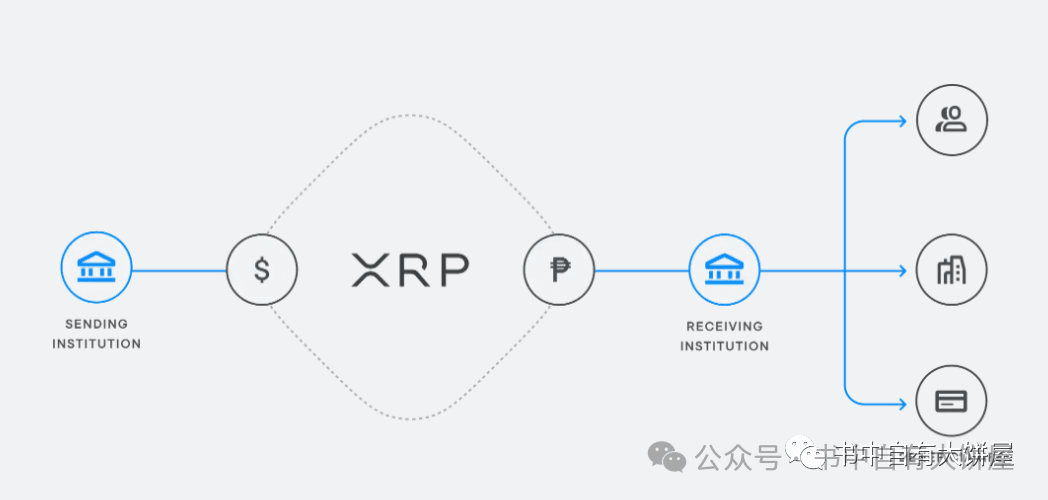
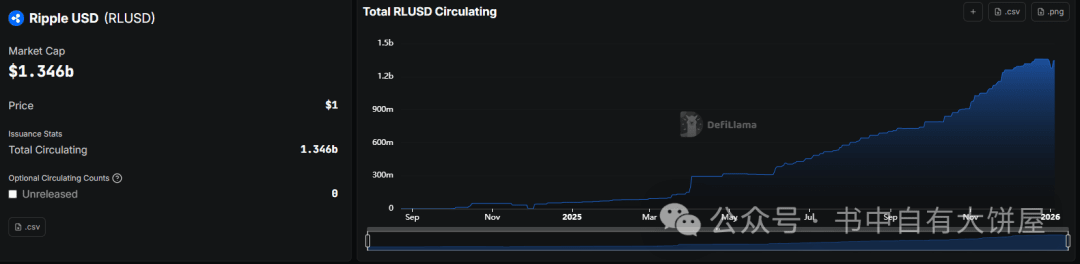
However, with the introduction of the (stablecoin bill), Ripple issued the RLUSD stablecoin, allowing stablecoins to be used as an intermediary for settlement in certain scenarios, making it much more reliable! This addresses its previous deficiencies.
Currently, the growth rate of RLUSD is very fast. In one year of 25, it increased by 1 billion, and it is expected to grow even faster in the future.
3. Main Products and Services
1. XRPL: Global cross-border payment network, using the RPCA (The Ripple Consensus Algorithm) algorithm, with a final confirmation time of 3–5 seconds; the official fastest speed is around 1000-1500, but the current actual speed on the chain is about 60-100.
2. ODL (On-Demand Liquidity): Main business, XPL and fiat currency exchange settlement layer, aiming to provide a cross-border transfer solution that is faster, cheaper, and more transparent than traditional systems (such as SWIFT).
3. xVia – Provides standard API access for business customers to integrate multiple payment gateways and channels.
ODL has expanded to nearly 40 fiat payment channels and introduced machine learning capabilities to optimize liquidity management.
RippleNet has over 300 financial institutions and payment providers as clients, covering multiple countries and regions.
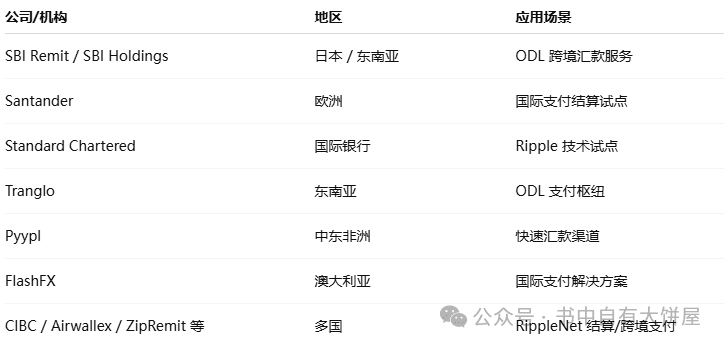
Some actual collaborations or use cases include:
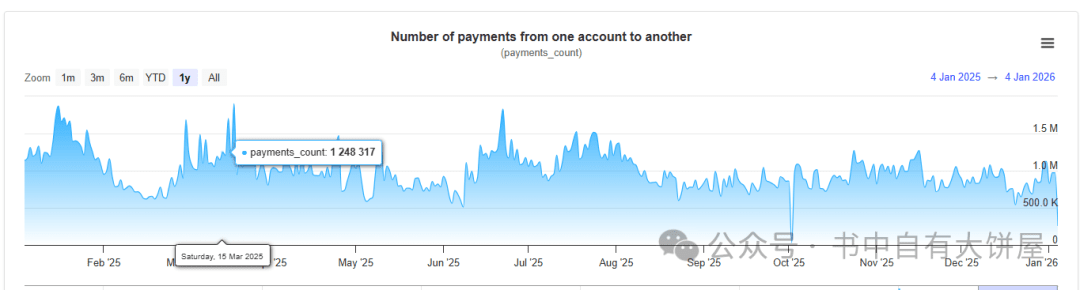
According to reports, XRP processed 15 billion USD/month in cross-border payments in 2024, and in the third quarter of 2025, it handled an average daily transaction volume of 1.8 million transactions.
I only believe in on-chain data. According to the on-chain data I have consulted, the peak daily transaction volume of XRP indeed reached 1.8 million, with an average daily volume of 700,000 to 800,000.
The peak daily transaction volume is 2 billion, with a low estimate of 100-200 million USD, with an average rough estimate of around 700-800 million. However, the data for 25 years is not as good as that for 22-23 years. Based on this data, the annual transaction volume is around 250-300 billion.
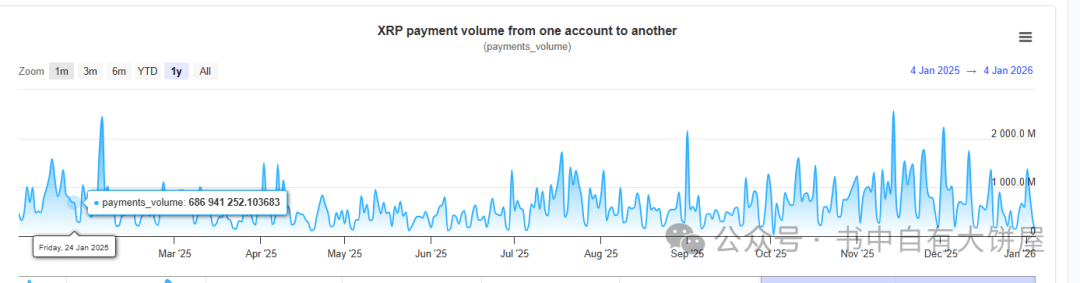
Don't think that the annual cross-border transfer payment amount of 250 billion is very high; let me provide you with a very indicative number. Visa reported a total transaction volume of 17 trillion in 2025, meaning XRP only has one-sixth of Visa's current volume.
So looking at it this way, Ripple still has enormous growth potential.
4. RWA
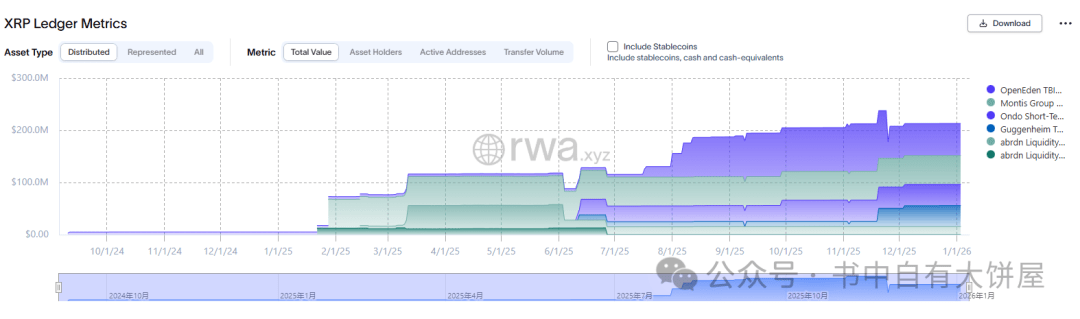
Currently, the RWA sector is also growing, with a total value of 330 million USD.
4. Financing Situation
In November 2025, a round of 500 million USD financing was completed, with a valuation of 40 billion and total financing of 780 million USD. This financing scale is also quite exaggerated, but the token valuation has far exceeded its company valuation, and the possibility of Ripple going public in the future cannot be ruled out.
5. Token Economics
Total supply: 100 billion units, currently circulating 60 billion, market value 125 billion, FDV 200 billion, Ripple has locked a large amount of XRP in Escrow contracts, releasing a maximum of 1 billion XRP per month for development and sales; unused portions will be returned to escrow. This selling pressure is quite significant; three years ago, when the price was 0.4, it is now 2 USD, a fivefold increase; however, the total circulating supply was only 40%, meaning over three years, 20% has been released, with an annual inflation rate of 7%. We can only say that fortunately, the business and the approval of the ETF have supported it; otherwise, the price would likely not have held up.
Currently, the XRP ETF was approved in November 25, with a total of 1 billion USD ETF, locking about 746 million XRP, which is less than 1% of the total market value. Experts also estimate that by '26 it will reach a volume of 5 billion, accounting for about 5% of the market.
Therefore, this wave of ETFs really supports its selling pressure. We can see that XRP's retracement went from 3.4 to 1.7, a 50% retracement, stronger than many altcoins, but of course weaker than Bitcoin and Ethereum.
6. Conclusion
Overall, the fundamentals are good, with actual applications and demand, and the company can maintain stable profits. If the company goes public in the future, it will form a linkage between the token and the stock, meaning that buying the token will increase its value, and the company's market value will rise. Moreover, the cross-border payment sector has great potential for the future. It has been mentioned that it is only one-sixth of Visa, but Visa's market value is 600 billion, so Ripple's market value is also one-sixth, which means its current valuation is quite reasonable; don’t expect a significant drop later!
Furthermore, the competition in the future payment landscape will become increasingly fierce. Any future stablecoin issuer could potentially become a competitor in cross-border payments. Currently, Ripple's stablecoin volume has not yet increased significantly, but fortunately, it has occupied a certain ecological niche over the past decade.
With the rise of on-chain cross-border payments in the future and the increase in ETF inflows, Ripple still holds some promise, as it is one of the few in the space that can genuinely solve problems and sustain profits, focusing on its field for over a decade without changing its name or token.
However, there are also downsides to mention, such as the release of inflation; full circulation is estimated to take another 5-6 years, depending on whether ETFs can absorb it and whether the business can grow rapidly. Additionally, there is the issue of not being listed, so specific revenue conditions are unclear. If it can go public as mentioned at the beginning, it would also resolve the transparency issue of revenue.$XRP