

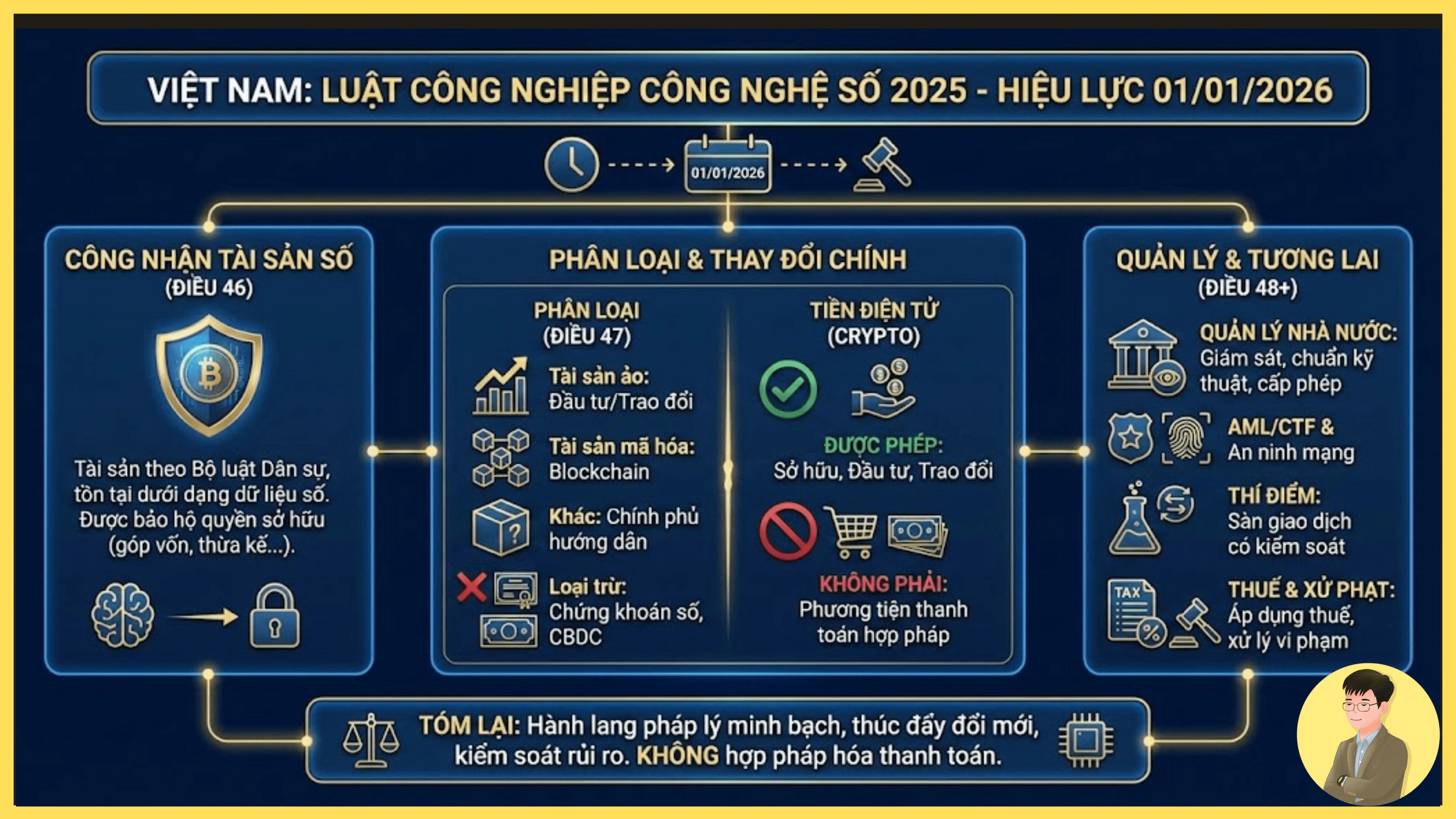
From January 1, 2026, the Law on Digital Technology Industry 2025 (No. 71/2025/QH15, passed on June 14, 2025) officially takes effect, marking the first major turning point in recognizing and managing digital assets (including those related to cryptocurrency) in Vietnam.
1. Recognition of digital assets
- Digital assets are officially defined in Article 46 as assets under the provisions of the Civil Code 2015, existing in the form of digital data, created, issued, stored, transferred, and authenticated by digital technology in an electronic environment.
=> This brings digital assets (including cryptocurrencies like Bitcoin, Ethereum...) out of the 'gray' legal area, protecting ownership rights like traditional assets (can be invested, inherited, secured, civil disputes...).
2. Classification of digital assets (Article 47)
- Virtual assets in the electronic environment: Can be used for exchange or investment purposes (this encompasses many popular cryptocurrencies such as virtual items in games, reward points, digital vouchers, loyalty points, etc.).
- Digital assets: Using encryption technology for authentication, creation, issuance, storage, and transfer.
- Other digital assets: To be detailed by the government later.
- Exclusions: Does not include digitized securities, central bank digital currency (CBDC), or other financial assets under current law.
3. Major changes in the field of cryptocurrency
- Virtual/cryptographic assets recognized for investment and exchange, protecting investors.
- Not a legal means of payment: Cryptocurrency is still not used as currency or for payment of goods/services (maintaining the old regulations of the State Bank, this act is prohibited).
- Virtual currencies in general and Bitcoin, Litecoin, etc., in particular are not currency and are not legal means of payment according to Vietnamese law. The issuance, provision, and use of virtual currencies in general and Bitcoin, Litecoin in particular (illegal means of payment) as currency or means of payment is prohibited.
4. State management (Article 48):
- Issuing technical standards, authentication. Monitoring business activities related to services (exchanges, custody...).
- Anti-money laundering, cybersecurity, terrorism financing (in coordination with the Anti-Money Laundering Law).
- Conditions for doing business in cryptographic asset services (require licensing, strict compliance).
- Pilot market: In conjunction with Resolution 05/2025/NĐ-CP (and related documents), piloting the cryptocurrency exchange (scale control, large capital requirements, information disclosure...).
- Proposed application of transaction tax, similar to securities transactions (0.1% on the transfer value of each transaction).
- Licensed exchanges will be responsible for withholding, reporting, and paying taxes on behalf of investors.
- After 6 months from the time the first exchange is licensed, off-system transactions (unlicensed exchanges) may face administrative penalties or criminal prosecution.
=> Detailed decrees and circulars (on declaration, tax payment, exemption thresholds...) will be gradually issued in 2026.
=> Thus, this year, cryptocurrencies have officially been recognized as a type of investment asset, and temporarily inherit existing laws on assets from civil law until more specific guidelines are provided.
=> How are investors protected? In cases of fraud, loss, investment, etc., they can report to the authorities just like with ordinary assets, as long as there is sufficient evidence.