
I added a small Newton Protocol position a couple of days ago. Nothing huge, just enough to make myself pay attention instead of scrolling past another AI project. At first I assumed it was following the same formula I've seen dozens of times: bigger models, smarter agents, more automation. But after spending some time reading through the design, I realized the part that interested me wasn't actually the AI.
It was the permission system.
That probably sounds like a strange reason to look at a project, but hear me out.
Most discussions around AI seem to focus on making models more capable. Better reasoning, longer memory, more autonomy. Those improvements matter, but I think they're making people overlook a more practical question.
What exactly should an AI be allowed to do?
There's a huge difference between an AI that can make decisions and an AI that's authorized to act on those decisions. Once an agent starts interacting with wallets, signing transactions, or moving assets, capability stops being the biggest concern. Authority becomes the real issue.
That's the part Newton Protocol made me think about differently.
Their approach revolves around what they call "authorization before execution." The idea isn't to assume an AI will always make the right choice. Instead, every action can be checked against predefined policies before anything actually happens.
That feels like a small wording change, but I don't think it is.
I work with automation whenever I can because it saves time, but I've also learned not to trust automation with unlimited freedom. A few months ago I had a trading script behave differently than I expected because of one condition I forgot to update. It wasn't a disaster, but it was enough to remind me that software doesn't need bad intentions to create bad outcomes.
Sometimes it simply follows instructions a little too well.
Newton's design seems built around accepting that reality instead of pretending AI will always make perfect decisions.
For example, developers can define which wallets an AI is allowed to access, which protocols it can interact with, spending limits, risk thresholds, or actions that still require human approval. Instead of hoping the agent behaves correctly every single time, the system creates boundaries that exist before execution ever begins.
That's the distinction I hadn't really appreciated before.
When people hear "security," they often imagine detecting attacks after they happen. Newton's philosophy seems closer to preventing unnecessary authority from existing in the first place.
The more I thought about it, the more it reminded me of how traditional financial systems already operate.
Banks don't let every employee move company funds whenever they want. Large transfers usually require multiple approvals. Corporate finance teams have spending limits. Even something as ordinary as paying with a credit card involves authorization checks before money leaves an account.
Nobody expects experience alone to eliminate risk.
Instead, systems are built around limiting what people are allowed to do.
That same logic feels increasingly relevant if AI agents eventually start managing digital assets on behalf of users.
Another detail that caught my attention was the team behind the project. Magic Labs has already helped onboard millions of users into crypto, so they're not approaching wallet infrastructure as complete newcomers. Whether Newton succeeds or not, I think that experience matters because identity, wallets, and authorization all intersect in ways that many AI discussions barely mention.
I'm not pretending I've found some hidden gem or that I've gone all in. My position is still relatively small because I want to see how adoption develops over time.
But I've noticed something interesting.
Whenever I revisit my notes on Newton, I spend less time thinking about AI intelligence and more time thinking about AI permissions. That's a shift I didn't expect.
Maybe the next stage of AI won't be defined by whichever model becomes the smartest.
Maybe it'll be defined by whichever systems can safely control what that intelligence is actually allowed to do.
For me, that's become the real investment thesis here.
I'm still watching, still learning, and still questioning my own assumptions. But if AI is eventually trusted to interact with capital, wallets, and financial infrastructure, then authorization might end up being just as valuable as intelligence itself.
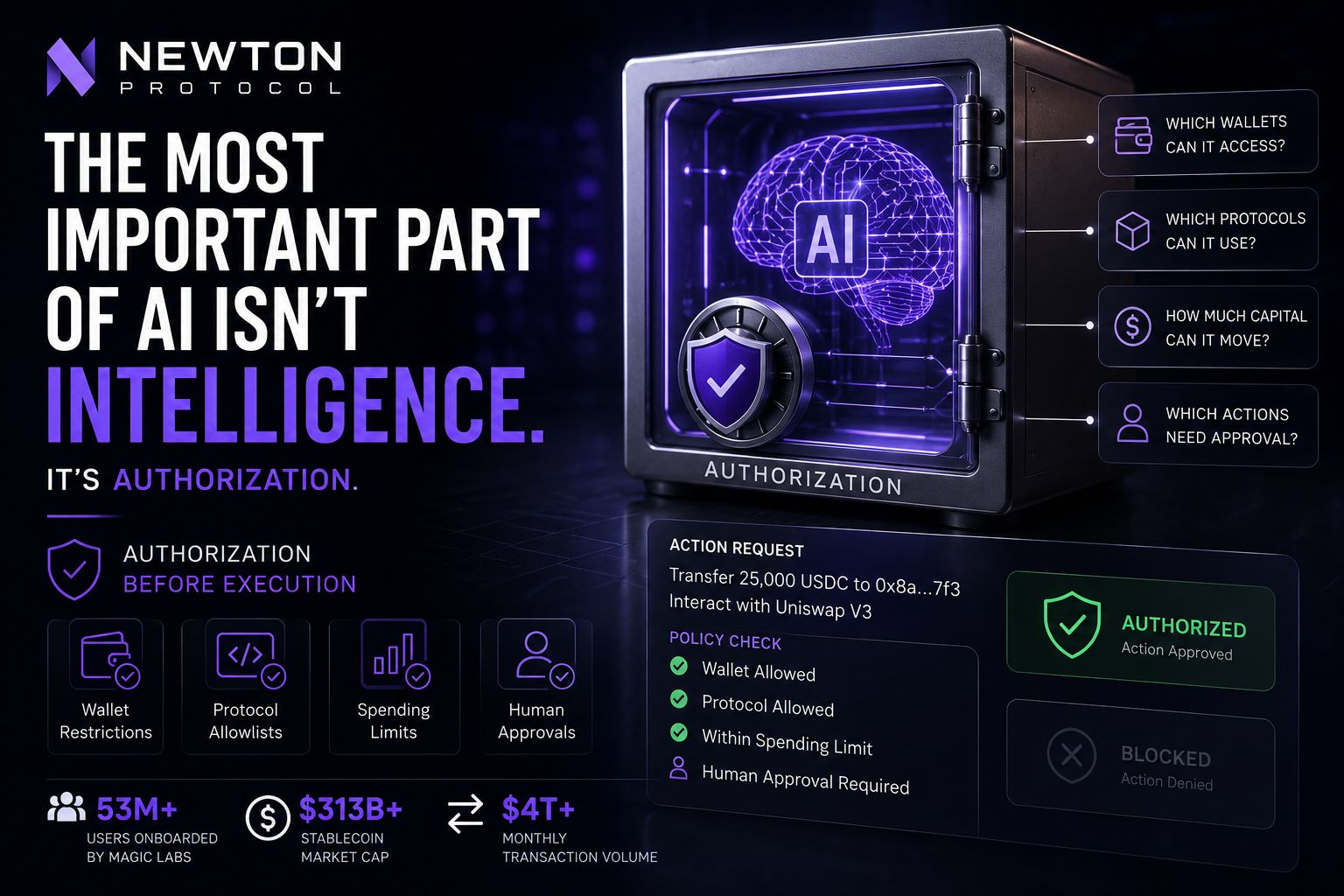
That's the part of Newton Protocol that convinced me to keep paying attention.
@NewtonProtocol #Newt $NEWT $NVDAB $BTC
