
Just read Ben @0x1164’s tweet and I immediately felt a strong resonance.
He said, “A brand is only a form of perception, and perception will eventually align with reality.”
As far as @GOATNetwork is concerned, the gap between perception and reality is extremely large right now.
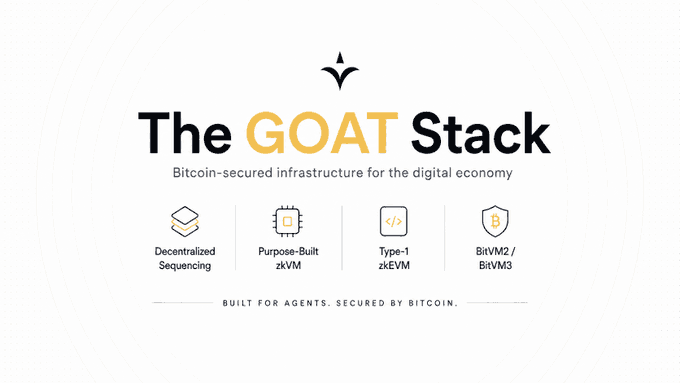
While most comparable products are still drawing up their product roadmaps, we’ve already released: BitVM2 bridge, a decentralized sequencer, a custom zkVM, and a complete suite of proxy infrastructure components—next up is BitVM3.
Perception will eventually catch up to reality. It always does.
I think Ben said it perfectly!
Bitcoin holders already hold assets worth hundreds of trillions, but the moment it comes to financial operations like cross-chain transfers, earning interest, or trading, the coins have to be handed to third-party custody or multi-signature bridges. Those so-called “Bitcoin L2” offerings out there are essentially sidechains or custodial bridges, and they lack a permissionless exit mechanism. The core contradiction GOAT Network seeks to solve is simple—when the system goes wrong, can the Bitcoin main chain govern itself?
GOAT’s approach is based on BitVM2 technology. Using only Bitcoin’s existing base primitives—pre-signed transactions, one-time signatures, and Taproot—it built a challengeable execution mechanism. Without upgrading the protocol, Bitcoin can verify off-chain computation and enforce correctness.
Let’s look at what GOAT has actually delivered on the ground, specifically:
In January 2026, GOAT’s BitVM2 testnet V3 officially went live—this is a test network with Bitcoin as the ultimate arbitration layer. The testnet has a complete zkRollup architecture, supporting off-chain execution on Layer 2, Bitcoin-anchored ordering, and mainnet dispute resolution.
To turn BitVM2 from theory into a usable system, GOAT did several key things: improved the Bitcoin-anchored ordering mechanism, supported efficient withdrawals, and compressed the data volume of fraud proofs by roughly 1,000x through Garbled Circuits and DV-SNARKs. At the same time, it also achieved a 1-of-n honest security model.
The entire stack is structured like this— a Bitcoin L2 settlement layer, a BitVM bridge, a Type-1 zkEVM execution layer, a decentralized sequencer, plus an agent payment system. Type-1 zkEVM is fully compatible with Ethereum, meaning developers can deploy existing EVM applications directly. Gas is paid with BTC—not wrapped assets, and not some separate utility token.
But what truly piques my interest is BitVM3.
BitVM3 mainly optimizes collateral efficiency and capital efficiency for bridging. On top of BitVM3, the GOAT team implemented a Label Forward Propagation scheme to achieve reusable garbled circuits, compressing off-chain data from hundreds of GB down to the MB level. The original BitVM3 architecture would take another 5 to 10 years to become practical, and GOAT shortened that to 6 to 12 months. This gap is a real, solid technical barrier.
GOAT’s plan goes beyond technology itself.
The project is already moving toward the AI agent economy—x402 payment channels, the ERC-8004 agent identity standard, the AgentKit developer toolkit, and the .goat domain service. For autonomous agents to transfer real value, they need a fully trusted settlement layer, and that’s exactly what GOAT aims to build. In February 2026, they jointly launched the global hackathon “Agent Economy on Bitcoin” with OpenBuild, with a total prize pool of about $3,500.
In the ecosystem, applications such as GOATUP, GOATSwap, and Avalon Finance can already interact in practice. The project also plans deep collaboration with ETFs, sovereign funds, and DAT to jointly build a decentralized Bitcoin Layer 2 infrastructure.
Regarding GOAT’s investment value, I have a few views:
First, the market’s understanding of GOAT is still lagging far behind the project’s actual progress. While most comparable projects are still working on their roadmaps, GOAT has already delivered the BitVM2 bridge, a decentralized sequencer, its own zkVM, and a complete suite of agent infrastructure. This “perception lag” in itself is an opportunity—once the market catches up, the valuation framework will recalibrate.
Second, the Bitcoin L2 track itself hasn’t even reached the ceiling yet. Kevin Liu, a core contributor to GOAT, once said: “The Bitcoin L2 market hasn’t truly started yet.” What’s currently being called Bitcoin L2 is essentially still a sidechain or a custodial bridge, lacking a permissionless exit mechanism and dispute resolution capabilities that can be enforced by the Bitcoin main chain. GOAT is one of the few projects that bakes a decentralized sequencer directly into the architecture, eliminating single points of failure and double-spend risk. In this still-embryonic market, the first-mover advantage combined with architectural advantages creates room for significant value capture.
Third, GOAT’s revenue model is also quite different from other projects. Many projects manufacture “artificial yield” through token incentives, while GOAT pursues real yield that is denominated in BTC and settled on-chain. Turning dormant BTC into sustainable yield-bearing assets: the corresponding market size is on the order of trillions.
Perception will eventually catch up to reality—this is a quote from Musk, and it’s also my judgment about GOAT Network. When the market truly understands what this project has already delivered and what direction it’s heading, the valuation logic will change completely. #LFGoat