



Original Jerry popular blockchain December 26, 2025 12:20 Japan immersed in reading on the novel reader
 This is the 2188th original issue of the popular blockchain
Author | Jerry
Produced by | Popular Blockchain (ID: hellobtc) [Total 2636 words, estimated reading time 7 minutes]
“The profit created by 1 dollar in bank deposits is 10 times that of the same amount of USDC on Aave.”
This assertion has been widely circulated in the community recently, although it lacks precise data sources, it likely reflects some real phenomenon. From traditional financial indicators like net interest margin (NIM), banks do indeed show structural advantages in profitability.
But can this '10x gap' explain everything?
When we shift our perspective from absolute profit to unit efficiency, from balance sheets to operational costs, from macro scale to per capita output, we uncover a starkly different story.
01
Profit duel between two worlds: scale vs efficiency
Absolute scale - The overwhelming advantage of banks
If we only look at net profits, traditional banks remain one of the most profitable machines on the planet.
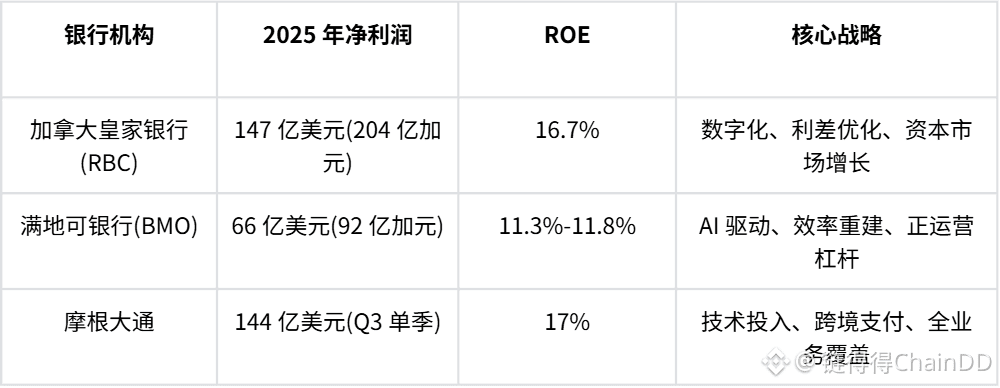
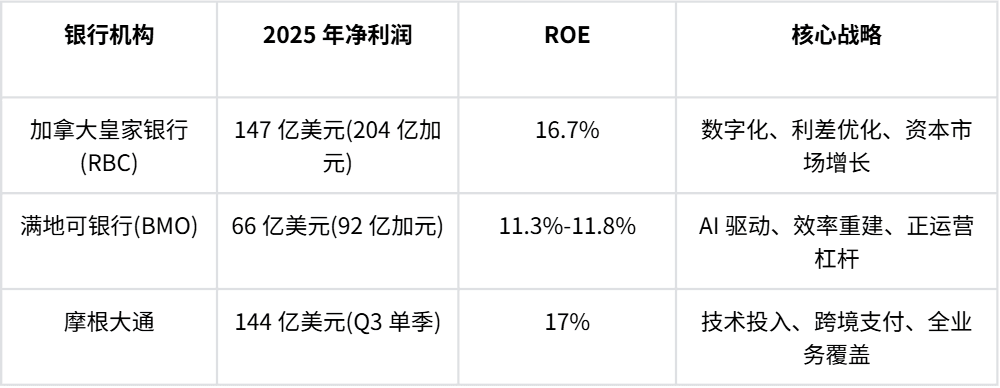
In the 2025 fiscal year, Royal Bank of Canada (RBC) achieved a net profit of CAD 20.4 billion (approximately USD 14.7 billion), representing a 25% increase over the previous year, with ROE rising from 15.5% to 16.7%. Bank of Montreal (BMO) reported a net profit of CAD 9.2 billion (approximately USD 6.6 billion), achieving a reduction in operational efficiency to 56.3% through a 'digital-first, AI-driven' strategy.
JPMorgan across the ocean is even more terrifying, achieving a net profit of USD 14.4 billion in just the third quarter of 2025, with an ROE of 17%.
Key indicators for top banks in 2025
On the DeFi side, the situation is completely different.
As the leader in the decentralized lending market, Aave's total fee income reached USD 389 million in 2024, a 244% year-over-year increase. As of October 2025, Aave's revenue for the year has exceeded USD 105 million, setting a record for the highest revenue for the same period in history.
Another giant, MakerDAO, achieved over USD 313 million in fee income in 2024, a 176% year-over-year increase. In December 2024 alone, MakerDAO generated close to USD 40 million in fees.
Emerging protocol Ethena's performance is even more impressive, with its monthly growth rate once reaching 150%, growing from USD 1.7 million in monthly fees to over USD 267 million by year-end in less than a year.
In the traditional financial world, these figures are even less impressive than those of a regional commercial bank. In absolute profit terms, banks have a crushing advantage.
Unit efficiency - The dimensionality reduction of DeFi
But if we look at it from another perspective, measuring 'how much cost is consumed for every dollar of income', the conclusion will be completely reversed.
In terms of human resource efficiency, traditional banks have a massive workforce dedicated to compliance monitoring, branch operations, IT maintenance, and customer service. JPMorgan's revenue per employee in 2024 is approximately USD 879,000, which is among the top levels in traditional industries.
However, leading DeFi protocols often require fewer than 100 core developers and operational staff to manage assets worth hundreds of billions of dollars. The annual revenue of protocols such as Uniswap Labs, Aave, and Lido Finance, divided by the number of core team members, can yield per capita revenue often reaching tens of millions of dollars. This extremely high capital leverage stems from smart contracts replacing a significant amount of administrative and operational functions, achieving a truly 'staffless' transaction processing.
The comparison of customer service costs is even more startling. Brazilian digital bank Nubank, while not a complete DeFi protocol, has adopted a similar minimalist digital architecture, making its data highly valuable for reference:
Comparison of customer service costs
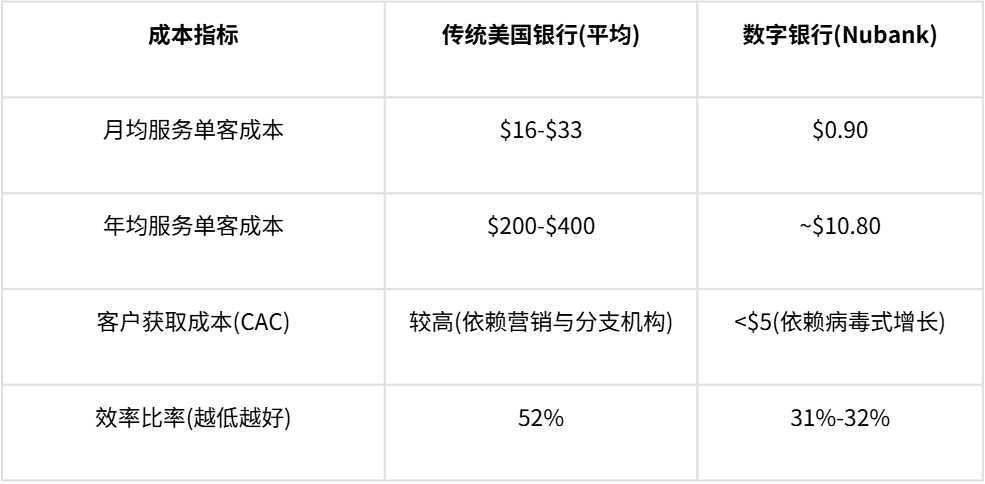
DeFi protocols go even further. Since there is no need to maintain any physical entities, and users operate through self-custody wallets, the service costs at the protocol level are almost zero. This extremely low operational cost means that even if the fees charged by the protocol are far lower than those of banks, their final profit margin can still be very high.
This is the other side of the '10x gap' story that you weren't told: in absolute scale, banks hold an overwhelming advantage; but in unit efficiency, DeFi has achieved a hundredfold advantage over banks.
02
Who does on-chain lending serve?
Aave's outstanding loan amount has exceeded USD 20 billion, but why would people borrow on-chain?
Analyzing the actual uses of Aave borrowers reveals essential differences between on-chain credit and traditional banking services. Borrower strategies can be categorized into four types:
Yield ETH arbitrage (45% share) - Borrowing WETH against staked ETH to earn the yield difference. This type of transaction accounts for 45% of the total outstanding loans and primarily comes from 'circular stakers' on platforms like EtherFi. As long as the WETH borrowing rate remains below 2.5%, basis trading can be profitable. Stablecoin circular staking - Forming basis trading through interest-bearing assets like USDe. This strategy is highly sensitive to funding rates and protocol incentives, and its scale can quickly shrink when market conditions change. Volatility collateral + stablecoin debt - This is the main source of interest used for leverage in increasing cryptocurrency holdings or for liquidity mining. The lending revenue from USDC and USDT accounts for over 50% of Aave's total revenue. Other strategies - Include shorting assets and trading currency pairs. Although some users use loans for real economic activities, the scale of such uses is extremely limited compared to 'on-chain leveraged arbitrage'. This reveals a key fact: current DeFi lending is essentially an amplifier of crypto-native leverage, directly linked to 'crypto GDP', rather than a financing tool for serving the real economy. This is the fundamental reason for the significant differences in their profit structures compared to traditional banks.
03
Why can banks maintain a profit advantage?
Why is the revenue efficiency of 1 dollar in banks still significantly higher than Aave? The answer lies in three structural differences:
Lower financing costs - Banks absorb funds based on the Federal Reserve's benchmark interest rate, typically lower than Treasury yields; whereas the deposit rate for USDC on Aave is often slightly above Treasury yields.
Higher risk transformation premium - Banks manage unsecured loans for tens of billions of dollars, and the complexity of credit risk management is much higher than DeFi's over-collateralized model. Although Aave's stablecoin loan rates can reach 10%-15%, the earnings mainly go to liquidity providers, with the protocol retaining only a small share. As intermediaries, banks can capture larger spreads, and unsecured credit has a higher risk premium.
Regulatory moat and pricing power - The oligopolistic structure of the banking industry, high user switching costs, and entry barriers grant banks strong pricing power, allowing them to earn considerable returns from the interest rate spread.
However, banks are not sitting idle; 2025 is becoming a turning point.
The passage of the GENIUS Act in the U.S. paves the way for institutional-level DeFi, with the organic trading volume of stablecoins exceeding USD 1 trillion, more than doubling year over year. More importantly, banks are actively 'adopting' DeFi technology.
Swift announced in 2025 that it would introduce a blockchain-based shared ledger to enable 24/7 real-time processing of cross-border payments. Tokenization platforms for real-world assets (RWA) have become the fastest-growing category in DeFi, with giants like BlackRock and Franklin Templeton already putting fund products on-chain.
Banks have not only avoided marginalization but have also expanded their product reach and liquidity through DeFi protocols.
04
Summary
Returning to the initial question: 'Is the profitability of banks really 10 times that of DeFi?'
The answer needs to be viewed from two perspectives:
In terms of absolute scale, banks occupy more than 90% of global financial profits due to their massive capital reserves, customer credit relationships, and legal frameworks. The performance of RBC, BMO, and JPMorgan in 2025 proves that banks have successfully resisted disruption by embracing AI and digitalization.
In terms of unit efficiency, DeFi has achieved a hundredfold advantage over banks. Through 'code is law', DeFi has eliminated the cost redundancies associated with branches, large compliance teams, and slow clearing processes.
However, for DeFi to truly threaten the profit foundation of banks, it must break free from the 'crypto cycle binding'. Lending protocols are gradually incorporating new types of risks and collateral such as tokenized RWA, on-chain credit, and crypto-native credit scores. When credit business decouples from price cycles, its profit margins will also escape the constraints of cycles.
DeFi may not be able to 'disrupt' banks at a single entity level, but it is 'disrupting' the operational logic of banking.
The true winner of this competition will be those hybrid financial institutions that can balance 'decentralized efficiency' with 'institutional safety'.