


Original title: (Issued tokens first, then raised; VVV rose 12x in half a year, and still secured an investment of $65 million)
Original author: Sanqing, Foresight News
On July 1, the privacy AI platform Venice completed a $65 million Series A funding round. The post-money valuation reached $1 billion. Dragonfly led the round, with participation from North Island Ventures, Coinbase Ventures, Archetype, Liquid2 Ventures, Morgan Creek, and others.
For the first time since Venice was established more than two years ago, it has introduced external institutions’ equity capital. The funding from this round will be used to build Venice’s first owned data center, reducing reliance on leased GPU computing power.
Meanwhile, according to Bybit market data, VVV’s annual price increase at one point exceeded 1,200%. It was around $1.62 at the beginning of the year, and on June 3 it reached an all-time high of about $21.469. The current price is hovering around $13, with a circulating market cap of roughly $600 million. The company disclosed that it became profitable in the first quarter of 2026, with annualized revenue exceeding $70 million.
Equity financing, not token cash-out
On January 27, 2025, Venice launched the VVV token on the Base chain with a total supply cap of 100 million tokens. 50% is distributed via airdrop: 25% to about 100,000 early users, and 25% to AI agent projects such as Virtuals, Luna, aixbt, and VaderAI, plus roughly 200 Coinbase AgentKit developers. Of the remaining allocation, 35% is held by Venice itself, 5% goes into the liquidity pool, and 10% is allocated to an incentive fund.
As you can see, Venice’s path to capitalization doesn’t follow the old route of round after round of equity financing like traditional AI startups. Instead, it first kickstarts the community with token economics, then brings in equity capital after the data proves out.
For a company that is already profitable and has already implemented a token-based deflation mechanism, the money being raised is not buying room to survive—it’s buying control over costs and autonomy over the supply chain.
In a long post in the announcement tweet about the funding, CEO Erik Voorhees disclosed the deal’s specific structure: Series A investors receive 8.98% equity in the company, plus a 1.5 million VVV attribution grant (vesting grant), and warrants to buy an additional 5 million VVV for about $66.5 million over the next eight years.
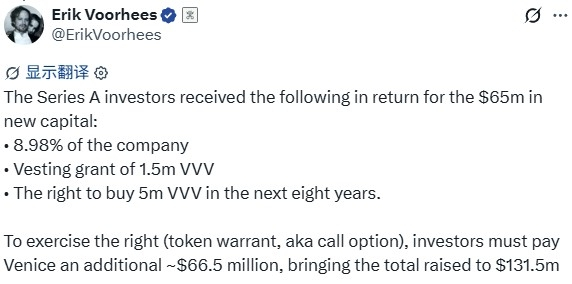
If all the warrants are exercised, the total amount of this transaction would expand from $65 million to $131.5 million. The tokens underlying the grants and warrants are locked for one year, followed by linear vesting over the next three years. Even if all warrants are fully exercised, the新增 circulating supply, according to Voorhees’s estimates, would be about 6,000 tokens per day—only about 0.2% of current daily trading volume. Therefore, the dilution impact on the secondary market is limited.
Voorhees emphasized that Venice is currently the largest holder of VVV in the VVV ecosystem. The company and its team together hold more than the amount of tokens issued when the token launched, and to date, they have not sold a single token.
Co-founded by a veteran of the crypto industry and a cloud computing engineer
Founder and CEO Erik Voorhees is one of the earliest crypto entrepreneurs. Before this, he founded the decentralized trading platform ShapeShift, and he has long been a representative voice for Bitcoin sovereignty and an anti-regulation stance. Venice’s privacy narrative continues the same position he has consistently held.
Co-founder, President, and Chief Technology Officer Jesse Proudman has more than 20 years of entrepreneurial and engineering experience. He founded the Seattle cloud hosting company Blue Box Group in 2003, building private cloud services based on OpenStack; it was acquired by IBM in 2015. He later co-founded the crypto asset trading platform Strix Leviathan. Before joining Venice full-time, he also served as Vice President at the fintech company Betterment for about three years.
Voorhees provides the vision and community narrative; Proudman is responsible for turning the narrative into infrastructure that can run at scale.
Alongside the funding announcement, Voorhees published a long article outlining Venice’s philosophical foundation: human thought is inherently private and not subject to scrutiny, but once minds begin to merge with machine intelligence, this sovereignty is being quietly taken back by mainstream AI companies under the name of “safety.” He raises the question: whether it’s a laboratory board or a government, who is actually authorized to hold the power to peer into human thoughts.
This stance is also a double-edged sword. Removing content moderation means Venice must shoulder on its own the content liability that may arise from uncensored outputs, as well as cross-jurisdiction regulatory pressure. In most countries and regions, where regulation of AI-generated content is still tightening, this is a risk that both investors and users need to confront—not just a bonus to the privacy narrative.
One API Key to access multiple uncensored models
Venice’s product narrative centers on one core promise: it does not record users’ prompts and responses on the server side. User inputs are encrypted on-device, transmitted encrypted end-to-end, and decrypted only inside an authenticated trusted execution environment (TEE).
Venice partners with external TEE service providers such as NEAR AI Cloud and Phala Network. Neither the GPU compute providers nor Venice itself can access plaintext data, and each response comes with a verifiable “remote attestation” proof. The platform also removes many of the extensive content moderation mechanisms common in mainstream AI products.
Privacy is not charity—it’s part of product pricing.
With a single interface or an API Key, users can access over 250 open-source and closed-source models, covering multiple formats including text, images, video, audio, and vector embeddings—along with anonymized access to mainstream models such as Claude, GPT, and Kimi, as well as fully private inference for some deployable open-source models.
On the product side, it also offers developers and AI agents capabilities such as MCP (Model Context Protocol, an open protocol that lets AI call external tools and data), file input, web search scraping, on-chain RPC proxying, and more. It also supports private coding by calling Venice’s models directly through programming tools like Claude Code and Cursor. In addition, it supports connecting Venice agents through instant messaging tools such as WhatsApp, Telegram, and Discord.
For commercialization, Venice adopts a free-with-subscription tiered model: the Free tier provides 10 daily text conversation credits; paid tiers range from Pro (starting at $18/month) to Pro Plus, up to the top-tier Max ($200/month, includes 22,500 points per month that can be rolled over for up to 3 months).
In addition to subscriptions, Venice also supports direct paid API calls using USDC on the Base chain. No account registration is required. It is designed specifically for automated agents; however, reports say that this portion of encrypted payments currently accounts for only about 8% of total revenue, while subscriptions and traditional API billing remain the main revenue sources.
In addition, VVV is not just a governance token.
After users stake VVV, they can mint DIEM. Each DIEM corresponds to a daily $1 API call quota with permanent validity. Even if the VVV market price fluctuates later, the minted DIEM quota is unaffected. During the staking period, users can still earn about 80% of regular staking rewards.
The funding announcement also disclosed that by this June, Venice’s platform has about 3.5 million registered users, processes about 1.7 million API calls per day on average, and reaches a token processing volume on the order of trillions per month.
While many AI companies in the industry are still telling stories with scale and vision, Venice chooses to tell its story with financial statements. Once its own compute power is deployed, whether Venice can sustain its “privacy” advantage and its sustainable cost advantage will be the real test in the next phase.
Original link