


For years, blockchain solved a huge problem: allowing people to move value without depending on a central authority. But as the ecosystem grew, another question emerged—one that is rarely discussed.
What happens before a transaction occurs?
Because one thing is knowing what happened after an operation, and a completely different one is having a layer that can evaluate whether that operation complies with certain rules before it is executed.
That shift in perspective is what caught my attention in Newton Protocol.
With Newton Mainnet Beta, the idea is to create an onchain authorization layer where transactions can be checked against active policies before settlement, generating an approval or rejection within the same process.
And although it may sound like a technical detail, it actually addresses one of the biggest problems for DeFi adoption.
Trust.
Because when we’re talking about large amounts of capital, vaults, institutions, or automated systems, it’s not only important that something works.
It also matters under what conditions it works.
That’s where concepts like compliance, identity, security, and risk start to matter more.
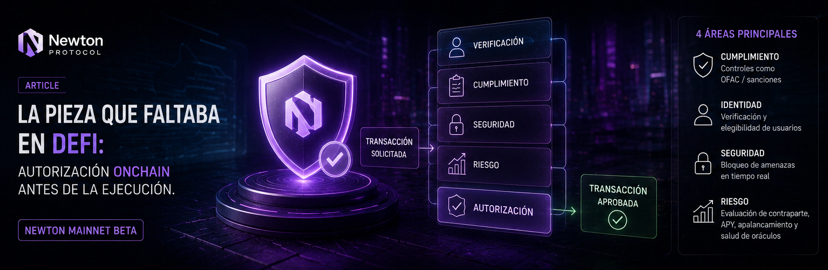
A vault shouldn’t depend only on rules written outside the system. A protocol shouldn’t only show what happened. More mature financial infrastructure needs mechanisms that can apply those decisions directly.
That’s why I think Newton is exploring an interesting direction.
It’s not just about adding more features to DeFi.
It’s about building a layer where rules can become part of execution.
And the closer crypto gets to a world with more institutional capital, real-world assets, and artificial intelligence agents taking action, the more important it will be to answer a question:
Who decides what can happen before it happens?
