What if the future of DeFi doesn’t depend on making more transactions… but on knowing which ones should happen?
Something that has always seemed strange to me about blockchain is that we have enormous transparency after something has already occurred. We can see movements, contracts, and operations, but many times the most important question comes too late: who verified that this action made sense before it was executed?
Because in traditional financial systems there’s something we often take for granted. Before money moves, there are rules, permissions, and controls. It’s not only about recording what happened—it's also about deciding under what conditions it was allowed to happen.
The more DeFi grows, the more I think this layer will be necessary. Because if we want more capital, institutions, and users to enter the ecosystem, the question won’t be only whether a transaction can be executed.
It will be whether it should be executed.
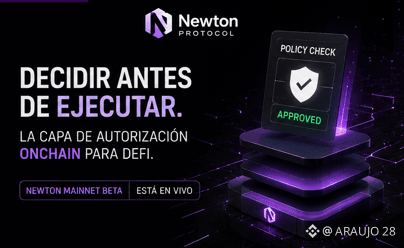
That’s why I started looking at @NewtonProtocol y Newton Mainnet Beta from another angle. Not as just another tool within crypto, but as an idea to create an onchain authorization layer where policies can be applied before value moves.
And that’s where something interesting comes up:
What happens when vaults can have rules that are truly enforced on-chain? What happens when security, risk, identity, and compliance stop being separate processes?
I think that will be one of the most important conversations of the next stage of DeFi.
Because blockchain has already learned to record actions.
Now the next step could be learning to control decisions.
#newt $NEWT @NewtonProtocol
Something that has always seemed strange to me about blockchain is that we have enormous transparency after something has already occurred. We can see movements, contracts, and operations, but many times the most important question comes too late: who verified that this action made sense before it was executed?
Because in traditional financial systems there’s something we often take for granted. Before money moves, there are rules, permissions, and controls. It’s not only about recording what happened—it's also about deciding under what conditions it was allowed to happen.
The more DeFi grows, the more I think this layer will be necessary. Because if we want more capital, institutions, and users to enter the ecosystem, the question won’t be only whether a transaction can be executed.
It will be whether it should be executed.
That’s why I started looking at @NewtonProtocol y Newton Mainnet Beta from another angle. Not as just another tool within crypto, but as an idea to create an onchain authorization layer where policies can be applied before value moves.
And that’s where something interesting comes up:
What happens when vaults can have rules that are truly enforced on-chain? What happens when security, risk, identity, and compliance stop being separate processes?
I think that will be one of the most important conversations of the next stage of DeFi.
Because blockchain has already learned to record actions.
Now the next step could be learning to control decisions.
#newt $NEWT @NewtonProtocol