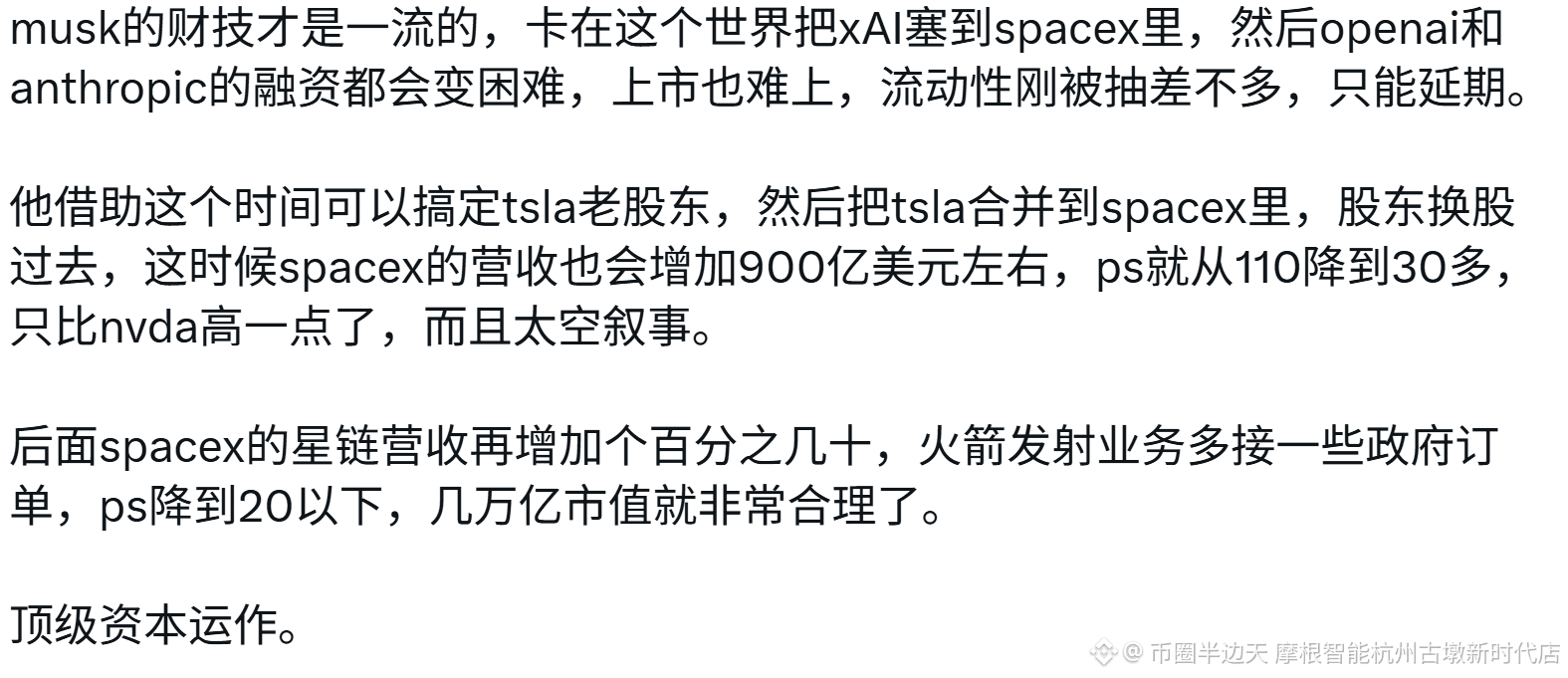
Many Tesla institutional shareholders believe that a merger would dilute their own equity—Tesla has clear cash flow and profitability, while SpaceX is still in a stage of large losses and heavy investment. Using Tesla’s high-quality assets to obtain SpaceX’s highly valued stock is not a good deal for Tesla shareholders;
Another way to look at it is that Tesla shareholders are hoping for a merger—Tesla has fallen 15% this year, and profits are declining, so the merger is being viewed as a “rescue.” What actually needs to be “handled” is the other side: with the stock-for-stock deal, existing SpaceX shareholders would see their stake diluted from 100% to less than two-thirds—those who lose out are them.
TSLA shareholders would ask: Why should I trade transparent, highly liquid TSLA for a more complex, higher-capital-expenditure, giant hybrid that relies more on Musk’s credit? SpaceX shareholders would ask: Why should I take on the auto cycle, low margins, regulatory and brand risks?
Another way to look at it is that Tesla shareholders are hoping for a merger—Tesla has fallen 15% this year, and profits are declining, so the merger is being viewed as a “rescue.” What actually needs to be “handled” is the other side: with the stock-for-stock deal, existing SpaceX shareholders would see their stake diluted from 100% to less than two-thirds—those who lose out are them.
TSLA shareholders would ask: Why should I trade transparent, highly liquid TSLA for a more complex, higher-capital-expenditure, giant hybrid that relies more on Musk’s credit? SpaceX shareholders would ask: Why should I take on the auto cycle, low margins, regulatory and brand risks?