



The day it was trying to boost the revenue leaderboard, I watched $WLFI for a while.
It sits between $AAVE and $CAKE. At first glance it looks like it’s part of the same group—protocols bringing in real money. But if you really categorize it together with AAVE, you can easily end up at a disadvantage. The most distinctive thing about this project is that it separates—cleanly, cleaner than almost any project on the market—the question of whether the protocol is profitable from whether the token is worth anything. So cleanly that looking at the same name, you can reach two completely opposite conclusions.
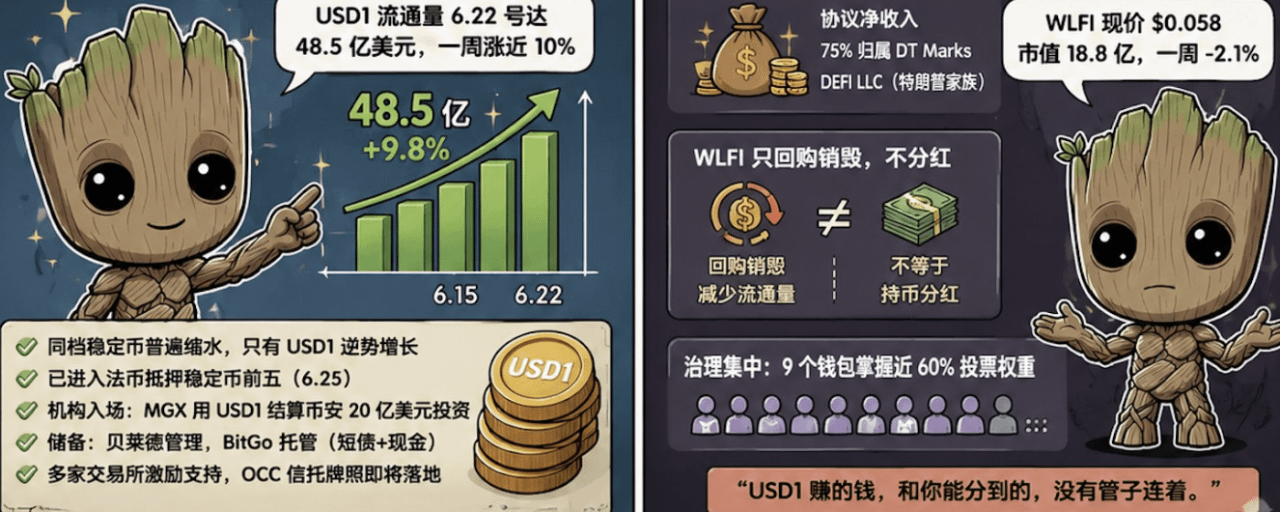
First, on the business side: USD1, this stablecoin, hit 4.85 billion in circulating supply on June 22. It rose by nearly 10 points over the course of the week. The key is that among stablecoins at the same level, most were shrinking that week. Sky’s USDS even fell by more than three points, dropping by nearly three hundred million. The entire stablecoin market that week was basically flat—except USD1, which was surging upward against the trend. By June 25, it had already firmly moved into the top five for fiat-collateralized stablecoins. Do the math: from the launch last March to now, it hasn’t even been a year and a half. In the history of stablecoins, this kind of pace ranks among the fastest.
What’s propping it up isn’t retail buying it little by little. It’s institutions lifting it from behind. The most telling example is the MGX from Abu Dhabi—settling in USD1 for a $2 billion investment into Binance. This is the largest stablecoin settlement deal in crypto history. Putting $2 billion into USD1 suddenly added $2 billion of liquidity out of thin air. And just that one transaction alone, estimates suggest it can bring the protocol $60–$80 million in revenue per year—provided Binance doesn’t redeem that money back. The reserves are managed by BlackRock and custody is handled by BitGo; on-chain it’s short-term treasuries and cash. Plus, in the recent period, Binance, Bybit, and Gate have all been running USD1 incentive programs. Bybit, for instance, handed out 40 million WLFI tokens as rewards. The OCC trust bank license reportedly is also close to approval. Once approved, USD1’s issuance will have a banking-level license endorsement. This coordinated set of moves is clearly designed to target institutions and compliance—not the game of grassroots plate-spinning.
So if you look purely at the $USD1 product, yes, it can perform—it has real growth and its revenue sources are clear. I’m not going to dance around that with you.
But the problem is here: over the same time period, WLFI’s current token price is only $0.058, with a market cap of $1.88 billion. And over that week it dropped 2.1%. Meanwhile, stablecoins are rising in big bursts, while the token quietly slides downward. These two paths trace completely opposite curves—not a coincidence. There’s a reason behind it.
Why? Open the whitepaper and you’ll understand.
WLFI is a governance token. It does not grant you any legal right to protocol revenue. Once money comes in, 75% goes to DT Marks DEFI LLC—the entity controlled by the Trump family. The protocol does use net revenue to buy back WLFI in the market and then burn it. That action compresses circulating supply—the logic is exactly the same as the BNB CAKE model of burning supply. But you have to distinguish buyback-and-burn from token-holder dividends completely. The former is a market action the protocol chooses to do; it can do it today and not do it tomorrow. The latter is written into the tokenomics model, meaning it’s a right holders can claim. When you buy WLFI, what you receive is governance voting power—specifically voting power capped at 5% per single wallet. Even funnier: earlier this January, a governance proposal—just nine wallets—ended up holding nearly 60% of the voting weight. In plain terms, the money USD1 earns and the portion you, as a WLFI holder, can receive from this project are intentionally separated. There’s no “pipe” connecting them. The root cause of why the token can’t move up lies right here.
Once you finish the token layer, there’s another layer that other protocols simply don’t have: politics and regulation.
Money from the Abu Dhabi Tanuun family: before Trump officially took office, five hundred million dollars was used to buy 49% of the shares. That was never disclosed at the time—it was later dug up by The New York Times. Along the way, two Tanuun associates also got seats on the board, and that wasn’t disclosed either. Now Congress is investigating whether this violates the constitutional “foreign compensation” red line. Just in the past few days, five Democratic senators jointly requested a hearing specifically to investigate this $500 million investment. Going further back: in April, there was another incident—WLFI used its own treasury tokens as collateral and borrowed $75 million in stablecoins from Dolomite, pushing that pool’s utilization rate up to 93%. Ordinary depositors couldn’t withdraw money for a while. The project team defended itself by saying there was no liquidation risk—but the market was genuinely nervous for a bit. These are not conclusions I came up with. They’re facts you can verify word-for-word in public reports. I’m laying them out so you can weigh the severity yourself—I’m not the one to decide how big a bomb this is.
Finally, back to the logic from the very beginning: this is a good entry point right now.
People who are bullish on this leaderboard have basically similar reasons. The clear law is about to land; once regulatory certainty arrives, agreements with real cash flows should be repriced across the board. That statement holds for most projects—but when it comes to WLFI, you have to take a detour. The ethical clause that’s currently holding up the clear law is precisely about whether government officials should cut financial interests with the crypto industry. And the cause of that clause is, conveniently, the Trump family’s own huge pile of crypto business. The White House’s stance is that the rules can apply uniformly—but they won’t accept terms for a specific position. Democrats say that without this clause, they can’t reach the 60 votes. With the Senate’s summer recess approaching, there are only about thirty-odd working days left. Ahead of it are a bunch of other bills. On Polymarket, the probability that this bill passes within the year used to be 74% a month ago, but it has fallen to 48% now. Same piece of good news hits AAVE and it’s pure tailwind. Hits WLFI and there’s an extra layer of political uncertainty, because whether the bill moves fast or slow is itself tied to the Trump family’s political situation—this is volatility that others don’t have to bear, but WLFI does have to bear on its own.
Stacked in three layers, one on top of another.
On the business side, USD1 is one of the fastest-growing stablecoins in this space. That’s true.
At the token level: WLFI does not capture protocol revenue. The money it earns can’t flow through to the token—this is also true.
On the external side, it also carries political and regulatory variables that other projects don’t have. That’s also true.
These three things do not conflict with each other—they can all be true at the same time. Being bullish on USD1’s growth is one matter. Deciding whether to buy WLFI is another. This project, more than most, needs you to separate these two issues and think them through independently.
Data as of the end of June: both stablecoin supply and the progress on the bill have started moving faster. If there are new updates, I’ll come back and update you.