

Blockchain protocols often pride themselves on being “permissionless” — anyone, anywhere can build on top of the protocol without asking for explicit approval.
But in practice, sometimes asking for permission is the wiser option.
According to the Snapshot interface, in the temperature check vote released by Lido DAO on "selecting solutions and teams for BNB Chain cross-chain wstETH", 81.13% of the votes were cast for "Axelar + Wormhole cross-chain solution".
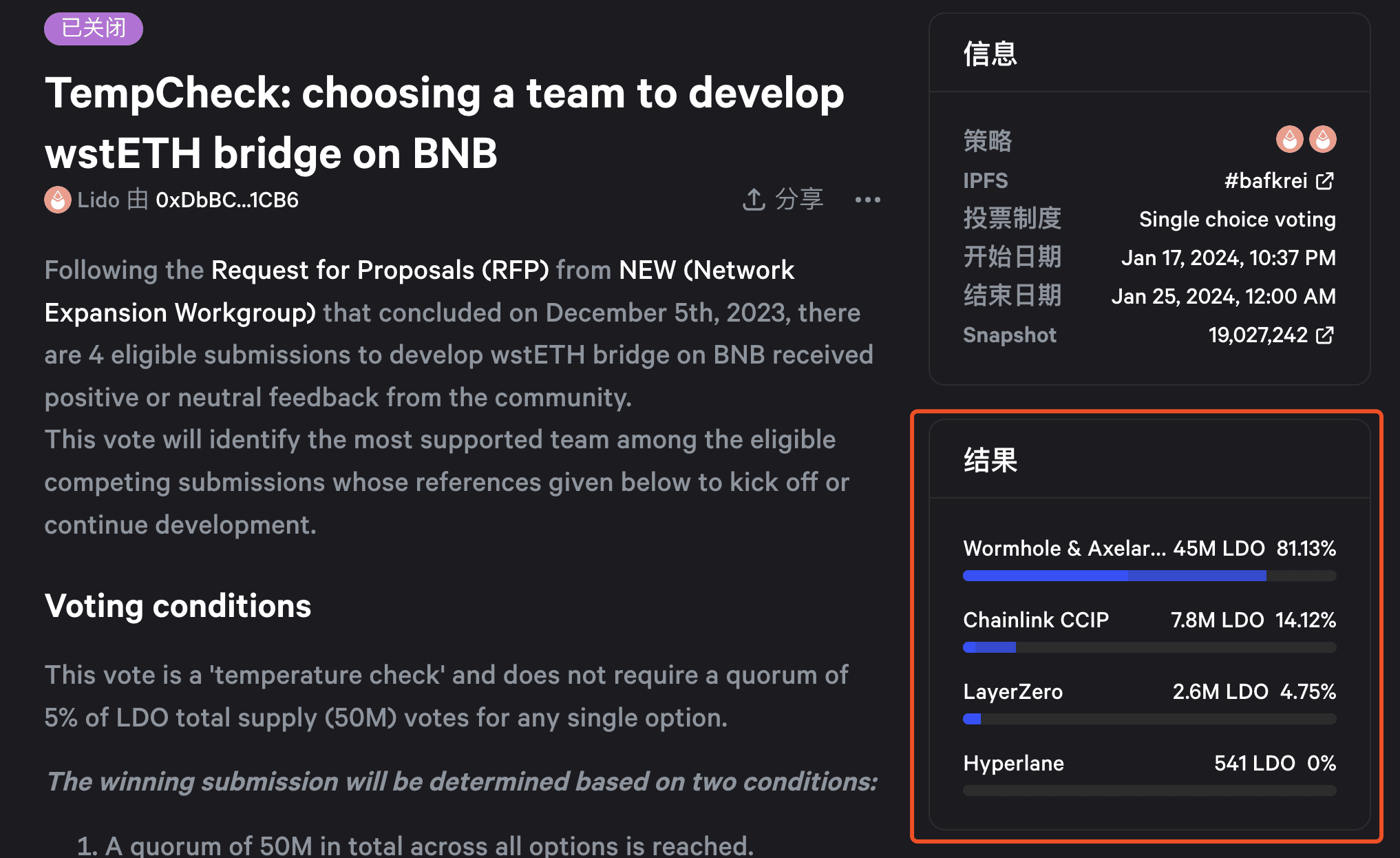
Image source: Snapshot
According to Axelar’s official introduction, the cross-chain solution was jointly proposed by Axelar Foundation and Wormhole. It is open source and scalable, and there is no vendor lock-in. In other words, Lido DAO can flexibly add or delete other cross-chain bridge providers and conduct cross-chain governance in the future.
This composability is a hallmark of the open-source approach in the Axelar and Wormhole proposals, and the other proposals were unable to replicate this in the vote, a flaw that could have skewed the outcome.
Initially, the bridge's contracts will be operated by validators from the Axelar network, contributors from the Wormhole Foundation, and multisigs from BNB Chain. Once cross-chain governance is implemented, ownership will be transferred to Aragon smart contracts operated by Lido DAO. Axelar Foundation and Wormhole will cover the costs of development and auditing, deploying the bridge as a public product at zero cost.
(Multiple crypto infrastructures jointly boycott LayerZero’s improper behavior)
It is worth noting that LayerZero deployed a cross-chain bridge for cross-chain stETH in October last year. Although LayerZero had previously requested the approval of Lido DAO (the community that manages the protocol), it deployed the bridge before waiting for the organization's formal approval. Critics believe that LayerZero is trying to impersonate Lido's official partner without DAO approval. At the time, a joint statement signed by multiple crypto infrastructure providers indicated that LayerZero seemed to be improperly taking advantage of its first-mover advantage and taking unfair means to "lock in" users ahead of competitors. In this temperature check vote, the LayerZero proposal received only 4.75% of the votes.
“The Axelar and Wormhole teams decided to collaborate and come together on a joint proposal where the security of both networks would be effectively combined to achieve strong security properties for transferring staked ether from one chain to another,” Interop Labs CEO Sergey Gorbunov told CoinDesk.
Robinson Burkey, Chief Business Officer at the Wormhole Foundation, said: “In my opinion, this is more important than a normal governance vote. It’s more about principle than actual technology. It’s in the best interest of the protocol to be able to communicate how you feel as a token holder. If you take power away from token holders, then you are undermining the foundation of decentralization.”