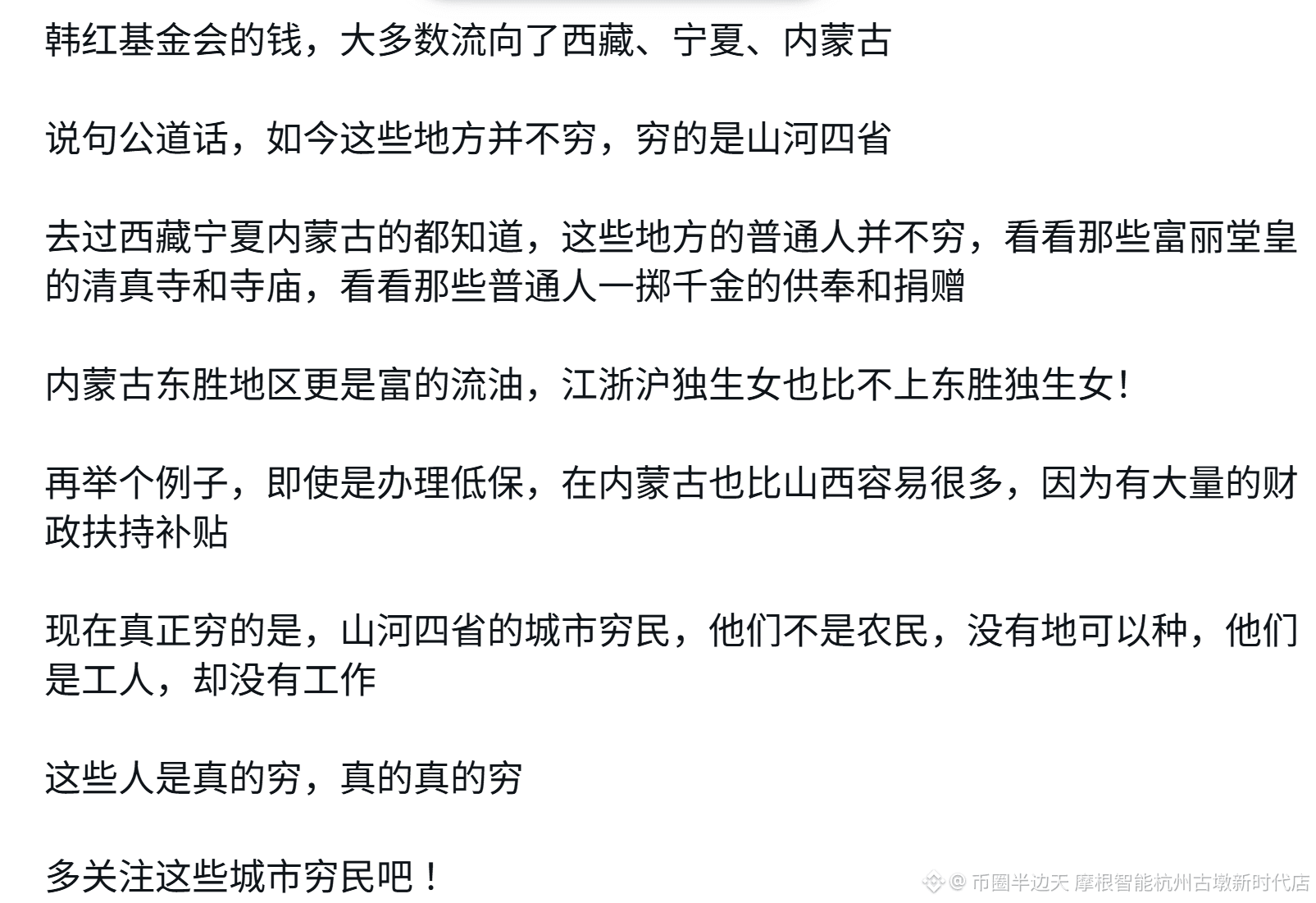
The urban disadvantaged groups in the four provinces along major rivers and mountains—especially older industrial areas, county towns, and low-income families that are unemployed or in flexible employment—have indeed been lacking visibility for a long time. They are not “traditional impoverished households,” but their cash flow, healthcare, elder care, and children’s education pressures may be very heavy.
Public information on the website of the Han Hong Foundation shows that its main line is grassroots/rural healthcare assistance, not simply giving money based on “which province is the poorest.” Its publicly described “Medical Assistance for 100 People” series states that, as of September 2022, its footprint includes 12 provincial-level regions: Tibet, Inner Mongolia, Xinjiang, Qinghai, Guizhou, Gansu, Ningxia, Shaanxi, Sichuan, Yunnan, Guangxi, and Heilongjiang—not only Tibet, Ningxia, and Inner Mongolia. The foundation’s publicly listed projects also include the Gansu earthquake, the Shigatse earthquake, Zhengzhou flood relief, and Wuhan anti-epidemic efforts.
I disagree with using temples, mosques, or the practice of offering and donating to temples/religious figures to judge that “ordinary people are not poor.” Religious buildings, religious donations, and local ordinary household income, as well as the accessibility of county and township healthcare and the emergency-response radius, are not the same thing. Even if Dongsheng/Ordos is well-off, that cannot represent all of Inner Mongolia; the impressions of Lhasa, Yinchuan, and Hohhot also cannot represent remote counties and rural townships.
Public information on the website of the Han Hong Foundation shows that its main line is grassroots/rural healthcare assistance, not simply giving money based on “which province is the poorest.” Its publicly described “Medical Assistance for 100 People” series states that, as of September 2022, its footprint includes 12 provincial-level regions: Tibet, Inner Mongolia, Xinjiang, Qinghai, Guizhou, Gansu, Ningxia, Shaanxi, Sichuan, Yunnan, Guangxi, and Heilongjiang—not only Tibet, Ningxia, and Inner Mongolia. The foundation’s publicly listed projects also include the Gansu earthquake, the Shigatse earthquake, Zhengzhou flood relief, and Wuhan anti-epidemic efforts.
I disagree with using temples, mosques, or the practice of offering and donating to temples/religious figures to judge that “ordinary people are not poor.” Religious buildings, religious donations, and local ordinary household income, as well as the accessibility of county and township healthcare and the emergency-response radius, are not the same thing. Even if Dongsheng/Ordos is well-off, that cannot represent all of Inner Mongolia; the impressions of Lhasa, Yinchuan, and Hohhot also cannot represent remote counties and rural townships.