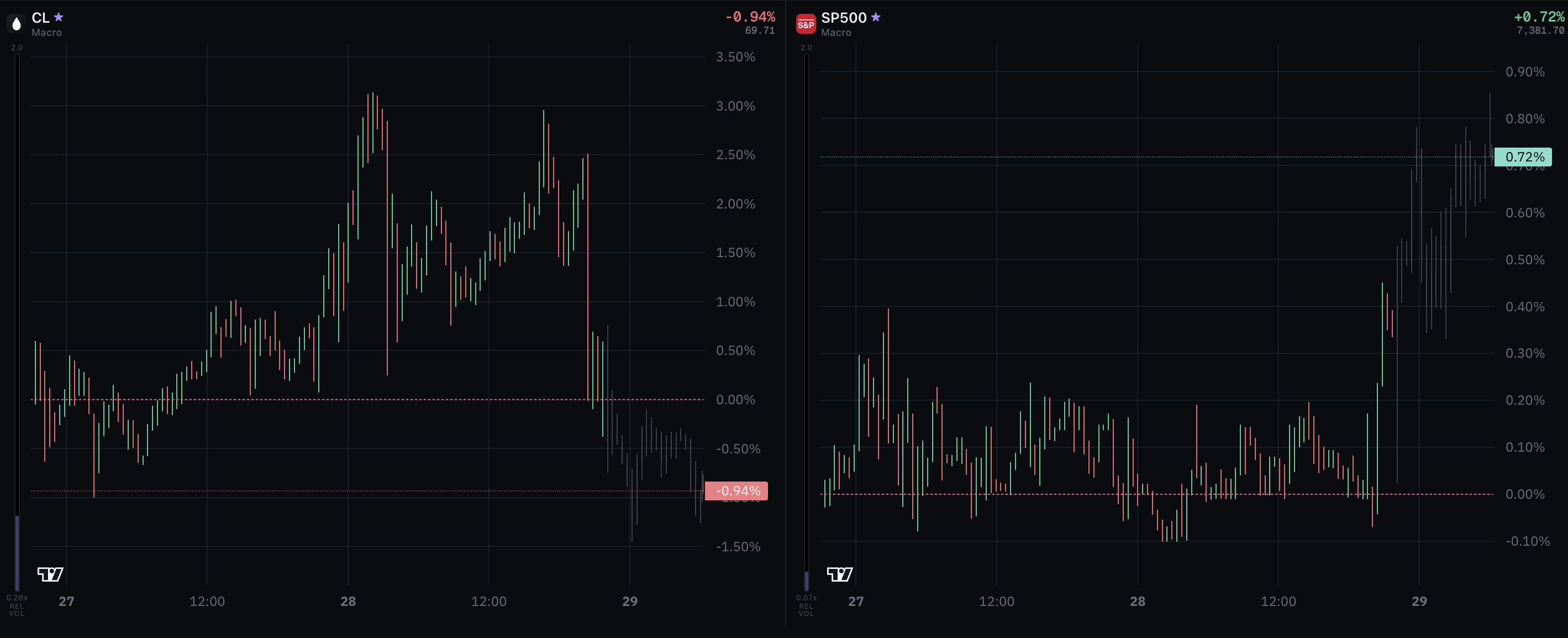
Last week, a four-party meeting in Switzerland had just "made good progress." But the fragility of the ceasefire memorandum signed by the U.S. and Iran far exceeded market expectations. It took effect only 11 days ago, when tensions flared again due to the two sides’ different interpretations of the Hormuz Strait provisions. This weekend, crude oil and the S&P 500 completed a full round of the cycle: "post-close escalation of the situation and easing of the atmosphere before the open."
U.S.-Iran situation
The root of the two countries’ differences is who actually has authority over the strait.
Iranian Foreign Minister Aragchi said last Sunday that, under the preliminary agreement, Iran has "exclusive rights" to manage traffic through the Strait of Hormuz, and that any attempt to bypass its authority "could trigger a series of strikes recently seen." This directly contradicts the U.S. position: Washington believes the agreement never granted Iran any control, and that this international shipping lane must remain unobstructed. U.S. Ambassador to the United Nations, Linda Thomas-Greenfield, issued a stern warning on Fox: the U.S. will not tolerate any further attacks on ships.
The spark for the conflict was that Iran attacked a ship trying to skirt the Omani coast and cross the strait while avoiding Iran’s designated shipping routes. Tehran wants all ships to use the specific routes along its coast; for every ship that diverts through Omani waters, Iran’s “leverage” effectively drains away. In the days that followed, Iran repeatedly attacked a container ship and a tanker carrying Qatar oil (Qatar is one of the parties mediating). The U.S. retaliated by targeting Iran’s communications facilities along the coast, as well as drone and missile positions. Iran then attacked Kuwait and Bahrain.
In Swiss negotiations, the U.S. and Iran had agreed to set up a “hotline” between U.S. forces and the Revolutionary Guard to coordinate passage scheduling through the strait, but as of last Saturday this hotline still hadn’t gone into operation. Meanwhile, Iran has restarted asking ships to “coordinate in advance” for passage. At the same time, negotiations have stalled. According to Iran’s state television, Iran skipped the originally scheduled technical talks on Sunday due to recent attacks and “unfulfilled conditions.”
The turning point came late Sunday night, just before the futures market opened. Axios reported that the U.S. and Iran have agreed to stop attacking each other and plan to meet in Doha on Tuesday, specifically to resolve the dispute over the strait.
Crude oil / S&P 500
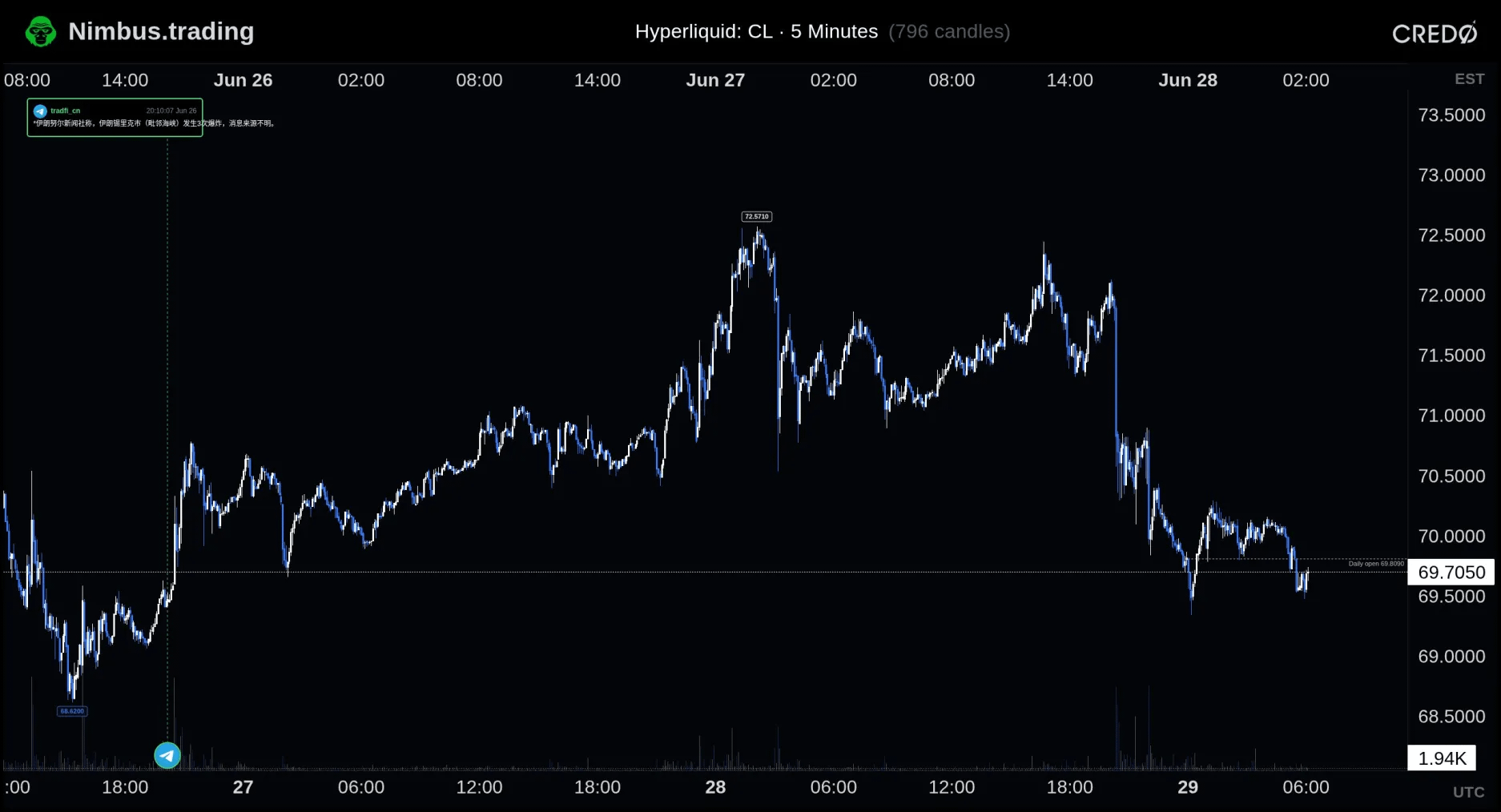
Early Saturday at 4:30, Iran’s Nour News Agency said there were three explosions in Sirik City, adjacent to the strait (source unclear). This “battle flare-up” signal put oil prices into an upward trend, topping out at $72.57.
On Sunday at 7:14, Trump poured fuel on the fire: “They very likely will never learn their lesson,” “Maybe one day we won’t be able to stay rational anymore and will be forced to use force to accomplish the mission,” and “If that happens, the Islamic Republic of Iran will cease to exist.” Oil prices remained in tense, choppy trading while staying elevated.
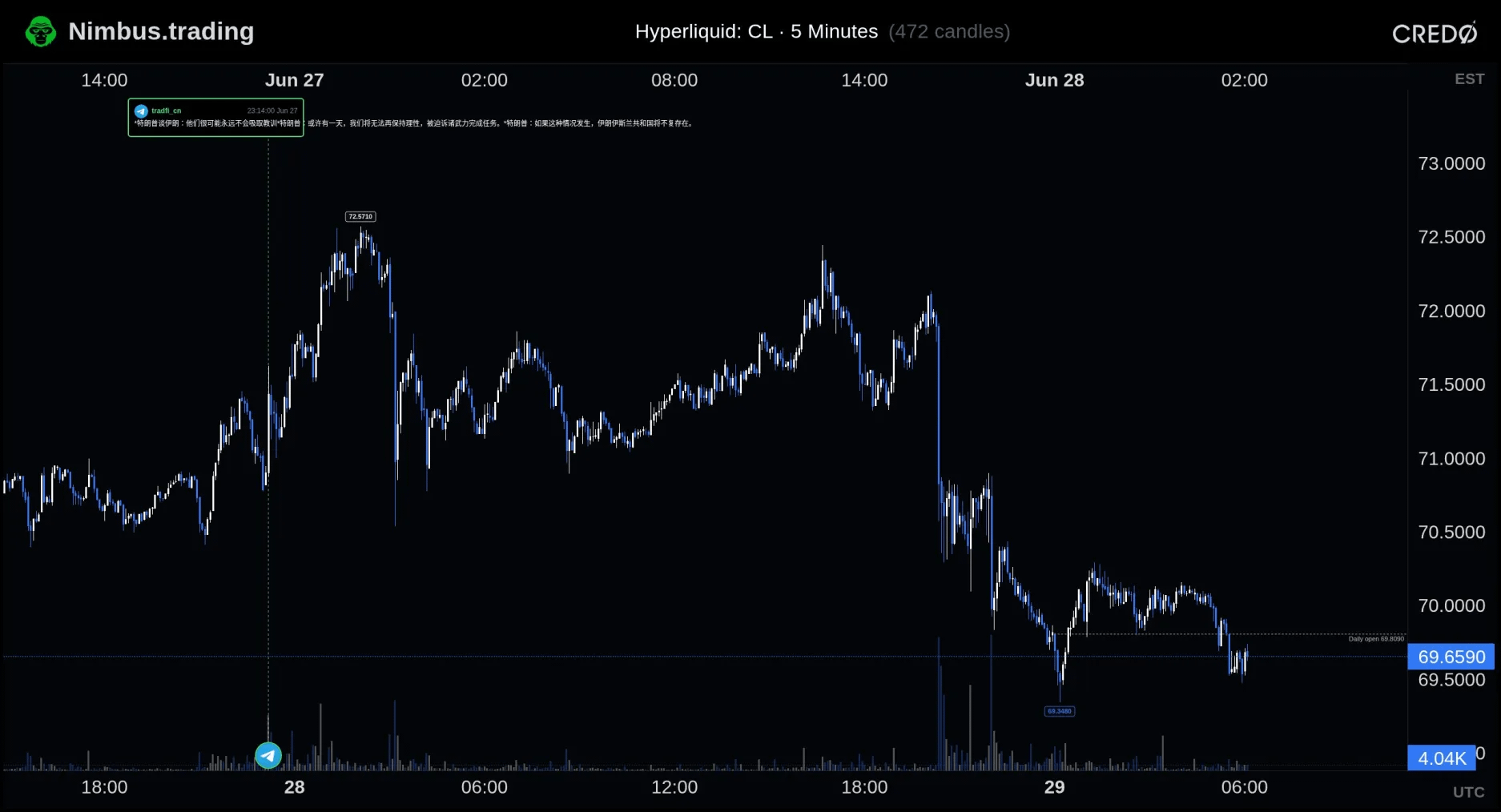
On Sunday at 8:42, Iran’s Revolutionary Guard said it carried out airstrikes on eight U.S. targets and warned it may take “stronger measures” against ships in the strait, while also warning that any violation of the ceasefire would lead to “all processes coming to a complete stop.” After oil prices briefly spiked, they fell back.
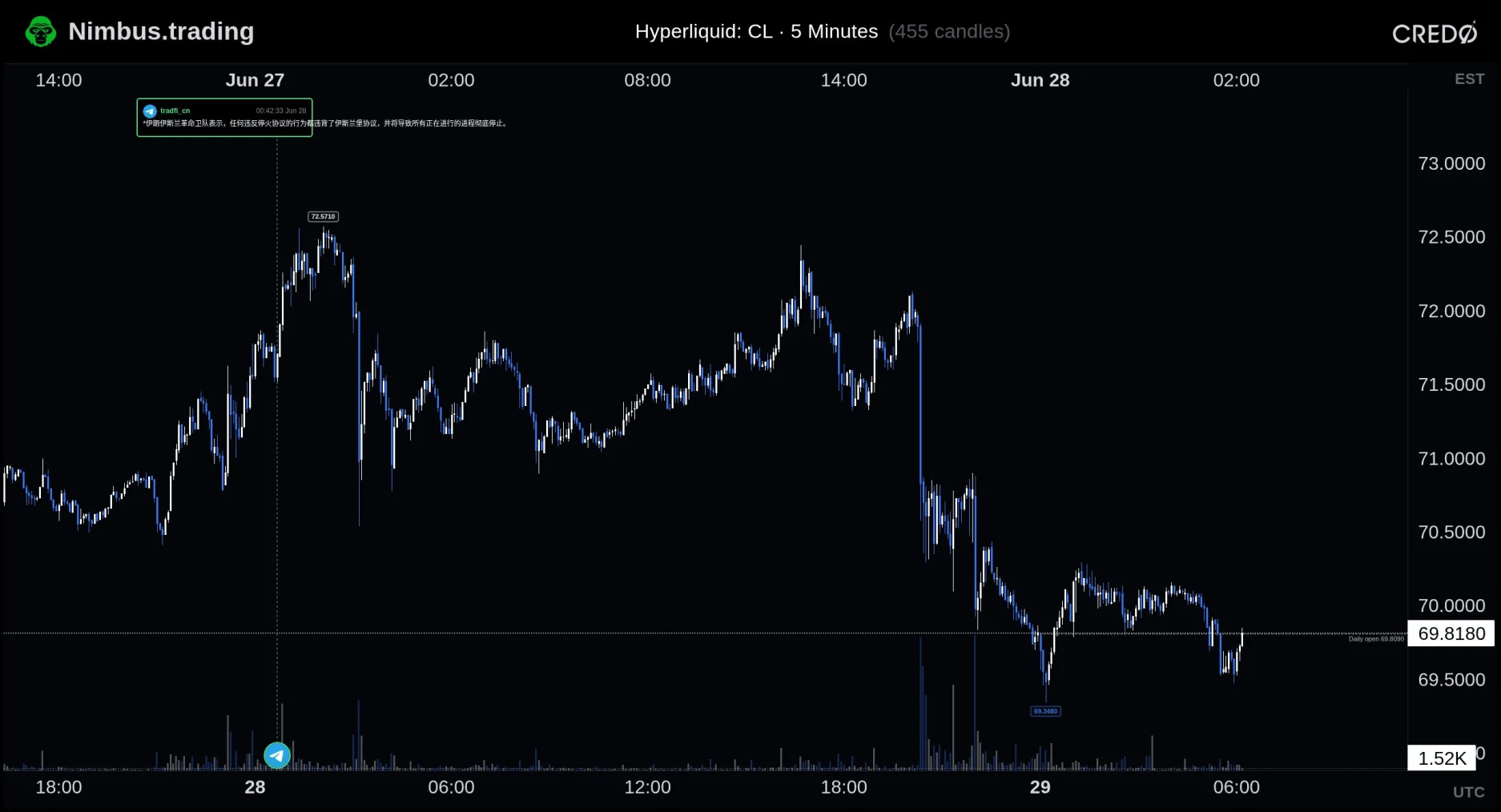
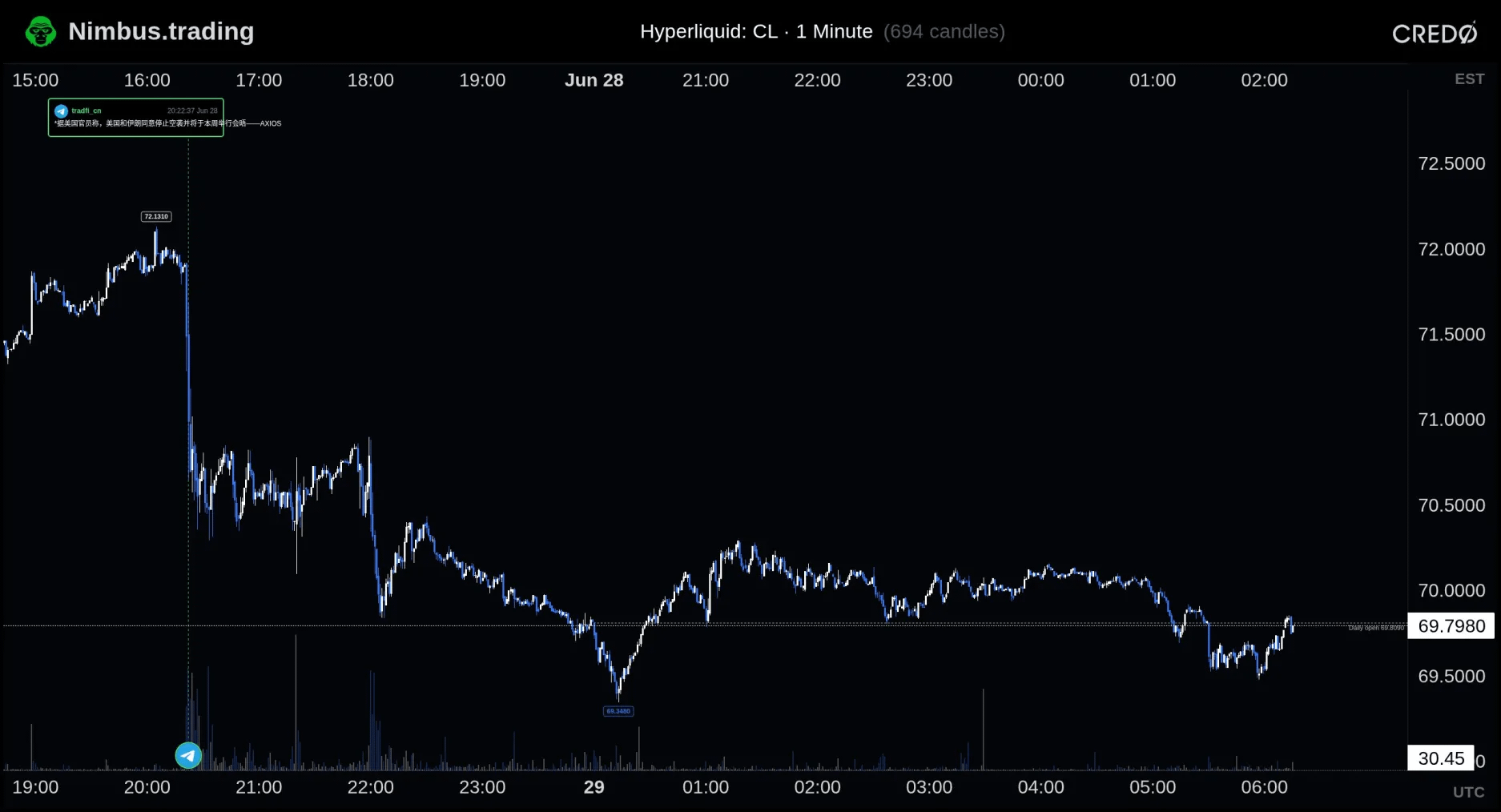
Monday at 4:22 a.m., Axios disclosed that the U.S. and Iran agreed to stop airstrikes and will meet this week. Oil prices plunged on the news, dropping from $72 to $69.3, down nearly 4% from the weekend high.
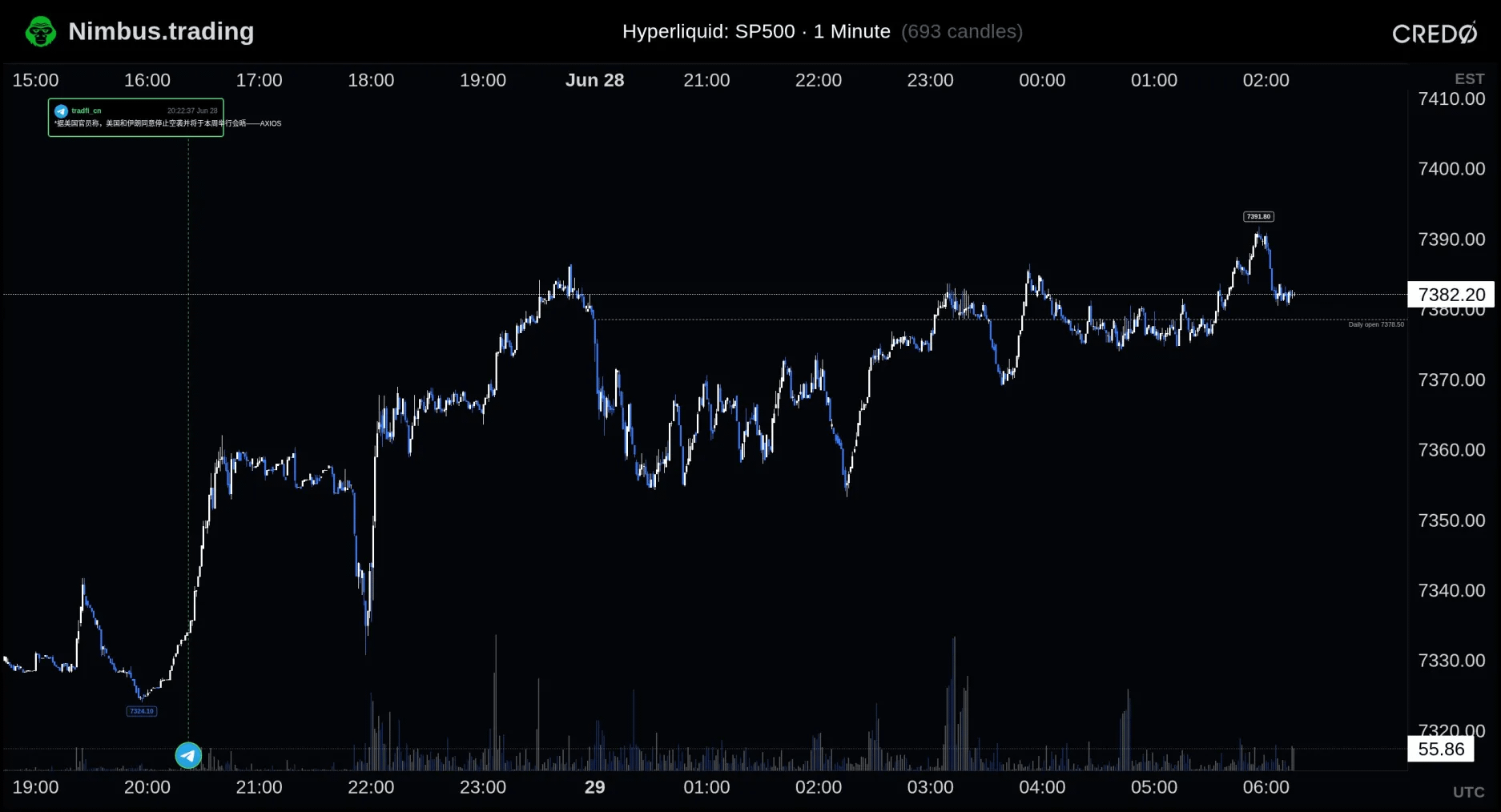
At the same time, TradeXYZ’s S&P 500 futures contract surged straight from 7,324 to an intraday high of 7,391. This is the most typical “risk-on” return—when geopolitical tensions ease and capital rotates from oil into stocks.
US stocks
At the individual-stock level, this weekend has been a broad-based recovery pattern: first stocks weakened slightly along with the broader market, then repaired as stock index futures opened higher. AI computing power and certain catalyst-driven stocks led the gains.
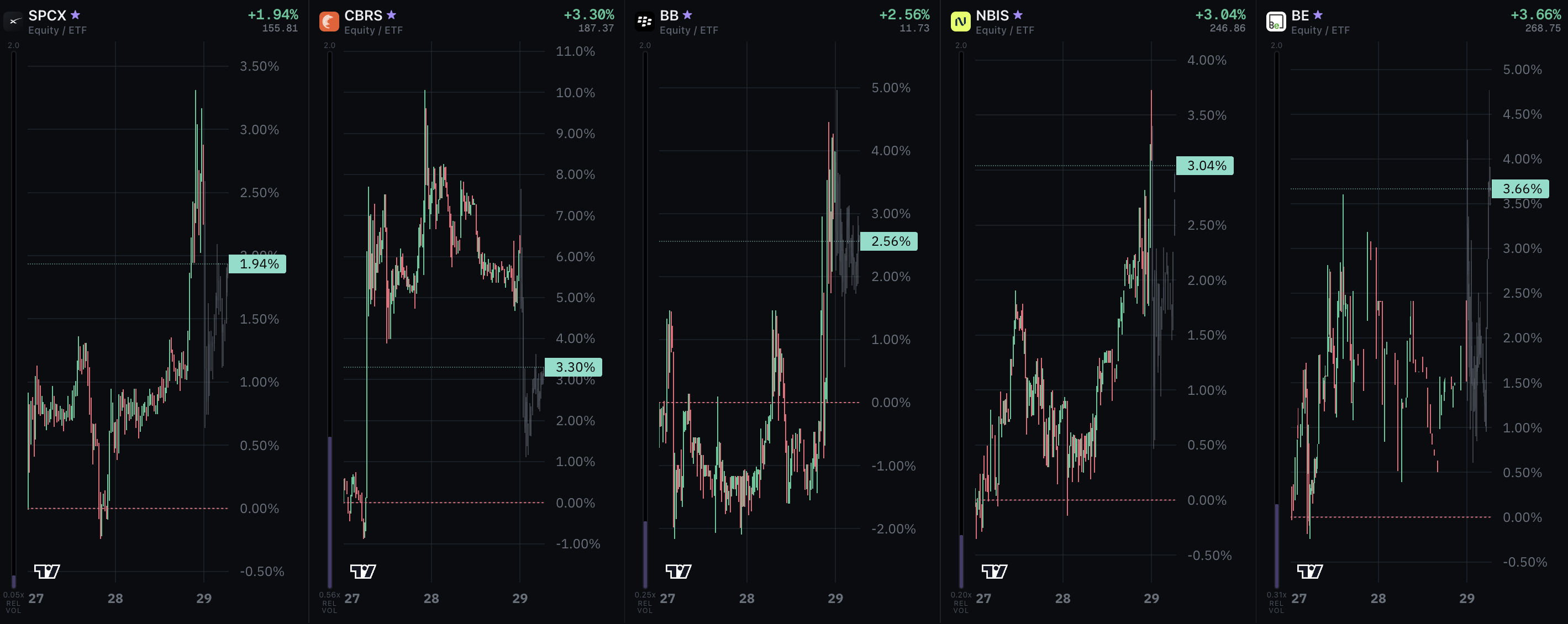
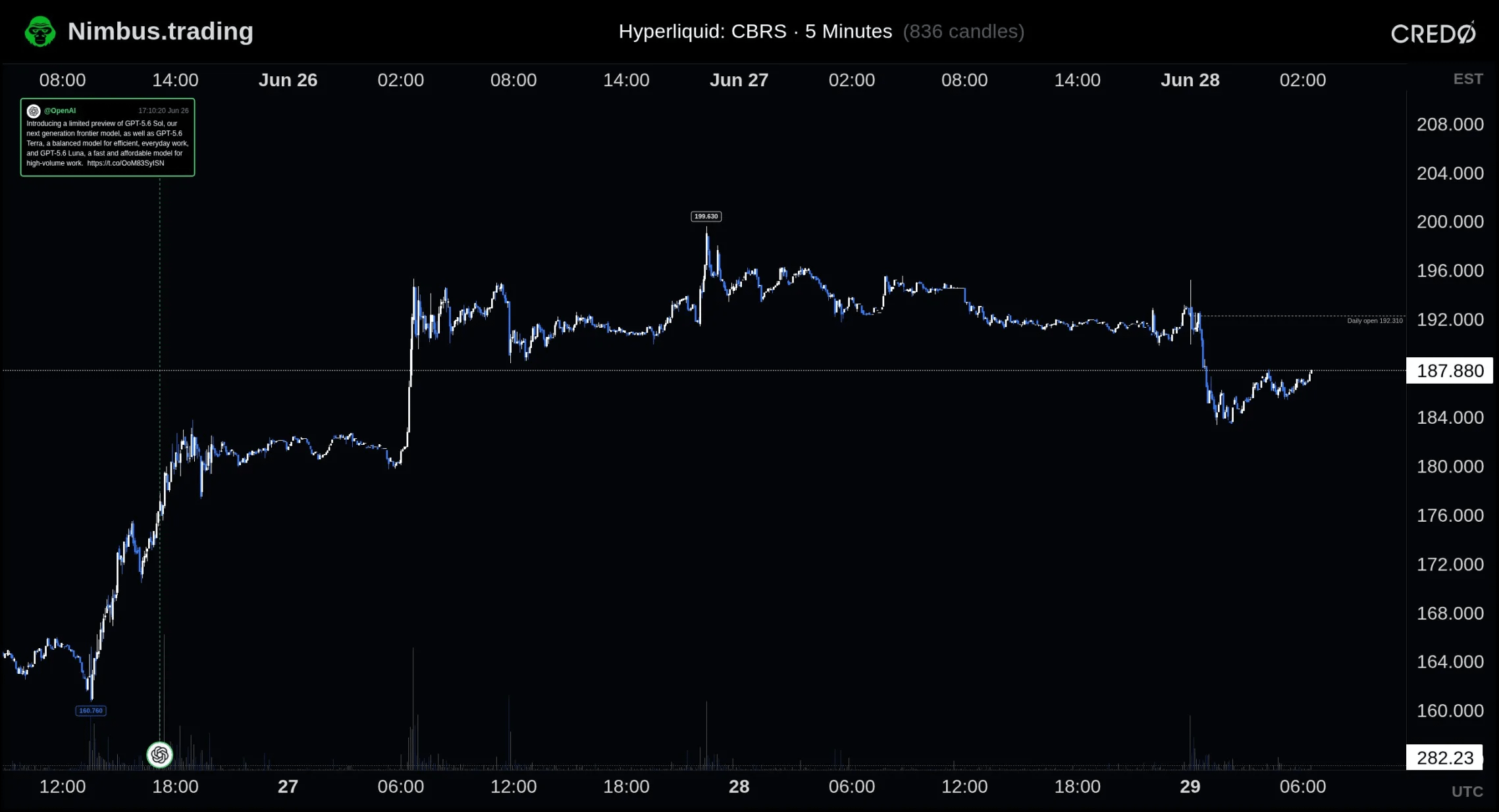
Most watched is CBRS (Cerebras, +3.30%). The catalyst came from a post in OpenAI’s Blog when it released GPT-5.6: GPT-5.6 is planned to go live on the Cerebras platform in July, with inference speeds up to 750 tokens per second, limited to selected customers. The combination of “frontier models × ultra-fast inference × an exclusive platform” leads the market to see Cerebras as a direct beneficiary of this round of inference arms-race competition.
Another item worth highlighting separately is BB (BlackBerry, +2.56%). A supply-chain angle discovery: traders found two new, not-yet-officially announced BB contract leads—one is BB × Astemo (formerly Hitachi Astemo), which would bring BB’s QNX immediate and long-term revenue royalty streams; the other is a partnership between MDA Space / Mitsubishi Electric. While it does not name BB, both companies’ underlying operating systems use QNX, indirectly benefiting BB (by the way, Mitsubishi holds about 22 million shares of BB). These kinds of “automotive-grade + space-grade OS penetration” hidden orders are a rare incremental storyline for an established blue-chip like BB.
In addition, NBIS (+3.04%) and BE (+3.66%) also strengthened in sync. Last Friday, NBIS and BE each fell 6.36% and 18.49% respectively; the weekend gains for these two stocks can be seen as, to some extent, a “bottoming rebound.”
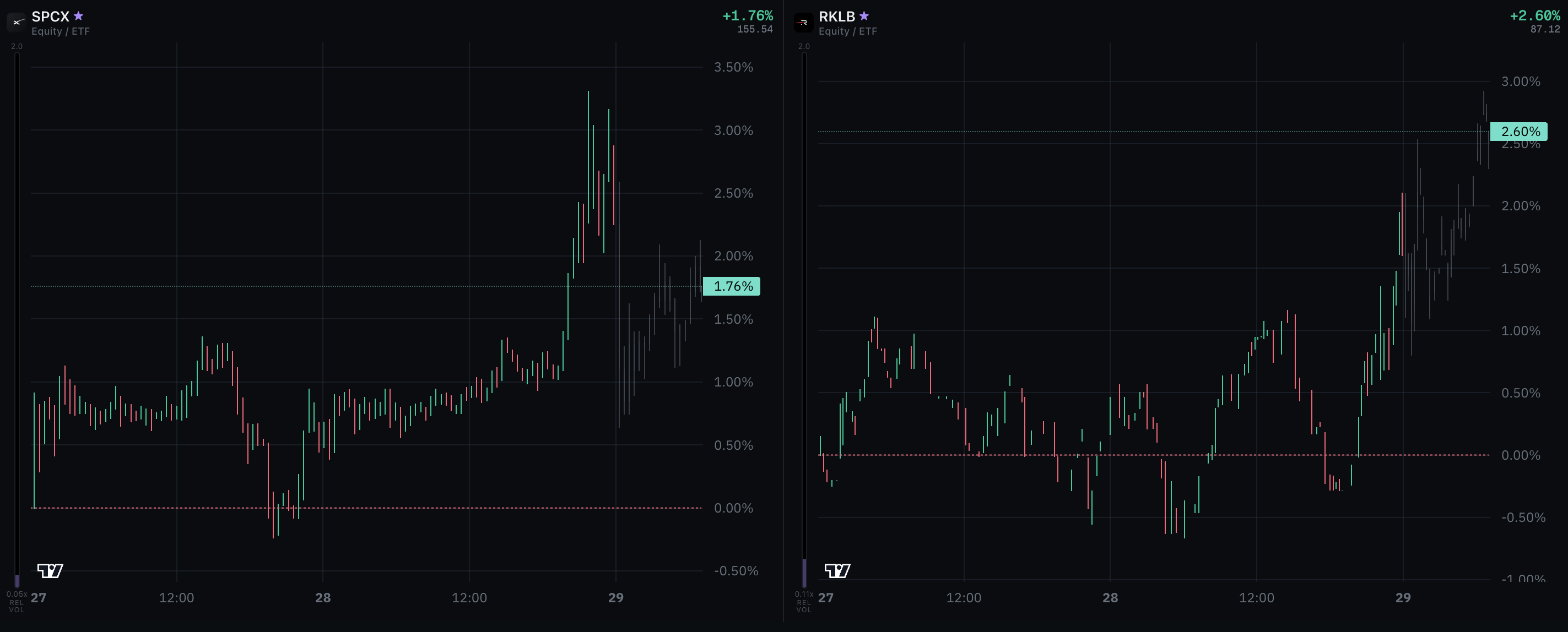
The space sector also performed well over the weekend, with SPCX and RKLB both up 3% for the weekend.