
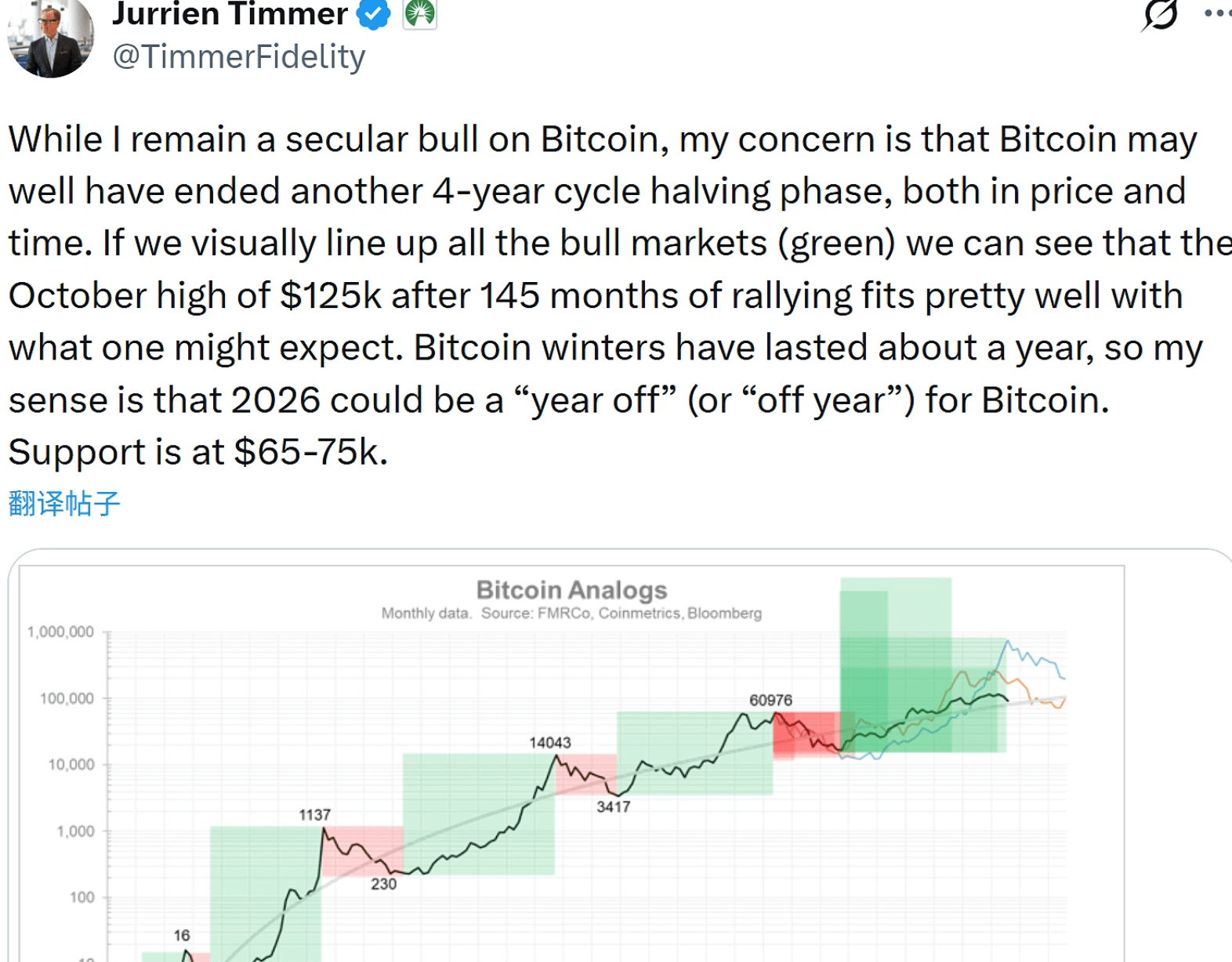
Fidelity's Global Macro Director Jurien Timmer's latest perspective has poured a bucket of cold water on the hot crypto market—he clearly stated on social media: Bitcoin may have ended a new four-year halving cycle, and 2026 could be a 'year of market closure', with support levels looking at $65,000-$75,000.
The realistic mapping of cycle theory
Timmer's core logic is clear and cold: in terms of time and price, the bull market cycle of Bitcoin has come to an end. After 145 months of increase, combined with this year's peak of $125,000 on October 12, it perfectly fits the rising pattern of past bull market cycles. It is like the changing of seasons; after a long rise, there will always be an adjustment in the winter.
'Off-year' has three levels of meaning
The so-called 'off-year' does not refer to the market closing, but rather to a threefold adjustment:
Layer 1: Price repair. Falling from a high of $125,000 to the range of $65,000-$75,000 means a 40-48% adjustment. This space is enough to digest speculative bubbles and allows new funds to enter the market.
Layer 2: Time digestion. Based on historical data, Bitcoin's 'winter' lasts about a year. During this period, the market will complete the transition from frenzy to rationality, accumulating energy for the next bull market.
Layer 3: Confidence rebuilding. During the overall silence of the market, true builders will continue to build infrastructure, while ordinary investors will experience a test of confidence, deepening their investment education.
Comparison and inspiration from gold
Timmer emphasizes gold's strong performance, which is not a coincidence. Gold has risen about 65% this year, maintaining most of its gains, showing typical bull market characteristics. The ebb and flow between Bitcoin and gold reflects the current change in market risk appetite: as economic uncertainty increases, funds may prefer traditional safe-haven assets like gold.
This differentiation suggests that cryptocurrency investors need to reassess their asset allocation logic. During Bitcoin's 'off-year', some funds may temporarily flow into traditional assets like gold until new catalysts appear in the crypto market.
The deeper logic of the support range
Why is the support level between $65,000 and $75,000? This is not a random guess:
From a technical perspective, this is a key area of previous breakthroughs, accumulating a large amount of cost support.
From a fundamental perspective, this range is close to the cost of positions for many large institutions, who will reassess their holdings at this position.
From a psychological perspective, this is an important support level at a round number, making it easy to form market consensus.
Practical advice for investors
In the face of a potential adjustment period, different investors should adopt different strategies:
Long-term holders can adopt a dollar-cost averaging strategy, gradually building positions in the range of $65,000-$75,000 to lower average costs.
Short-term traders need to reduce leverage, set strict stop losses, and avoid being overly consumed during adjustments.
Observers can patiently wait for bottom signals, focusing on changes in trading volume and institutional fund flows.
History does not simply repeat itself but rhymes
It is important to note that while cycle theory has reference value, each cycle has its uniqueness. The 'off-year' of 2026 may not completely replicate historical trends. Current global macroeconomic environment, regulatory changes, and institutional participation are all changing, which will affect the depth and duration of Bitcoin's adjustment.
Seagull's observation
Timmer's warning is worth noting, but should not be over-interpreted. It is more like a rational reminder from an experienced macro analyst rather than a death sentence for the market. The investment market always progresses through cycles, with madness comes calmness, and with peaks come troughs.
For true long-term investors, the 'off-year' may actually present an opportunity—an opportunity to accumulate chips at lower prices, an opportunity to reassess their portfolios, and an opportunity to prepare for the next bull market. After all, only seeds tested through winter can bloom more brilliantly in spring.
The charm of the market lies in its unpredictability, while wisdom lies in respecting rules while maintaining flexibility. In the crypto world, surviving is more important than making quick money.