

The resurgence of mining activities at the data level does not equate to legalization. Strict policy enforcement remains the dominant theme.

"China's Bitcoin hashrate is quietly returning to the top three globally!"
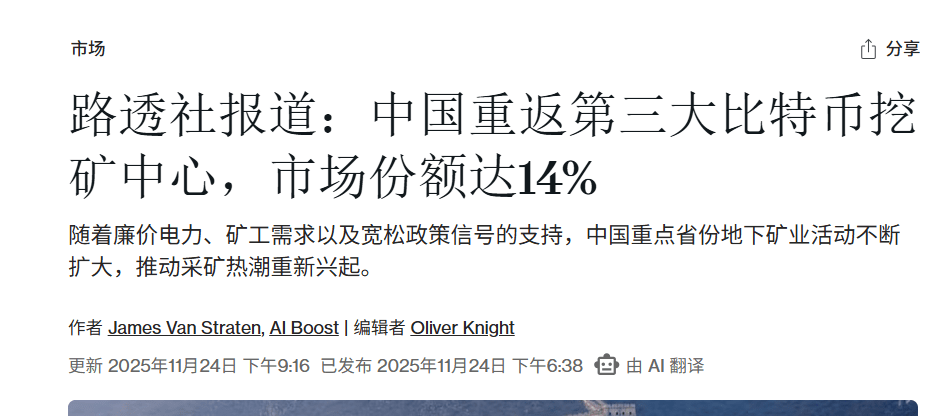
Just recently, a news report published by Reuters caused quite a stir and sparked much speculation within the global cryptocurrency community. Many began to wonder: Has the policy direction changed?
However, just a few weeks later, a bucket of cold water was poured on them from the Northwest—a sudden wave of large-scale mining shutdowns occurred in Xinjiang. Industry estimates suggest that as many as 400,000 mining machines were collectively "shut down."
This dramatic scene once again laid bare the shady reality of Bitcoin mining in China to the world.
01 Computing power "recovers": China returns to third place globally?
In November 2025, Reuters published an exclusive report, citing data from the Hashrate Index, pointing out that China's share of global Bitcoin network hashrate has quietly rebounded to about 14%, ranking third in the world.
The report states that this phenomenon is mainly occurring in regions rich in electricity resources, such as Xinjiang, where some enterprises and individual miners have redeployed their mining machines.
The data doesn't lie. This "14%" figure, compared to the low point after the complete shutdown in 2021, does indeed mean that a considerable amount of computing power is geographically returning to China.
The news sparked a flurry of discussion in the market. "Has the policy been loosened?" "Is mining going to be legalized?" Such speculations began to quietly spread. After all, computing power equals power, and China's "return" is of great significance to the global mining landscape.
However, all these speculations seem far too naive in the face of another major piece of recent news.
02 A Major Turning Point! A Sudden Mine Disaster Strikes Xinjiang
"The power went out suddenly, without any warning."
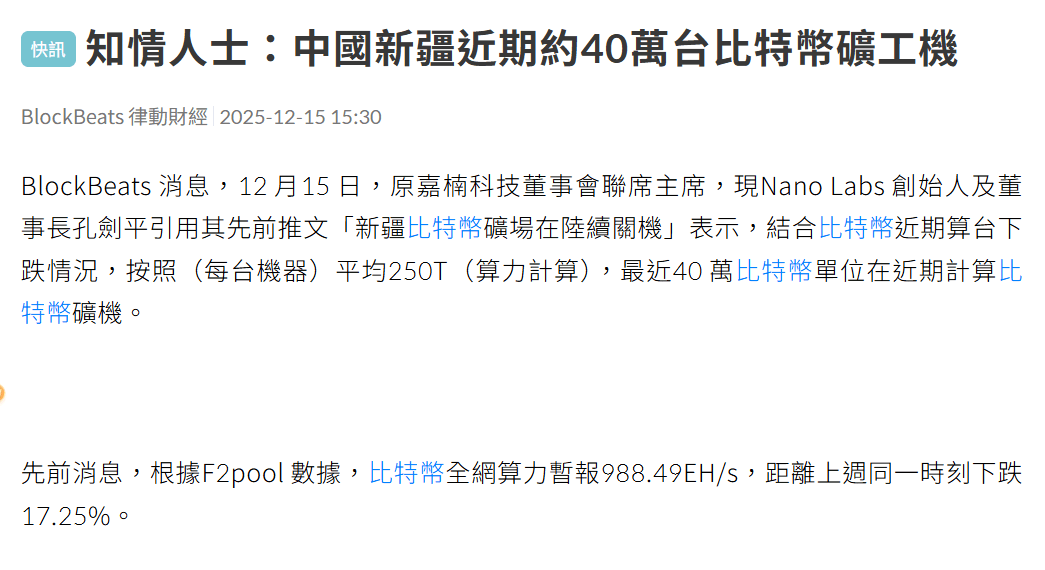
Recently, multiple blockchain data monitoring platforms and mining communities have reported that Xinjiang is experiencing a large-scale wave of Bitcoin mining farm shutdowns.
Huge scale: According to industry insiders and media reports, the number of Bitcoin mining machines involved in this shutdown may be as high as 400,000.
A sharp drop in computing power: On-chain data clearly shows that the network's computing power has declined significantly in a short period of time. Statistics show that the computing power dropped by about 17% within a week, with the largest single-day drop being about 8%, and the epicenter is Xinjiang.
Regulatory intervention: Although there is no publicly available national document, information circulating within the mine indicates that the shutdown is directly related to receiving a letter of assistance from local development and reform commissions and other departments, which was followed by power outages and evictions.
From optimistic reports of "rebound in computing power share" to the harsh reality of "hundreds of thousands of mining machines shutting down instantly," the turnaround came too quickly, catching industry insiders off guard.
This once again confirms an ironclad rule: in China, policy risk is always the sharpest sword of Damocles hanging over the mining industry.
03 Is it contradictory? No, this is simply China's "cat and mouse game."
On one hand, there's the "return" of computing power data; on the other, there's the "crackdown" of regulatory iron fist. This seemingly contradictory situation profoundly reveals the current state of Bitcoin mining in China—a continuous "cat-and-mouse game."
To understand this, we must see two levels:
First, the shady truth behind the "increased share of computing power".
The "China computing power" measured by third-party organizations is mainly based on the geographic location of network data such as mining pool IP addresses.
It detects "mining machines physically located in China", but this is by no means equivalent to "legal and compliant mining farms".
This computing power may come from:
Small-scale mines hidden in remote areas that utilize abandoned water and electricity.
Deployments disguised as data centers or high-tech enterprises are a case of "selling dog meat under the guise of mutton."
Scattered mining machines held by individuals or small groups.
Therefore, the rebound in data reflects more the increased activity of computing power in the gray area during specific periods (such as the high water season when electricity prices are low) and its detection by monitoring networks, rather than policy loopholes.
Second, the "top-level policy" has never been relaxed.
Since the issuance of the 2021 Notice on Further Preventing and Handling Risks of Virtual Currency Trading and Speculation, China's definition of virtual currencies has remained unchanged:
Mining is classified as an "outdated" industry because its high energy consumption and high emissions directly conflict with the "dual carbon" target.
The related business constitutes illegal financial activity: the policy red line is clear and has never been revoked.
The national-level strict regulatory stance remains rock-solid. Any temporary "relaxation" at the local level is merely a gap in the regulatory attention cycle, not a policy shift.
04 What does this shutdown really signify?
The sudden closure of mines in Xinjiang sends an extremely strong signal:
1. "Campaign-style regulation" is not a thing of the past: Regulatory authorities retain the capability and determination to launch special clean-up campaigns at any time. Once large-scale, high-energy-consuming illegal mining is identified, the crackdown can be swift and thorough.
2. Data "repatriation" ≠ safe landing: The illusion created by rising computing power rankings is dangerous. As long as policy bans remain in place, all domestic computing power is in a "naked" state and could be wiped out at any time.
3. The gray costs are extremely high: the cost of mining machines, deposits, and construction fees invested by miners may vanish instantly in the face of a crackdown, and losing everything is the biggest risk.
For China's Bitcoin mining industry, one reality that must be repeatedly recognized is:
✅ The ban has never been lifted: the nationwide cleanup policy of 2021 remains in effect.
✅ The nature of mining has never changed: it remains a high-energy-consuming industry that the state has explicitly ordered to be phased out.
✅ The risks are always extremely high: Any mining activity within the territory faces the risk of unpredictable policy crackdowns.
The resurgence in data is merely a brief respite for the gray areas; the iron fist of policy remains ever-present. The mass power outage affecting 400,000 mining machines in Xinjiang serves as a stark reminder:
“In China, mining has never been a technical or economic issue, but a purely policy issue. Any risk that ignores this will eventually come at a price.”
Therefore, regardless of fluctuations in computing power data, one core judgment should always remain clear: before official decree permitting it, there is no room for "legal mining" within China. All operations are a dangerous game of cat and mouse with regulators.
In this "cat and mouse game," the cat has never relinquished its initiative.
▌Disclaimer:
The content of this article represents only the author's views and does not promote or endorse any business or investment activities. It should not be considered actual investment advice. Readers are advised to establish correct investment concepts and enhance their risk awareness.