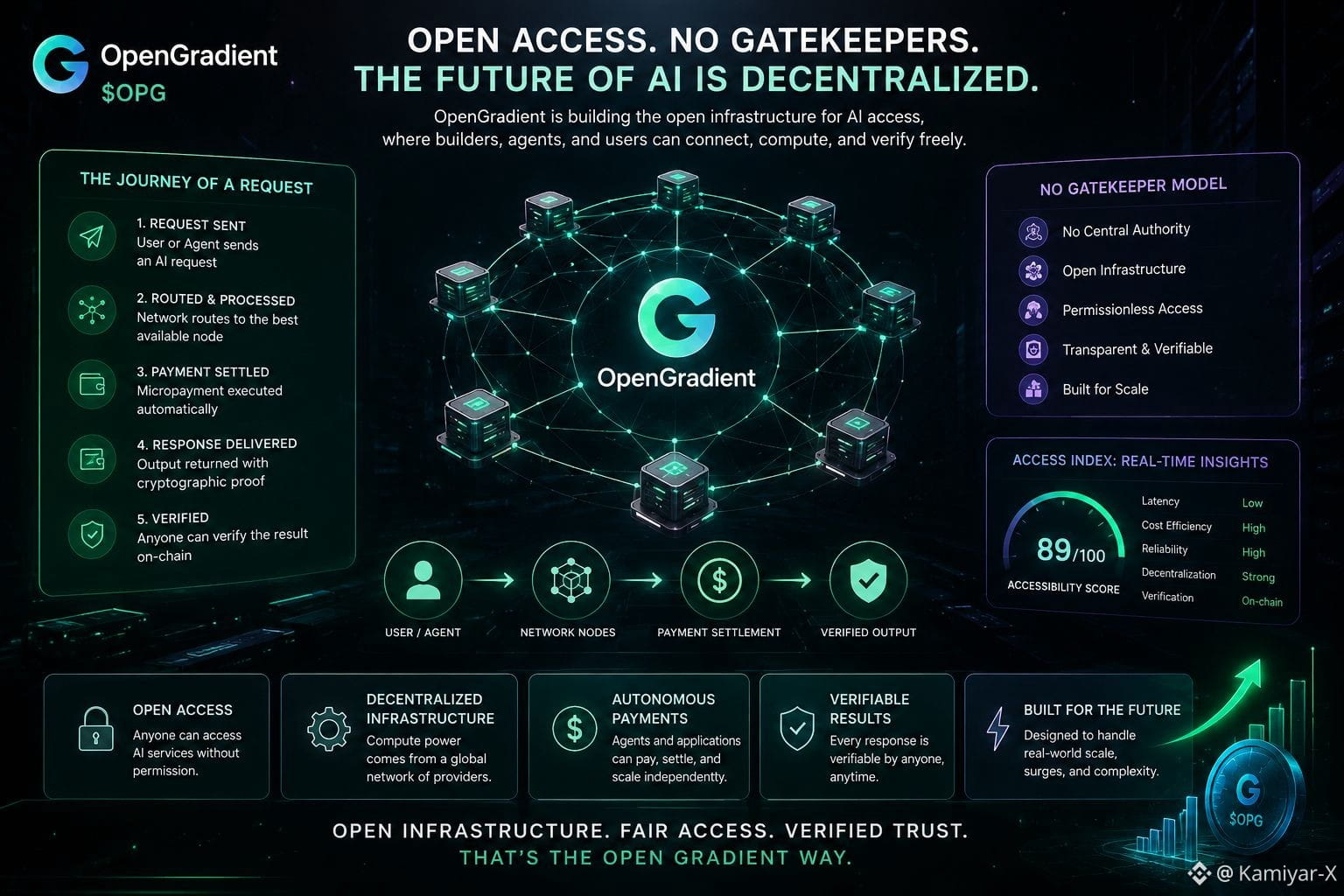
The first thing that caught my attention wasn’t the AI response itself. It was what happened before the response arrived.
One request completed instantly. Another slowed down. That simple difference made me think about something most people rarely discuss: the infrastructure behind AI access.
Who decides where a request goes? Which node handles the workload? How are payments processed? And perhaps most importantly, how can users verify that the result they receive is genuine?
That is why I view OpenGradient and $OPG as more than just another AI project.
Open access does not eliminate costs. Compute resources still need funding. Operators still require incentives. Verification still consumes resources. The real question is whether access depends on a centralized gatekeeper or remains available through an open network.
The No-Gatekeeper Model Access Index becomes valuable only if it reveals where friction actually exists.
Builders should be able to access AI services without seeking approval. Autonomous agents should be able to pay, route requests, receive outputs, and verify results independently. Infrastructure providers should compete on performance and reliability rather than privileged access.
I remain cautious whenever a platform claims to be “open.”
The real challenge appears when usage surges, infrastructure is stressed, and settlement becomes more complex. In those moments, does the network remain open, or do hidden bottlenecks quietly reappear?
That is the standard I believe OpenGradient must meet.
#OpenGradient #OPG $OPG
@OpenGradient