Let’s start with the conclusion: “The project’s fundamentals are good, its temperament is solid, and its logic is perfect.”
1. Basic project information📁
01丨Project Brief Description
Chromia (CHR) is known as Chromia Coin in Chinese. The team is currently based in Stockholm, Sweden. CHR is a Layer 1/0 blockchain designed to solve the scalability problem of DApp. It uses a Byzantine fault tolerance mechanism combined with Proof of Work (PoW) consensus to verify transactions.
Unlike other Layer 1s that focus on smart contracts, Chromia focuses more on the construction of DAPP. At the same time, its development language Rell also has high compatibility, and developers of other languages can quickly learn and get started.
Chromia proposes a new concept in blockchain - relational blockchain, which is similar to sharding and can realize data transfer to each other. It also has the feeling of data cross-chain. It is a concept of database and blockchain. combine. It would be more appropriate to describe Chromia as an interoperable database that can be retrieved.
02丨Project development history
On December 20, 2018, the relational blockchain language Rell was launched;
In Q2 of 2019, the Pstchain (back-chain) custody model was launched;
On January 31, 2020, the test network was launched, and the test included DAPP, SSO, token trading and block explorer;
In May 2020, 22 million CHR were destroyed;
On November 19, 2021, an $80 million fund for game development teams was announced;
In August 2022, the ETH interoperability framework will be launched, which allows Chromia to communicate cross-chain with other EVM-compatible chains;
In February 2023, a new pledge page, directory chain function, etc. will be launched on the test network;
03丨Team information
1)Chromia Way
The development company of Chremia was founded in 2014. Since its establishment, it has been deeply involved in the blockchain industry and the construction of related technologies.
2) Alex Mizrahi (Chief Technology Officer)
He claims to have started programming at the age of 10 and has extensive experience in mathematics, computer science, algorithms, UI design and IT languages. Has more than 20 years of IT development experience and has served as CTO of Chromia Way for more than 9 years;
3) Or Perelman (Chief Operating Officer)
He also served as COO at Chromia for nine years and worked hard on CHR's global market operations and promotion. He is a serial entrepreneur. His main business is centered around the encryption field. He majored in law during college.
4) Henrik Hjelte (CEO)
Master of MBA, as the CEO of Chromia, he has rich experience in project management. He is also an early investor and helps some start-up companies to expand their business as a consultant;
2. Token Economy💰
Market code: CHR
Token type: Token
First release time: 2019-05-29
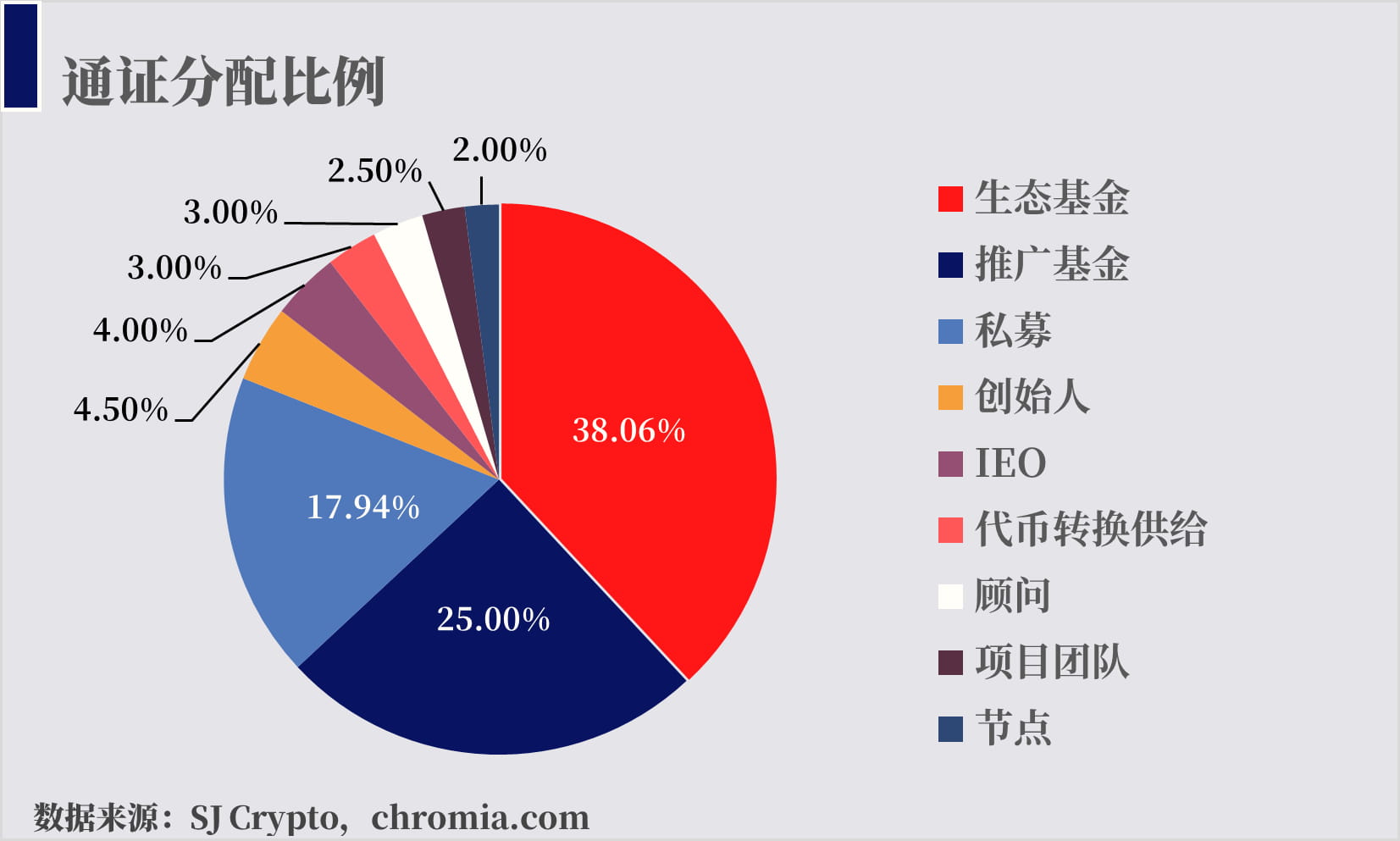
Token distribution mechanism:
The total supply of CHR tokens is 1 billion, with a current supply of 978 million and a circulating supply of 537 million, including a pledged amount of 42.7 million;
In addition, CHR was burned once in May 2020, and the number of tokens burned was 22 million, so theoretically the supply of CHR cannot reach 1 billion in total;
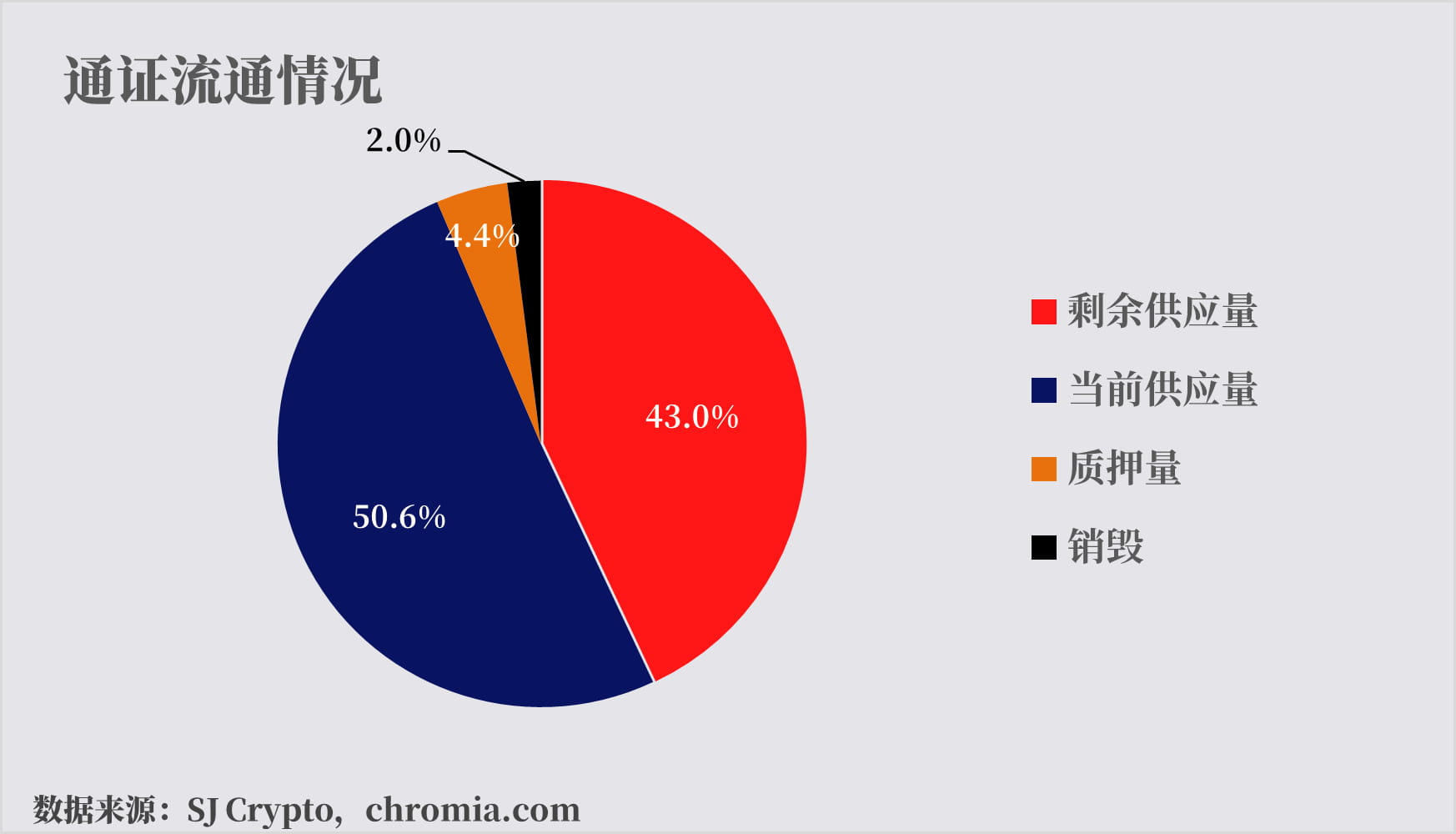
In addition, in terms of the overall distribution of tokens, the team holds a larger share, and the proportion of consultants is also higher than that of other projects. At this stage, the project is not completely decentralized. . As described by the team: If certain extreme situations occur (regulation, bad attacks, etc.) the team can require 2/3 of the nodes to reach consensus;
Token incentive design:
Supplier: Get incentives by running nodes to verify the network and produce blocks;
User: The charging system of DAPP is not fixed, and normal use within DAPP does not require interactive gas fees. However, if necessary, users need to pay service fees to DAPP.
Developers: Developers who develop DAPP can flexibly customize the charging model of their DAPP. This type is closer to the traditional Internet application of Web2; but developers also need to pay DAPP hosting fees to the node provider;
Holders: CHR holders can pledge tokens in the network in exchange for 25% annualized income (non-constant)
Section: Layer1//Metaverse (NFT/Game)
*Section introduction
Layer1: Layer1 is the generally recognized meaning of public chain in the industry. As the underlying infrastructure of the industry, it provides a development and operation environment for applications in various fields. Note: Some projects with Layer as the development goal will also be classified by me in this section.
Metaverse: Metaverse is a virtual environment with actual and credible asset value and identity concepts. Users can socialize, entertain and create on this platform. The reason why CHR is listed in this section is because of its The development of DAPP is more related to this.
3. Basic structure of the project⚖️
01丨Internet role
Supplier: The supplier here refers to the institution or individual that runs the nodes in the network. It is the operating backbone of the network. The supplier can selectively run multiple nodes at the same time. Nodes are mainly responsible for the production of blocks and supporting the basic operation of the network; node production and network governance are not the same role, but are divided into [SP] and [NP]. The former has the rights to govern voting and create node clusters. The priority is higher than the [NP] responsible for block production;
Node: At the same time, nodes are also divided into main nodes and sub-nodes. The main node is responsible for network operation and can produce and verify blocks; while the sub-nodes only perform verification but cannot produce blocks. The architecture of CHR is somewhat similar to a cross-chain architecture. The main node produces blocks in the system chain, and the sub-nodes provide data verification support for DAPP in the side chain;
PS: The main node and sub-node here are unofficial definitions, but my definitions for the convenience of readers’ understanding;
02丨Overview of consensus mechanism/algorithm
Chromia's consensus mechanism is based on an upgrade of the PBFT Byzantine Fault Tolerance mechanism, called eBFT, and is defined as a Proof of Authority (POA) consensus mechanism. Only nodes that are recognized as trustworthy can be responsible for producing blocks and verifying transactions; the fault tolerance rate of this consensus mechanism is 1/3;
03丨Pass usage scenarios
Serves as the platform’s native token
Pay DAPP hosting fees
Pool pledge
Token pegs within the ecosystem
04丨The composition logic of the platform
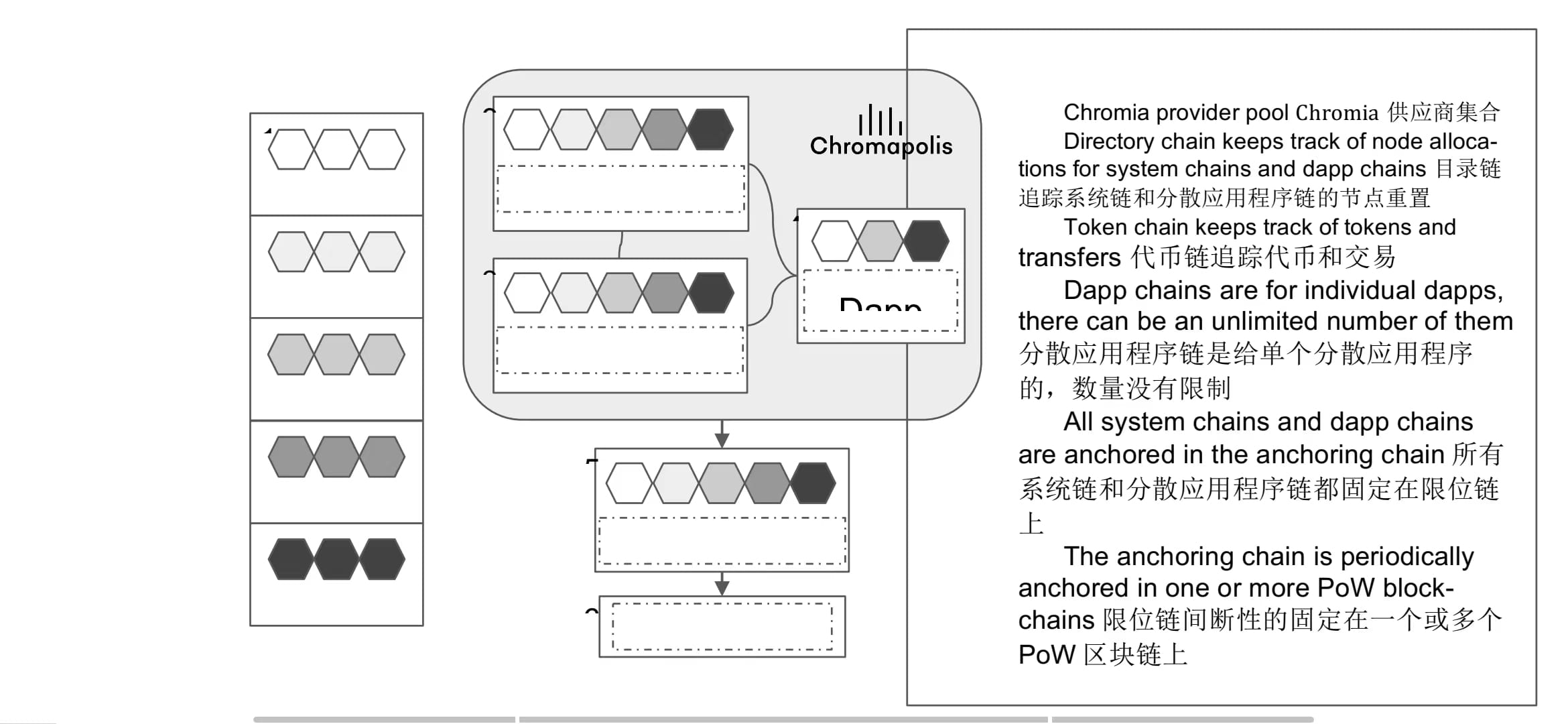
Chromia is a parallel environment composed of multi-layer chain logic. It achieves high scalability under the division of labor of the multi-layer chain architecture. The architecture composed of multi-chain logic can support the Chromia system to remain smooth even in the environment where local updates occur. operation, and can also better support the operating environment of DAPP on the chain.
Source chain: A chain specifically used for client verification of data without downloading an entire blockchain ledger;
Directory chain: manages all DAPPs in the network and stores all information on the chain. Node data updates will occur and be recorded on the directory chain;
Token source chain: Track and record the token information and distribution of other chains;
Anchor chain: records the hash values of transactions that occur in other chains, and also monitors the chain situation of consensus exceptions/failures. If consensus fails, the blocks on the anchor chain will be used as the basis for consensus correction. This is a chain running in the external environment, which is equivalent to a magic mirror;
4. Main product/technical features😍
01丨Rell language
Rell is a language specifically designed for [relational blockchain] with database as its core. It is similar to commonly used modern programming languages such as JavaScript and Kotlin, so it is not difficult to learn in a general sense; the purpose of Rell language is to Make blockchain development more ergonomic, with the advantages of censorship resistance, optimized security, simplicity, convenience, expressiveness, and meta-programming;
02丨PostChain framework
The back-chain framework can be simply understood as a shared database model on the chain. Chromia uses this database as the core to spread out and support the data needs of DAPP. Each DAPP can also be a side chain. Any data and information that occurs on the side chain will be stored in a database, and changes to the database will also be recorded on the chain;
PS: The back-chain framework does not refer to a single chain, but the operating logical framework of the entire network. Under this structure, Chromia is more like a Layer0 platform, with the database as the core
03丨Ethereum Interoperability Framework (EIF)
It is a cross-chain communication protocol compatible with EVM. It can also be broadly understood as the native Layer 2 protocol on Chromia. Based on this protocol, it will be able to support Chromia to interact with any other EVM-compatible chain, which will also play a role in the development of the ecosystem. to help with scalability;
04丨DAPP development logic
Different from the current mainstream application logic developed with smart contracts, Chromia's application development path is more user-friendly. Even when users access applications on its chain, they will not realize that it is an application with blockchain as the underlying support. , there is no need to pay additional interaction fees during the interaction process; DAPP itself can also be run on Layer 2, allowing developers to maintain higher flexibility in control;
5. Market competition landscape⚔️
01丨Introduction to the competitive landscape of the industry⚔️
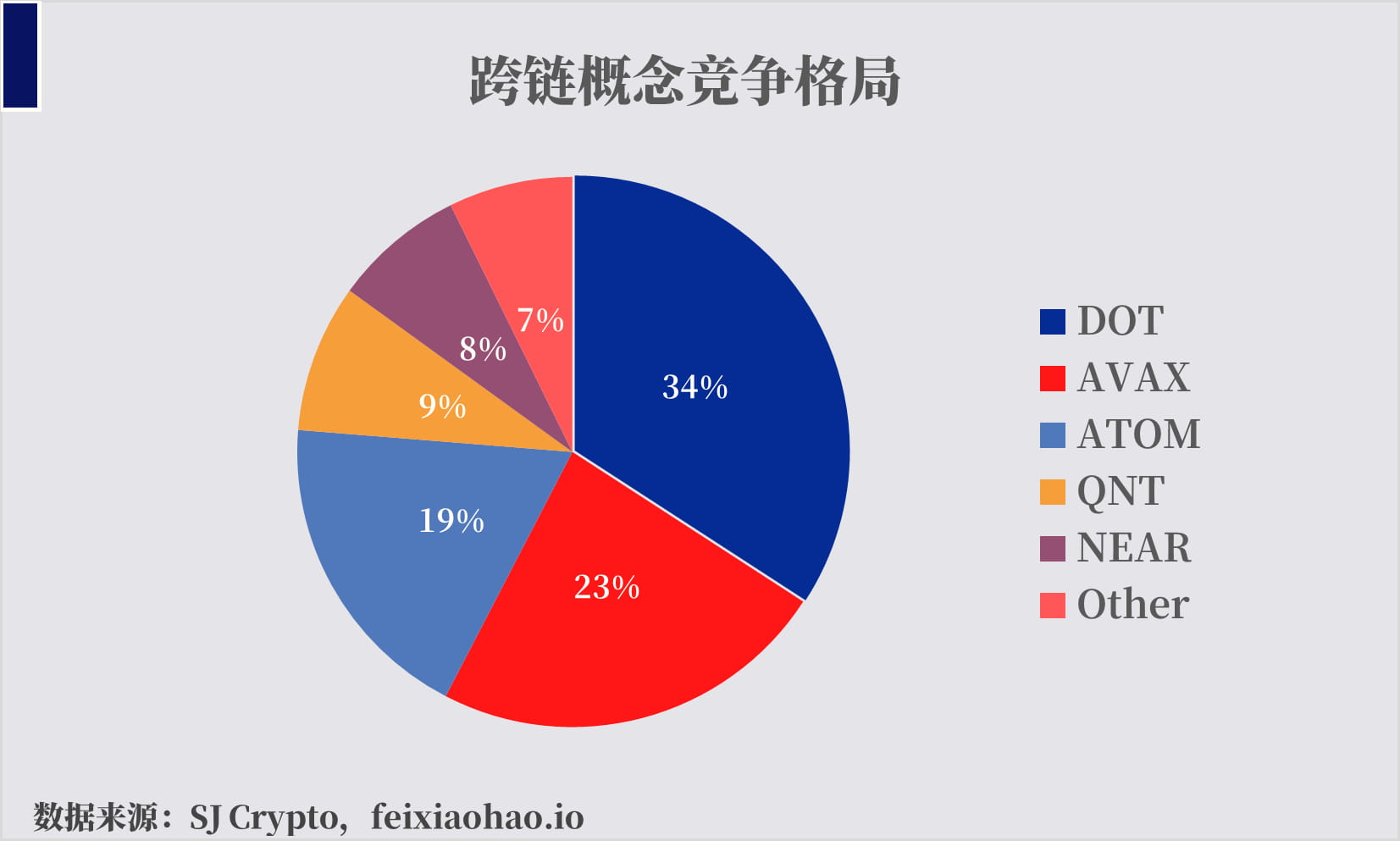
At present, there are not many researchers in the industry who define Chromia as a Layer 0 track, but after reviewing its framework and implementation scenarios, I believe that Chromia will be more appropriate as a Layer 0 platform. And Layer0 has a high degree of overlap with the cross-chain sector, so the following uses a cross-chain sector distribution map I made in the past to introduce the expanded sector;
The Layer0 sector is a rigidly needed sector in the future multi-chain landscape. This will turn the future industry ecological network into a divergent network with the Layer0 platform as the core, forming interactions between ecosystems through cross-chain bridging, so for sectors The future value is beyond doubt.
02丨Competitors Similarities and Differences⚔️
In terms of implementation, CHR has a high degree of similarity with DOT, but the design of the economic model will be more developer-friendly; compared with DOT, the ecological scale of CHR is far less than that of DAPP. In terms of implementation concepts, I think CHR has the advantage;
6. Summary of investment views
01丨Community situation
CHR's community is actually one of the better ones among the projects of the same period. From the observation of TG groups, the average activity of the community groups is better than that of other projects of the same period, and the atmosphere is also more objective and rational. More attention will be paid to the interaction of the network itself and ecological participation.
02丨Team strength/developer group
CHR's development group is still dominated by development companies. The overall development group is not very large, with two to three hundred people (Discord data). However, from a development perspective, the design of Chromia's DAPP charging/hosting model is more beneficial to developers. ; In addition, the background of its team and project consultants are very excellent. The team has very rich cross-industry resources, especially the parent company’s original business involving real estate and other aspects. The consulting team also has the founders of the Swedish Land Bureau and well-known blockchain projects. persons;
From the perspective of resource fundamentals, it deserves evaluation.
03丨Ecological situation
CHR's ecological landscape is similar to most projects that do not have high market popularity, but because of those projects that rely on teams to independently develop their ecology; in terms of ecological resources, Chromia once rode the wave of Gamefi/NFT and attracted market attention, so it was also attracted by the industry. It is widely defined as an NFT public chain, but this is actually not rigorous;
On a platform like Chromia with DAPP development as its core, ecosystems such as Gamefi and NFT are just the tip of the iceberg that its ecological sector can achieve. In terms of ecological extensibility, Chromia will have broader possibilities, rather than being limited to [NFT] Public chain] this section;
04丨Summary of opinions😀
From the perspective of long-term value, Chromia's project fundamentals are worthy of evaluation, and the team is constantly under construction. For investors with long-term funds, you can pay attention to it. It is a platform project with stable temperament;
From the perspective of sector competition, Chromia is more like a Layer 1 platform with a good DAPP development environment and a Layer 0 platform that supports Layer architecture;
There are also expectations for future narratives. According to the development progress, the launch of the platform’s mainnet this year may also attract market attention; overall, the project’s implementation logic is perfect and its foundation is solid, making it a stable value project;
However, due to its omissions in public relations, its concept and positioning are relatively vague to the outside world, and future narrative explosions in the segment (Layer 0) may not necessarily be noticed by the market.
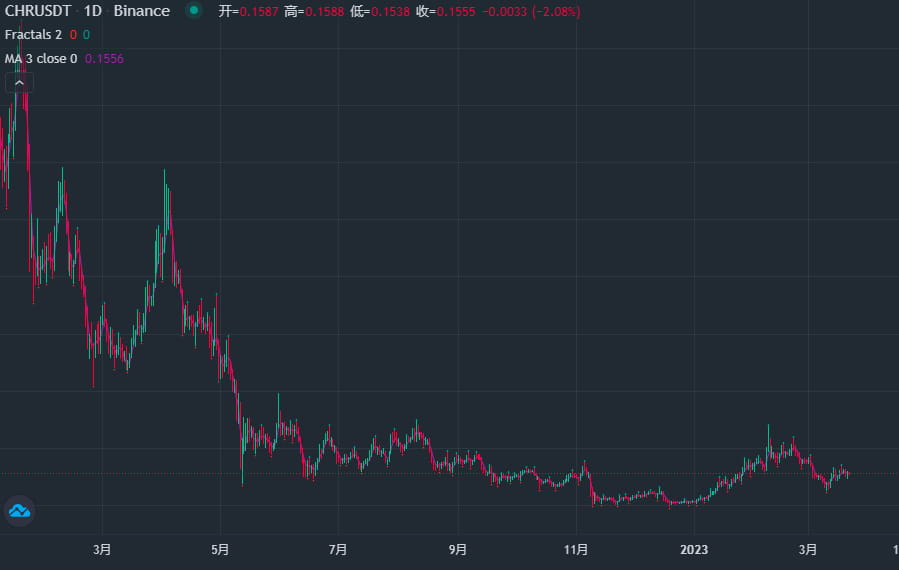
-From the perspective of the secondary market, CHR is in a relatively bottom area;📈