
Waseem Ahmad mir
7k Posts

Waseem Ahmad mir
 Square Verified+
Binance square Content Creator | Binance KOL | Trader | BNB Holder | Web3 Marketer | Blockchain Enthusiast | Influencer | X-@Meerwaseem2311

Traders League Badge Expert
High-Frequency Trader
1.9 Years
179 Following
37.5K+ Followers
112.3K+ Liked
1 Badges
Posts
All
Quotes
Videos
Live
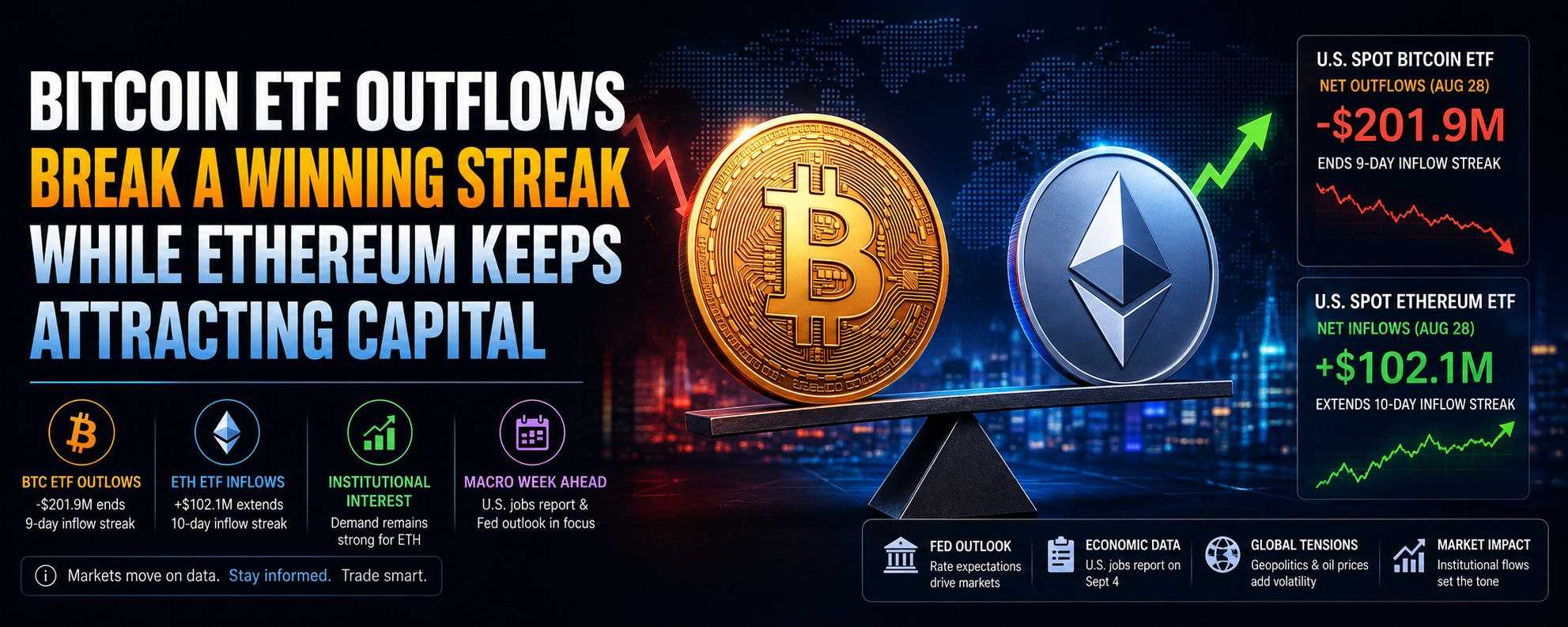
Today's Futures Gainers Are Exploding But Traders Should Be Careful
Today’s futures leaderboard is showing some massive moves:
🔥 $4 +55%
🔥 $PROM +41%
🔥 $SKR +32%
🔥 $BROCCOLIF3B +31%
🔥 $CYS +26%
At first glance, it looks like an altcoin breakout. But after checking the market, the reasons behind these pumps are very different.
PROM appears to be experiencing strong momentum and speculative demand, with recent data showing no single confirmed major catalyst behind the move.
SKR has a stronger fundamental narrative. Solana Mobile recently continued its Seeker ecosystem activity, including SKR claim rounds, new ecosystem developments and security initiatives.
CYS has been extremely volatile following recent exchange-listing attention, including the Upbit listing catalyst earlier this month.
Meanwhile, tokens like 4 and BROCCOLIF3B are much more speculative and can move aggressively because of lower liquidity and momentum-driven trading.
⚠️ What should traders do now?
The biggest mistake is buying simply because a token is already showing +30% to +50%.
Instead:
• Don't FOMO into vertical candles
• Wait for consolidation or a retest
• Check whether volume supports the breakout
• Watch open interest and funding rates
• Use strict risk management if trading futures
• Take partial profits instead of expecting every pump to continue
A green leaderboard does not automatically mean a safe buying opportunity.
Some of these moves may continue, especially when there is real spot demand and cross-market confirmation. But others could simply be short squeezes or low-liquidity momentum spikes.
My approach: I would rather miss the first pump than become exit liquidity at the top.
Trade the confirmation, not the excitement. 📊
Today’s futures leaderboard is showing some massive moves:
🔥 $4 +55%
🔥 $PROM +41%
🔥 $SKR +32%
🔥 $BROCCOLIF3B +31%
🔥 $CYS +26%
At first glance, it looks like an altcoin breakout. But after checking the market, the reasons behind these pumps are very different.
PROM appears to be experiencing strong momentum and speculative demand, with recent data showing no single confirmed major catalyst behind the move.
SKR has a stronger fundamental narrative. Solana Mobile recently continued its Seeker ecosystem activity, including SKR claim rounds, new ecosystem developments and security initiatives.
CYS has been extremely volatile following recent exchange-listing attention, including the Upbit listing catalyst earlier this month.
Meanwhile, tokens like 4 and BROCCOLIF3B are much more speculative and can move aggressively because of lower liquidity and momentum-driven trading.
⚠️ What should traders do now?
The biggest mistake is buying simply because a token is already showing +30% to +50%.
Instead:
• Don't FOMO into vertical candles
• Wait for consolidation or a retest
• Check whether volume supports the breakout
• Watch open interest and funding rates
• Use strict risk management if trading futures
• Take partial profits instead of expecting every pump to continue
A green leaderboard does not automatically mean a safe buying opportunity.
Some of these moves may continue, especially when there is real spot demand and cross-market confirmation. But others could simply be short squeezes or low-liquidity momentum spikes.
My approach: I would rather miss the first pump than become exit liquidity at the top.
Trade the confirmation, not the excitement. 📊
Verified
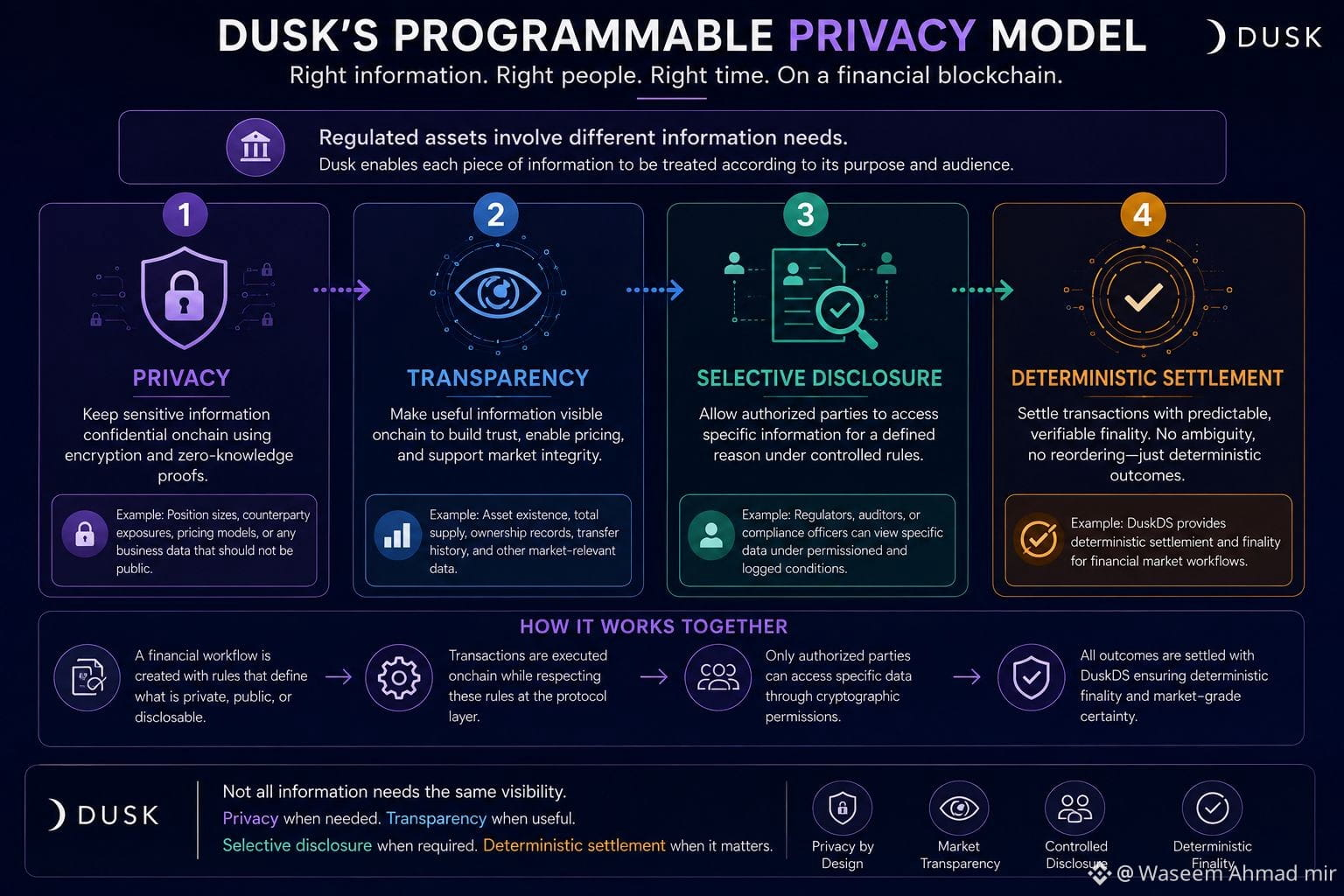
A financial blockchain doesn't need every piece of information to be treated the same way.
That's the part of Dusk's privacy model I keep coming back to.
Think about a regulated asset. There may be information that the market should be able to see. At the same time, some details may need to stay confidential. And in another situation, an authorized institution might need access to specific information for a defined reason.
Dusk's approach is built around those different requirements rather than forcing one visibility setting onto everything. Its documentation describes privacy with selective disclosure alongside public and transparent flows.
For me, that makes the word “programmable” important.
The idea isn't simply that transactions are private. It's that the financial workflow can determine what should be visible, what should remain confidential, and when particular information should be available to an authorized party.
Then there is settlement.
Dusk describes deterministic settlement as a core requirement for market infrastructure, with DuskDS providing deterministic finality for financial workflows.
So I see four pieces working together:
Privacy where it is needed.
Transparency where it is useful.
Selective disclosure when authorized review requires it.
Deterministic settlement when the transaction needs a predictable final outcome.
That combination is what makes Dusk's approach to regulated markets worth following for me. It's less about choosing between a completely public or completely private blockchain, and more about giving financial workflows different ways to handle information.
#dusk
$DUSK
@Dusk
That's the part of Dusk's privacy model I keep coming back to.
Think about a regulated asset. There may be information that the market should be able to see. At the same time, some details may need to stay confidential. And in another situation, an authorized institution might need access to specific information for a defined reason.
Dusk's approach is built around those different requirements rather than forcing one visibility setting onto everything. Its documentation describes privacy with selective disclosure alongside public and transparent flows.
For me, that makes the word “programmable” important.
The idea isn't simply that transactions are private. It's that the financial workflow can determine what should be visible, what should remain confidential, and when particular information should be available to an authorized party.
Then there is settlement.
Dusk describes deterministic settlement as a core requirement for market infrastructure, with DuskDS providing deterministic finality for financial workflows.
So I see four pieces working together:
Privacy where it is needed.
Transparency where it is useful.
Selective disclosure when authorized review requires it.
Deterministic settlement when the transaction needs a predictable final outcome.
That combination is what makes Dusk's approach to regulated markets worth following for me. It's less about choosing between a completely public or completely private blockchain, and more about giving financial workflows different ways to handle information.
#dusk
$DUSK
@Dusk
Thank you @Binance Square Official ! Really happy to see my name among the #TradebStocks campaign winners. Appreciate the opportunity and the support from the Binance community. Looking forward to the 9th Anniversary swag! 🎉🏆


Binance Square Official
·
--
Congratulations to our #TradebStocks campaign winners! Each winner will receive a set of Binance 9th Anniversary Swag! Please check your Feed Secretary notice and submit the delivery address within 7 days of receiving the notification. Thank you!
🏆 Winners: @Waseem Ahmad mir @CryptoYash @Hua BNB @Draven Kai @William_George @LearnToEarn @Casper Sheraz @Mastering Crypto @X mucaN @Leo_Carter @LinhInsights @AmnaJen @三月 - M A R C H @Masao Fast News @GOLF123 @Thilina_Mihisara @Aquarius52 @yosreia @Blockchain_sch @Crypto_GR
🏆 Winners: @Waseem Ahmad mir @CryptoYash @Hua BNB @Draven Kai @William_George @LearnToEarn @Casper Sheraz @Mastering Crypto @X mucaN @Leo_Carter @LinhInsights @AmnaJen @三月 - M A R C H @Masao Fast News @GOLF123 @Thilina_Mihisara @Aquarius52 @yosreia @Blockchain_sch @Crypto_GR
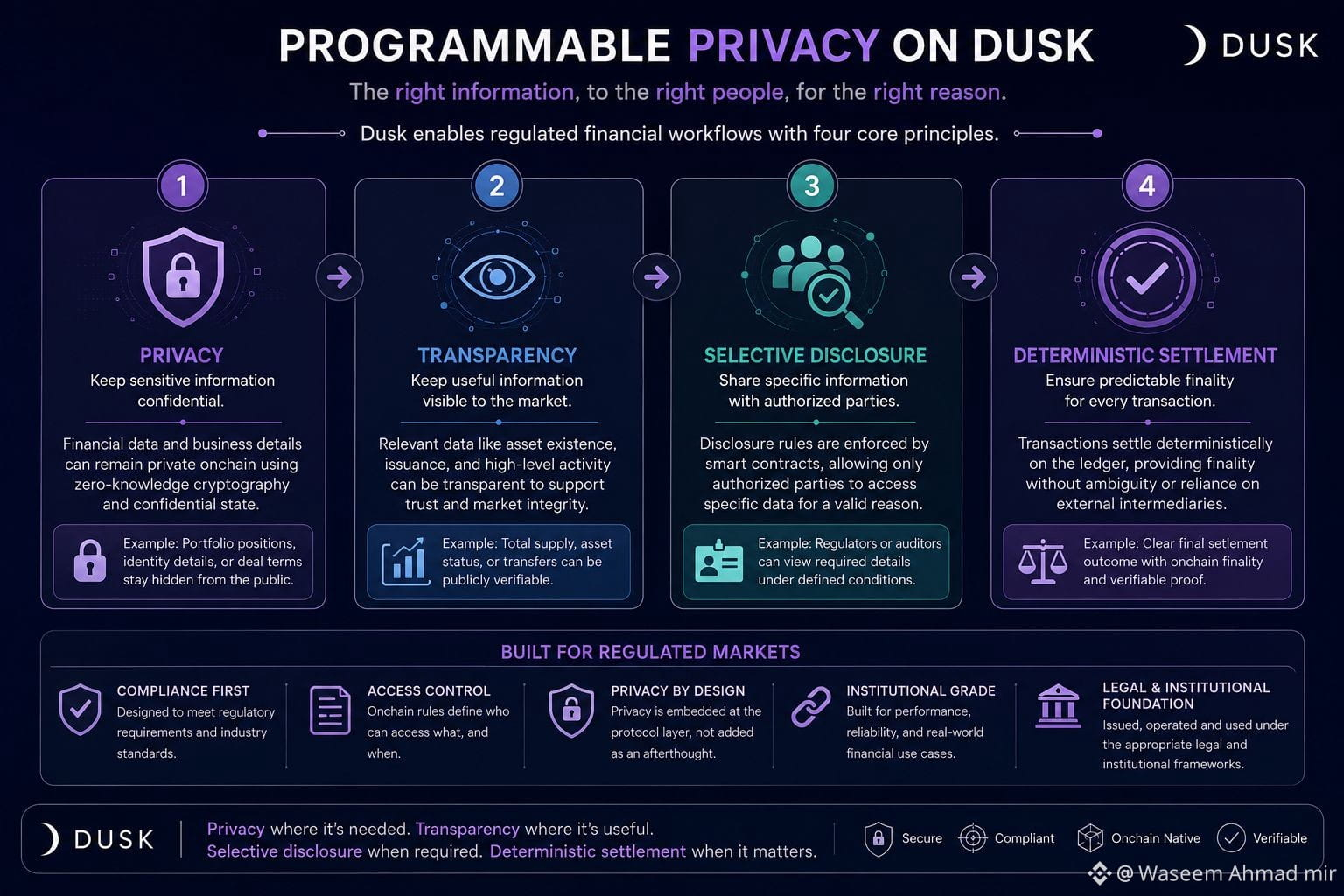
One thing I keep coming back to with financial blockchains not every piece of information needs the same level of visibility.
Think about a regulated asset.
There can be information that is useful for the market to see. There can also be information that should remain confidential. Then there may be situations where an authorized party needs to see specific information for a particular reason.
Dusk's approach to this is what it calls programmable privacy.
The idea is fairly straightforward: use privacy where it's needed, keep transparency where it's useful, and allow selective disclosure when an authorized party needs particular information. Dusk's documentation describes these as part of the protocol's approach to regulated workflows.
I like this way of looking at privacy because it isn't an all-or-nothing decision.
A market participant doesn't necessarily need to expose every financial detail to everyone. But that doesn't mean authorized review should become impossible either.
Then there is the settlement side.
Dusk describes deterministic settlement as another core requirement for regulated financial workflows. The goal is predictable finality rather than leaving the settlement outcome uncertain.
So the four ideas fit together:
Privacy when information shouldn't be public.
Transparency when visibility is useful.
Selective disclosure when specific review is required.
Deterministic settlement when the transaction needs a clear final outcome.
That's a much more specific proposition than simply calling Dusk a privacy blockchain.
#dusk $DUSK @Dusk
Think about a regulated asset.
There can be information that is useful for the market to see. There can also be information that should remain confidential. Then there may be situations where an authorized party needs to see specific information for a particular reason.
Dusk's approach to this is what it calls programmable privacy.
The idea is fairly straightforward: use privacy where it's needed, keep transparency where it's useful, and allow selective disclosure when an authorized party needs particular information. Dusk's documentation describes these as part of the protocol's approach to regulated workflows.
I like this way of looking at privacy because it isn't an all-or-nothing decision.
A market participant doesn't necessarily need to expose every financial detail to everyone. But that doesn't mean authorized review should become impossible either.
Then there is the settlement side.
Dusk describes deterministic settlement as another core requirement for regulated financial workflows. The goal is predictable finality rather than leaving the settlement outcome uncertain.
So the four ideas fit together:
Privacy when information shouldn't be public.
Transparency when visibility is useful.
Selective disclosure when specific review is required.
Deterministic settlement when the transaction needs a clear final outcome.
That's a much more specific proposition than simply calling Dusk a privacy blockchain.
#dusk $DUSK @Dusk
Verified
A regulated asset doesn't stop being regulated just because it moves onchain.
That sounds obvious, but it's an important point when looking at Dusk.
If a financial asset is going onchain, there still have to be rules around who can access it, what transfers are allowed, what information needs to be available, and how the transaction finally settles.
This is where Dusk's idea of programmable privacy makes sense to me.
The goal isn't to make the whole market invisible. Dusk's approach is built around using privacy where it's needed while keeping transparency available where it's useful. Specific information can also be disclosed to authorized parties when a workflow requires it.
I think that distinction is important.
An investor may not want every detail of their financial activity exposed publicly. But an authorized party may still need evidence for a particular review. Those aren't necessarily contradictory requirements.
Then there is settlement.
Dusk describes deterministic settlement as a core part of its infrastructure for regulated markets. The idea is to give financial workflows predictable finality rather than treating settlement as something separate from the rest of the process.
So the four things I'm taking from Dusk are pretty straightforward:
Privacy where needed.
Transparency where useful.
Selective disclosure when authorized review requires it.
Deterministic settlement for the final transaction.
For regulated finance, that combination is more interesting to me than simply calling Dusk a privacy blockchain.
What matters most for regulated assets moving onchain?
#dusk $DUSK @Dusk
That sounds obvious, but it's an important point when looking at Dusk.
If a financial asset is going onchain, there still have to be rules around who can access it, what transfers are allowed, what information needs to be available, and how the transaction finally settles.
This is where Dusk's idea of programmable privacy makes sense to me.
The goal isn't to make the whole market invisible. Dusk's approach is built around using privacy where it's needed while keeping transparency available where it's useful. Specific information can also be disclosed to authorized parties when a workflow requires it.
I think that distinction is important.
An investor may not want every detail of their financial activity exposed publicly. But an authorized party may still need evidence for a particular review. Those aren't necessarily contradictory requirements.
Then there is settlement.
Dusk describes deterministic settlement as a core part of its infrastructure for regulated markets. The idea is to give financial workflows predictable finality rather than treating settlement as something separate from the rest of the process.
So the four things I'm taking from Dusk are pretty straightforward:
Privacy where needed.
Transparency where useful.
Selective disclosure when authorized review requires it.
Deterministic settlement for the final transaction.
For regulated finance, that combination is more interesting to me than simply calling Dusk a privacy blockchain.
What matters most for regulated assets moving onchain?
#dusk $DUSK @Dusk
Programmable privacy
0%
Selective disclosure
0%
Regulatory compliance
0%
Deterministic settlement
0%
0 votes • Voting closed
30D trade $DUSK 216.8 USDT
Privacy in financial markets isn't about hiding everything. It's about knowing what actually needs to be visible.
That's the part of Dusk's approach that makes sense to me.
Some information can be public when transparency is useful. Other information may need to stay private because financial positions and transactions aren't necessarily something everyone should see.
Then there is selective disclosure.
If an authorized party needs to review particular information, the idea is to provide that access without turning the whole system into an open book. For regulated markets, that distinction matters.
I think this is where Dusk's idea of programmable privacy becomes more interesting than simply saying “private blockchain.”
The goal is to have different levels of visibility depending on the situation:
Privacy where it makes sense.
Transparency where it is useful.
Disclosure when an authorized review requires it.
And deterministic settlement so the financial workflow has a clear outcome.
Those four pieces are what I keep coming back to when I read about Dusk.
A regulated financial market has different requirements from a normal public transaction system. Making everything visible isn't always practical, but making everything hidden isn't the answer either.
The interesting challenge is finding a way to handle both.
That's the problem Dusk is trying to address with programmable privacy for regulated markets.
#dusk $DUSK @Dusk
That's the part of Dusk's approach that makes sense to me.
Some information can be public when transparency is useful. Other information may need to stay private because financial positions and transactions aren't necessarily something everyone should see.
Then there is selective disclosure.
If an authorized party needs to review particular information, the idea is to provide that access without turning the whole system into an open book. For regulated markets, that distinction matters.
I think this is where Dusk's idea of programmable privacy becomes more interesting than simply saying “private blockchain.”
The goal is to have different levels of visibility depending on the situation:
Privacy where it makes sense.
Transparency where it is useful.
Disclosure when an authorized review requires it.
And deterministic settlement so the financial workflow has a clear outcome.
Those four pieces are what I keep coming back to when I read about Dusk.
A regulated financial market has different requirements from a normal public transaction system. Making everything visible isn't always practical, but making everything hidden isn't the answer either.
The interesting challenge is finding a way to handle both.
That's the problem Dusk is trying to address with programmable privacy for regulated markets.
#dusk $DUSK @Dusk
Verified
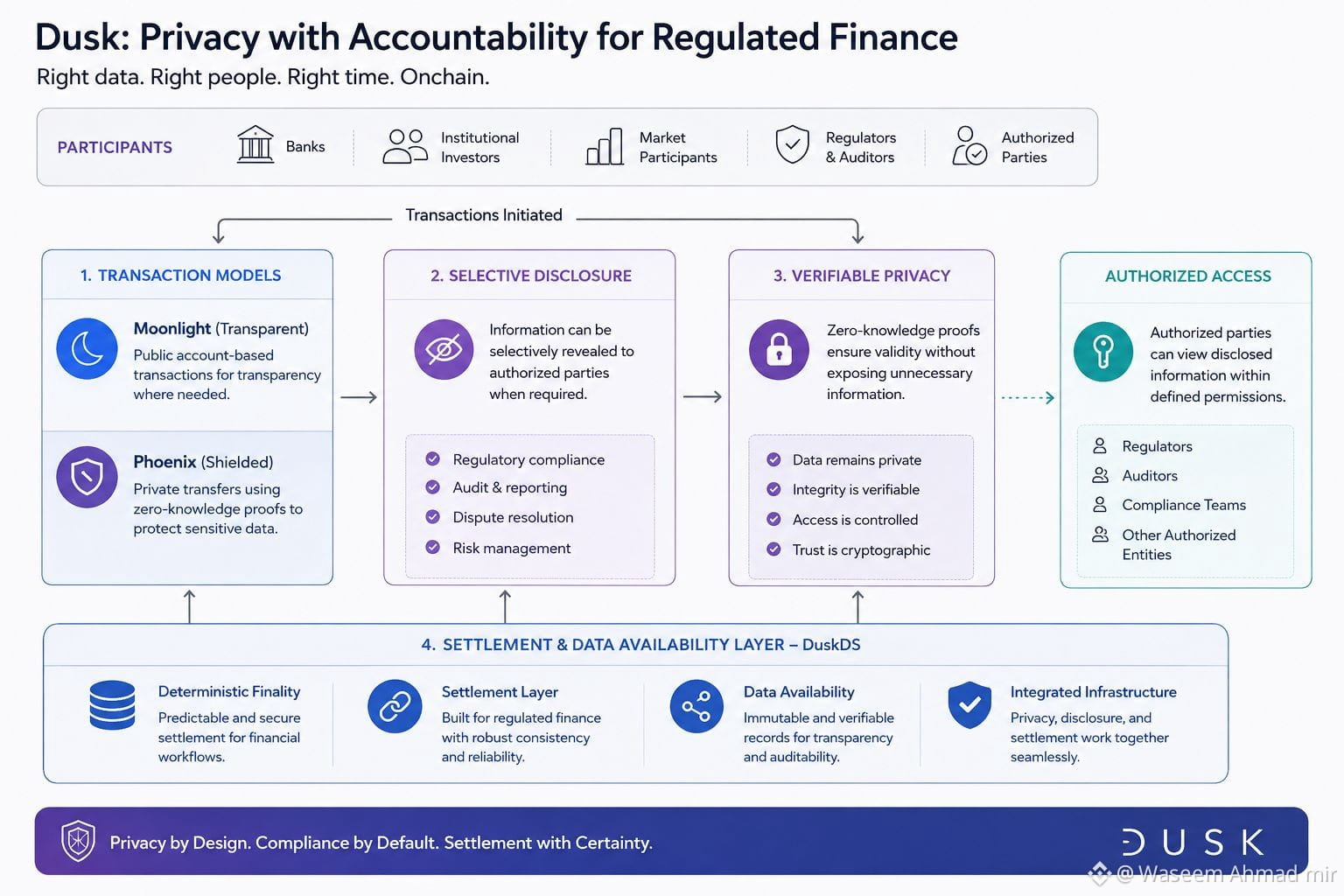
Financial markets need privacy, but they also need a way to check what happened.
That balance is what caught my attention with Dusk.
The idea isn't to make everything private and call it done. Dusk's approach is more flexible.
Some information can stay public when transparency is useful. Other information can remain confidential when exposing it would create problems for an investor, institution, or market participant. Then, when an authorized party needs specific information, selective disclosure can provide that information without making the whole transaction history public.
I think that makes much more sense for regulated finance than treating privacy and transparency as two completely separate choices.
The technical side is interesting too. Dusk has both public and shielded transaction models. Moonlight is used for transparent account flows, while Phoenix supports shielded transfers using zero-knowledge proofs. Users can also selectively reveal information when required for regulation or auditing.
Then there's settlement.
DuskDS provides the settlement and data-availability layer, with deterministic finality designed for financial workflows. That means the privacy side isn't being built separately from the settlement side. They're part of the same infrastructure.
That's probably the part of Dusk I find most interesting.
For regulated markets, the goal isn't simply “make everything private.” It's being able to decide what should be visible, what should stay confidential, who can receive additional information, and how the final transaction is settled.
#dusk
$DUSK
@Dusk
That balance is what caught my attention with Dusk.
The idea isn't to make everything private and call it done. Dusk's approach is more flexible.
Some information can stay public when transparency is useful. Other information can remain confidential when exposing it would create problems for an investor, institution, or market participant. Then, when an authorized party needs specific information, selective disclosure can provide that information without making the whole transaction history public.
I think that makes much more sense for regulated finance than treating privacy and transparency as two completely separate choices.
The technical side is interesting too. Dusk has both public and shielded transaction models. Moonlight is used for transparent account flows, while Phoenix supports shielded transfers using zero-knowledge proofs. Users can also selectively reveal information when required for regulation or auditing.
Then there's settlement.
DuskDS provides the settlement and data-availability layer, with deterministic finality designed for financial workflows. That means the privacy side isn't being built separately from the settlement side. They're part of the same infrastructure.
That's probably the part of Dusk I find most interesting.
For regulated markets, the goal isn't simply “make everything private.” It's being able to decide what should be visible, what should stay confidential, who can receive additional information, and how the final transaction is settled.
#dusk
$DUSK
@Dusk
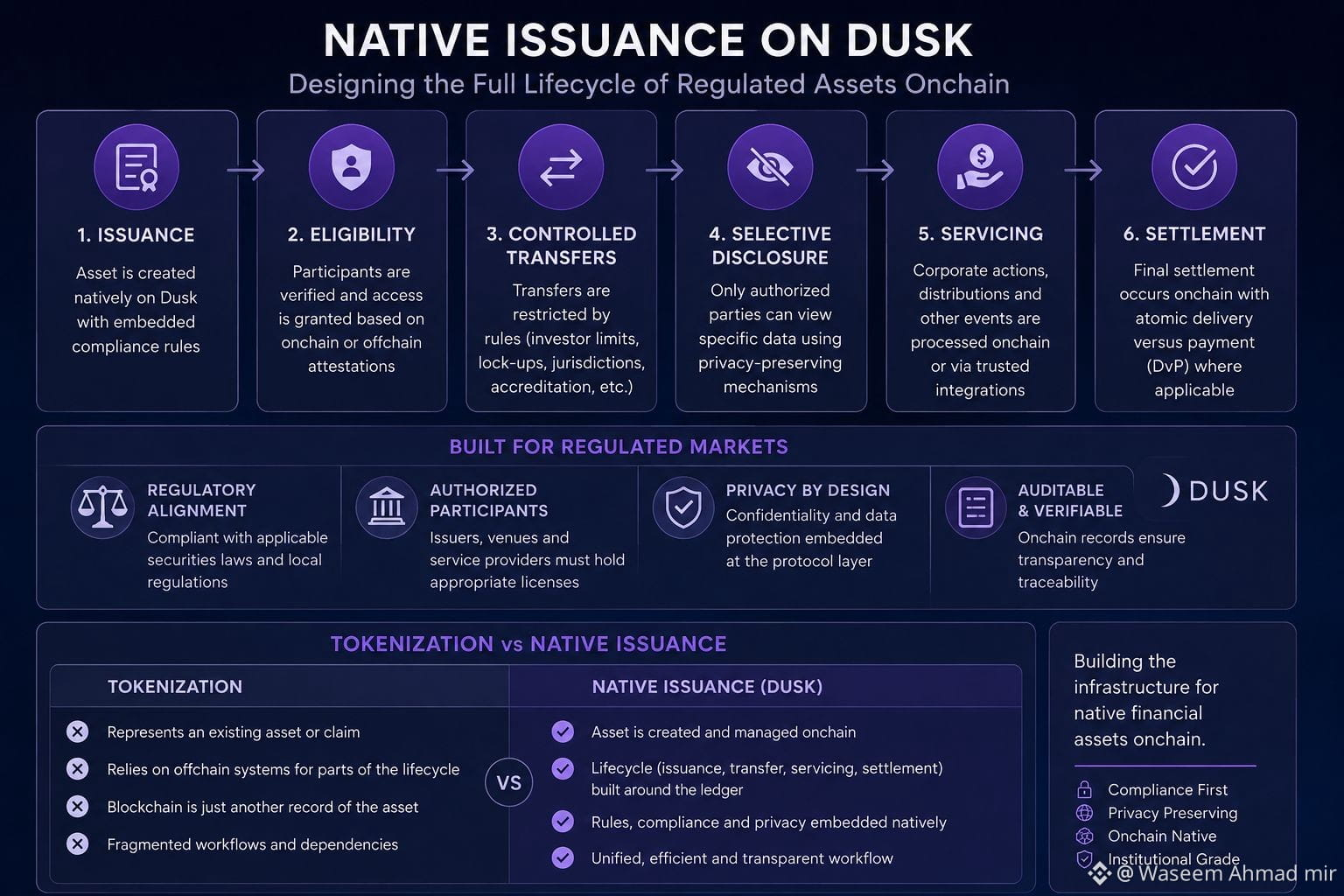
I think tokenized and native are two words that get mixed together too easily.
I've been reading Dusk's material on native issuance, and the difference is actually pretty simple.
With tokenization, a token represents an asset or a claim on an asset. The original asset and parts of its lifecycle can still depend on systems outside the blockchain.
Native issuance takes a different approach. The asset itself is created and managed onchain, so things like issuance, transfers, servicing and settlement can be designed around the ledger instead of treating the blockchain as just another record of an asset that lives somewhere else.
That becomes more interesting with regulated securities.
A financial asset still needs rules around who can access it, who can transfer it, what information can be disclosed, and how settlement works. Dusk's documentation specifically describes eligibility, controlled transfers, selective disclosure and settlement as parts of the regulated-asset workflow.
But there is an important detail here: putting a regulated security onchain doesn't remove the need for the right legal and institutional setup. The issuer, venue and product still need the required authorization for the activity they're carrying out.
So for me, the interesting part of Dusk isn't simply “RWAs on a blockchain.”
It's the idea of designing more of the asset's lifecycle around the blockchain while still accounting for the requirements of regulated markets.
That distinction between representing an existing asset and building the asset workflow natively around the ledger is what I wanted to understand better.
#dusk $DUSK @Dusk
I've been reading Dusk's material on native issuance, and the difference is actually pretty simple.
With tokenization, a token represents an asset or a claim on an asset. The original asset and parts of its lifecycle can still depend on systems outside the blockchain.
Native issuance takes a different approach. The asset itself is created and managed onchain, so things like issuance, transfers, servicing and settlement can be designed around the ledger instead of treating the blockchain as just another record of an asset that lives somewhere else.
That becomes more interesting with regulated securities.
A financial asset still needs rules around who can access it, who can transfer it, what information can be disclosed, and how settlement works. Dusk's documentation specifically describes eligibility, controlled transfers, selective disclosure and settlement as parts of the regulated-asset workflow.
But there is an important detail here: putting a regulated security onchain doesn't remove the need for the right legal and institutional setup. The issuer, venue and product still need the required authorization for the activity they're carrying out.
So for me, the interesting part of Dusk isn't simply “RWAs on a blockchain.”
It's the idea of designing more of the asset's lifecycle around the blockchain while still accounting for the requirements of regulated markets.
That distinction between representing an existing asset and building the asset workflow natively around the ledger is what I wanted to understand better.
#dusk $DUSK @Dusk
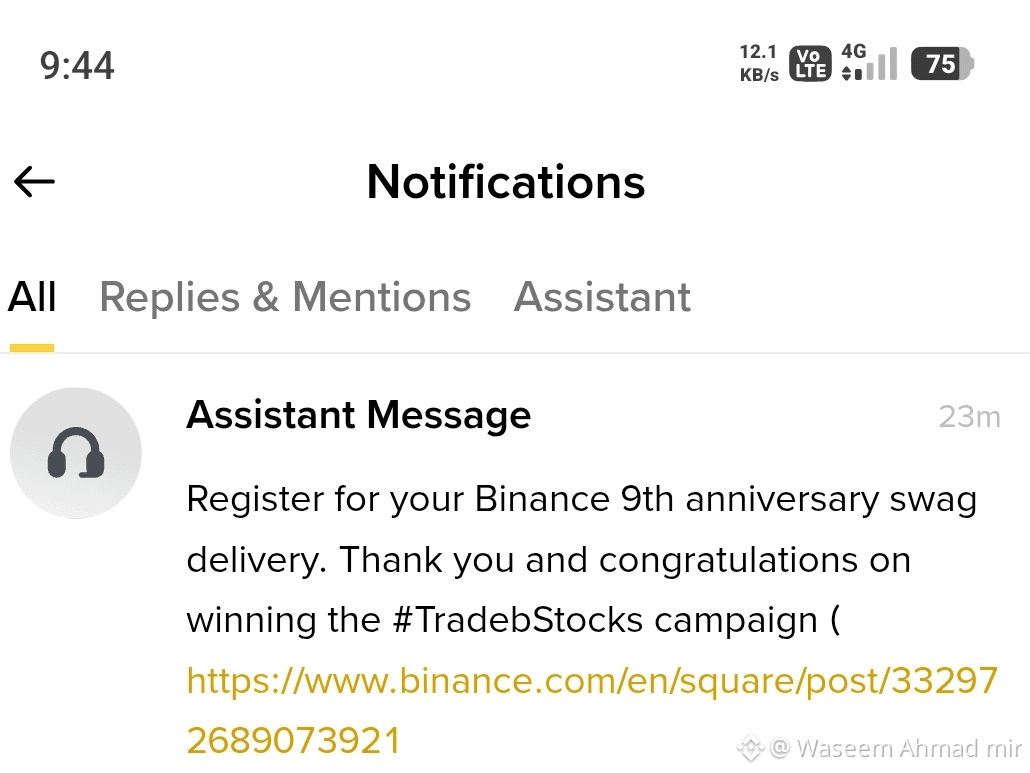
Alhamdulillah ❤️
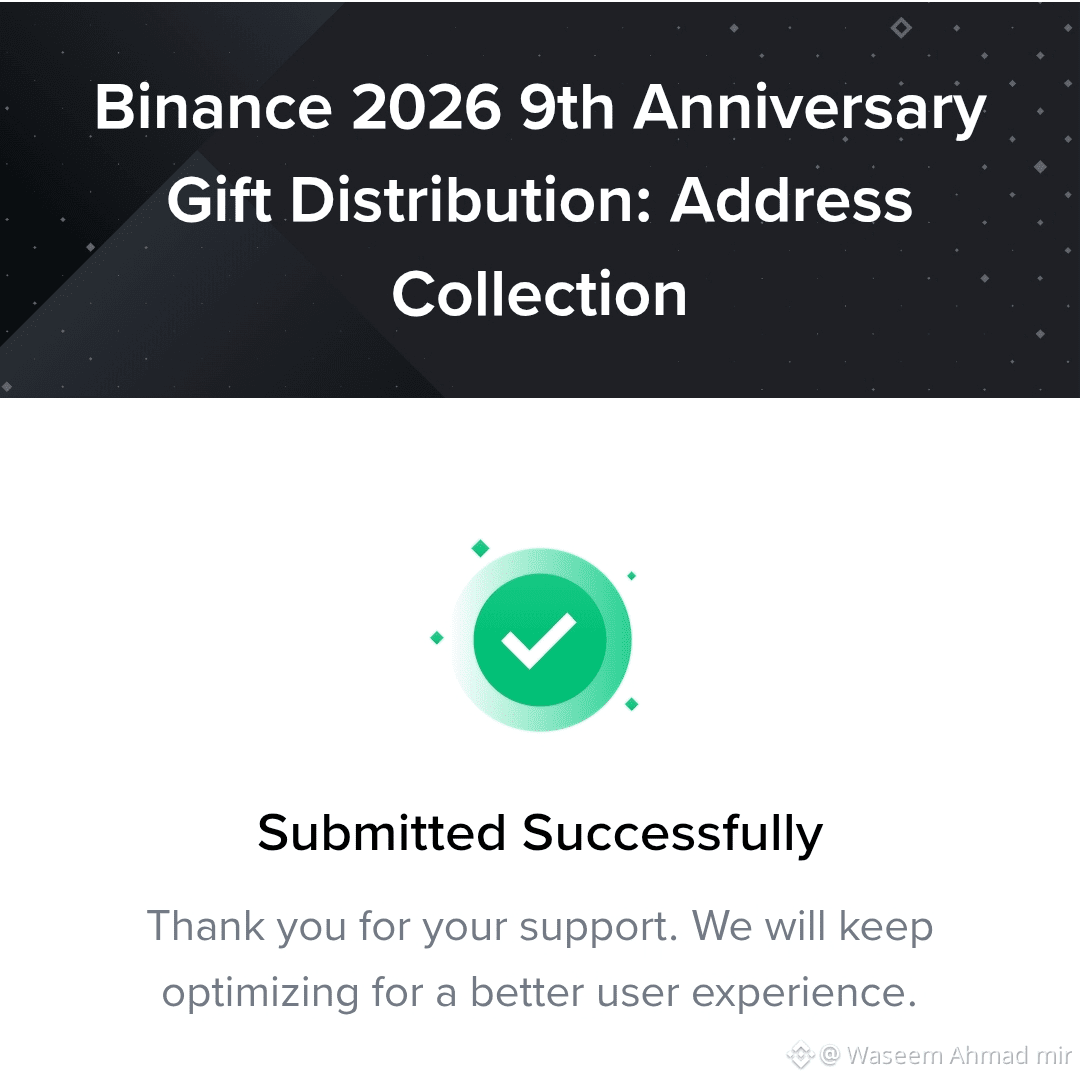
What a beautiful surprise! 🥳 I’m happy to share that I won the Binance 9th Anniversary Swag Set through the #TradebStocks campaign. 🎁
I joined to share my bStocks experience with the community, and it feels great to see that effort recognized.
Address submitted successfully. Now waiting for the swag to arrive! 📦
Big thanks to @Binance Square Official Also Binancians and congratulations to all the other winners. 💛
#TradebStocks #Binance9YA
What a beautiful surprise! 🥳 I’m happy to share that I won the Binance 9th Anniversary Swag Set through the #TradebStocks campaign. 🎁
I joined to share my bStocks experience with the community, and it feels great to see that effort recognized.
Address submitted successfully. Now waiting for the swag to arrive! 📦
Big thanks to @Binance Square Official Also Binancians and congratulations to all the other winners. 💛
#TradebStocks #Binance9YA
Binance Square Official
·
--
Share #TradebStocks & win our exclusive Binance 9YA Swag Set
Post on Binance Square with #TradebStocks , share your bStock trading experience or tutorial, and win an exclusive Binance 9th Anniversary swag set.
Activity Period: 2026-06-11 14:00 (UTC) - 2026-06-17 23:59 (UTC)
Rewards:
Share bStock tutorials and personal experiences of trying them the first time. Share with newcomers or the community. Best content will be ranked by originality, personal touch, engagement rate, and comment quality:
🥇 10 winners to content in English🥇 10 winners to content in Chinese (including Simplified and Traditional Chinese)🥇 10 winners to content in other languages
Each winner would win a set of exclusive Binance 9th year anniversary swags, you can only participate in one language.
[IMPORTANT] Content Directions
Your content should follow either of the following directions:Tutorials: How to use the product and your personal experience using it, including screenshotsYour trades: What's your first pick in bStock? Drop your trade and analysis.Suggestions: After using the product, anything else you think we can do with bStock to make Binance expand its narrative on financial super appNot too long, easy to understand, and catch people's attention at first sight.
Things to Avoid
Using AI to generate full ideas or fabricate images in your contentDo not exclude real personal experiences or screenshots to convince your audience you really used the productCopy and paste of any official content to make it your own
Having the personal touch in your content could make you stand out from the crowd. Have fun creating!
About bStocks:
Binance users can now trade and convert bStocks, tokenized securities each backed 1:1 by a US share held at a regulated custodian. bStocks are the first tokenized securities admitted to the FSRA Official List - issued under an FSRA-approved Prospectus and traded on a Recognised Investment Exchange. Find more in our official announcement.
Important notes:
Disclaimer: bStocks Tokenized Securities are classified as Certificates representing certain Financial Instruments (paragraph 92, Schedule 1 to FSMR). bStocks are not stocks or shares and bStocks do not allow holders to directly own a share or stock in the underlying listed company. bStocks do not represent any affiliation with the underlying asset's issuer. bStocks are offered through an Approved Prospectus in the ADGM and are not offered in any other jurisdiction. No public offer is made outside of the ADGM. Tokenized Securities are available only to eligible users in permitted jurisdictions on a secondary market basis only. It is your sole responsibility to ensure that accessing and trading Tokenized Securities is lawful in your jurisdiction before proceeding. Accessing this product from a jurisdiction in which it is prohibited or restricted does not create any liability or obligation on the part of Binance. We may restrict, suspend, reject, cancel, or unwind access or transactions if we determine, in our sole discretion, that your access or transaction may breach applicable law, product restrictions, eligibility criteria, sanctions requirements, or the relevant offering documents.
No information displayed in connection with Tokenized Securities is intended as an offer, solicitation, promotion, recommendation, or invitation to buy or sell securities in any jurisdiction. Tokenized Securities are not offered, sold, distributed, made available, or accessible in the United States or to, or for the account or benefit of, U.S. persons. The Tokenized Securities have not been and will not be registered under the U.S. Securities Act of 1933 or any U.S. state securities laws and a public offering of bStocks will not be conducted in the United States or any other jurisdiction (other than the ADGM). By accessing this product, you represent and warrant that you are not a U.S. person, are not located in the United States, are not acting for the account or benefit of any U.S. person, and will not access, purchase, sell, transfer, redeem, or otherwise transact in Tokenized Securities from within the United States.
For more information, see the Terms of Use, Exchange Rules, Exchange Procedures, relevant Prospectus (if applicable to you and understanding that the offer is only made in ADGM, no public offer is being made elsewhere and viewing the prospectus does not constitute an invitation or solicitation outside ADGM), bStocks Minting and Redemption Product Terms, Admission to Trading Notice and Risk Warning.
Terms and Conditions:
Participants must create the question post and include #TradebStocks , or the post will not be recognized as valid entries. Questions, replies or comments with only emojis, numbers, or meaningless content do not count as valid entries. Suspected spam, or artificially inflated comments under multiple posts, or the use of AI bot will be disqualified from the activity.Comments posted using @Binance BiBi will not be counted.If the same participant qualifies for both Prize A and Prize B, only 1 set of rewards will be sent to the same winner. If the same participant qualifies for multiple positions in Prize A, the valid question with the best popularity (the highest number of impressions and valid replies) and quality (depth) receives the reward. If the same participant qualifies for multiple positions in Prize B, the valid answer with the best popularity (the highest number of valid likes & comments) and quality (depth) receives the reward. This Activity is only available to Binance users who have completed identity verification.If any participant is found to have suspicious views, artificial engagement, or is suspected of using automated bots to boost volume, they will be disqualified from rewards, and those views will not be counted.Published content must be original. Plagiarism or malicious spamming will result in disqualification.Posts involving Red Packets or giveaways will be deemed ineligible for rewards.Any modification of previously published posts with high engagement to repurpose them for this promotion will result in disqualification.Illegally bulk-registered accounts or sub-accounts shall not be eligible to participate or receive any rewards.Only data from Binance Square posts will be counted for reward calculation.Any posts found to violate the Binance Square Community Guidelines or the Binance Square Community Platform Terms and Conditions will be ineligible for rewards.Participants are required to keep their campaign-related posts published for a minimum of 30 days following the Activity's end date. Deleting posts within this period is not permitted.Winners’ addresses will be collected via Feed Secretary on Binance Square before delivery. Binance will work with logistics partners to cover the Customs clearance cost and other related costs. However, it’s important for the receiver to provide relevant documents required by the Customs and support the clearance process.Should there be a situation where the recipient still receives notification from the courier regarding Customs Clearance fee payment, please contact via Customer Service. It’s not advised for the recipient to pay for the clearance fee and request reimbursement afterward. Any payment made by the recipient without prior communication with Binance will not be reimbursed. Binance reserves the right to disqualify any participants who, in its reasonable opinion, are acting fraudulently or not in accordance with any applicable terms and conditions (e.g., wash trading, illegally bulk account registrations, self-dealing, or market manipulation).Binance reserves the right at any time in its sole and absolute discretion to determine and/or amend or vary these terms and conditions without prior notice, including but not limited to canceling, extending, terminating or suspending this activity, the eligibility terms and criteria, the selection and number of winners, and the timing of any act to be done, and all participants shall be bound by these amendments.Binance reserves the right to disqualify any participants who tamper with Binance program code, or interfere with the operation of Binance program code with other software.Binance reserves the right of final interpretation of this Activity.There may be discrepancies between this original content in English and any translated versions. Please refer to the original English version for the most accurate information, in case any discrepancies arise.
Activity Period: 2026-06-11 14:00 (UTC) - 2026-06-17 23:59 (UTC)
Rewards:
Share bStock tutorials and personal experiences of trying them the first time. Share with newcomers or the community. Best content will be ranked by originality, personal touch, engagement rate, and comment quality:
🥇 10 winners to content in English🥇 10 winners to content in Chinese (including Simplified and Traditional Chinese)🥇 10 winners to content in other languages
Each winner would win a set of exclusive Binance 9th year anniversary swags, you can only participate in one language.
[IMPORTANT] Content Directions
Your content should follow either of the following directions:Tutorials: How to use the product and your personal experience using it, including screenshotsYour trades: What's your first pick in bStock? Drop your trade and analysis.Suggestions: After using the product, anything else you think we can do with bStock to make Binance expand its narrative on financial super appNot too long, easy to understand, and catch people's attention at first sight.
Things to Avoid
Using AI to generate full ideas or fabricate images in your contentDo not exclude real personal experiences or screenshots to convince your audience you really used the productCopy and paste of any official content to make it your own
Having the personal touch in your content could make you stand out from the crowd. Have fun creating!
About bStocks:
Binance users can now trade and convert bStocks, tokenized securities each backed 1:1 by a US share held at a regulated custodian. bStocks are the first tokenized securities admitted to the FSRA Official List - issued under an FSRA-approved Prospectus and traded on a Recognised Investment Exchange. Find more in our official announcement.
Important notes:
Disclaimer: bStocks Tokenized Securities are classified as Certificates representing certain Financial Instruments (paragraph 92, Schedule 1 to FSMR). bStocks are not stocks or shares and bStocks do not allow holders to directly own a share or stock in the underlying listed company. bStocks do not represent any affiliation with the underlying asset's issuer. bStocks are offered through an Approved Prospectus in the ADGM and are not offered in any other jurisdiction. No public offer is made outside of the ADGM. Tokenized Securities are available only to eligible users in permitted jurisdictions on a secondary market basis only. It is your sole responsibility to ensure that accessing and trading Tokenized Securities is lawful in your jurisdiction before proceeding. Accessing this product from a jurisdiction in which it is prohibited or restricted does not create any liability or obligation on the part of Binance. We may restrict, suspend, reject, cancel, or unwind access or transactions if we determine, in our sole discretion, that your access or transaction may breach applicable law, product restrictions, eligibility criteria, sanctions requirements, or the relevant offering documents.
No information displayed in connection with Tokenized Securities is intended as an offer, solicitation, promotion, recommendation, or invitation to buy or sell securities in any jurisdiction. Tokenized Securities are not offered, sold, distributed, made available, or accessible in the United States or to, or for the account or benefit of, U.S. persons. The Tokenized Securities have not been and will not be registered under the U.S. Securities Act of 1933 or any U.S. state securities laws and a public offering of bStocks will not be conducted in the United States or any other jurisdiction (other than the ADGM). By accessing this product, you represent and warrant that you are not a U.S. person, are not located in the United States, are not acting for the account or benefit of any U.S. person, and will not access, purchase, sell, transfer, redeem, or otherwise transact in Tokenized Securities from within the United States.
For more information, see the Terms of Use, Exchange Rules, Exchange Procedures, relevant Prospectus (if applicable to you and understanding that the offer is only made in ADGM, no public offer is being made elsewhere and viewing the prospectus does not constitute an invitation or solicitation outside ADGM), bStocks Minting and Redemption Product Terms, Admission to Trading Notice and Risk Warning.
Terms and Conditions:
Participants must create the question post and include #TradebStocks , or the post will not be recognized as valid entries. Questions, replies or comments with only emojis, numbers, or meaningless content do not count as valid entries. Suspected spam, or artificially inflated comments under multiple posts, or the use of AI bot will be disqualified from the activity.Comments posted using @Binance BiBi will not be counted.If the same participant qualifies for both Prize A and Prize B, only 1 set of rewards will be sent to the same winner. If the same participant qualifies for multiple positions in Prize A, the valid question with the best popularity (the highest number of impressions and valid replies) and quality (depth) receives the reward. If the same participant qualifies for multiple positions in Prize B, the valid answer with the best popularity (the highest number of valid likes & comments) and quality (depth) receives the reward. This Activity is only available to Binance users who have completed identity verification.If any participant is found to have suspicious views, artificial engagement, or is suspected of using automated bots to boost volume, they will be disqualified from rewards, and those views will not be counted.Published content must be original. Plagiarism or malicious spamming will result in disqualification.Posts involving Red Packets or giveaways will be deemed ineligible for rewards.Any modification of previously published posts with high engagement to repurpose them for this promotion will result in disqualification.Illegally bulk-registered accounts or sub-accounts shall not be eligible to participate or receive any rewards.Only data from Binance Square posts will be counted for reward calculation.Any posts found to violate the Binance Square Community Guidelines or the Binance Square Community Platform Terms and Conditions will be ineligible for rewards.Participants are required to keep their campaign-related posts published for a minimum of 30 days following the Activity's end date. Deleting posts within this period is not permitted.Winners’ addresses will be collected via Feed Secretary on Binance Square before delivery. Binance will work with logistics partners to cover the Customs clearance cost and other related costs. However, it’s important for the receiver to provide relevant documents required by the Customs and support the clearance process.Should there be a situation where the recipient still receives notification from the courier regarding Customs Clearance fee payment, please contact via Customer Service. It’s not advised for the recipient to pay for the clearance fee and request reimbursement afterward. Any payment made by the recipient without prior communication with Binance will not be reimbursed. Binance reserves the right to disqualify any participants who, in its reasonable opinion, are acting fraudulently or not in accordance with any applicable terms and conditions (e.g., wash trading, illegally bulk account registrations, self-dealing, or market manipulation).Binance reserves the right at any time in its sole and absolute discretion to determine and/or amend or vary these terms and conditions without prior notice, including but not limited to canceling, extending, terminating or suspending this activity, the eligibility terms and criteria, the selection and number of winners, and the timing of any act to be done, and all participants shall be bound by these amendments.Binance reserves the right to disqualify any participants who tamper with Binance program code, or interfere with the operation of Binance program code with other software.Binance reserves the right of final interpretation of this Activity.There may be discrepancies between this original content in English and any translated versions. Please refer to the original English version for the most accurate information, in case any discrepancies arise.
Verified
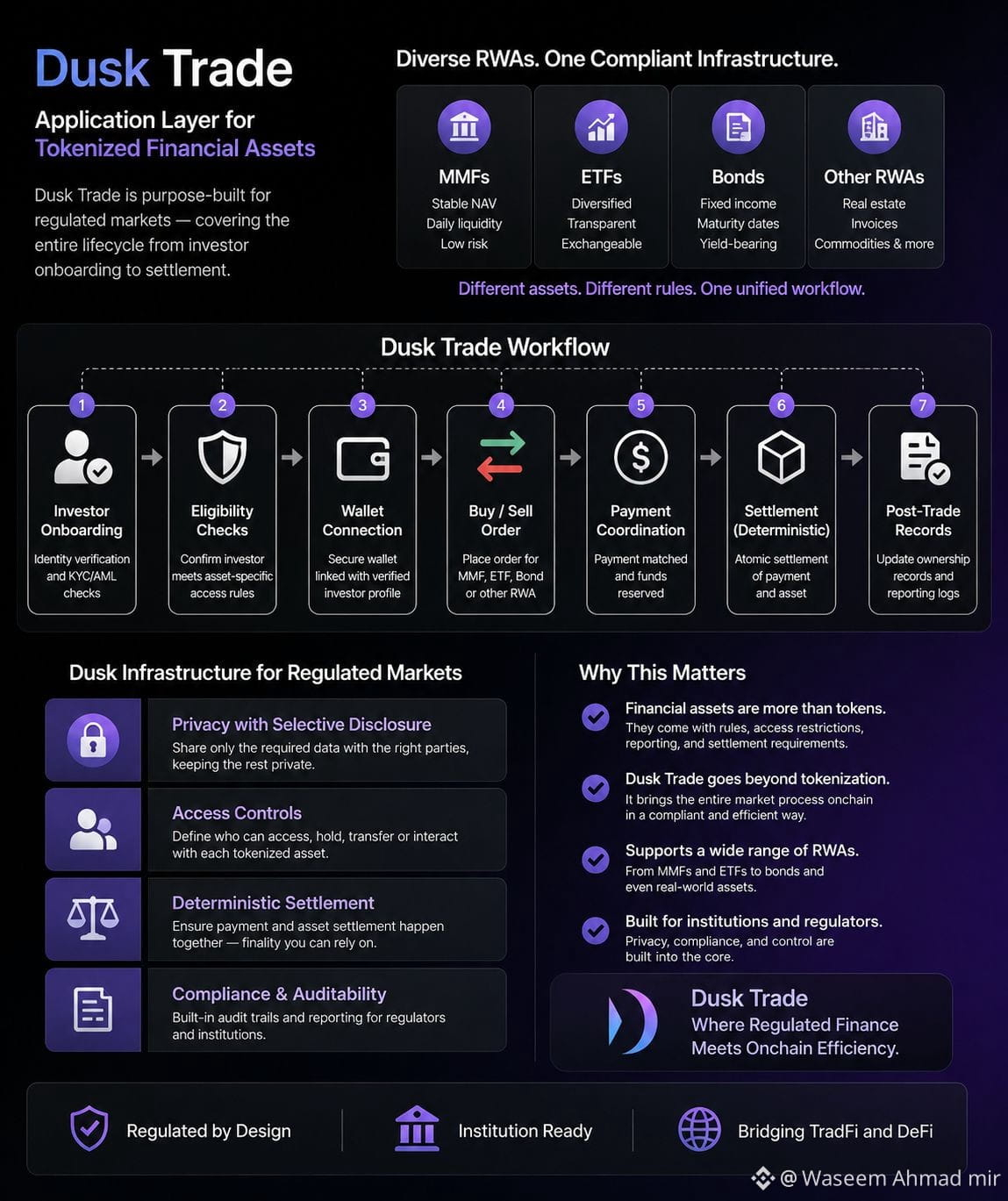
MMFs, ETFs, bonds and other RWAs don't all work the same way. That's what makes bringing them onchain interesting.
I've been looking more closely at Dusk Trade because the idea isn't simply to put one type of financial asset on a blockchain.
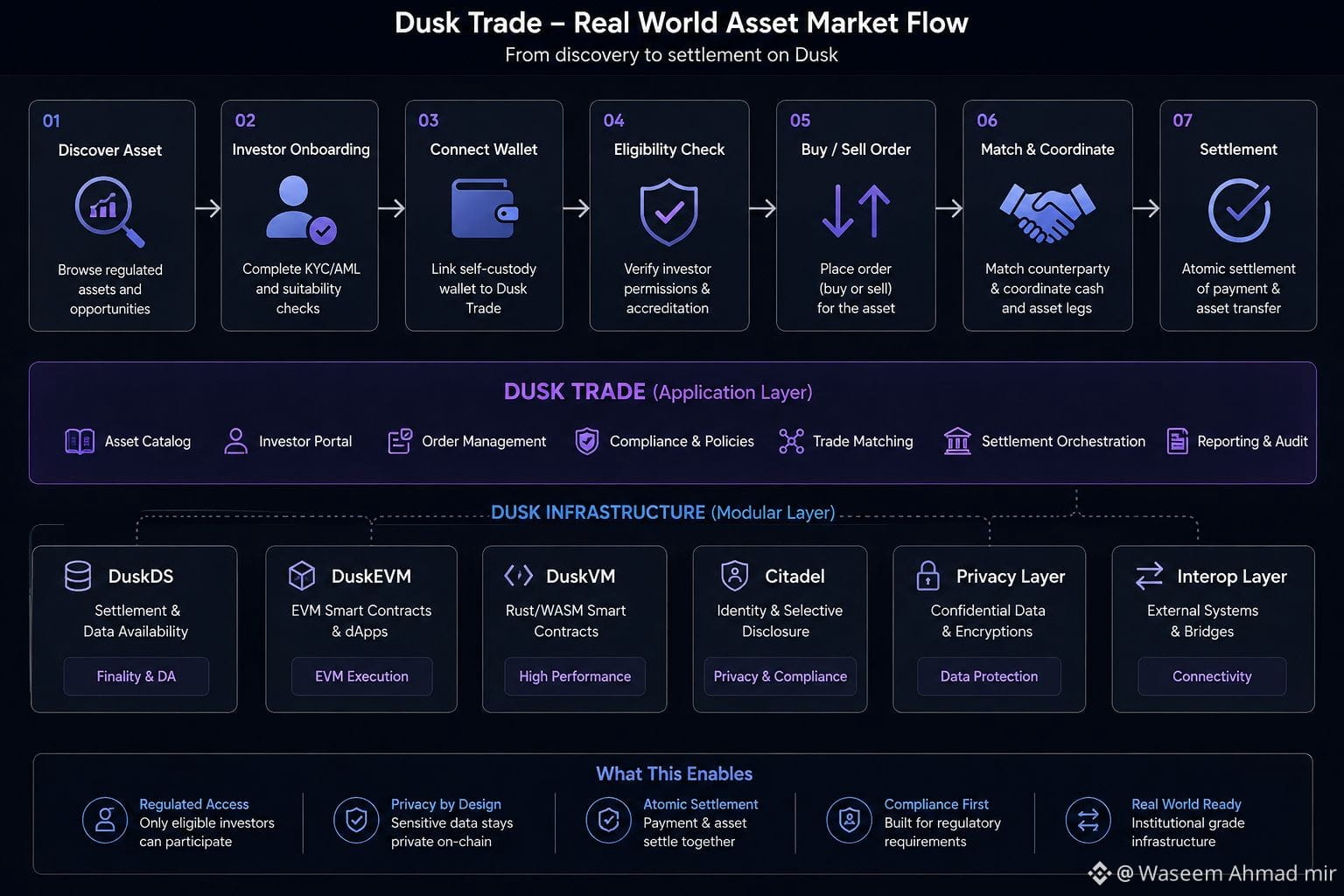
Dusk describes Dusk Trade as the application layer for tokenized financial assets. The workflow includes things such as investor onboarding, eligibility checks, wallet connection, buying or selling, payment coordination and settlement.
That's important because a financial asset isn't just a token sitting in a wallet.
There can be rules around who is allowed to access it, how it can be transferred, what information needs to be available, and how the payment and asset sides of a transaction are settled.
Dusk's broader infrastructure is being built around those kinds of regulated-market requirements. Its current materials describe privacy with selective disclosure, access controls and deterministic settlement as part of the infrastructure for regulated digital assets.
The MMF, ETF and bond examples caught my attention because they show the range of assets Dusk is targeting rather than treating “RWA” as one single category.
I don't think the interesting question is simply whether these assets can be represented onchain.
The harder question is whether the surrounding market process can work there too.
That's where Dusk Trade becomes interesting to me: not just the asset itself, but the workflow around ownership, eligibility, trading and settlement.
#dusk $DUSK @Dusk
I've been looking more closely at Dusk Trade because the idea isn't simply to put one type of financial asset on a blockchain.
Dusk describes Dusk Trade as the application layer for tokenized financial assets. The workflow includes things such as investor onboarding, eligibility checks, wallet connection, buying or selling, payment coordination and settlement.
That's important because a financial asset isn't just a token sitting in a wallet.
There can be rules around who is allowed to access it, how it can be transferred, what information needs to be available, and how the payment and asset sides of a transaction are settled.
Dusk's broader infrastructure is being built around those kinds of regulated-market requirements. Its current materials describe privacy with selective disclosure, access controls and deterministic settlement as part of the infrastructure for regulated digital assets.
The MMF, ETF and bond examples caught my attention because they show the range of assets Dusk is targeting rather than treating “RWA” as one single category.
I don't think the interesting question is simply whether these assets can be represented onchain.
The harder question is whether the surrounding market process can work there too.
That's where Dusk Trade becomes interesting to me: not just the asset itself, but the workflow around ownership, eligibility, trading and settlement.
#dusk $DUSK @Dusk
Verified
I think the part people miss about tokenization is everything that comes after creating the token.
I was reading about Dusk Trade and that was the thing that stood out to me.
Dusk Trade isn't the base blockchain. It's the application layer for tokenized financial assets on Dusk. The docs describe it around actual market workflows: finding an asset, onboarding investors, connecting a wallet, checking eligibility, buying or selling, coordinating the payment and asset sides, and settling the transaction.
That makes more sense to me than just saying “put financial assets onchain.”
For regulated assets, the token itself is only one part of the process. There are questions about who can access it, who can hold or transfer it, what information needs to stay private, and how the payment and asset settlement happen together. Dusk's market infrastructure is built around those requirements.
Dusk Trade sits on top of that infrastructure. Underneath it, Dusk provides different pieces for different jobs, including DuskDS for settlement and data availability, DuskEVM for EVM applications, DuskVM for Rust/WASM contracts, and Citadel for identity and selective disclosure.
That's the part I'm interested in.
Tokenization gets the headline, but the actual market workflow is where things become complicated. Dusk seems to be spending a lot of its design effort on that part.
#dusk $DUSK @Dusk
I was reading about Dusk Trade and that was the thing that stood out to me.
Dusk Trade isn't the base blockchain. It's the application layer for tokenized financial assets on Dusk. The docs describe it around actual market workflows: finding an asset, onboarding investors, connecting a wallet, checking eligibility, buying or selling, coordinating the payment and asset sides, and settling the transaction.
That makes more sense to me than just saying “put financial assets onchain.”
For regulated assets, the token itself is only one part of the process. There are questions about who can access it, who can hold or transfer it, what information needs to stay private, and how the payment and asset settlement happen together. Dusk's market infrastructure is built around those requirements.
Dusk Trade sits on top of that infrastructure. Underneath it, Dusk provides different pieces for different jobs, including DuskDS for settlement and data availability, DuskEVM for EVM applications, DuskVM for Rust/WASM contracts, and Citadel for identity and selective disclosure.
That's the part I'm interested in.
Tokenization gets the headline, but the actual market workflow is where things become complicated. Dusk seems to be spending a lot of its design effort on that part.
#dusk $DUSK @Dusk
Verified
I was looking at DuskEVM today and one thing made more sense to me than the usual “EVM-compatible” description.
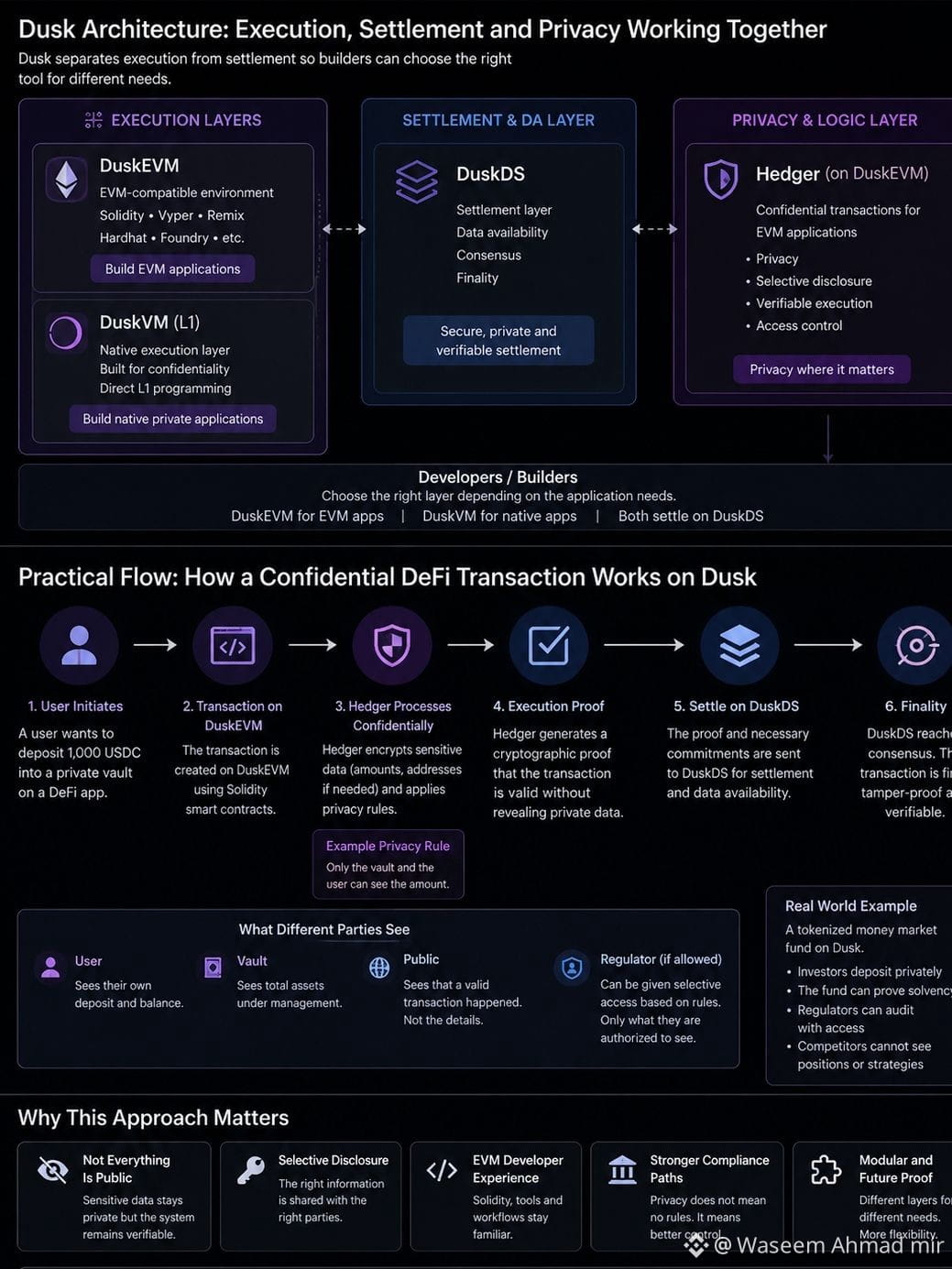
Dusk has separated execution from settlement.
DuskEVM is the EVM execution layer, where developers can use Solidity and familiar EVM tools. DuskDS sits underneath it as the settlement and data-availability layer. So the two aren't doing the same job.
Then there is Hedger.
According to the Dusk documentation, Hedger runs on DuskEVM and is designed for EVM-first applications that need confidential flows. Dusk describes its approach around privacy, selective disclosure and verifiable execution rather than simply making everything public or everything private.
That distinction is important for financial applications.
A transaction can involve information that shouldn't necessarily be visible to everyone, while the system can still need rules around who is allowed to see certain information.
That's the part of Dusk I find worth following. The project isn't treating privacy as the only goal. Its architecture is trying to give builders different tools depending on what an application actually needs: DuskEVM for EVM development, DuskVM for direct L1 execution, and DuskDS for settlement and data availability.
I'm more interested in seeing how builders use these pieces than repeating another generic “privacy blockchain” description.
#dusk $DUSK @Dusk
Dusk has separated execution from settlement.
DuskEVM is the EVM execution layer, where developers can use Solidity and familiar EVM tools. DuskDS sits underneath it as the settlement and data-availability layer. So the two aren't doing the same job.
Then there is Hedger.
According to the Dusk documentation, Hedger runs on DuskEVM and is designed for EVM-first applications that need confidential flows. Dusk describes its approach around privacy, selective disclosure and verifiable execution rather than simply making everything public or everything private.
That distinction is important for financial applications.
A transaction can involve information that shouldn't necessarily be visible to everyone, while the system can still need rules around who is allowed to see certain information.
That's the part of Dusk I find worth following. The project isn't treating privacy as the only goal. Its architecture is trying to give builders different tools depending on what an application actually needs: DuskEVM for EVM development, DuskVM for direct L1 execution, and DuskDS for settlement and data availability.
I'm more interested in seeing how builders use these pieces than repeating another generic “privacy blockchain” description.
#dusk $DUSK @Dusk
Putting an asset on a blockchain and issuing an asset on a blockchain aren't necessarily the same thing.
That's the distinction I found interesting in Dusk's approach to tokenized financial assets.
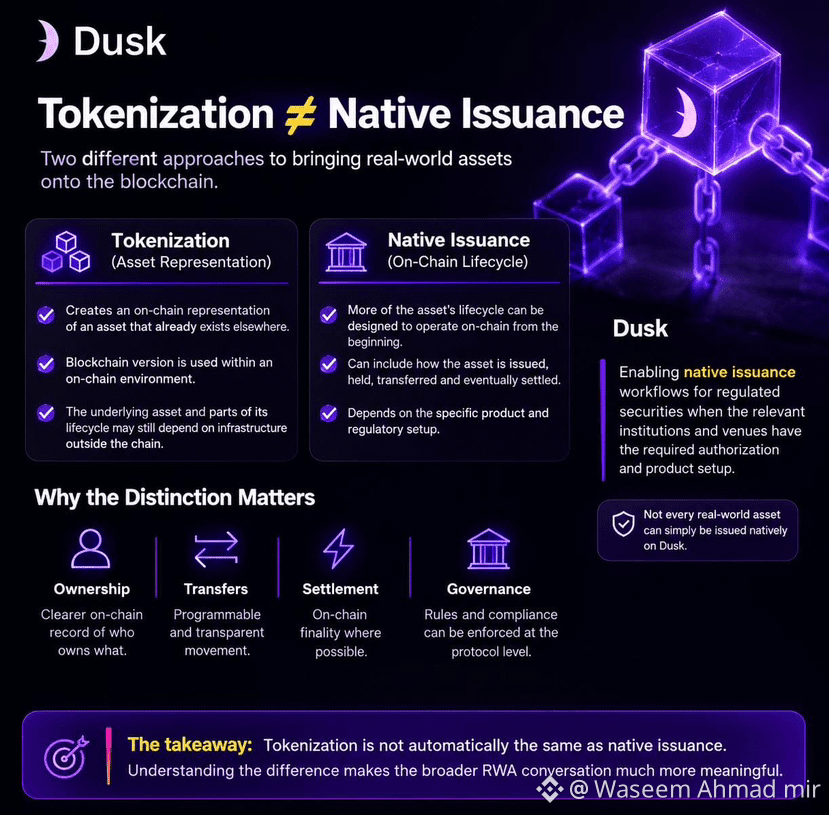
Tokenization can mean creating an on-chain representation of an asset that already exists elsewhere. The blockchain representation can then be used within an on-chain environment, but the underlying asset and parts of its lifecycle may still depend on infrastructure outside the chain.
Native issuance takes a different approach.
Instead of only representing an existing asset on-chain, more of the asset's lifecycle can be designed to operate on-chain from the beginning. That can include how the asset is issued, held, transferred and eventually settled, depending on the specific product and regulatory setup.
For regulated securities, that distinction matters.
Dusk describes its infrastructure as capable of supporting native issuance workflows for regulated securities when the relevant institutions and venues have the required authorization and product setup. So this isn't a claim that every real-world asset can simply be issued natively on Dusk.
What I find interesting is the direction of the architecture.
Rather than treating blockchain as a separate layer that only creates a digital wrapper around traditional assets, native issuance asks a bigger question: how much of the financial asset's actual lifecycle can be handled on-chain?
That could have implications for how ownership, transfers and settlement are structured.
For me, the important takeaway is simple: tokenization is not automatically the same as native issuance. Understanding that difference makes the broader RWA conversation much more meaningful.
#dusk
$DUSK
@Dusk
That's the distinction I found interesting in Dusk's approach to tokenized financial assets.
Tokenization can mean creating an on-chain representation of an asset that already exists elsewhere. The blockchain representation can then be used within an on-chain environment, but the underlying asset and parts of its lifecycle may still depend on infrastructure outside the chain.
Native issuance takes a different approach.
Instead of only representing an existing asset on-chain, more of the asset's lifecycle can be designed to operate on-chain from the beginning. That can include how the asset is issued, held, transferred and eventually settled, depending on the specific product and regulatory setup.
For regulated securities, that distinction matters.
Dusk describes its infrastructure as capable of supporting native issuance workflows for regulated securities when the relevant institutions and venues have the required authorization and product setup. So this isn't a claim that every real-world asset can simply be issued natively on Dusk.
What I find interesting is the direction of the architecture.
Rather than treating blockchain as a separate layer that only creates a digital wrapper around traditional assets, native issuance asks a bigger question: how much of the financial asset's actual lifecycle can be handled on-chain?
That could have implications for how ownership, transfers and settlement are structured.
For me, the important takeaway is simple: tokenization is not automatically the same as native issuance. Understanding that difference makes the broader RWA conversation much more meaningful.
#dusk
$DUSK
@Dusk
Verified
Financial privacy isn't very useful if the people who need to verify a transaction can't do their job.
That's the part of Dusk's approach I find interesting.
For regulated financial markets, making everything completely public can expose information that participants may not want everyone to see. But going to the other extreme and making activity completely hidden creates a different problem when authorized parties need to review it.
Dusk approaches this with programmable privacy.
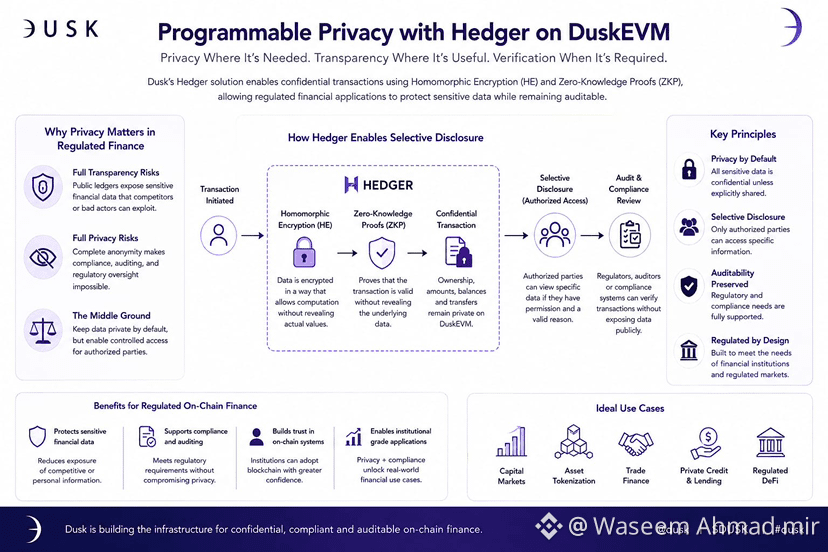
The idea is to keep sensitive transaction information confidential while still supporting selective disclosure when authorized review is required. In the material I read about Hedger on DuskEVM, confidential transactions use a combination of homomorphic encryption and zero-knowledge proofs.
That combination matters because privacy isn't being treated as simply "hide everything."
Hedger is designed for confidential ownership, transfers, amounts and balances while retaining auditability. The goal is to give regulated financial applications a way to protect sensitive information without removing the ability to verify activity when that verification is required.
I think that's a much more practical way to look at blockchain privacy.
A financial institution doesn't necessarily need every transaction detail visible to the entire network. At the same time, it can't simply operate in an environment where legitimate review becomes impossible.
That's where selective disclosure becomes important.
Dusk is building around that middle ground: privacy where it's needed, transparency where it's useful, and controlled review when required.
For regulated on-chain finance, that distinction could matter just as much as the underlying blockchain technology.
#dusk
$DUSK
@Dusk
That's the part of Dusk's approach I find interesting.
For regulated financial markets, making everything completely public can expose information that participants may not want everyone to see. But going to the other extreme and making activity completely hidden creates a different problem when authorized parties need to review it.
Dusk approaches this with programmable privacy.
The idea is to keep sensitive transaction information confidential while still supporting selective disclosure when authorized review is required. In the material I read about Hedger on DuskEVM, confidential transactions use a combination of homomorphic encryption and zero-knowledge proofs.
That combination matters because privacy isn't being treated as simply "hide everything."
Hedger is designed for confidential ownership, transfers, amounts and balances while retaining auditability. The goal is to give regulated financial applications a way to protect sensitive information without removing the ability to verify activity when that verification is required.
I think that's a much more practical way to look at blockchain privacy.
A financial institution doesn't necessarily need every transaction detail visible to the entire network. At the same time, it can't simply operate in an environment where legitimate review becomes impossible.
That's where selective disclosure becomes important.
Dusk is building around that middle ground: privacy where it's needed, transparency where it's useful, and controlled review when required.
For regulated on-chain finance, that distinction could matter just as much as the underlying blockchain technology.
#dusk
$DUSK
@Dusk
Verified
What caught my attention about Dusk and NPEX wasn't the word “blockchain.” It was the type of market they were trying to put on-chain.
NPEX is a stock exchange in the Netherlands that is licensed as a Multilateral Trading Facility (MTF). The 2024 announcement described Dusk and NPEX working together on infrastructure for issuing, trading and tokenizing regulated financial instruments.
That's a different starting point from simply creating another token and looking for somewhere to use it.
The idea is to bring parts of the existing financial market infrastructure onto a blockchain environment, while keeping the regulatory framework around the assets and venue.
The announcement points to several potential advantages of on-chain finance: faster settlement, automation of certain processes, interoperability between financial organizations and easier access to liquidity.
But what I found more interesting was the underlying approach.
Dusk isn't describing regulated assets as something that only becomes useful after being wrapped into a generic DeFi product. The goal is to provide infrastructure that financial institutions and regulated venues can actually build on.
That fits with where Dusk is heading today. The network is built for regulated on-chain finance, combining programmable privacy, selective disclosure and deterministic settlement.
And the NPEX partnership gives that idea a concrete example: a regulated financial venue exploring blockchain infrastructure for real-world financial instruments.
For me, that's a more interesting RWA story than simply counting how many assets can be tokenized. The real question is whether the infrastructure can fit the requirements of the financial markets those assets already belong to.
@Dusk
#dusk
$DUSK
NPEX is a stock exchange in the Netherlands that is licensed as a Multilateral Trading Facility (MTF). The 2024 announcement described Dusk and NPEX working together on infrastructure for issuing, trading and tokenizing regulated financial instruments.
That's a different starting point from simply creating another token and looking for somewhere to use it.
The idea is to bring parts of the existing financial market infrastructure onto a blockchain environment, while keeping the regulatory framework around the assets and venue.
The announcement points to several potential advantages of on-chain finance: faster settlement, automation of certain processes, interoperability between financial organizations and easier access to liquidity.
But what I found more interesting was the underlying approach.
Dusk isn't describing regulated assets as something that only becomes useful after being wrapped into a generic DeFi product. The goal is to provide infrastructure that financial institutions and regulated venues can actually build on.
That fits with where Dusk is heading today. The network is built for regulated on-chain finance, combining programmable privacy, selective disclosure and deterministic settlement.
And the NPEX partnership gives that idea a concrete example: a regulated financial venue exploring blockchain infrastructure for real-world financial instruments.
For me, that's a more interesting RWA story than simply counting how many assets can be tokenized. The real question is whether the infrastructure can fit the requirements of the financial markets those assets already belong to.
@Dusk
#dusk
$DUSK
Verified
Privacy on an EVM chain gets a lot more interesting when compliance is part of the problem.
That is what caught my attention about Hedger.
According to Dusk's explanation, Hedger is built specifically for the DuskEVM execution layer. Instead of relying on one cryptographic technique, it combines homomorphic encryption with zero-knowledge proofs.
The homomorphic encryption side is based on ElGamal over elliptic-curve cryptography and allows computations to be performed on encrypted values without exposing those values. The zero-knowledge proofs are then used to prove that computations are correct without revealing the underlying inputs.
What I find interesting is where Dusk is taking this.
The goal isn't simply to hide transactions. Hedger is designed around financial applications where privacy and auditability both matter. The source describes confidential ownership, transfers, amounts and balances, while retaining the ability for transactions to be audited when required.
There is also an important distinction from Zedger. Zedger was designed for UTXO-based layers, while Hedger is built for the EVM environment. That means developers working with the EVM stack can approach confidential transactions without giving up the familiar Ethereum tooling that DuskEVM is designed to support.
The part I'm most curious about is the potential for obfuscated order books. Dusk says Hedger lays the groundwork for this, with the aim of protecting trading participants from exposing their intent or positions.
For regulated markets, that combination of confidentiality and reviewability is a much more interesting problem than simply making everything private.
@Dusk
#dusk
$DUSK
That is what caught my attention about Hedger.
According to Dusk's explanation, Hedger is built specifically for the DuskEVM execution layer. Instead of relying on one cryptographic technique, it combines homomorphic encryption with zero-knowledge proofs.
The homomorphic encryption side is based on ElGamal over elliptic-curve cryptography and allows computations to be performed on encrypted values without exposing those values. The zero-knowledge proofs are then used to prove that computations are correct without revealing the underlying inputs.
What I find interesting is where Dusk is taking this.
The goal isn't simply to hide transactions. Hedger is designed around financial applications where privacy and auditability both matter. The source describes confidential ownership, transfers, amounts and balances, while retaining the ability for transactions to be audited when required.
There is also an important distinction from Zedger. Zedger was designed for UTXO-based layers, while Hedger is built for the EVM environment. That means developers working with the EVM stack can approach confidential transactions without giving up the familiar Ethereum tooling that DuskEVM is designed to support.
The part I'm most curious about is the potential for obfuscated order books. Dusk says Hedger lays the groundwork for this, with the aim of protecting trading participants from exposing their intent or positions.
For regulated markets, that combination of confidentiality and reviewability is a much more interesting problem than simply making everything private.
@Dusk
#dusk
$DUSK
Verified
DuskEVM is interesting because it doesn't ask EVM developers to start from scratch.
If you're already building with Solidity, Vyper, Foundry, Hardhat, viem or ethers, the idea is to bring that familiar workflow into the Dusk stack.
But the part I find more interesting is what happens underneath.
DuskEVM is the Ethereum-compatible execution environment, while DuskDS handles consensus, settlement and data availability. DUSK is used for execution and can move between Dusk L1 and DuskEVM through the bridge.
The transaction flow is also worth paying attention to.
A transaction first reaches the DuskEVM sequencer, then gets included in an L2 block. The batcher publishes the transaction data to DuskDS, while state commitments and fault proofs connect the resulting state to DuskDS settlement.
That last part is important because transaction inclusion and settlement aren't the same thing. Just seeing a transaction included doesn't mean you should assume finality based only on how much time has passed.
I also like that Dusk isn't forcing every application into the same environment.
For Solidity applications, EVM wallets and existing Ethereum tooling, DuskEVM is the obvious route.
For Rust/WASM contracts that need to work directly with the Dusk L1, DuskVM remains the option.
So the interesting part isn't simply "Dusk now has EVM."
It's that Dusk is giving developers a familiar execution environment while keeping it connected to its own settlement and data-availability layer.
@Dusk
#dusk
$DUSK
If you're already building with Solidity, Vyper, Foundry, Hardhat, viem or ethers, the idea is to bring that familiar workflow into the Dusk stack.
But the part I find more interesting is what happens underneath.
DuskEVM is the Ethereum-compatible execution environment, while DuskDS handles consensus, settlement and data availability. DUSK is used for execution and can move between Dusk L1 and DuskEVM through the bridge.
The transaction flow is also worth paying attention to.
A transaction first reaches the DuskEVM sequencer, then gets included in an L2 block. The batcher publishes the transaction data to DuskDS, while state commitments and fault proofs connect the resulting state to DuskDS settlement.
That last part is important because transaction inclusion and settlement aren't the same thing. Just seeing a transaction included doesn't mean you should assume finality based only on how much time has passed.
I also like that Dusk isn't forcing every application into the same environment.
For Solidity applications, EVM wallets and existing Ethereum tooling, DuskEVM is the obvious route.
For Rust/WASM contracts that need to work directly with the Dusk L1, DuskVM remains the option.
So the interesting part isn't simply "Dusk now has EVM."
It's that Dusk is giving developers a familiar execution environment while keeping it connected to its own settlement and data-availability layer.
@Dusk
#dusk
$DUSK
Log in to explore more content