

In the summer of 2023, YGG officially announced the closure of six SubDAOs, including parts of YGG Turkey, YGG Korea, and YGG Brazil. The announcement was written with restraint: 'After community voting, due to inactivity and ROI not reaching the threshold, operations will be terminated.'
But the community erupted. Some questioned: 'Is this the promise of decentralization? Just close it when you want?'
Others sneered: 'Expand by making grand promises, and when contracted, shift the blame to 'community voting'.'
On the surface, this is a strategic contraction; on a deeper level, it is YGG's most honest lesson: it acknowledges that not all places are suitable for the same model, and not all enthusiasm can be converted into a sustainable economy.
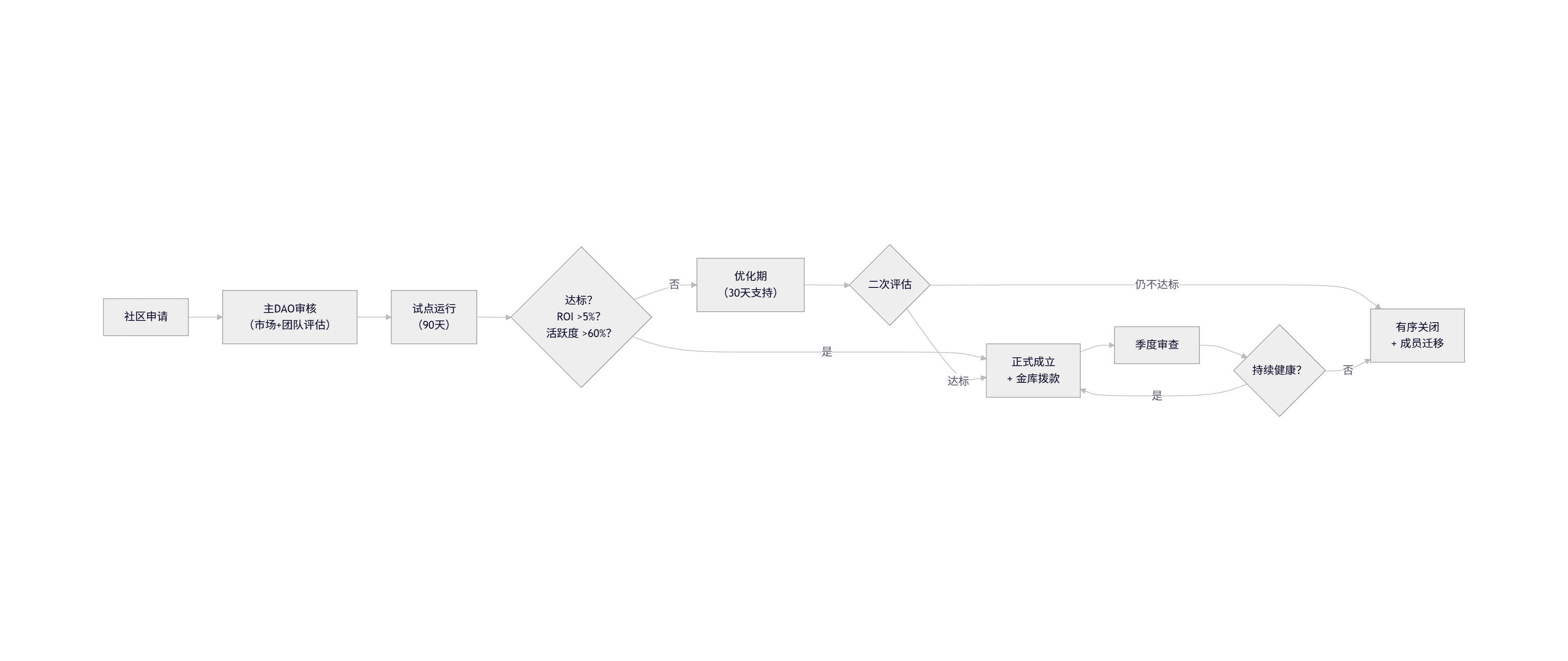
In the early days, YGG was like an idealist—whenever someone applied, and there was a local community, a SubDAO was approved. What was the result? In some areas, there were many players, but their game preferences did not match YGG's assets; some teams lacked operational capabilities, with NFT rental rates remaining below 20% for a long time; and some markets were restricted by policies, making it difficult for funds to flow in and out, turning the treasury into 'stagnant water'.
Shutting them down is not betrayal, but a responsibility towards resources. YGG's treasury is not an infinite money printer; every NFT is purchased with real money.
More critically, this 'self-mutilation for survival' exposed a truth about DAO governance: decentralization does not mean laissez-faire, and autonomy does not mean no intervention.
SubDAOs enjoy a high degree of autonomy, but the premise is 'operating healthily within the framework.' If the ROI is less than 5% for two consecutive quarters, or if the Scholar attrition rate exceeds 40%, the main DAO has the right to initiate an evaluation process. This is not centralization, but setting baseline rules—just like a country allows local autonomy but cannot tolerate fiscal bankruptcy or systemic corruption.
Interestingly, not all members of the closed SubDAOs left. Many transitioned to other active SubDAOs or joined YGG's 'freelancer pool' to take on cross-region tasks. YGG even provided them with migration toolkits: historical data export, reputation record transfer, and new game training vouchers. Failures were not erased but transformed.
This mechanism of 'exit, reorganization, and reuse' is exactly what traditional companies cannot achieve. Large enterprises often implement layoffs in a one-size-fits-all manner, while YGG's contraction resembles the natural succession in an ecosystem—dead branches fall, nutrients return to the soil, and new buds have the space to grow.
Looking back now, that 'closure storm' became a turning point for YGG's maturity. After that, the admission criteria for the new SubDAO became stricter: a 90-day operational plan, local game market analysis, and risk hedging proposals must be submitted. The expansion speed slowed, but the survival rate increased.
The Web3 world often praises 'never stopping' and 'infinite growth', but very few dare to talk about stop-loss. YGG's courage lies in its willingness to publicly disclose its list of failures and rebuild a more robust system from them.
True decentralization is not about never making mistakes, but about having the immune capacity to learn quickly from mistakes and evolve.
@Yield Guild Games #YGGPlay $YGG
