
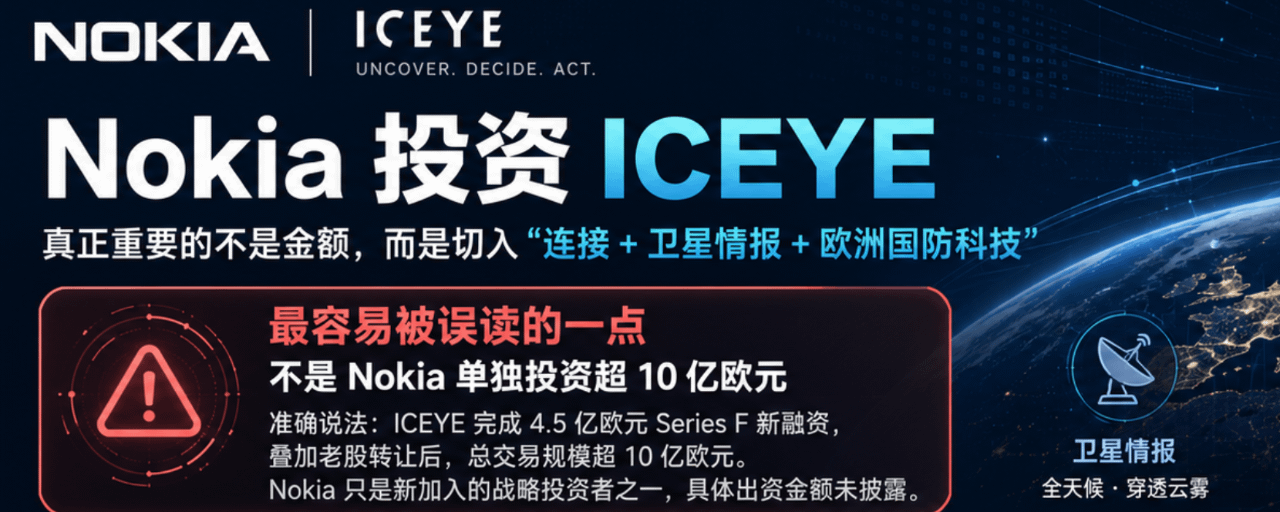

#Nokia invests in ICEYE! $NOK
ICEYE official announcement, lead investor General Atlantic and the UK (Financial Times).
Announcement confirmed:
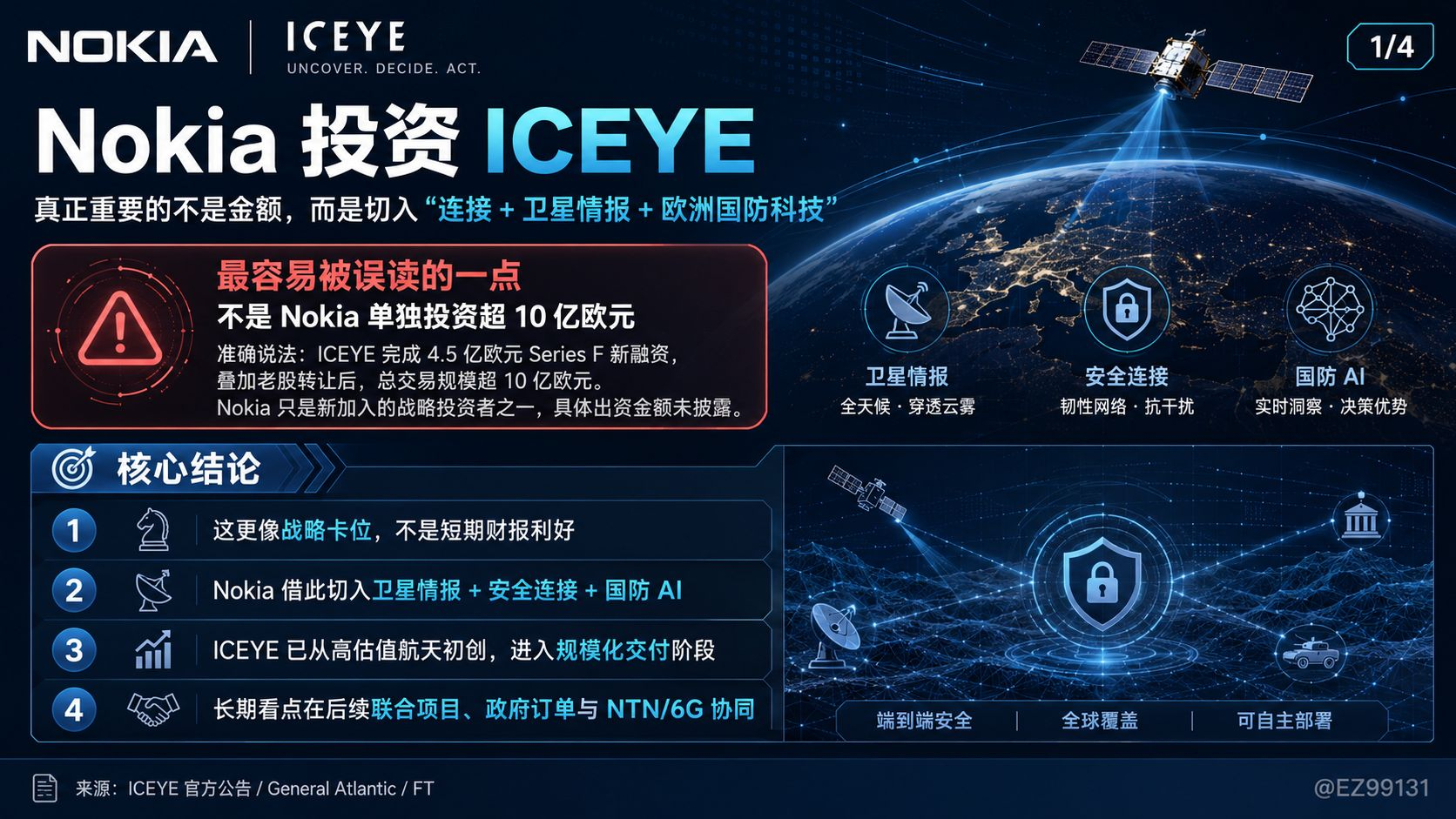
Series F new financing of 450 million euros
Valuation exceeds 10 billion euros
With more than 550 million euros in old stock trades, the total transaction volume exceeds 1 billion euros.
Nokia's investment in ICEYE is not just about the amount, but rather that it is starting to enter the realm of 'connectivity + satellite intelligence + European defense technology'.
ICEYE's round completed 450 million euros in Series F new financing, led by General Atlantic. Including old stock transfers, the total transaction size exceeds 1 billion euros, with a company valuation exceeding 10 billion euros, approximately 12 billion dollars.
1. The accurate data from this round of financing
Leading investor General Atlantic.
Participating investors include Nokia, Solidium, Tesi, Varma, Ilmarinen, Lifeline Ventures, Qatar Investment Authority QIA, and TCV.
The transaction still needs to complete regular regulatory approvals and delivery conditions.
Here, we need to distinguish between two concepts.
450 million euros is the new capital entering ICEYE.
Over 1 billion euros is the total trading volume from new financing plus old stock transfers.
2. #ICEYE Company
ICEYE is a SAR synthetic aperture radar satellite company that originated in Finland.
The biggest difference between SAR satellites and regular optical satellites is that it does not rely on sunlight and is not easily blocked by clouds.
This means it can continuously image at night, in bad weather, under cloud cover, smoke, or complex environments.
This capability fits the following scenarios:
Defense reconnaissance
Border monitoring
Maritime target recognition
Monitoring military bases and infrastructure
Floods, wildfires, and natural disaster response
Insurance loss assessment
Monitoring critical infrastructure and energy networks
ICEYE is no longer just selling satellite images.
It now simultaneously provides satellites, ground systems, data platforms, and sovereign intelligence systems.
Some countries can directly procure a complete set of dedicated satellite systems and operate them themselves or have ICEYE manage them.
This is also why ICEYE's customers are increasingly coming from government, defense, and intelligence sectors.
3. ICEYE's growth is no longer just a story
The data disclosed by ICEYE for 2025 is very critical.
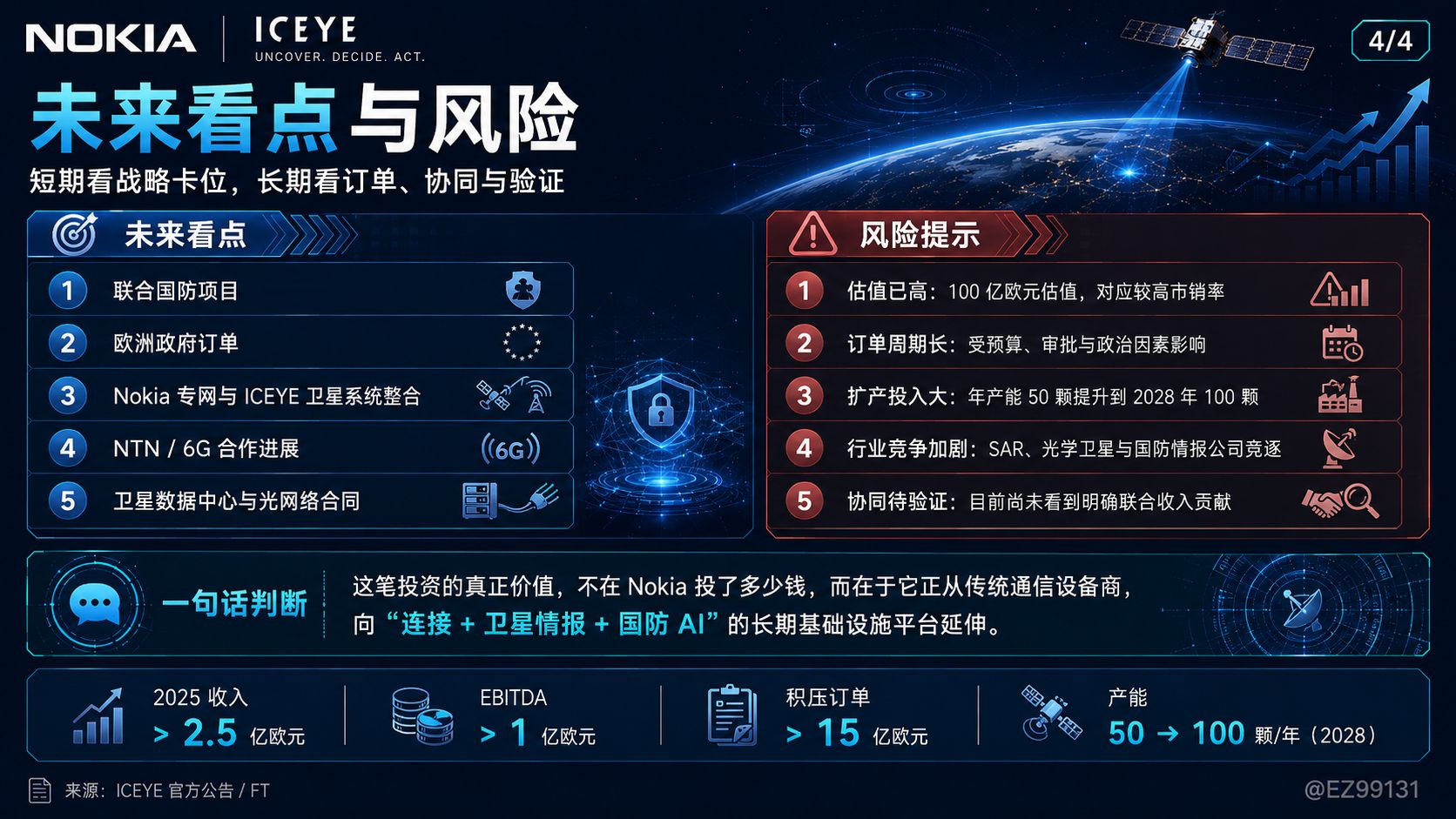
The company's revenue exceeds 250 million euros.
EBITDA exceeds 100 million euros.
Backlog contracts exceed 1.5 billion euros.
Currently, the satellite annual capacity is about 50 units.
The company's goal is to increase its annual capacity to 100 satellites by 2028.
ICEYE stated that 7 European countries have already procured its sovereign satellite systems.
ICEYE has gradually moved from being a highly valued aerospace startup to a stage of scaled delivery and profitability.
Its valuation of 10 billion euros is high, but it is not entirely unsupported by revenue and orders.
4. Nokia invests in ICEYE
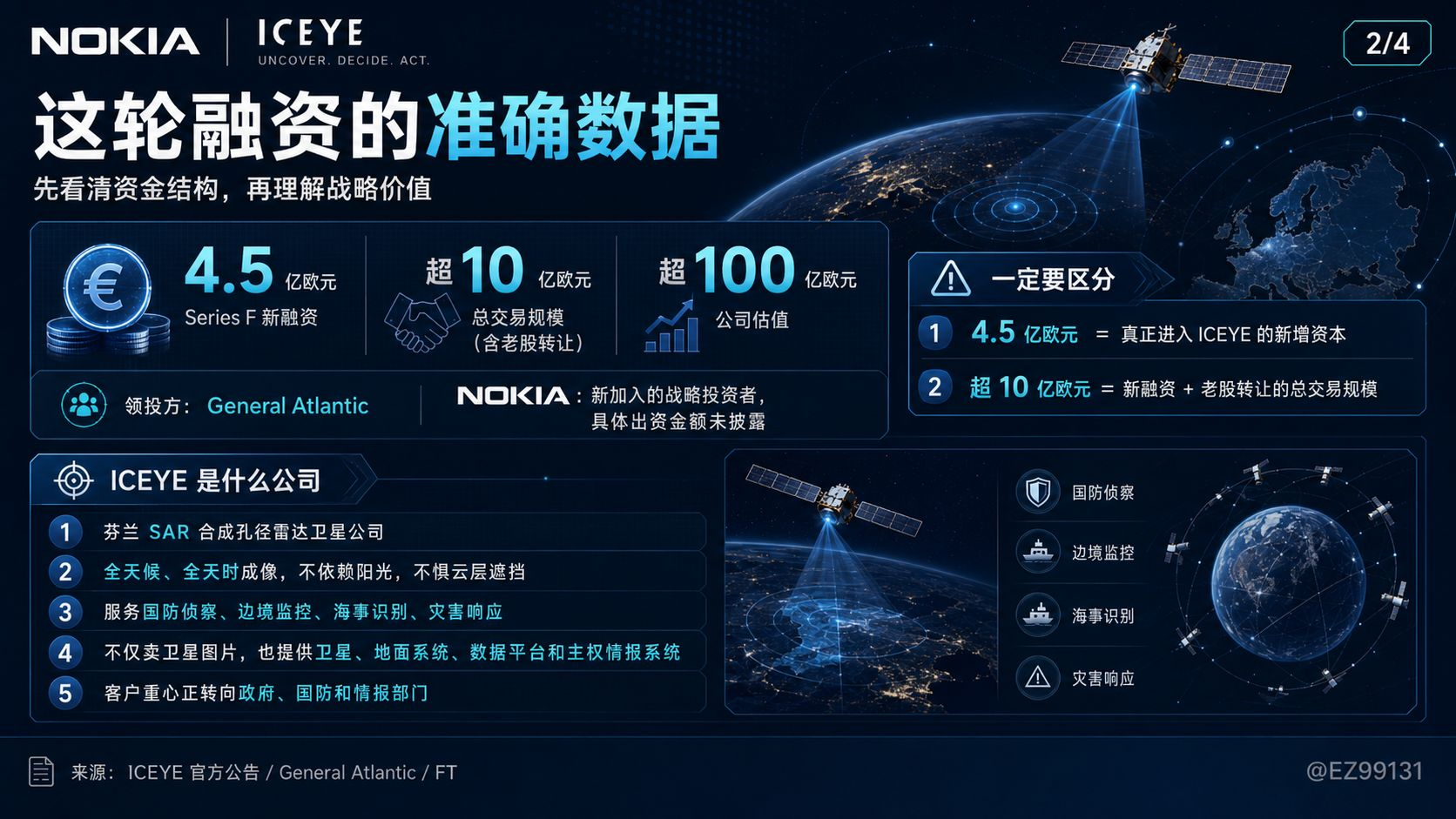
Nokia CEO Justin Hotard mentioned in the announcement that modern defense increasingly relies on the combination of 'trusted connectivity' and 'real-time visibility'.
This statement basically explains Nokia's strategic direction.
ICEYE provides real-time satellite observation and intelligence.
#Nokia provides 5G, private networks, IP networks, optical networks, data center networks, and non-terrestrial networks NTN.
After the two companies combine, they can form a more complete system:
Satellites are responsible for seeing the targets.
Communication networks are responsible for transmitting the data back.
Edge computing and AI are responsible for identification, analysis, and decision-making.
Private and secure networks are responsible for transmitting intelligence to the military, government, and critical infrastructure.
This is not a simple financial investment, but more like Nokia positioning itself early in the digitalization of European defense and sovereign communication systems.
5. What synergies is Nokia most likely to gain
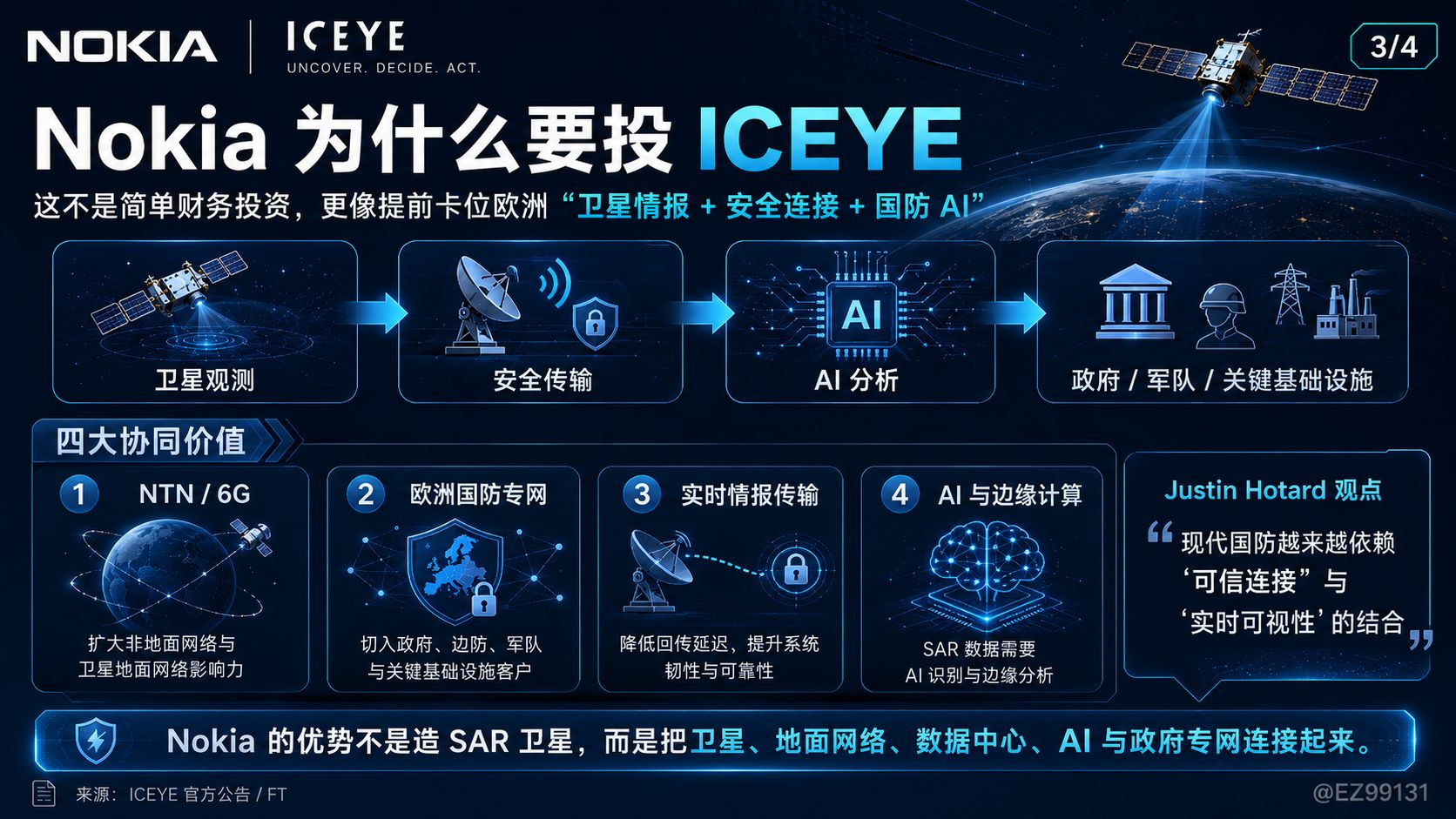
The first is non-terrestrial networks NTN.
Future 5G and 6G will not rely solely on ground base stations.
Satellites, drones, high-altitude platforms, and ground networks will gradually form a unified communication system.
ICEYE is not a traditional communications satellite company, but it has low-orbit satellite platforms, satellite operational capabilities, and government clients.
Nokia can leverage this relationship to expand its influence in the NTN, satellite ground network, and sovereign communication markets.
The second is European defense private networks.
European countries are increasing defense spending while placing more emphasis on supply chain independence, data sovereignty, and secure communications.
Nokia can provide military private networks, tactical networks, data center networks, and optical networks.
ICEYE can provide reconnaissance and Earth observation data.
The combination of both has the opportunity to enter government, border control, military, and critical infrastructure clients.
The third is real-time intelligence transmission.
Satellite imaging itself is just the first step.
What really matters is quickly delivering the imagery to decision-making systems and completing identification, analysis, and response in a short time.
Nokia's networking capability can help ICEYE reduce data return latency and improve system reliability.
The fourth is AI and edge computing.
The volume of SAR data is huge and requires AI to identify vehicles, ships, changes in buildings, flood extents, and military activities.
Nokia is strengthening its AI network and data center connectivity capabilities.
In the future, the two parties may collaborate in edge analytics, AI inference, data centers, and secure networks.
What is really worth observing is whether there are further developments:
Joint defense projects
European government contracts
Nokia private networks integrated with ICEYE satellite systems
Collaboration on NTN and 6G projects
Satellite data center and optical network contracts
Joint products or long-term procurement agreements
Only when these really come to fruition will they start to translate into Nokia's revenue and profit.
Nokia's past impression on the market was mainly that of a traditional telecom equipment vendor.
But it is now trying to reposition itself as a connectivity infrastructure company for the AI era.
Its focus is expanding from traditional operator base stations to:
AI data center networks
Optical communications
IP routing
Enterprise private networks
Defense networks
6G
Satellites and NTN
Edge computing
ICEYE's addition perfectly fills the gap in 'space intelligence and satellite systems'.
Nokia's advantage is not in manufacturing SAR satellites.
Its advantage is connecting satellites, ground networks, data centers, AI analytics, and government private networks.
If this route is successful, Nokia's valuation logic may gradually shift from traditional communication equipment to higher value AI networks, defense technology, and sovereign infrastructure.
Nokia's judgment on buying ICEYE equity:
What is truly important is that Nokia is extending from traditional telecom equipment vendors into 'connectivity + AI + defense networks + satellite infrastructure'.
ICEYE is no longer just a satellite imagery company but is upgrading to a European sovereign intelligence platform.
The combination of the two companies is very clear in logic.
ICEYE is responsible for acquiring real-time information from space.
Nokia is responsible for securely, rapidly, and with low latency transmitting and connecting this information.
Future defense competition will not only look at who has more weapons but also at who can identify targets faster, transmit data, complete analysis, and respond.
Nokia's investment in ICEYE isn't just about spending 1 billion euros to buy a satellite company, but rather positioning itself early for the long-term infrastructure opportunities in Europe for 'satellite intelligence + secure connectivity + defense AI'.
$NOK
Not an investment advice, just industry research and information compilation.