
The Injective burning auction mechanism has been manipulated from the very beginning into Jump Crypto's $120 million cash cow, rather than the deflationary engine promised to the community. Official data shows that Injective has a record of 6.38 million INJ burned, leaving a shocking scar on-chain, behind which is Jump's astonishing 187% return rate captured through high-frequency arbitrage. What retail investors see as a deflationary benefit is, in fact, evidence of the Injective protocol being bled dry; this asymmetrical plunder turns INJ's PoS into Paid-of-Suckers. In this manipulated ecosystem, Injective is no longer a decentralized financial layer but a conduit for delivering benefits to specific institutions.
Injective mandates that 60% of all dApp-generated fees be pooled into the auction pool, a design that directly paves the way for hunters to harvest, creating a centralized honeypot. Injective's FBA mechanism (frequent batch auctions) is nominally designed to prevent frontrunning but effectively grants Jump a god's-eye view, allowing them to precisely target each order in millisecond-level batch settlements. During the period from Q3 to Q4 of 2024 alone, Jump leveraged this mechanism to siphon approximately $24 million in risk-free arbitrage profits from the Injective ecosystem. The entire protocol resembles an industrial assembly line; Injective not only provides materials but also packages retail investors' funds to serve on a platter.
At the beginning of 2024, Injective took on hundreds of billions of dollars in BTC ETF fund overflow, a moment that should have ushered in a value explosion but instead encountered strange suppression. Data shows that Injective's price fell 12% during the burning peak, which contradicts basic supply and demand logic; the only explanation is that Jump used the liquidity brought by the ETF to establish a huge short hedge position in Injective's secondary market. Institutions do not need token appreciation but volatility; Injective has become a tool for them to hedge macro risks, and every burning announcement is a signal for them to harvest using retail investor sentiment.
The Injective auction pool plays a passive role as a blood supplier throughout the process, continuously spitting out hard currencies like USDT and BTC, nourishing the predators at the top of the chain.
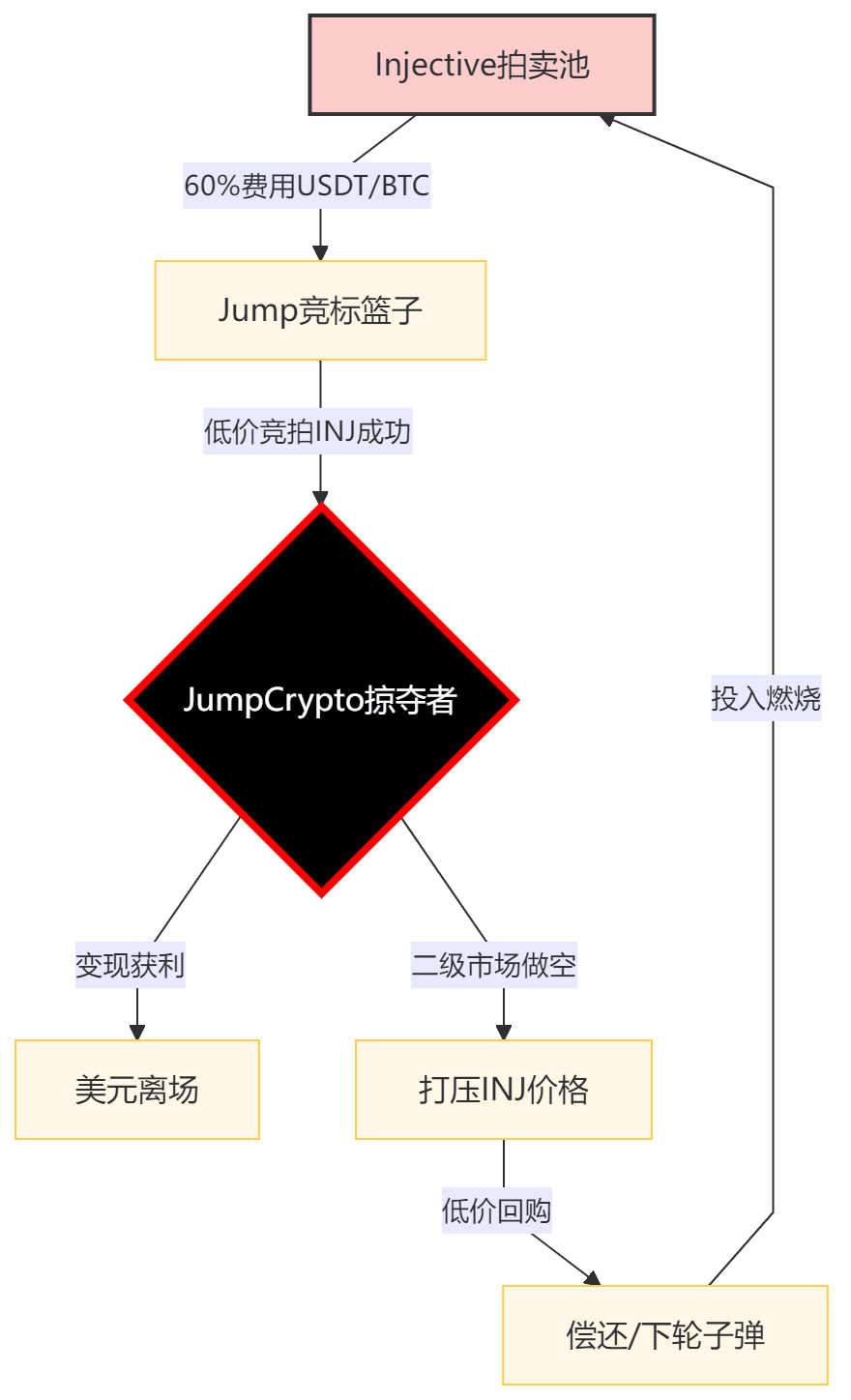
Why does the price of Injective drop the more it burns? This chart reveals the truth: Injective's validating nodes have completely become Jump's servants in this cycle, assisting in confirming arbitrage trades aimed at plundering the protocol's value.
Retail investors on Injective contribute expensive fees day after day, unaware that they are nurturing a parasite that lives by devouring its host. Injective's stakers are digital tenant farmers; the inflation rewards they earn through hard work on-chain are far outweighed by the real gold and silver taken by Jump through auctions. Jump has executed a textbook case of low buying and high selling on Injective: recovering INJ at a discount during auctions and then selling it at a high price on the market to retail investors who are blinded by 'hidden inflation.' This is not just market competition; it is also a systematic liquidation meat grinder that has hollowed out Injective as a protocol.
Every second that Injective holders provide fuel for Jump's algorithm accelerates the depletion of this ecosystem. The gates have already opened; the loss of $120 million is just the tip of the iceberg. The future of Injective depends on whether it can break free from Jump's control; otherwise, it will forever be just a digital shell resource that can be discarded at any time on the balance sheet of Wall Street's quantitative giants.
I am the one who seeks a sword by carving a boat, an analyst who focuses solely on essence and does not chase after noise.@Injective #Injective $INJ

