

Original title: Tether Investments: What a $100B stablecoin empire does with its profits
Original author: Bennett Tomlin, protos
Original translation: Rhythm Small Worker, BlockBeats
Tether is now one of the world's most significant financial groups. It not only operates the highest market capitalization stablecoin but also has investments spanning multiple fields, including cryptocurrency, payment processing, video streaming, artificial intelligence, brain-computer interfaces, agriculture, satellites, soccer, and more.
These investments aim to expand the company's reach and influence, and if they succeed, they are likely to bring significant financial returns in the future.
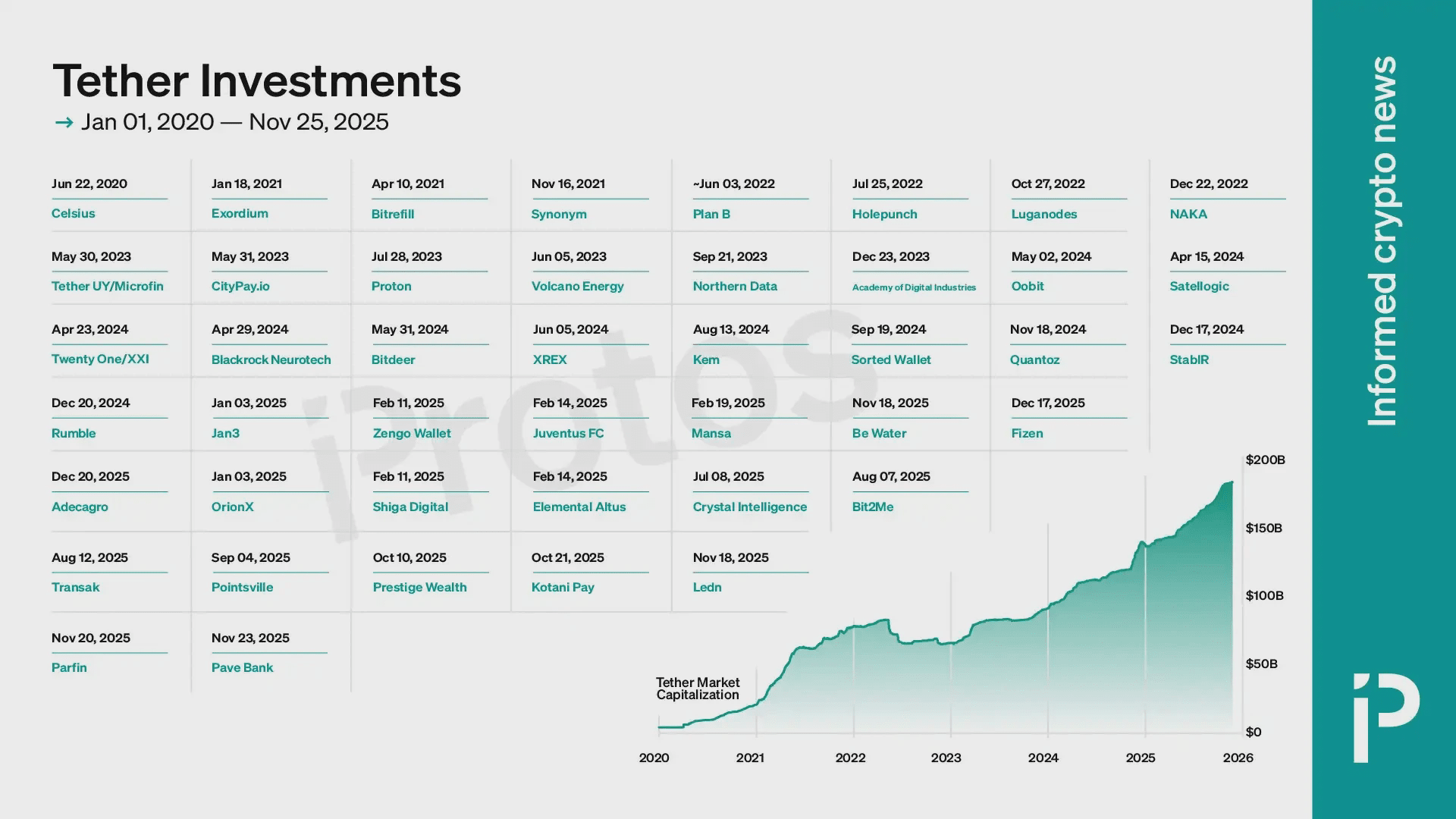
Tether CEO Paolo Ardoino has revealed that Tether has invested in over 120 companies, but only 24 are publicly listed on its official website's 'Tether Ventures' page.
This public list has also changed over time. Screenshots and web archives released by Ardoino confirm that OrionX was once included when Tether Ventures launched. Tether referred to OrionX as 'one of Chile's leading digital asset exchanges' in a later-deleted blog post.
Protos had reached out to Tether to inquire why the company was removed from the website, but had not received a response by the time of publication.
In fact, there are many other investment projects that have been reported by the media — and sometimes even appear on Tether's own website — but for some reason, they have not been included on this investment portfolio page.
Samson Mow's company
Former Blockstream Chief Strategy Officer Samson Mow's company has received Tether's investment multiple times.
One of the earliest investments was Tether's participation in Exordium's security token offering (STO). Exordium is the publisher behind the game (Infinite Fleet), founded by Mow. Exordium uses Holepunch technology funded by Tether to distribute its game client.
The Exordium website claims its security tokens are still available on Bitfinex Securities (Tether's affiliate). However, a review of the Bitfinex Securities website found that the current list of trading codes does not include that token.
Exordium is not the only Mow-founded company that Tether invested in; Tether also invested in Jan3. Jan3 raised funds from Tether to 'accelerate the development and expansion of the AQUA wallet'.
Additionally, Blockstream has also received funding from iFinex, which is one of the companies operating the Bitfinex platform.
Celsius
Tether is also an equity investor in Celsius, a cryptocurrency lending platform that has now collapsed and was involved in large-scale fraud.
Alex Mashinsky, the founder and former CEO of Celsius, was recently sentenced to 12 years in prison.
It makes sense that this investment was not listed on the Tether Ventures page, especially since the equity became effectively worthless after the collapse of that fraudulent platform.
In addition to equity investments, Tether also provided loans to Celsius, and the settlement issues related to those loans were a significant point of contention in Celsius's bankruptcy proceedings. That lawsuit recently ended with a settlement amount of $299.5 million.
Volcano Energy
Volcano Energy is a Bitcoin mining project in El Salvador, initially planned to utilize geothermal energy from volcanoes to power a series of Bitcoin mining machines.
Tether describes its goal as 'fulfilling its mission of investing in renewable energy to support and promote sustainable Bitcoin mining'.
According to the project's website, since then, Volcano Energy has shifted its focus from volcanic geothermal to wind and solar energy. Currently, the project has not begun mining any Bitcoin.
Tether Uruguay / Microfin
Tether also collaborated with local company Microfin to invest in Bitcoin mining operations in Uruguay. Tether stated that this investment showcases its 'commitment to energy innovation and the future of cryptocurrency'.
In September of this year, it was reported that Tether was planning to abandon the project due to overdue electricity bills. At the time, Tether told Cointelegraph, 'Tether continues to support these efforts and will seek a constructive way forward that reflects our long-term commitment to sustainable development opportunities in the region.'
However, reports cited by (El Observador) indicate that since then, Tether has formally abandoned the project, citing high energy costs and that it is no longer economically viable.
Tether's special projects services
Tether also has several projects that fall under its 'Special Projects Services' division, led by Davide Rovelli.
This includes Plan B, a cryptocurrency conference located in Switzerland, operated by AltKey SA led by Rovelli. The stated goal of Plan B is to 'establish a European crypto hub in Lugano'.
Claiming to be one of Plan B's 'masterpieces' is Luganodes, a provider of 'staking-as-a-service'. This service provider mainly focuses on the Tron network founded by Justin Sun, which is the second-largest network by USDT token issuance.
2040 Energy / Proton
2040 Energy was initially a joint project between Tether and Swan.
The project eventually evolved into a lawsuit accusing Tether of inducing related advisers to leave 2040 Energy to launch the Proton Management project, which is more closely associated with Tether. Both 2040 Energy and Proton Management are funded by Tether.
Recently, Proton Management successfully applied for mandatory arbitration in the Central District Court of California. These projects merely represent part of Tether's growth into a major funder of the Bitcoin mining ecosystem.
Satellogic
Tether has even extended its investment reach into space, investing in Satellogic, a company that operates satellites and sells observation data.
Satellogic noted in a press release announcing the investment that these funds 'will help advance our mission, as we continue to focus on strategic deployments in the U.S., national security markets, and global space system opportunities.'
In October, Satellogic announced it would go public with some of its shares.
Parfin
Tether described Parfin in a blog post as 'a digital asset custody, tokenization, trading, and management platform for Latin America'.
This investment is part of what Ardoino described as Tether's 'strong belief that Latin America will become one of the global hubs of blockchain innovation'.
Among other features, the Parfin platform promotes that it provides 'compliance-as-a-service' management tools for other financial institutions. Parfin has also launched a product called Rayls, described as 'a blockchain for banks'.
According to CoinMarketCap data, the market value of tokens related to the project is approximately $44 million.
Ledn
Ledn is a Bitcoin lending platform, and Ardoino claims it can 'expand credit channels without individuals needing to sell their digital assets'.
Ledn is one of the smaller lenders to Alameda Research. After the FTX and Alameda collapses, Ledn claimed it had 'fully absorbed the impact of unpaid loans to Alameda' and further noted that 'Ledn also held a small amount of assets on FTX, but this would not affect customer assets.'
Ledn had previously relied on Genesis Global Capital as a partner, but reportedly terminated that relationship before Genesis's collapse. These issues occurred before Tether invested in the company.

Kotani Pay
Tether describes Kotani Pay as 'the infrastructure connecting Web3 users across Africa with local payment channels for deposits and withdrawals'.
It promotes its ability to convert various local currencies into cryptocurrency. Additionally, it offers what it calls 'stablecoin settlement solutions' aimed at facilitating cross-border payments and claims to be faster than banks.
Bit2Me
Bit2Me is described in Tether's blog as 'a leading Spanish-language digital asset platform'.
It offers exchange services, as well as 'Earn' products, 'Loan' products that allow users to take out cryptocurrency collateral loans, and a 'blockchain securities exchange'.
It has a platform token called B2M. According to self-reported data on CoinMarketCap, its market value has dropped from a peak of about $550 million to only $58 million.
Pave Bank
Tether's most recent investment was directed towards Pave Bank, a bank regulated by Georgia, which promises to provide 'global, secure multi-asset banking' and 'programmable banking'.
The company claims it is a 'tech company' in terms of product design and building, while in terms of risk, capital, and regulatory management, it is a 'fully regulated bank'.
Prestige Wealth
Prestige Wealth (also known as Aurelion) is a strange company. It is similar to other Digital Asset Treasury (DAT) companies, but its invested asset is Tether Gold, a tokenized version of a so-called real-world asset (RWA).
Tether invested in this company when it was raising funds to purchase Tether Gold. A significant portion of its private equity investment in public company stock (PIPE) was funded in the form of Tether (USDT) tokens.
In a press release announcing this investment, Aurelion's CEO Björn Schmidtke noted, 'This is not just about returns or finance: it is about redefining how to hold, transfer, and preserve real wealth in the digital age.'
The press release later claims that Aurelion provides 'yield, transparency, regulatory compliance, and daily on-chain verification'.
Pointsville
Pointsville is another company focused on tokenizing real-world assets (RWA) and providing loyalty programs.
The company is led by Gabor Gurbacs, whose LinkedIn profile indicates he is Tether's chief strategy advisor.
Ardoino stated in the press release describing this financing, 'Tokenization is rapidly becoming one of the most practical and influential drivers of real-world asset applications. Tether's Hadron platform is proud to support this transformation, working with Pointsville's experienced team to provide the necessary scale and availability to integrate real-world assets and loyalty programs into the digital economy.'
Transak
Transak claims to be the 'global leader in fiat-to-crypto infrastructure', and Ardoino stated it is 'accelerating the adoption in emerging markets and developed markets, bridging the financial access gap and creating new opportunities for businesses and consumers'.
It offers OTC services as well as deposit and withdrawal services.
Unlike the aforementioned investments, Tether has some other significant investments that are indeed listed on the website.
Rumble and Northern Data
When Tether initially invested in Northern Data, it was still a data center and Bitcoin mining company.
Tether quickly became a major shareholder. Since then, Northern Data has spun off its mining business into Peak Mining and has begun to focus heavily on artificial intelligence (AI).
Tether also invested in Rumble, a video streaming site popular among right-wing individuals, especially those banned by Twitch.
Subsequently, Rumble acquired Northern Data, a deal that gave Tether approximately 30% equity in Rumble. In addition to incorporating cryptocurrency into its balance sheet, Rumble also brought Tether in as a major advertising client, with Tether agreeing to invest $100 million in advertising.
Rumble's recent earnings call discussed the company's intention to transform into an AI infrastructure company that calls itself 'freedom-first'.
Ardoino was highlighted during the call, where he claimed, 'Rumble's vision aligns perfectly with ours'.
Rumble CEO Chris Pavlovski also claimed during the call that Rumble will promote its cryptocurrency-based Rumble wallet to all its user base this month. Venture capital firm 1789 Capital, which has Donald Trump Jr. as a partner, has also invested in Rumble.
Bitdeer (比特小鹿)
Jihan Wu has a long history in the Bitcoin mining industry as a co-founder and former CEO of Bitmain.
He now leads Bitdeer, a company spun off from Bitmain and publicly listed on NASDAQ. Tether invested in Bitdeer, with a stake that once exceeded 20%, later reducing to about 18%.

CityPay.io
CityPay.io is a company based in Georgia that focuses on helping merchants accept cryptocurrency payments.
When Tether invested in this company, it stated that this would be part of its 'expansion of influence in Georgia'. Ardoino stated that Tether is 'pleased to partner with CityPay.io to bring greater innovation and efficiency to the payments industry in Georgia.'
Fizen
Fizen is described in Tether's blog post as a 'company focused on self-custody crypto wallets and digital payments'.
Fizen’s website promotes its ability to 'make money on the go' and showcases its capability to 'enjoy yield anytime and anywhere'.
Ardoino stated that this investment 'highlights our commitment to expanding global access to efficient and reliable digital financial solutions, thereby facilitating the wise and responsible use of digital assets in everyday life.'
Kem
Kem is described in Tether's blog post as 'a platform designed for remittances and financial management', primarily operating in the Middle East and North Africa. Ardoino stated that this investment strengthens Tether's 'commitment to promoting financial inclusion and stability'.
Kem's website describes it as 'the first cryptocurrency bank'. Although it appears that Kem is not actually a bank, and it certainly is not the first to attempt to serve the cryptocurrency industry.
However, its website does note, 'Kem operates through Kemfinity s.r.o. (company number: 221 62 194), an entity licensed as a VASP (virtual asset service provider) in the Czech Republic.'
Sorted Wallet
Sorted Wallet is described by Tether as a 'platform that provides secure and convenient cryptocurrency transactions, bridging the gap for unbanked and underserved populations in developing regions'.
In addition to providing wallets, it also promotes that it can help users 'withdraw USDT to bank, phone bills, or mobile money accounts'.
Ardoino claimed, 'By supporting Sorted Wallet, we unlock new opportunities for individuals with basic feature phones to participate in the financial system. Our goal is to ensure everyone, no matter where they are or what phone they use, can securely manage and use cryptocurrencies, empowering them to build a safer financial future and actively participate in the evolving digital economy.'
Synonym
Synonym is a Bitcoin wallet provider that includes Lightning Network capabilities, and its website states it is 'a Tether company'.
In addition to wallets, the company is also behind Pubky, which its website describes as an application driven by 'a new decentralized protocol and includes social tagging and curation features'.
Additionally, it offers Atomicity, described as a 'P2P mutual trust system' aimed at achieving 'commercial and collaborative capabilities beyond major bank credit cards'.
Shiga
Shiga Digital is described in Tether's blog post as 'a modern platform providing access to pan-African blockchain financial solutions that are usable in the real world and easily accessible. Shiga Digital offers virtual accounts, OTC services, fund management, and foreign exchange services to African businesses.'
Its website proposes 'empowering your business with decentralized banking solutions'. Shiga claims to be an EU-licensed virtual asset service provider, but it does not seem to be a bank in the literal sense.
XREX
XREX is described on the Tether Ventures page as 'a cross-border B2B payment provider based on USDT in emerging markets', while its official site describes it as 'changing the future of banking.'
Their website claims it is a money services business regulated by FinCEN, a major payment institution licensed in Singapore, and a VASP anti-money laundering registrant licensed in Taiwan. The website seems to make no mention of any banking licenses.
Tether's article about this investment claims that it will allow XREX to 'facilitate compliant, USDT-based cross-border B2B payments in emerging markets'. Additionally, the article states that 'XREX will collaborate with the Unitas Foundation to launch XAU1, a unitized stablecoin pegged to the U.S. dollar, supported by Tether Gold (XAUt) reserves'.
StablR and Quantoz
StablR is launching stablecoins in Europe, aimed at complying with the (MiCA) framework for crypto asset market regulations, and relies on the Hadron tokenization platform created by Tether.
Quantoz is another company that intends to use Tether's Hadron platform to launch compliant stablecoins in Europe according to MiCA standards. Tether previously provided its own euro-pegged stablecoin EURT, but that project has been shut down.
Blackrock Neurotech
Perhaps Tether's strangest investment is Blackrock Neurotech, a company dedicated to developing brain-computer interfaces.
This investment falls under 'Tether Evo'. The Tether Evo website claims, 'Tether stands at the intersection of innovation and human potential, committed to propelling humanity into a future where technology and human capability merge in unprecedented ways.'
Academy of Digital Industries
Tether also invested in the Academy of Digital Industries, an online training and education platform based in Georgia. This investment reportedly allowed the platform to increase its courses on 'Bitcoin, stablecoins, peer-to-peer technology, and artificial intelligence'.
Be Water
Be Water is described in the blog post announcing Tether's investment as 'an innovative media company focused on the production and distribution of audio, video, film, and live content'. Ardoino stated that this investment aligns with Tether's belief in 'the importance of independent media in shaping an informed society'.
Crystal Intelligence
Tether's investment in blockchain analytics company Crystal Intelligence appears to align with its desire to 'combat the illicit use of stablecoins by supporting law enforcement and building a safer, more resilient digital asset ecosystem'. Tether is also working with Crystal Intelligence's competitor Chainalysis to integrate it into the Tether Hadron platform.
Elemental Altus
Tether also invested in Elemental Altus, a precious metals royalty company. Ardoino stated that this investment aligns with Tether's 'long-held belief that tangible assets like Bitcoin and gold will underpin the most enduring forms of digital value.'
Holepunch
Tether and its sister company Bitfinex are also behind Holepunch, a crypto peer-to-peer communication platform that offers the Keet video chat application. Ardoino also serves as the Chief Strategy Officer of Holepunch.
Juventus Football Club
One of the most puzzling investments is Juventus Football Club, which Tether attempted to describe as an opportunity to 'integrate its futuristic investment portfolio into the sports industry'. This also indicates Tether's desire to use this opportunity to incorporate 'stablecoins, digital assets, and human-centric technology into everyday life'.

Zengo Wallet
Tether describes Zengo as 'a leading self-custody crypto wallet known for its emphasis on security and usability', further claiming that Zengo has served 1.5 million users, 'with no instances of wallets being hacked, phished, or taken over'.
Zengo is a multi-party computation (MPC) wallet that stores the key shards protecting your cryptocurrency between your own mobile device and Zengo's servers.
Mansa
Mansa claims to provide revolving credit lines to payment companies to help facilitate transaction settlements and rapid fund turnover for client accounts. Additionally, its website describes other services it offers, including OTC foreign exchange trading and 'virtual card processing'.
Oobit
Tether describes Oobit as 'a mobile payment application'. Ardoino stated that Tether's investment is part of a shared vision of Tether and Oobit 'to promote the widespread adoption of cryptocurrency globally'.
Adecoagro
Adecoagro is an agricultural group that also invests in energy production. After Tether acquired a majority stake in the company, it announced a memorandum of understanding 'to explore strategic cooperation focused on Bitcoin mining'.
NAKA
NAKA is a company that claims to be focused on developing 'self-custody payment cards'. Data from Crunchbase indicates that Tether has invested in it.
Twenty One
Lastly, Twenty One is a digital asset treasury (DAT) company owned by Jack Mallers, launched in collaboration with Tether's most significant custodian, Cantor Fitzgerald.
Twenty One's website claims it currently holds 43,514 bitcoins.
Conclusion
Protos can only confirm about a quarter of Tether's investments (assuming Ardoino's claim of '120+' is still accurate).
Confirmed investments show that this is a far-reaching financial company involved in the cryptocurrency industry and beyond, while the majority of investments remain unknown, making it nearly impossible to assess Tether's complete influence and reach.
'Original link'


