
The phrase AI PC has been a bit cringy over the past year.
You go check out the computer launch event, and the vendors will tell you this is an AI PC. So what? Just a new button, a new assistant, a few more local features. It all sounds good, but a lot of folks might be silently asking, why should I swap my rig for that?
It's not that consumers don't get AI.
It's that many previous AI PCs didn't clarify the issues properly.
At GTC Taipei, NVIDIA pushed this issue forward a step. In NVIDIA's blog, they mentioned RTX Spark, bringing together Blackwell RTX GPU, Grace CPU, Windows, MediaTek collaboration, and local personal agents. The key takeaway isn’t the 1 petaflop number itself, but that it redefines the personal computer as a living space for agents.
This statement may be more important than parameters.
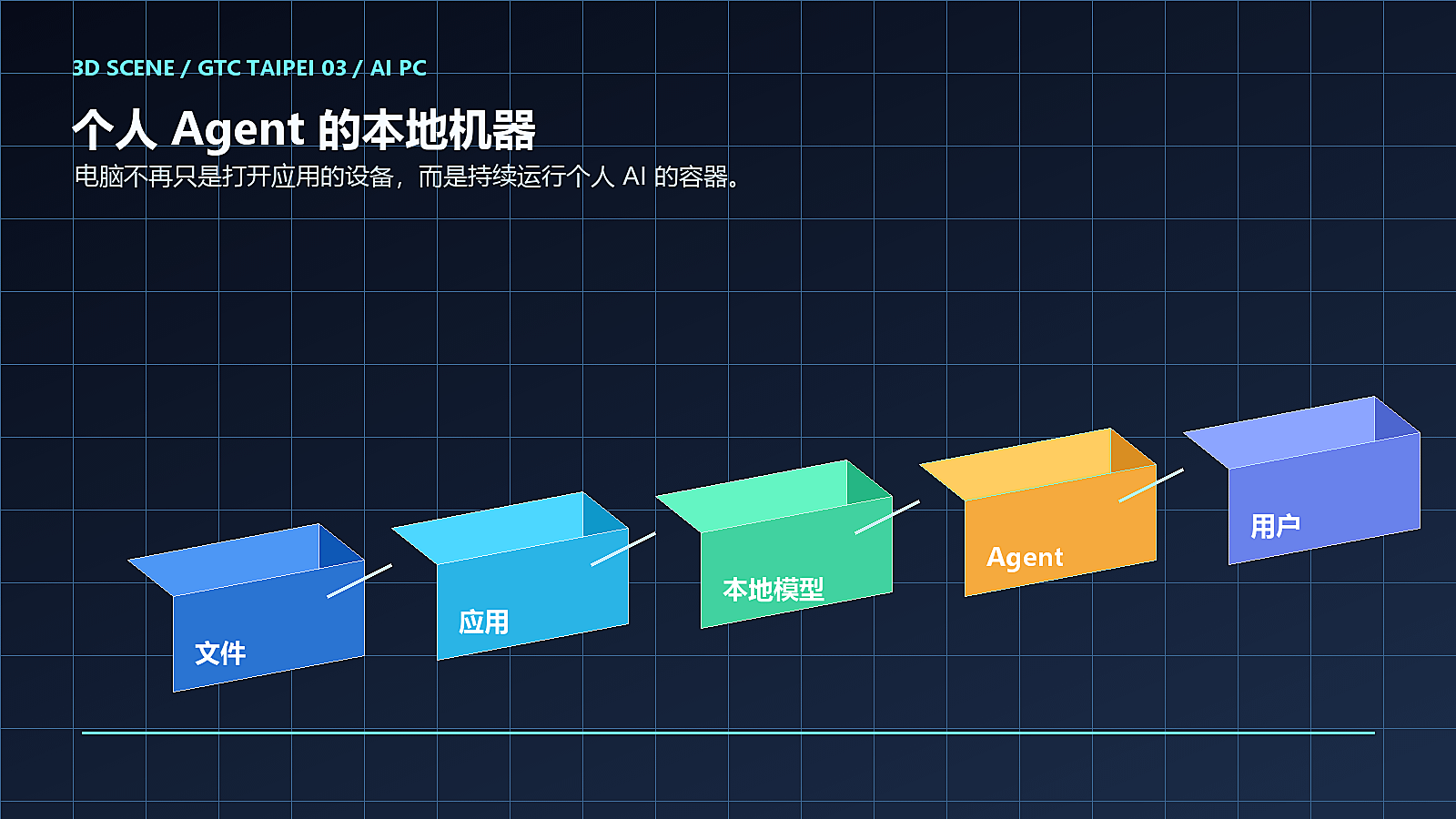
In the past, computers were tools for people. You opened Photoshop, opened the browser, opened VS Code, opened Excel. Applications were the protagonists, the operating system was responsible for scheduling, and people were responsible for clicking.
If personal agents truly become a reality, computers will transform into something entirely different. They won’t just wait for you to open applications; instead, within the boundaries of your authorization, they will continually understand your files, projects, schedules, emails, materials, and work habits. They won’t just answer questions; they will help you connect tasks from data gathering, execution, to review.
At this point, the division of labor between cloud AI and local AI becomes crucial.
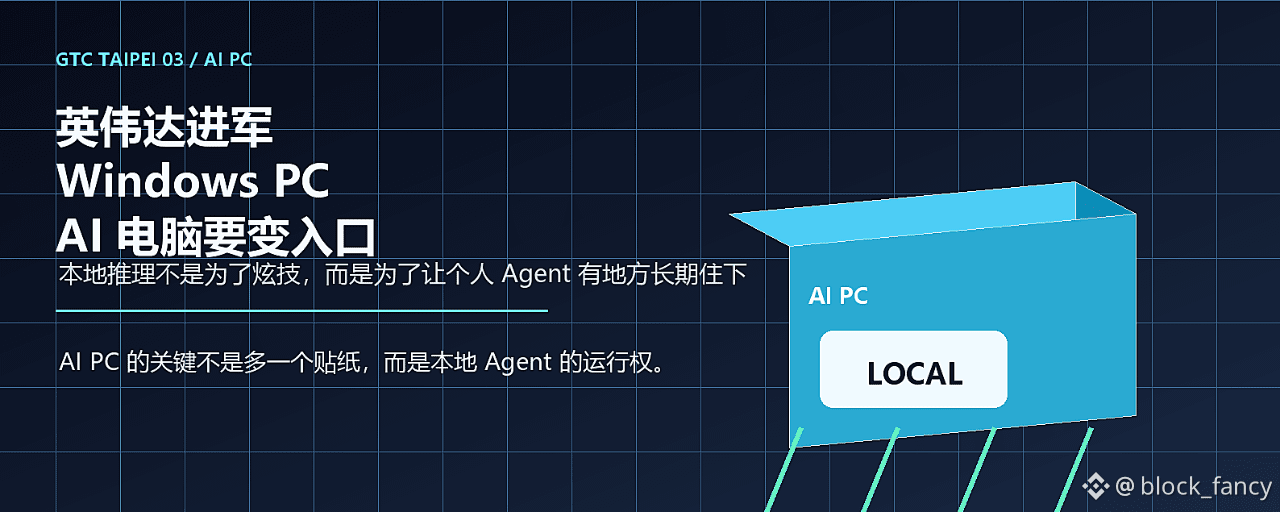
Cloud models are stronger, update faster, and are suited for complex reasoning and large-scale capabilities. But personal data, private files, low-latency operations, and offline scenarios can't all be handed over to the cloud. A truly useful personal agent must know what’s on your computer, must be able to interact with local applications, and must have virtually no wait time for many small tasks.
This is the value of local reasoning.
It's not about proving that computers can run models too.
It’s about making agents closer to people’s daily lives.
Imagine a very ordinary afternoon. You have a pile of meeting notes on your desktop, a dozen tabs open in your browser, someone on WeChat urging you to revise a proposal, and a version of a PPT from last month sitting on your hard drive. A cloud chatbot can certainly help you write things, but it doesn’t know which files on your computer are the latest, which page you just modified, or which sentence a certain client cares about most.
If local agents can understand this context under authorization, they become more than just a Q&A box.
It will become a new gateway to your computer.
This also reflects NVIDIA's impact on the Windows PC industry. AI PCs are not a new selling point for the PC industry, but rather a shift of AI applications from cloud services to personal workspaces. Whoever controls this access point has the opportunity to redefine how users interact with AI daily.
The biggest gateway for mobile internet in the past was the smartphone. Why is the smartphone powerful? It's not because it has the strongest computing power, but because it’s personal, always on, and knows your location and behavior. For personal computers to regain importance in the AI era, it won’t be about benchmark scores, but whether they can become long-term containers for personal intelligence.
This will affect many industries.
For software companies, applications may need to be restructured. The NVIDIA blog mentions Adobe redesigning Photoshop and Premiere’s AI and graphics performance for RTX Spark. This detail is worth watching because it shows that AI PCs are not just hardware vendors shouting slogans; real value needs to be released through application restructuring.
If applications don't change, local computing power will just sit idle.
If applications change, the situation will be different. Editing software can understand, generate, preview, and render local materials. Design software can allow agents to make suggestions within your project files. Development tools can understand context in local code repositories. Office software can connect documents, spreadsheets, emails, and schedules.
This is the truest opportunity for AI PCs.
It’s not just about giving you another chat window.
It’s about making every application on the computer a work scene that agents can access.
Of course, there are many challenges involved.
How is the local agent authorized? Can it read my files? To what extent? Who is responsible if it makes mistakes? Can it automatically send emails, modify documents, or submit code? If it runs in the background, how is privacy and security ensured? If the model becomes smarter locally, how do software and hardware vendors split the profits?
None of these questions are easy.
But because it’s difficult, it shows that AI PCs cannot be solved merely by slapping on a label.
I believe the real turning point for AI PCs isn't how powerful the first batch of hardware is, but whether we will see some indispensable use cases in the next year or two. For instance, local code agents, local video editing agents, local document agents, local design agents. As long as there’s one scenario that makes users feel uncomfortable without local computing power, the logic of upgrading will hold.
Otherwise, it’s just marketing jargon.
The profound impact of GTC Taipei lies in NVIDIA repositioning personal computers back at the center of the AI industry chain. In the past, everyone thought the future of AI was in the cloud, in data centers, in massive clusters. Now, it says personal devices should also have their own smart factories—smaller but closer to you.
If this judgment holds true, the AI industry will shift from cloud API competition to a hybrid competition of cloud plus local.
Model companies need to consider how models can reduce size and latency locally. Software companies need to think about how applications can be opened to agents. Hardware companies need to figure out how local computing power can be truly perceived by users. Operating system companies need to design permissions, context, memory, and security.
You see, AI PCs are finally not just about PCs anymore.
It has turned into a battle for personal AI access.
In the future, when we buy computers, we might not just ask about screen size, battery life, weight, and performance. We will also ask if this machine can support my personal agent, if it can understand my data securely, and if it can save me from repetitive small actions in my daily work.
Only then can AI PCs be said to have truly shed the label.