
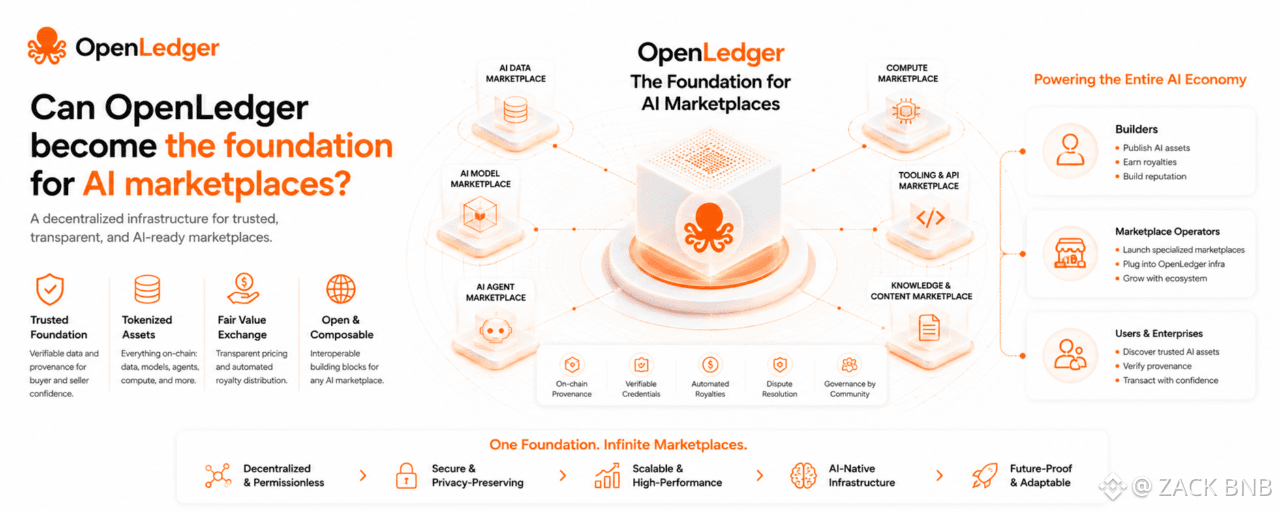
I think when talking about an AI marketplace, many people often imagine a place similar to an app store for models.
The model creator uploads products, users select the right model, pay the fee, and then use it.
That mindset isn't wrong, but if we only focus on the model, we're missing a huge part of the AI economy.
A true AI marketplace needs more than just models.
It needs data, models, agents, inference, attribution, and a mechanism to share value among the contributors to the final output.
This is why I see OpenLedger ... potentially having a rather unique position.
In traditional marketplace models, sellers and buyers are quite clear.
One side sells the product, the other pays.
But in AI, value isn't created by a single party.
A good model may require specialized datasets from various contributors.
An agent can use multiple different models to complete a task.
A valuable output can result from data, models, fine-tuning, and agent logic all working together.
If the marketplace only pays the person who deploys the final model, all the contributions behind the scenes will be overlooked.
OpenLedger ... is trying to address that point with Datanets, ModelFactory, OpenLoRA, and Proof of Attribution.
Datanets is the first layer.
It helps data be organized by domain instead of being thrown into a common warehouse.
Financial, medical, legal, environmental, or gaming data all have their own contexts.
An AI marketplace that wants good models can't just rely on mass data.
It requires specialized, cleaner data with clearer origins and identifiable contributors behind it.
Without this layer of data, the marketplace could easily become a place to list models with no one knowing where they learned from.
ModelFactory is the next layer.
It helps builders create or fine-tune specialized models from data in the system.
This is crucial because the demand for AI in the future won't just revolve around a few generalized models.
Different industries will need smaller, more specialized models that understand the domain better.
A strong AI marketplace must allow multiple builders to create models that serve very specific needs.
But the issue isn't just about creating models.
The question is who benefits from the value when that model is used.
This is where Proof of Attribution becomes the distinguishing feature of OpenLedger.
If a model is fine-tuned from data in Datanets, and that model generates valuable inferences, the system needs to know which data contributed to that output.
Without attribution, the marketplace will revert to the old model: data creators get paid once or not at all, while long-term value flows to the operator of the final product.
OpenLedger is trying to build a different logic.
Data, models, and agents can all be viewed as economic parties within the same value stream.
For example, a financial agent creates a valuable risk report.
That output could come from a specialized model fine-tuned with market data, on-chain data, and historical analysis.
In a typical marketplace, users only pay the final agent or app.
But in a marketplace based on OpenLedger, that value can be traced back to acknowledge the model creator and data contributor.
In my view, this is what makes OpenLedger resemble an AI marketplace platform more than a standalone AI tool.
It's not just about creating a place to sell AI products.
It creates infrastructure for various types of AI contributions to be identified, utilized, and monetized in a more transparent way.
Such a marketplace could open up many new roles.
People with specialized data can contribute to Datanets.
Builders can use that data to create models through ModelFactory.
Agent developers can build agents based on existing models.
End-users pay for inferences or tasks.
Proof of Attribution stands in the middle to acknowledge who contributed to the final value.
If this loop works, the marketplace won't just be a place to buy and sell.
It becomes an economic system.
The good part is that incentives can be aligned better.
Data contributors have a reason to provide high-quality data because good data can generate rewards when the model is used.
Model builders have a reason to choose better datasets because model quality affects long-term usage.
Agent developers have a reason to use more reliable models because better outputs will retain users longer.
These three groups will no longer operate separately.
They get pulled into the same value loop.
Of course, I don't think OpenLedger has definitively become the default platform for AI marketplaces.
This problem is quite tough.
The first challenge is data quality.
If Datanets doesn't have enough good data, model builders won't have a strong reason to build on the system.
The second challenge is attribution.
If Proof of Attribution mismeasures contributions, rewards will be skewed and top contributors won't stick around for long.
The third challenge is the builder experience.
A marketplace can only thrive if builders find it easy to create models, deploy models, and reach real users.
Additionally, there's the trust issue.
Marketplace users need to know which models are worth using, which datasets are reliable, and which agents have a good track record.
OpenLedger can provide an on-chain record layer, but that record needs to be turned into an interface and signals that are easy to understand.
If there's only technical data that users can't read, the marketplace will still struggle to scale.
But in terms of direction, I see OpenLedger tackling the big questions.
The future AI marketplace won't just be a place to list models.
It will be a place where data, models, and agents exchange value together.
And to achieve that, a clearer infrastructure is needed to record contributions, track origins, and distribute rewards.
OpenLedger could become the foundation for that kind of marketplace because the project doesn't start from a single model.
It starts from the entire value chain: data enters Datanets, models are created through ModelFactory, agents or apps use models to generate outputs, and Proof of Attribution acknowledges the contributions behind.
In my opinion, this is a point worth monitoring.
If OpenLedger does well, the AI marketplace won't just be a place to sell AI tools, but a place where data creators, models, and agents can all become real economic entities in the AI economy.
@OpenLedger #OpenLedger $OPEN