

NTT pioneers 'contactless haptic' illusion technology
On May 12, Japanese telecom giant NTT announced the successful development of the world's first 'illusion haptic technology', allowing users to convey the softness and viscosity of objects remotely using only visual information, without the need for specialized haptic devices.
NTT states that this mechanism combines hand motions captured by a smartphone or computer camera with the deformation visuals displayed on the screen, creating a tactile illusion in the brain. Users can experience the sensation of virtually touching objects just through visual changes on the screen.
The development of this technology is driven by the recent boom in virtual reality (VR) and augmented reality (MR) technologies. In the past, conveying tactile texture required specialized haptic devices, making it challenging for consumers to intuitively grasp the true tactile feel of products while shopping online, which affected their purchasing decisions.
However, humans can actually judge the softness and weight of objects solely based on visual information, but there hasn't been a complete answer regarding which visual information can systematically determine tactile perception. To this end, NTT focuses on virtual object deformation, aiming to identify specific visual parameters that can convey texture in a non-contact state.
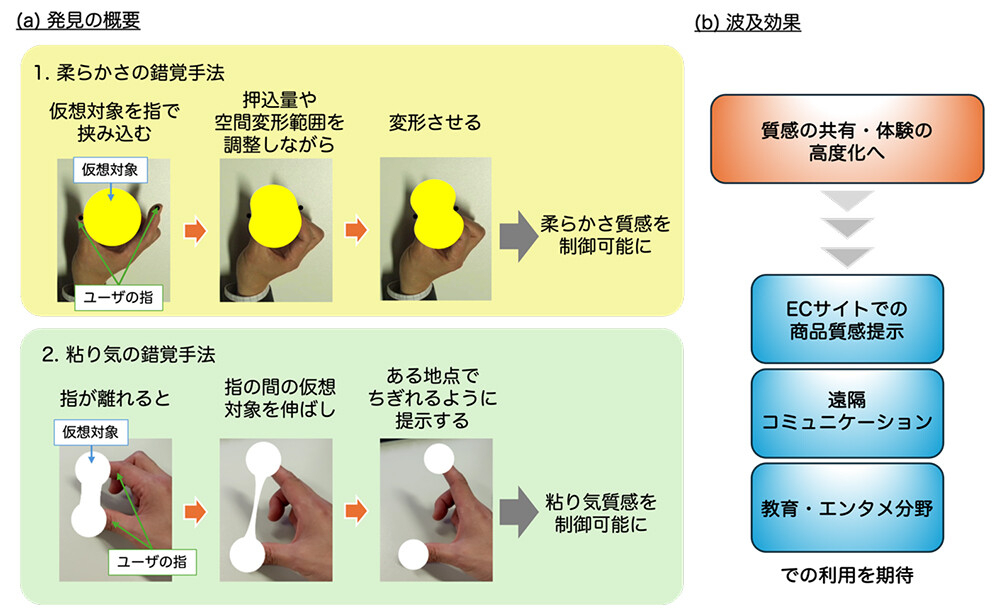 Source: NTT Press Release - Japan's NTT pioneers 'contactless tactile' illusion technology.
NTT controls deformation parameters, analyzing three major technological highlights.
In the official article, NTT explains the three core points of the technology:
Softness performance
The research team operates softness perception by controlling the spatial deformation range of the virtual object when pressed. Experimental results show that the perception of softness changes with the spatial deformation range, achieving the softest visual illusion around 16 to 32 pixels.
Using this range as parameters for virtual space object deformation allows for a purely visual, contactless presentation of softness.
Viscosity performance
By controlling the virtual object's stretching distance as the finger moves, users can manipulate their perception of viscosity.
NTT has consistently confirmed through laboratory and online testing that the longer the virtual object is stretched, the stronger the viscosity felt by the user, successfully achieving a tactile sensation that was previously difficult to present visually in a non-contact manner.
Real-time control based on hand movements
NTT's system can instantly calculate deformation parameters based on the hand trajectory captured by the camera and synchronize the display on the screen.
With this mechanism, users can operate virtual objects and receive realistic tactile feedback without needing to buy or wear extra gear.
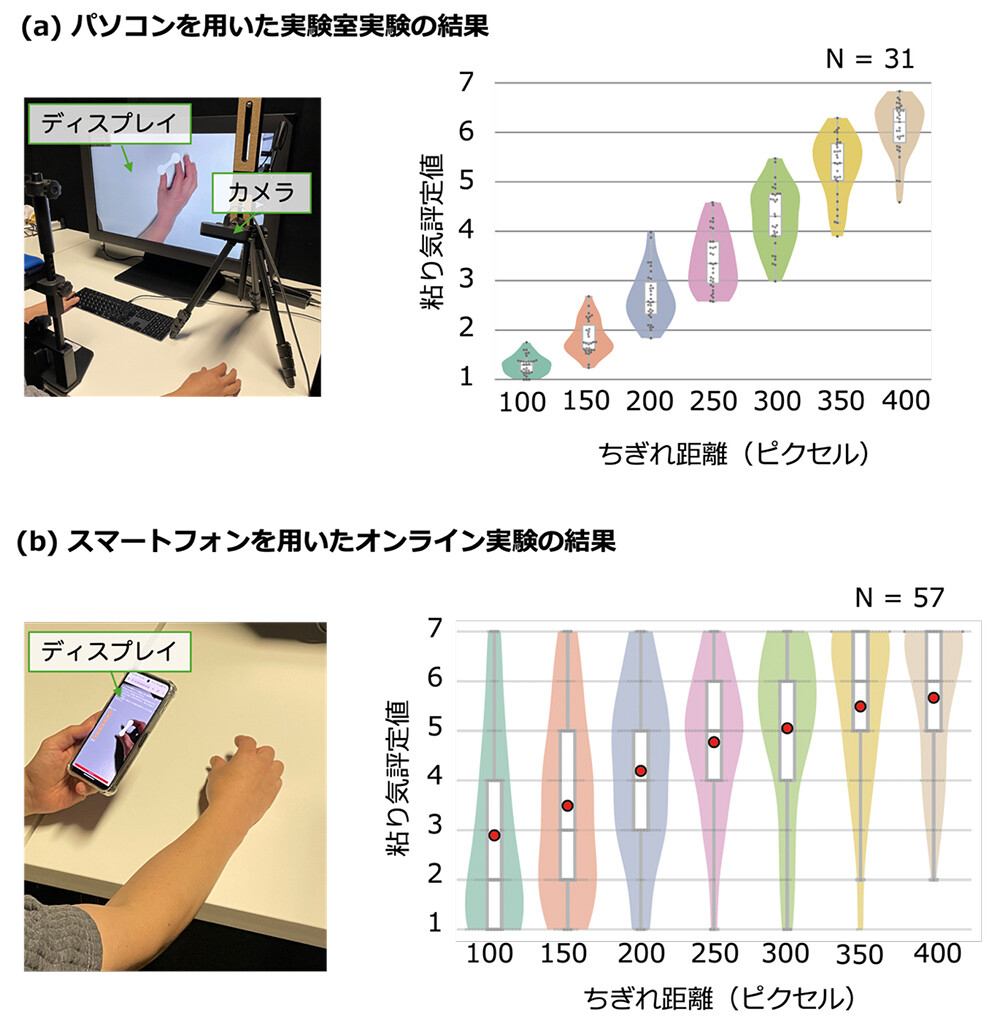 Source: NTT Press Release - Japan's NTT pioneers 'contactless tactile' illusion technology experimental methods.
Japanese netizens humorously divert into interesting applications.
Although NTT has focused the application prospects of contactless tactile technology on e-commerce, remote communication, and training, many Japanese netizens have humorously diverted the conversation towards adult entertainment based on the ability to convey softness and viscosity.
Some users exclaimed: 'Humanity is moving towards some interesting directions,' and others cited this as one of the reasons why 'being born in Japan is great.' Some users remarked that while initially impressed by this remarkable tech, they couldn't help but chuckle at the comments section filled with various gentlemanly remarks.
Regarding future application scenarios, many netizens suggest that this technology must be integrated into VR devices, believing that combining VR can provide a stronger sense of immersion and 'insertion feeling.' One user even left a humorous formula: 'FANZA (Japanese adult site) + VR + NTT = World Peace.'
Many netizens pointed out that this technology instantly defined its future applications, joking that the official description could have summarized it with 'tactile sensation' but instead chose the terms 'viscosity' and 'softness,' highlighting Japan's particular expertise in this field.
Further reading:
(Sword Art Online) is coming true! Super fans showcase Meta Quest 3 test video, can the real world be 'supernova' too?
'Experience softness and viscosity without contact! NTT's new technology brings us closer to the metaverse, and the internet humorously diverges into interesting applications.' This article was first published in 'Crypto City.'