

Last night I was scrolling through X, watching those AI videos, and I suddenly had this feeling:
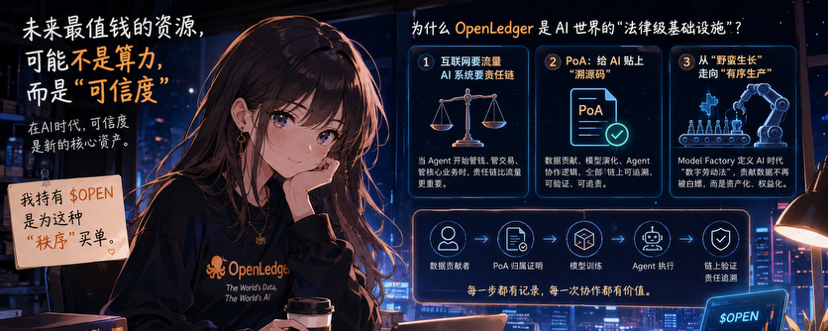
In the future, the most valuable asset might not be computational power or models, but trustworthiness.
Everyone knows the current info landscape online.
Stuff like copy-pasting, rewriting, and AI bulk generation - it’s all mixed up with the real deal. A lot of content looks slick, but you have no clue where it’s from, and you can’t even tell if it’s been manipulated behind the scenes.
In the Web2 era, this issue wasn’t a deal breaker; after all, most folks were just scrolling through content.
But the AI era is a whole different ball game.
When AI starts helping you make decisions, manage funds, and execute tasks, if you can’t even figure out the data sources, the risk is way bigger than most people realize.
That's also why I'm keeping an eye on @OpenLedger .
A lot of projects are focused on rolling models, rolling parameters, and rolling computing power, but OpenLedger seems to be tackling a different issue:
How to prove that AI's conclusions are credible.
Many people see PoA (Proof of Attribution) as just a copyright tool, but I think that's a bit of an underestimation.
To me, it resembles a responsibility tracking system.
Where the data comes from, who contributed it, how the model was trained, and what stages it went through, all should be traceable.
Just like you can check the origin of your veggies, in the future, AI's outputs should also have traceable sources.
Especially in high-risk scenarios like finance and healthcare, without traceability, even the smartest AI won't truly instill confidence.

I've recently been diving into their Model Factory and feel the same vibes.
It's not just about training models; it's attempting to establish a more equitable value distribution mechanism.
In the past, those who contributed data often didn't see any returns, with value concentrated in the hands of the platform.
Now, data, models, and inference processes can all be recorded and quantified, giving contributors a chance to earn corresponding rewards.
The biggest change behind this is:
The AI industry is transitioning from wild growth to a more regulated operation.
Back in the day, the internet was all about traffic first.
In the future, AI may place more emphasis on accountability, ownership, and verification.
So, I bought $OPEN not because I think it's definitely going to pump tomorrow.
It's because I believe that when AI truly enters the large-scale application phase, credibility will definitely become a core asset.
Without credibility, even the strongest model is just a black box.
Only infrastructure that can build trust and order is likely to weather the cycles.

Perhaps that's the real reason to pay attention to #OpenLedger .