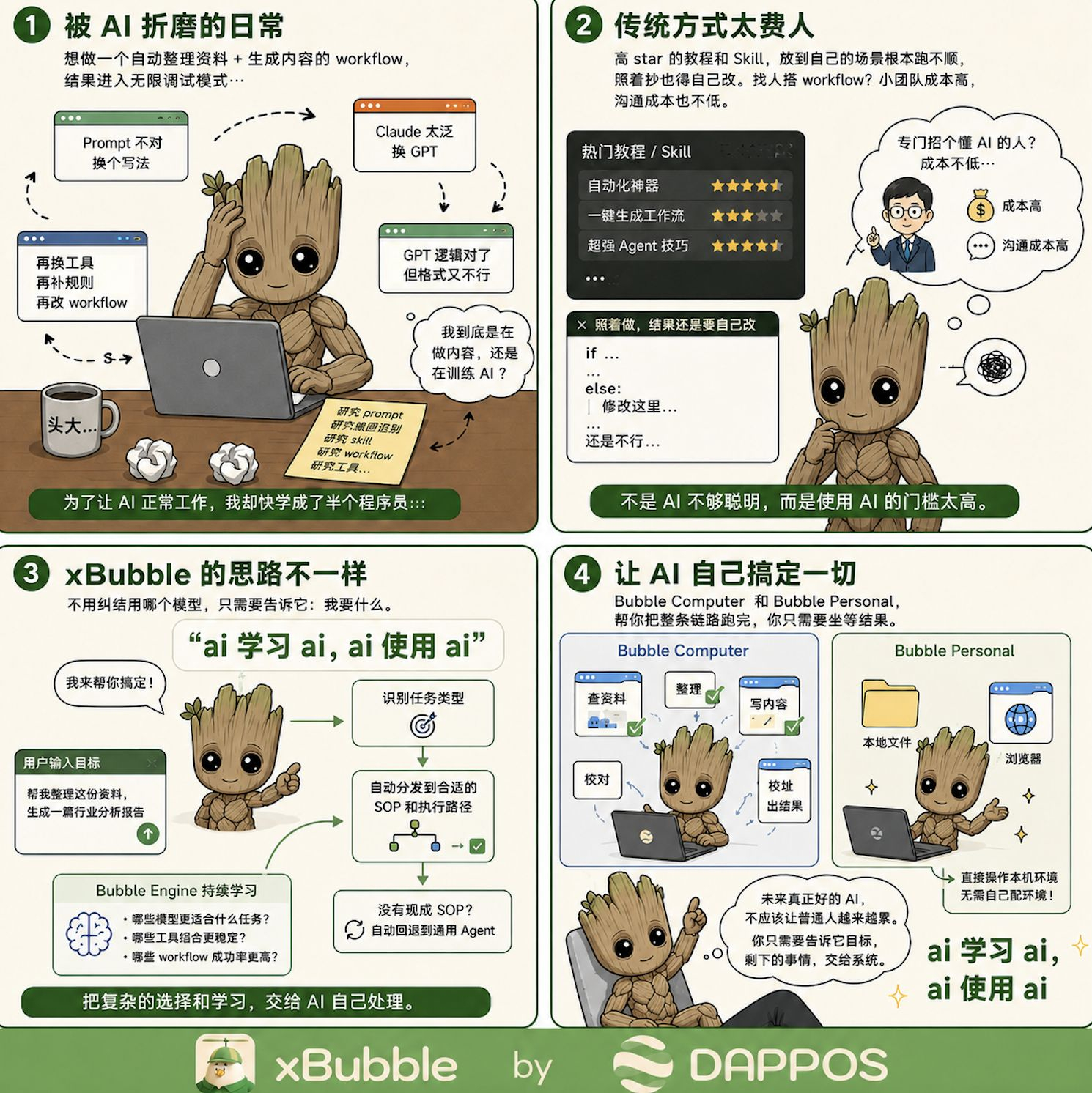


I've really been getting wrecked by AI lately. A few days ago, I wanted to set up a 'automated data organization + auto content generation' workflow. Now everyone's online hyping AI Agents, automation, and low-code futures. At first, I thought it would just be a quick setup.
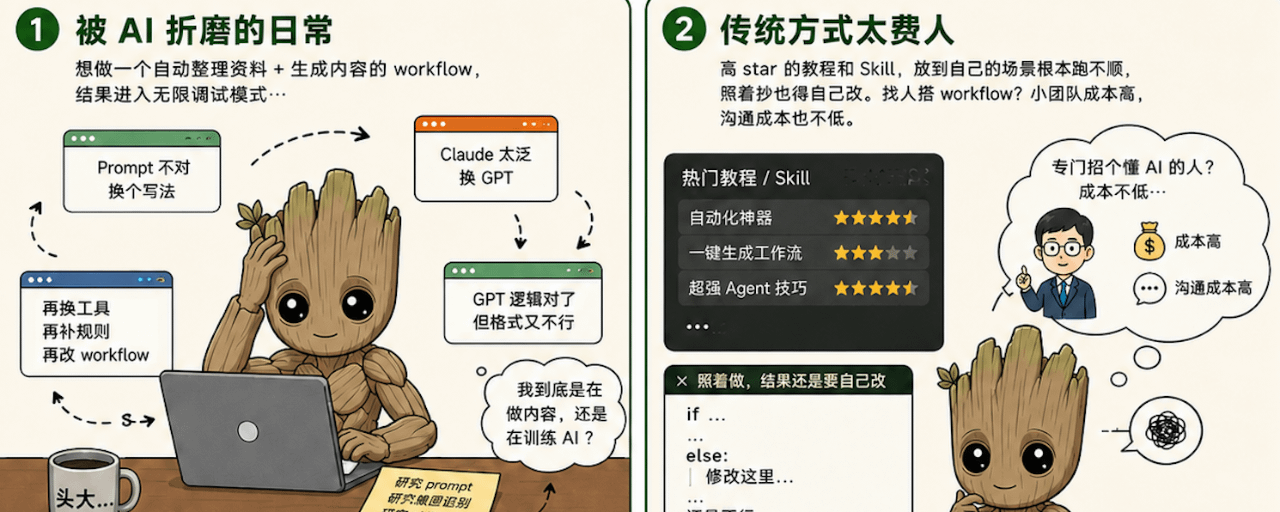
But as soon as I started, I was thrown into an endless debugging mode.
This prompt is off, let’s rewrite it. Claude is too broad, switching to GPT. GPT has the right logic, but the format is off. Then I keep switching tools, adding rules, tweaking the workflow. Sometimes I can't even tell if I'm 'creating content' or 'training AI'.
And stuff like this really messes with your mindset.
With the same tool, some people can get it done in a dozen minutes; sometimes I can spend two hours going back and forth on a single result. Those highly starred Skills on the internet look impressive one after another, but once you try to plug them into your own scenario, many of them simply don’t run smoothly.
If you just copy it, you still have to tweak it little by little yourself in the end.
Later, I even thought about having someone help me build workflows. But if I think about it carefully, it’s kind of awkward for a small team. Hiring someone who understands AI isn’t cheap; and coordinating requirements, explaining logic, and doing back-and-forth rework can sometimes be even more exhausting than just figuring it out yourself.
Later, I slowly realized that the biggest problem with AI isn’t, in fact, that it’s “not smart enough.”
Instead, ordinary people have to learn too many extra things in order to use AI well.
You need to research prompts, understand the differences between models, study skills, examine workflows, and figure out which tool fits which task. Real work only takes up part of the time—the rest of the effort is all about “making the AI work properly.”
So when I recently tried @dappOS_com’s @xbubble_xyz, I felt its approach was quite different.
Many AI products are currently teaching users: how to write prompts, how to build workflows, and how to tune agents.
But xBubble is more like it’s doing something else:
“AI learning AI, using AI to use AI”
From my own experience, the biggest realization is that I don’t have to keep obsessing over “which model to use for this step.”
I only need to tell it what I want.
Bubble Pilot can identify the task type on its own, then automatically route it to the appropriate SOP and execution path. If there isn’t an existing SOP, it will also automatically fall back to a general Agent.
The key is that its backend Bubble Engine keeps learning.
Which models fit which tasks, which tool combinations are more stable, which workflows have higher success rates—those once very time-consuming things are now starting to be handled by AI itself.
Honestly, that experience is pretty great.
Because in many cases before, it wasn’t that AI couldn’t get the job done. Instead, for the AI to do the work, users themselves would have to learn up fast to become almost half a programmer.
Especially this kind of mode like Bubble Computer—I really feel it.
Earlier, I had to complete an entire task by myself—opening and switching between several windows: researching, organizing, writing, proofreading, and then outputting.
Now it runs the entire chain end-to-end by itself.
Including Bubble Personal’s local mode, which is also pretty interesting. You can directly operate local files and browsers on your machine, but users don’t have to set up the environment themselves.
Lately, I’m increasingly convinced that truly good AI shouldn’t make ordinary people more and more exhausted.
Instead, AI learns how to use AI on its own.
Users only need to tell it the goal—everything else is handled by the system.