


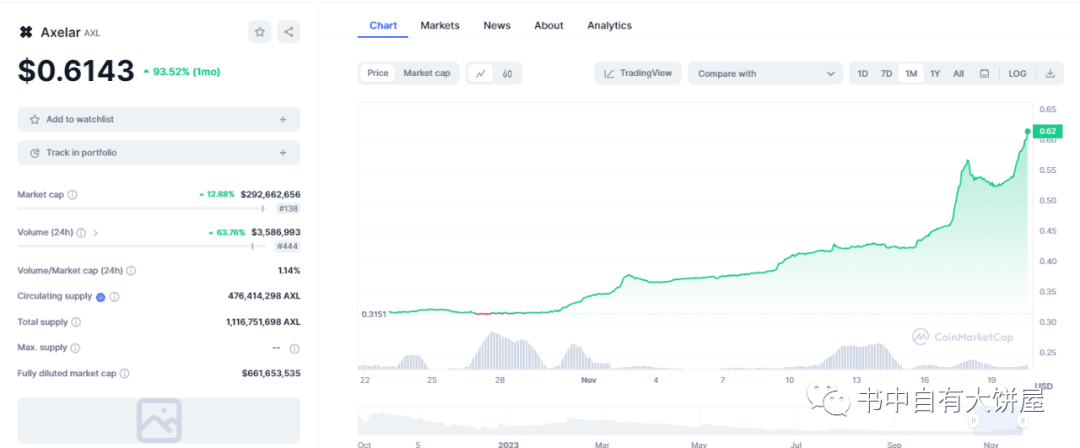
Today we will continue to talk in our order. Today we will talk about a project that has been recommended by friends in the group for a long time. Then I looked at it again and found that its recent performance is very good. It has nearly doubled in the past month. , you must know that projects that can be launched in advance must have some advantages. Let’s decipher the following together today. It is the new star Axelar network in the cross-chain industry. Its current market value is 290 million US dollars, and its ranking has reached 130+. In fact, this project I I've seen it before, it's ranked around 200, and it's been going strong lately.
Introduction
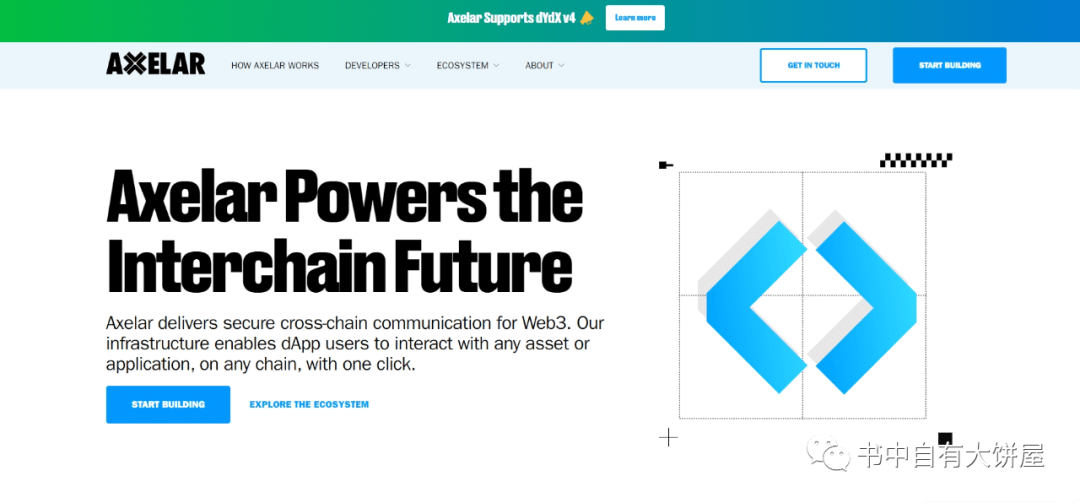
Axelar claims to provide "secure cross-chain communication" for Web3. The project provides a decentralized network and tools to help builders of decentralized applications (dApps) communicate seamlessly across chains through its suite of protocols, tools, and APIs.
Axelar Mainnet Axelar Mainnet is essentially a public chain built through Cosmos SDK, using Tendermint as the consensus protocol. The nodes in the network not only need to package blocks, but also need to verify the authenticity of external blockchain data and transfer external areas. Blockchain data. Nodes are both operators of the Axelar network and verifiers of external networks. To become a node of the Axelar network, you need to be able to choose a light client that runs a connected external blockchain.
Axelar is connected to Polkdot's EVM compatible chain Moonbeam and will also enjoy Polkdot's data sharing. The project can basically be connected to the public chains of the EVM ecosystem, which better enriches its cross-chain selectivity.
However, Axelar uses its own public chain as the relay chain, and its security depends on the degree of decentralization of the main network validators. At present, it says that it is a decentralized layer 1 and a Proof of Stake (PoS) consensus mechanism, but it currently only has 75 validators, and the rules for becoming a validator are very simple, that is, the number of pledged AXL must be among the top 75 , if you only have 75 validators, you can say that you are decentralized. This is a bit of a boast.
Operating principle
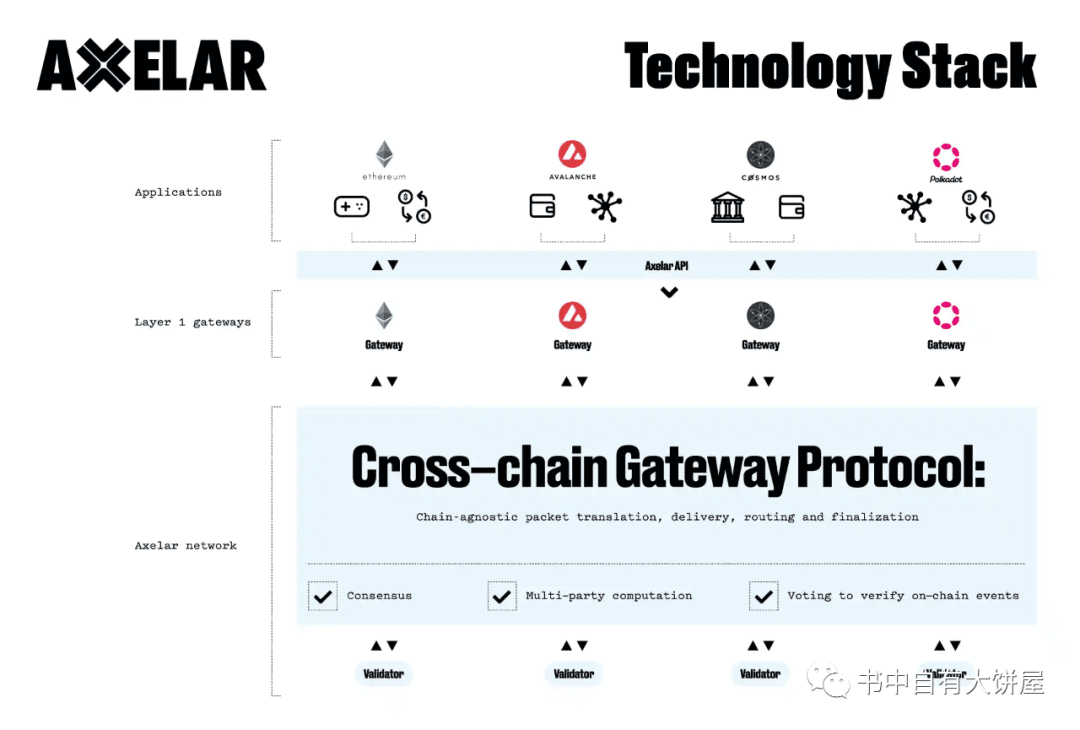
From the perspective of implementation, Axelar is a complete PoS public chain with an independent decentralized network and verifiers, which essentially verifies inter-chain communication through a third party. The process can be simply described as: the verifier monitors the transaction requests issued on the source chain, completes the verification of the legality of the transaction on the Axelar chain, and then passes it to the target chain to complete the transaction.
The following figure shows the working diagram of Axelar: Axelar will deploy smart contracts called "gateways" on each connected public chain (Layer 1 gateways in the figure). Verifiers need to run nodes or light clients on these chains. , monitor transaction requests from these chains through the "gateway" and report the transaction requests to the Axelar public chain; then, the verifier will vote on all reports and complete transaction verification on the Axelar public chain (in the figure Axelar Network layer); after completing the verification, the transaction operation can be performed again through the gateway on the connection chain.
Project Features
What sets Axelar apart is its secure cross-chain communication on dynamic validators. While a handful of projects are using optimistic settings and federated multisig, Axelar claims to be the only network building these features on Proof-of-Stake.
Axelar has three core components - a decentralized network, a software development kit consisting of protocols and APIs, and a set of gateway smart contracts for cross-chain connectivity.
Cross-Chain Gateway Protocol (CGP): This protocol is similar to the Border Gateway Protocol Internet. The protocol is used to connect multiple autonomous blockchain ecosystems and is responsible for routing across them.
Cross-chain Transfer Protocol (CTP). The protocol is similar to Application Level Protocol Transport, the Hypertext Transfer Protocol on the Internet. It is an application-level protocol stack that sits on top of routing protocols such as CGP and other routing technologies. Application developers can connect their dapps on any chain to perform cross-chain requests. Users can use the CTP protocol to make interactive requests with any on-chain application using simple API calls similar to HTTP GET/POST. Developers can lock, unlock and transfer assets between any two addresses on the blockchain platform, and cross-chain application triggers (for example, dapps on chain A) can be updated.
If other applications on chain B meet certain search conditions (interest rate > The state of the smart contract on chain B). The protocol allows program composability across the blockchain ecosystem.
team
The two founders of the team are both core members of the Algorand founding team and have strong academic backgrounds and blockchain development experience. One of the co-founders, Sergey Gorbunov, received his bachelor's and master's degrees from the University of Toronto and his PhD from MIT. He specialized in cryptography during his PhD and started working as an assistant professor at the University of Waterloo in 2016. Another co-creator, Georgios Vlachos, received his bachelor's and master's degrees from MIT and won the gold medal in the International Mathematical Olympiad (IMO).
Financing
The current financing situation found is that it has received Series B financing, with a total of US$63.75 million in institutional financing and a valuation of US$1 billion.
Seed round financing $3.75 million November 13, 2020.
Series A financing $25 million July 16, 2021.
Series B financing $35 million February 15, 2022.
Approximately 50 million U.S. dollars have been raised in token financing, so the total financing amount is more than 100 million.
Token economy
The current total number of tokens is 1,116,804,507, 476,429,855 are in circulation, and the circulation rate is 42%. However, it is inflated every year, and the annual inflation rate is 8.5%. In addition to the releases, there is a minimum of 200 million more tokens in circulation every year. , the current currency price is 0.6 US dollars, and the peak was $1.09 (2022-10-12). From this point of view, it has almost recovered by half, so the recent increase may be a bit higher than expected.
The distribution of Axelar Network’s token AXL is as follows:
Community programs: 35.96%. Community Sales: 5%. Supporters: 29.54%. Core team: 17%. Corporate operations: 12.5%. All are released linearly over 4 years, so the core team and the company’s currency holdings are approximately 30%, including community plans, which are actually in the hands of the team.
Then let’s look at other data. The TVL on the chain is 140 million US dollars. This performance can be said to be quite good. Compared with other public chains, there is still some gap compared with L2. Compared with L2’s arb (1.3 billion ), TVL2.1 billion.
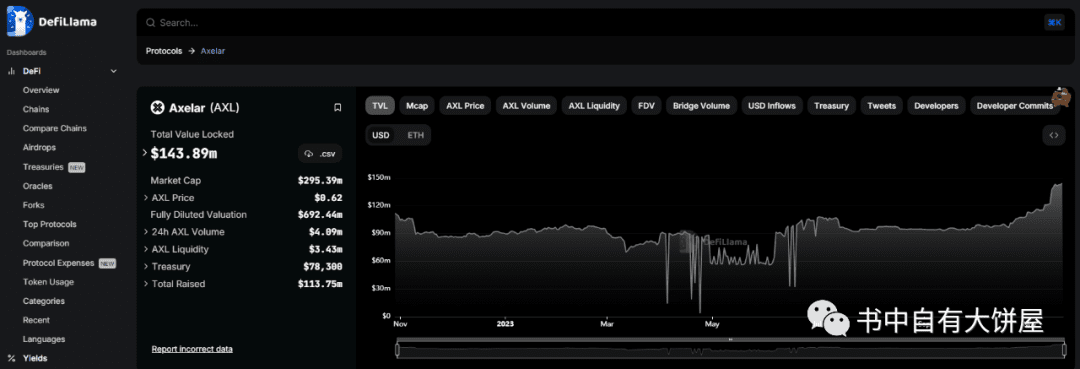
Then look at the data on the chain. It is currently connected to 53 public chains, and the transaction volume has reached 6.8 billion. One of the more eye-catching data is that its pledge report is 11.5%. This return is actually relatively high.
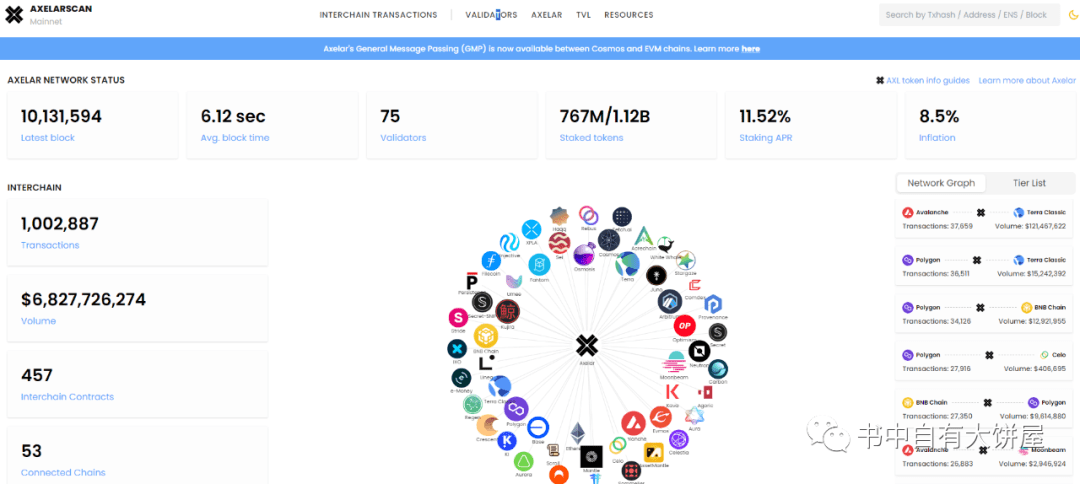
Finally, let’s summarize this project. It belongs to the cross-chain track. In fact, we know that the two largest cross-chain companies have already dominated there, namely DOT and Cosmos. Many of the projects we will talk about later are based on these two. It is done, so basically the dominance of the two cross-chains is unshakable. The DOT method is relatively heavy. Once it is completed like a viaduct, it will be very efficient. Cosmos is relatively simple. Give you a shovel and you can shovel out a road. Just use it, it’s simple and quick to use. And this project is also built using Cosmos. In fact, the field of cross-chain is quite embarrassing, that is, so many chains will be needed in the future, because there were many chains before. This is because of the performance problems of Ethereum, such as insufficient speed and too high gas. , but the current outbreak of L2 has actually solved some of the problems of Ethereum, so this is a relatively embarrassing point of the current cross-chain project, so this project is smarter. It later transformed into L2 cross-chain, and also achieved some If it succeeds, it will not only make tools, but also make DEX. This is the reason for its cleverness. The second problem is that it is built based on cosmos sdk and uses a relay chain to cross-chain. There is actually no innovation in it. As for this surge, the reason is actually simple, because it has raised more than 100 million U.S. dollars before, and its valuation has reached 1 billion U.S. dollars, so it was originally in the low valuation range. As for how much the increase can be, we can actually compare it with the current cross-chain duo. Currently, they are around 3 billion, which means there is still 10 times the room. However, it cannot reach the height of the duo. Coupled with the increase in the bull market, it is also That's about 10 times the space.