

Welcome to the beginner’s guide to InfinitySwap’s Ethereum Virtual Machine Container, or EVMC!
This article is intended for a general audience and does not require prior knowledge of blockchain technology, however, if you are confident that you understand the basics of Ethereum and the Internet Computer, please check out our more detailed introduction, “How InfinitySwap’s Ethereum Virtual Machine Container (EVMC) Works and Why It Matters”.
Without further ado, let’s get started!
Smart Contracts and Solidity
You may have heard of smart contracts before – they are digital agreements that automatically execute when certain conditions are met. EVMC is a platform that allows you to run smart contracts written in a language called Solidity on the Internet Computer (ICP), a blockchain that is now compatible with Ethereum.
Solidity is a computer language used to write smart contracts on blockchain platforms. It is designed to be a safe and reliable language, making it difficult to write code that could cause problems or security issues.
Smart contracts written in Solidity are stored entirely on the blockchain, making them transparent, secure, and tamper-proof.
EVMC Architecture
Now, let’s talk about the architecture of EVMC. It has four key components: 1) EVM API container, 2) EVM executor container, 3) signature verifier container, and 4) blockchain container. Containers are like bundles of computer code and the data required for the code to run.
The EVM API container receives requests from Ethereum clients and Internet Computer agents, then batches these requests into a pool of pending transactions. The EVM Executor container processes these transactions, updates the global EVM state, and updates the blockchain container accordingly.
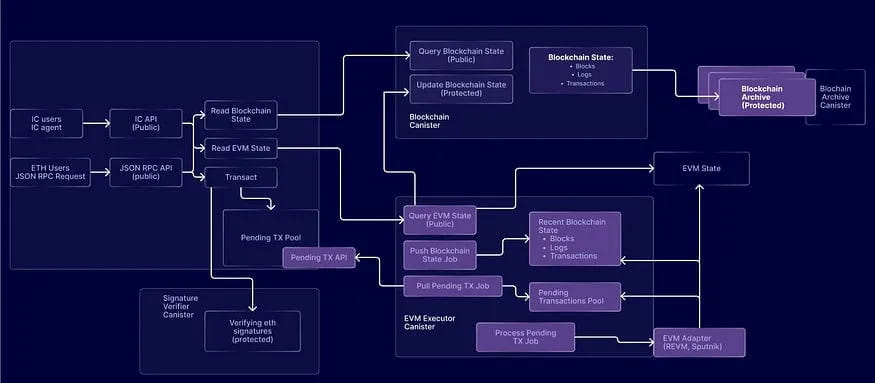
The blockchain container is where the Ethereum chain blocks are stored. It remains in the fixed container storage of the Internet Computer. Stable container storage ensures the security of information, otherwise this information may be lost when the container's code is mined and replaced with updated code.
The signature verifier container is used to verify the signature of Ethereum transactions, which is a computationally expensive task performed in a dedicated pool of containers to avoid doing too much computation in the EVM API container.
What makes InfinitySwap’s EVMC so great
EVMC is faster than the main Ethereum network EVM implementation because it optimizes transaction throughput by performing signature verification and transaction batching. EVMC is completely on-chain, code and data are executed in Web Assembly, and parallel computing is achieved through a multi-container architecture, which makes EVMC extremely fast.
EVMC is important because it is a revolutionary development of the best existing features of the EVM on Ethereum, and much more!
EVMC is fully tested with high coverage across core modules. EVMC uses existing libraries such as REVM, Retest, canister-SDK (Software Development Kit), and the Internet Computer's stable repository to make full use of existing Ethereum libraries.
in conclusion
In summary, InfinitySwap’s EVMC is an innovative project that has created a fast, cost-effective EVM implementation that is compatible with Ethereum smart contracts but runs on the Internet Computer.
The EVMC architecture consists of four components that work together to process transactions and update the global EVM state and data stored on the blockchain accordingly. It is a revolutionary enhancement of the Ethereum Classic EVM on a fast, secure and transparent new blockchain.

IC content you care about
Technology Progress | Project Information | Global Activities

Collect and follow IC Binance Channel
Get the latest news