

In the early morning of February 2, 2023, the Bitcoin network minted the heaviest block in history with a size of 4MB, 4 times higher than the normal 1MB limit. The reason is that there is a transaction with an image "engraved" on it, this transaction almost occupies the entire space of block <774628>.
This block became a historical milestone for Bitcoin NFT, paving the way for the Bitcoin NFT or Ordinals Inscription movement from then on.
In the article below, we will dig deeper into Bitcoin NFT and its impacts on the market.
1. Concepts
If you are familiar with the concept of NFT, you will surely understand its uniqueness and non-stackability like tokens.
On other Blockchain networks such as Ethereum or BNB Chain, there are sets of standards (also known as rule sets) specifically for creating NFTs such as ERC-721, ERC-1155. These standards require tokens (NFTs) created on them to operate according to certain rules, making it easy for users and applications to create and interact with these tokens (NFTs).
This is not the case with the Bitcoin network, the Bitcoin network does not support its own standard for creating NFTs. Bitcoin Blockchain has only one system for confirming transactions called Bitcoin Transaction Protocol. That's why Bitcoin cannot build smart contracts on it, this is also the biggest difference between Bitcoin and Ethereum and later generation Blockchains.
Since its inception on January 3, 2009, Bitcoin's only application has been to store value. Although Bitcoin still does its job very well, the revolutionaries do not want to stop there, they want the Bitcoin network to be busier and more applicable. With such ideals in mind, a software engineer named Casey Rodarmor created the Ordinals protocol – which allows users to mint NFTs on the Bitcoin network.

Some commonly used terms in Bitcoin NFT
Ordinals: is the name of the protocol that allows NFTs to be created on the Bitcoin network. In the official Ordinals documents, the "ordinal number" also refers to the ordinal number of the sats. Sats are the smallest unit of Bitcoin, 1 BTC = 100,000,000 sats, each sats has its own serial number every time it is created.
Inscription: is the content engraved onto sats to create Bitcoin NFTs. You can also understand Inscription as NFT on the Bitcoin network.
Inscribe: is the operation of engraving Inscription onto sats, similar to the “mint” operation of regular NFTs.
Digital Artifact: is the founder's term for NFTs that are stored to a higher standard than regular NFTs. Accordingly, for an NFT to be a Digital Artifact it must have the following properties: decentralized, immutable, full on-chain and cannot be restricted.
To make it easier to imagine, you can understand that Inscription is an NFT on the Bitcoin network, and Inscription is a type of Digital Artifact. Digital Artifact is a small category within NFTs that has more advanced properties as mentioned by the author. Digital Artifact does not necessarily belong to the Bitcoin network.

In the framework of the article, for ease of understanding, I will use Bitcoin NFT to mean Inscription or NFT on the Bitcoin network, and "mint" or "sculpture" to mean Inscribe.
2. How a Bitcoin NFT is created
As explained in the section above, other Blockchains like Ethereum have their own set of standards that support the rapid creation of NFTs, but the Bitcoin network is much more difficult. Bitcoin does not support building smart contracts on it, creating NFTs before 2017 was impossible.
Thanks to the arrival of the SegWit 2017 and Taproot 2021 upgrades, it is the perfect stepping stone for the birth of Bitcoin NFTs, especially the Tapscript proposal (BIP342) included in the Taproot upgrade that allows transactions to be carried out according to specified instructions. The founder of Ordinals took advantage of this to attach NFT information to transactions to create Bitcoin NFTs.
Mechanism to create Bitcoin NFT/Inscription
After each Bitcoin transaction, a UTXO (Unspent Transaction Output) is created - it is like a certificate certifying your balance and is saved on the Bitcoin network.
The Ordinals protocol allows attaching your NFT (Inscription) information to UTXOs, also known as engraving NFTs into Bitcoin, of course the "sculpted" data has been encoded into string form before. In other words, Ordinals engraves the NFT onto your balance certificate.
The smallest unit of Bitcoin is Satoshi (1 BTC = 100,000,000 sats), so the smallest amount of BTC that can be stored and traded is 1 sats, corresponding to that 1 BTC will create at most 100,000,000. NFTs. The Ordinals protocol allows tracking individual sats and engraving NFT information on it. These Bitcoin NFTs are stored entirely on-chain on the Bitcoin network and can be transferred back and forth through Ordinals.
Difference between Bitcoin NFT and traditional NFT
Returning to “traditional NFTs”, each NFT usually consists of 2 parts:
Token information: deployed from smart contract and stored completely on-chain.
Metadata: the content of NFTs, usually stored on decentralized storage systems such as IPFS, which can also be centralized storage systems. Metadata is linked to the token through an on-chain information field of the token, tokenURI.
With Bitcoin NFT, it is different, all information about NFT is stored completely on-chain, thereby creating differences compared to "traditional NFT".
Firstly, Bitcoin NFT completely inherits Bitcoin's characteristics of complete decentralization, transparency, security and immutability once it is stored on the network.
Second is the ability to censor content, anyone running a BItcoin full node can create Bitcoin NFTs, so it is impossible to control the content that users upload, even if it is sensitive content. .
Third is about how to determine rarity. For "traditional NFTs", its value is determined by artistic value, use value, etc. but with Bitcoin NFT, a new factor is added. is the sats number that the NFT is engraved into.
Ordinals theory divides the rarity for sats into 6 categories:
common: any satoshi that is not the first satoshi in its block;
uncommon: sat at the first position of each block;
rare: first sat of each difficulty adjustment;
epic: first sat of each Bitcoin Halving season;
legendary: first sat of each cycle;
mythic: first sat of genesis block.
You can learn more about Ordinals' rarity grading system here: https://docs.ordinals.com/overview.html
3. Impact of Bitcoin NFT on the market
Since its inception, Bitcoin has been seen as a place to store value, and even more so as a means of payment when El Salvador legalized BTC. But this time, it seems Bitcoin has gone further than founder Satoshi Nakamoto could have thought. Bitcoin NFT not only impacts the operation of the Blockchain network, but also affects the crypto economy.
For the Bitcoin Blockchain network
Since the historic 4MB block, the number of Inscriptions created on the Bitcoin network is increasing day by day in a "only up" fashion. Currently, there have been nearly 500,000 Inscriptions created.
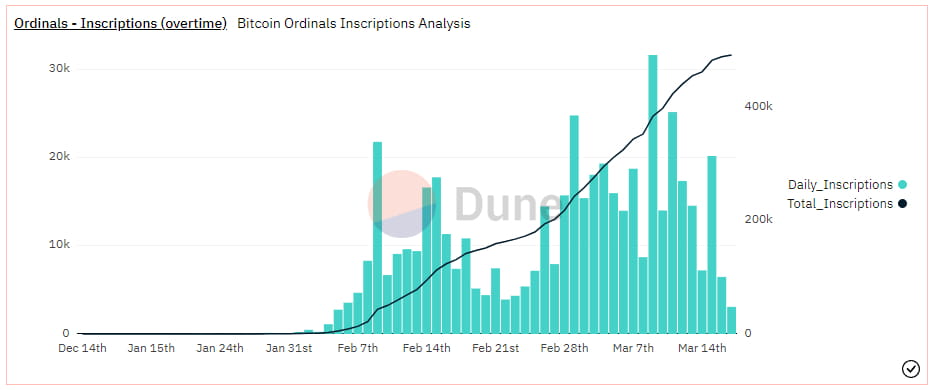
Along with that, the size of each block is often heavier than before, because the demand for engraving Inscriptions is increasing from the community. This is two-sided:
The block size becomes heavier, causing the Bitcoin network to become increasingly cumbersome, causing miners to constantly upgrade hardware to accommodate and also creating a barrier for "small-handed miners".
On the contrary, the network is busier, which means miners will earn more fees from transactions. When each Halving season passes, the reward from mining Bitcoin will be reduced by half, Bitcoin NFT opens another door for miners to have more motivation to "turn on the app".
Another beneficial point for the Bitcoin network is that with the development of Bitcoin NFT, many Inscribe - NFT sculpture services will spring up to serve the demand, but need to run a full node to be able to provide the service. , thereby making the Bitcoin network more decentralized.

For the crypto economy
Like the message that the historic 4MB block wants to convey: "Make Bitcoin magical again".
The Bitcoin NFT movement is associated with a revolution that takes the value and applicability of Bitcoin even further. Bitcoin NFT helps attract a lot of attention from the community, thereby increasing the value of Bitcoin.
Now, Bitcoin holders have more benefits for the Bitcoins they hold.
Plus, engraving an NFT onto Bitcoin will encourage the owner to keep it instead of selling it. Just like when you engrave a beloved painting on a bar of gold, you'll want to keep it rather than sell it.
Limitations of Bitcoin NFTs
But there are still limitations of Bitcoin NFT:
First in terms of costs, a busier network means users will likely have to pay higher fees for each of their transactions, even though it has nothing to do with NFTs.
Currently, the infrastructure for Bitcoin NFTs is only in the developing stage, with many limitations in terms of friendliness for “non-tech” users.
The prices of Bitcoin NFTs are suffering from high fomo.
Many junk projects have sprung up to usurp users' assets.
The impossibility of censorship is also a cultural point that needs to be considered.
Bitcoin NFTs and more
More than just buying/selling/storing NFTs, Bitcoin NFTs are the start of an economy revolving around JPEGs on the Bitcoin network. Inscription, Marketplace, Wallet, Swap creation services have appeared. In the future, we should look forward to a blooming DeFi ecosystem on Bitcoin.
The appearance of Bitcoin NFT has created a heated war between two camps. One side sees it as a reform that increases benefits for Bitcoin, the other side thinks that Bitcoin NFT is unnecessary, it is attacking the Bitcoin network.
4. Ordinals ecosystem
Note: Below are prominent projects that receive a lot of attention from the community according to the author's personal observations, all for informational purposes only, not financial advice.
Outstanding Bitcoin NFT collections
Taproot Wizards
It is impossible not to mention Taproot Wizards, a historic collection. The first NFT of the collection is what created the historic 4MB block.
Taproot Wizards is a collection of 2,121 simple-drawn wizard NFTs that first appeared on Reddit r/Bitcoin, and were later supported by Udi Wertheimer with the message “Make Bitcoin magical again.”

Bitcoin Rocks
Inspired by Ether Rock, one of the famous collections on Ethereum. Bitcoin Rocks is a collection of 100 rock-shaped NFTs. Bitcoin Rocks has an Inscription range from 71 to 241. The current floor price of Bitcoin Rocks fluctuates around 10 BTC (~ 260,000 USD).

Ordinal Punks
Punks often represent the first NFTs in a space, the same goes for Ordinals. Ordinal Punks inherited that pioneering spirit and entered the Bitcoin network with 100 NFTs minted at the first 650 Inscriptions. Currently, the floor price of Ordinal Punk is about 4.75 BTC (~ 127,000 USD).

Bitcoin Punks
Another Punks-themed collection on the Bitcoin network, the highlight of Bitcoin Punks is that it is the first 10,000 NFT collection deployed on Bitcoin via Ordinals. Currently, the floor price of Bitcoin Punks is about 0.67 ETH (~ 1,139 USD). Bitcoin Punks is also the first collection to be supported and available for sale on the OKX NFT Marketplace.

Twelvefold
A collection of 300 NFTs issued by Yuga Labs on the Bitcoin network. Twelvefold is a collection of generative art described by Yuga Labs as a combination of many elements such as time, mathematics, logic, blockchain. It is then expressed in 3D shapes on a 12×12 grid with 4 color bands representing the 4 seasons: spring, summer, fall, and winter, thereby creating unique art panels.
On March 6, 2023, Twelvefold officially opened the auction of 288 NFTs, with a total of 3,246 participants with a total value of 735.7 BTC (~ 16 million USD). The highest bid was 7.1159 BTC (~$184,000) for a Twelvefold NFT.

DeGods
DeGods – one of the most famous collections released on Solana in the early days has also set foot on the Bitcoin network. On March 14, 2023, DeGods officially transferred all 535 previously burned NFTs to the Bitcoin network in a single block. These 535 NFTs were also quickly "sold out" afterwards, the price of each NFT was 0.333 BTC.

Other outstanding projects in the Ordinals ecosystem
In addition to NFT collections, the Ordinals ecosystem has begun to sprout projects on wallets, marketplaces and Inscribe Tool – a tool to “sculpt” NFTs. (@twittername)
Inscribe tools: @ordinalsbot, @trygamma, @ordswap
Inscription Wallets: @SparrowWallet, @ordinalswallet, @xverseApp, @unisat_wallet
Inscription Marketplace: @OrdinalsMarket_, @ordinalswallet, @ordswap, @trygamma, @generative_xyz
summary
Although Ordinals has attracted a lot of attention and received the support of many big names in recent times, there are still many difficulties that need to be resolved. Every innovation is met with mixed opinions, Ordinals is only in the beginning stages, in the future we can expect a boom to "Make Bitcoin magical again".
Thank you for reading, if you find the article useful, please follow Binance Feed and my other channels.
Link3: https://link3.to/hoangdefi