

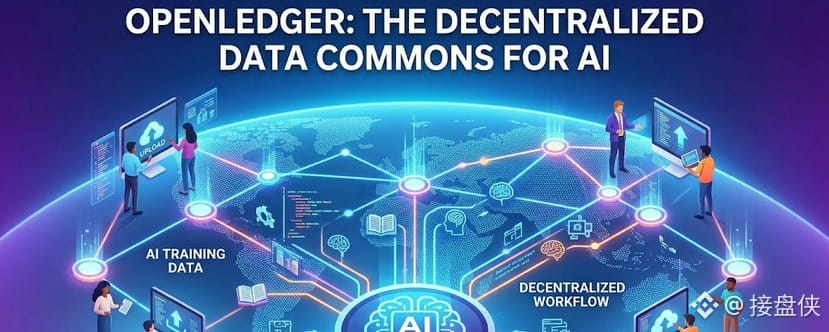

In today's explosive AI landscape, have you ever pondered a question: are we nurturing a tech future that benefits all of humanity, or merely feeding the super monopoly of a few tech giants?
Currently, the development of AI heavily relies on three core elements: computing power, algorithms, and data. However, high-quality data is increasingly being walled off and monopolized by centralized giants. For developers, accessing clean, high-quality, compliant AI training data is becoming more and more challenging.
To break the 'data isolation' and monopoly deadlock, OpenLedger was born. It's not just a tech framework; it's a disruptive revolution regarding data sovereignty and decentralized collaboration in the age of AI.$OPEN
What is OpenLedger?
In simple terms, OpenLedger is a decentralized 'Data Commons' network built specifically for artificial intelligence.#openledger
It utilizes the immutability of blockchain technology, token incentive mechanisms, and privacy-preserving computations to build a secure, transparent, and scalable decentralized data infrastructure (DePIN). In the OpenLedger ecosystem, data is no longer private property locked in giant servers but a digital asset built and shared by global contributors.#OpenLedger
Its core mission is very clear: to enable the flow of high-quality AI data while ensuring that the rights of data providers are absolutely respected.
Core Advantages: What can OpenLedger use to change the AI ecosystem?
The reason OpenLedger has garnered attention from the tech and Web3 worlds is that it addresses the core pain points in the traditional AI data supply chain:
High-quality decentralized data pipeline: Traditional data collection is noisy and inefficient. OpenLedger decentralizes the workflow of data collection, cleaning, labeling, and validation to users and automated nodes worldwide. This 'crowdsourcing + AI' model can produce high-quality datasets suitable for large language model (LLM) training at extremely low costs and high speeds.
Absolute data rights and traceability: On OpenLedger, every contribution, modification, and use of data is permanently recorded on the blockchain ledger. This means that every piece of data you contribute now has a digital 'ID card.' It’s clear whose data was used in training AI models, fundamentally resolving intellectual property and compliance disputes.
The 'sovereign restoration' and incentives for data contributors: In the past, the behavioral data we generated on social media and the internet was taken for free by giants to train AI, and we didn’t get a dime. But in OpenLedger, 'data is an asset.' Users who contribute data, participate in data tagging, or run validator nodes can earn ecosystem tokens as incentives. You become the true master of your own data.
A perfect balance of privacy and security: By introducing cutting-edge cryptographic techniques like zero-knowledge proofs (ZKP), OpenLedger allows AI models to train without directly accessing users' raw private data. This opens the door for AI applications in highly privacy-sensitive industries like healthcare and finance.
How does it work?
The operational logic of OpenLedger can be simplified into three steps:
Contribution and Cleaning: Data providers (individuals or institutions) upload raw data, and decentralized nodes clean and denoise the data.
Validation & Storage: Validator nodes audit data quality to ensure it is genuine and compliant, then securely distribute and store it in a decentralized storage network.
Consumption: AI developers and research institutions pay tokens to access these high-quality datasets for model training and fine-tuning.
It's a perfect closed-loop ecosystem. The richer the data, the more AI developers are attracted; the more developers there are, the greater the value generated by the ecosystem, which in turn incentivizes more people to contribute high-quality data.
Why is now the best time to focus on OpenLedger?
By 2026, AI will move from 'general large models' to deep waters of 'vertical field applications.' The general internet data has been mostly 'consumed' by large models, and future AI competition will hinge on unique, high-quality, and compliant professional data.
OpenLedger is right at the forefront of this era. It not only injects real-world application scenarios into Web3 but also provides the entire AI industry with a completely open-source and decentralized development path that does not rely on centralized giants.@OpenLedger
The future of AI should not be defined by a few, but shaped collectively by global data contributors. OpenLedger is building a new sovereign era of AI that is transparent, fair, and open.