

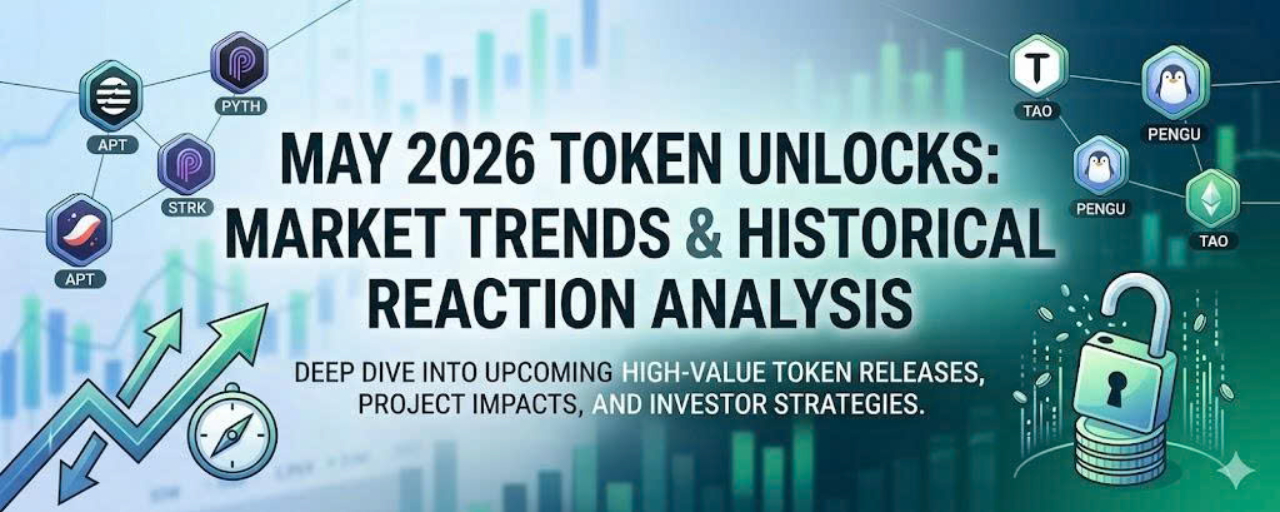

Hey there, keeping an eye on token unlocks is a crucial part of risk management strategy. This May 2026, the market is bracing for a real supply 'storm' with estimated unlocks valued in the billions.
Here’s a deep dive on key events, trends, and the market's historical reactions to give you the best overview.
I. Focus on major unlock events in May 2026
This month sees a combination of massive 'Cliff Unlocks' (one-time unlocks) and daily linear unlocks.
1. Pyth Network ($PYTH ) - The biggest supply 'shock'

Unlock Dates: Expected from May 19 to May 21, 2026.
Value: Approximately 2.13 billion tokens (equivalent to over 1 billion USD depending on market price).
Recipients: Ecosystem Growth, Publisher Rewards, Private Sales, and Protocol Development.
Analysis: This is the most pressure-filled unlock event as it significantly increases circulating supply. With most tokens held by early investors (Private Sales) and data providers, the profit-taking pressure is very real.
2. Starknet ($STRK ) - Pressure from Early Contributors

Unlock Dates: May 15 and May 22, 2026.
Details: Unlocking around 64 million STRK for early investors and contributors.
Analysis: Starknet has adjusted its unlock schedule since 2024 to reduce shocks, but at the current price, this event remains a challenge for the project's demand.
3. Other Noteworthy Projects
Aevo (AEVO): Continuing the 1:1 conversion from RBN, creating almost maximal circulating supply.
Aptos ($APT ): Periodic unlock (around 11.3 million tokens) in mid-month, valued at over 100 million USD.
 APTUSDTPerp0.6997-3.82%
Pudgy Penguins (PENGU): A 'newcomer' in the large unlock token scene on May 17, attracting the attention of NFT and Memecoin investor groups.
II. Historical Market Reactions to Token Unlocks
Based on historical studies (like Keyrock's report), price reactions typically break down into 3 phases:
Pre-unlock Phase: Prices often trend down slightly or move sideways due to retail investors' anxiety. Many choose to sell early to avoid a 'dump'.
The 72-hour period around the unlock date: This is the most sensitive time. Statistics show that over 88% of major unlocks result in negative returns within 72 hours, with an average drop of about -16%.
Post-unlock Phase: If the project has good news (mainnet, major partnerships) accompanying it, the price can rebound quickly (V-shape). Conversely, if liquidity is low, the price will continue to 'probe new lows'.
III. Market Trends and Suggested Strategies
1. Current Trends
The market in 2026 is shifting towards an 'AI-native' model, demanding higher transparency. Unlock events are no longer 'surprise variables' but have become 'structural risks'. Investors nowadays tend to:
Avoid tokens with a FDV (Fully Diluted Valuation) too high compared to Market Cap.
Prioritize projects with Staking or Burn mechanisms to absorb some of the new supply.
2. Strategies for Investors
For holders: If the unlock event represents >5% of the total circulating supply (as in the case of PYTH), consider placing a tight stop-loss or hedging with corresponding short orders.
For new buyers: Don’t rush to 'catch the bottom' on the unlock day. Wait for 3-5 days for the market to absorb the sell-off from large wallets (Whales).
Monitor On-chain data: Use tools like TokenUnlocks or DropsTab to track whether tokens have actually been moved to exchanges (CEX) or not.
Note: A large unlock doesn’t always lead to a price drop if the project team has a 'price support' strategy or announces important updates at that time to retain investors. This is personal opinion, not financial advice. #DYOR🟢
Do you hold any tokens on this month’s unlock list and need me to check the detailed schedule of the shark wallets (Early Investors)?