Strategy! AI-related stocks make up 40% of the US stock market; what does history remind us?
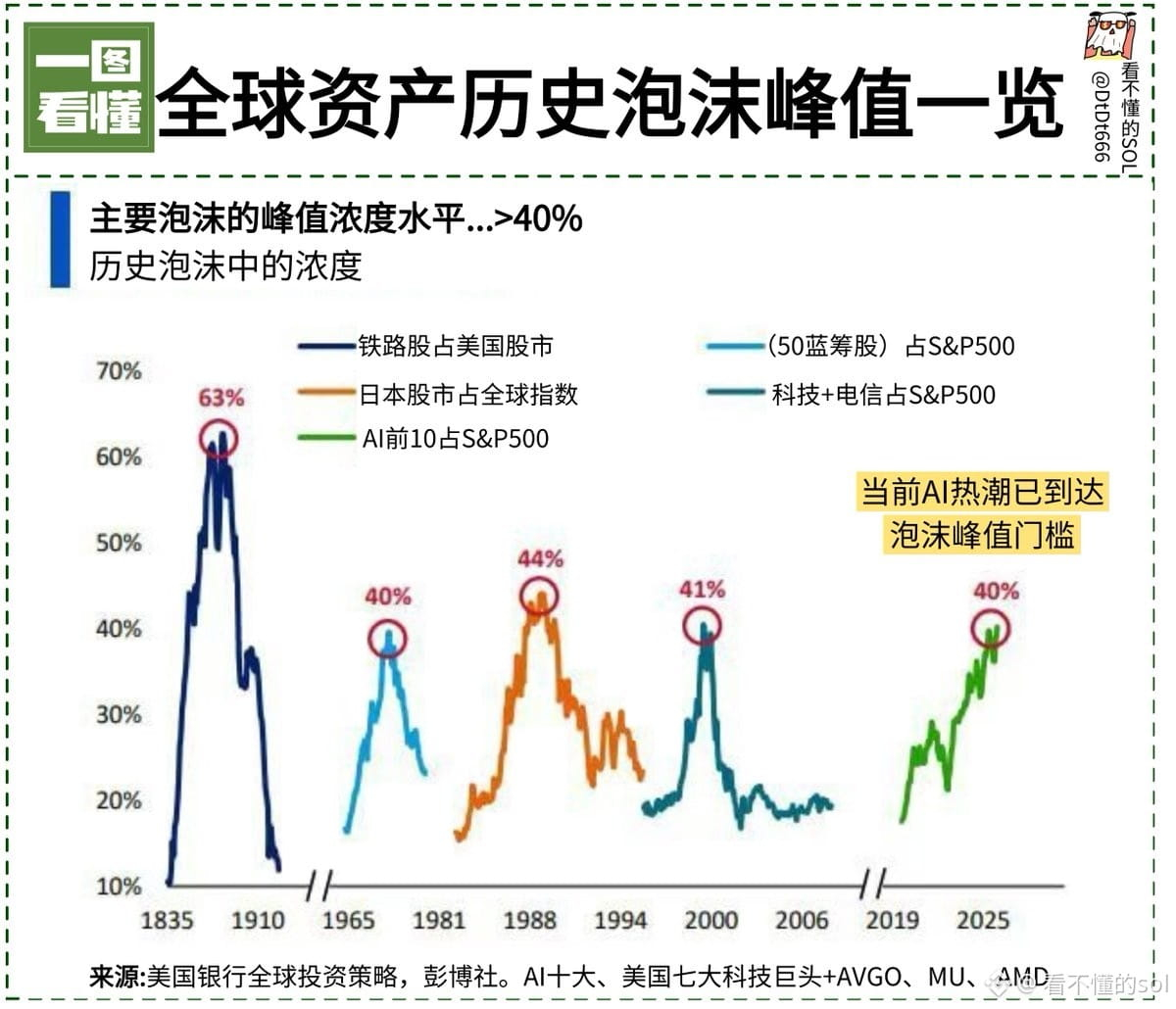
According to Bank of America data, AI-related stocks in the S&P 500 are nearing a 40% weight.
This proportion has only happened three times in history.
In 1972, during the "Nifty Fifty" bubble, top stocks accounted for about 40%, and afterwards, US indices phased down by about 50%.
In 1990, during the Japanese market bubble, it reached about 44%, and then the Nikkei dropped 63% within two years.
In 2000, during the dot-com bubble, it was around 41%, leading to a maximum drawdown of 78% for the Nasdaq.
All three instances featured high concentration, high valuation, and high volatility.
After each, the market underwent a prolonged adjustment.
Now, with the AI sector approaching 40%, valuations are not low, and the volatility is significant.
This isn't to say AI doesn't have a future, but rather that in the current structure, history hasn't favored comfortable entries and exits.
So, what to do?
I recommend keeping it super simple, two paths:
First, maintain dollar-cost averaging.
Regardless of peaks or troughs, buy a little each week/month; over time, this will average out your costs.
Even if there’s a pullback later, those who DCA have a far better mental capacity than those who go all-in at once, while ensuring they don't miss out.
Second, hold cash and wait for opportunities.
Not buying now doesn’t mean being bearish; it means waiting for a more favorable entry point.
The market never runs out of opportunities; it’s just that when they arise, you need to have cash on hand.
Buffett currently has nearly $400 billion in cash; why should we panic?
History may not repeat itself, but it sure does rhyme.
Keep dollar-cost averaging, hold cash, and wait for the wind to turn.
According to Bank of America data, AI-related stocks in the S&P 500 are nearing a 40% weight.
This proportion has only happened three times in history.
In 1972, during the "Nifty Fifty" bubble, top stocks accounted for about 40%, and afterwards, US indices phased down by about 50%.
In 1990, during the Japanese market bubble, it reached about 44%, and then the Nikkei dropped 63% within two years.
In 2000, during the dot-com bubble, it was around 41%, leading to a maximum drawdown of 78% for the Nasdaq.
All three instances featured high concentration, high valuation, and high volatility.
After each, the market underwent a prolonged adjustment.
Now, with the AI sector approaching 40%, valuations are not low, and the volatility is significant.
This isn't to say AI doesn't have a future, but rather that in the current structure, history hasn't favored comfortable entries and exits.
So, what to do?
I recommend keeping it super simple, two paths:
First, maintain dollar-cost averaging.
Regardless of peaks or troughs, buy a little each week/month; over time, this will average out your costs.
Even if there’s a pullback later, those who DCA have a far better mental capacity than those who go all-in at once, while ensuring they don't miss out.
Second, hold cash and wait for opportunities.
Not buying now doesn’t mean being bearish; it means waiting for a more favorable entry point.
The market never runs out of opportunities; it’s just that when they arise, you need to have cash on hand.
Buffett currently has nearly $400 billion in cash; why should we panic?
History may not repeat itself, but it sure does rhyme.
Keep dollar-cost averaging, hold cash, and wait for the wind to turn.